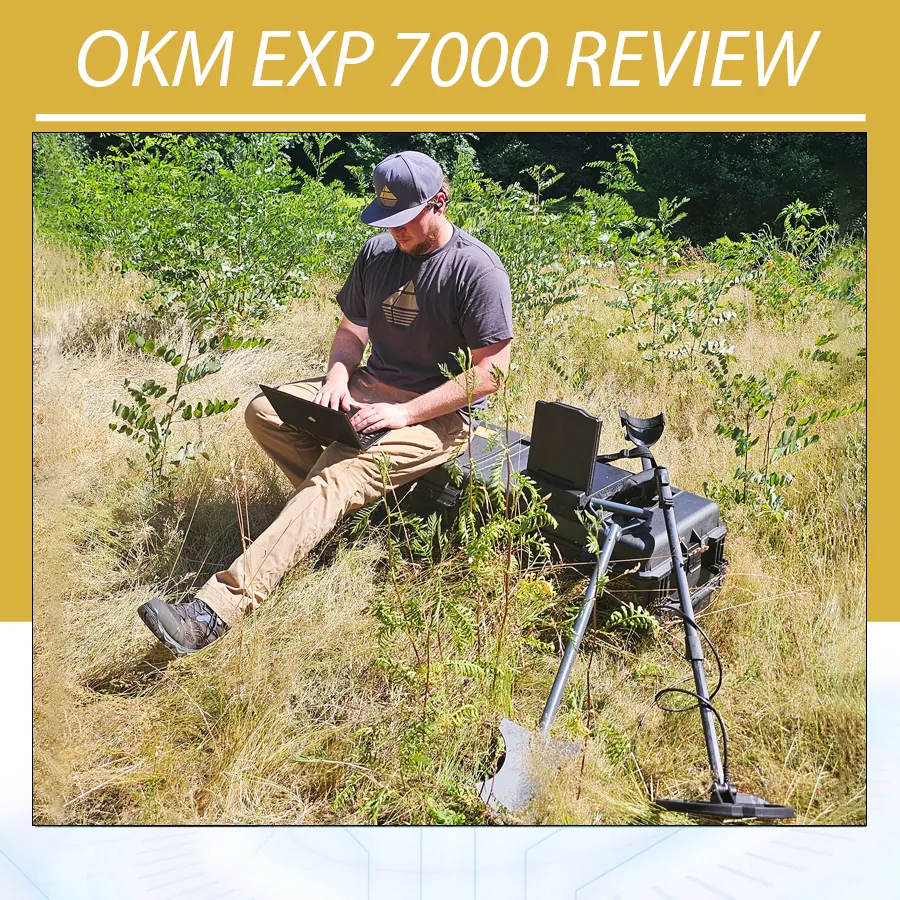
EXP 7000 Review: OKM Professional Plus Complete Guide
The EXP 7000 Professional Plus brings several kinds of ground investigation into one equipment package. For buyers comparing advanced scanners, its appeal is the ability to collect survey data, examine anomalies, and investigate shallow metal targets using different operating modes. Understanding how those functions fit together is more useful than judging the system by its largest advertised depth number.
This EXP 7000 review evaluates the documented features of OKM’s Professional Plus model, including its SuperSense system, VLF coil, eight operating modes, software, handling, and practical limitations. It is a manufacturer-documentation review, with illustrative survey examples and buying advice; it does not report an independent field test.
Our assessment is that this system deserves consideration when recording and reviewing ground data is central to the job. Its value becomes less compelling when the main requirement is simply locating individual coins with minimal setup.

What is the EXP 7000 Professional Plus?
OKM positions the Professional Plus as a combined ground-scanning and metal-detection platform. Its published mode list covers 3D Ground Scan, Magnetometer, Live Scan, Mineral Scan, Tunnel Scan, Pinpointer, 3D VLF Scan, and VLF Metal Detection. The package also includes Visualizer 3D Studio Professional Edition and a Windows notebook for reviewing recorded measurements. See the official OKM product page for current delivery details.
The important distinction is between gathering a spatial record of an area and listening for a target while searching. Both can support an investigation, but they answer different questions. A recorded survey helps compare the location and extent of responses. Conventional detecting helps an operator follow a local signal.
For example, someone investigating an old building footprint may want several recorded passes over an area. Someone recovering a recently lost ring may mainly need a manageable coil, consistent audio, and careful coverage. Before comparing specifications, decide which of those working patterns resembles your own project.
EXP 7000 specifications at a glance
The figures below come from the technical specifications in the OKM EXP 7000 user manual, October 2025 edition. They describe individual components and stated operating conditions.
| Component or feature | Documented specification |
|---|---|
| Control unit weight | 1.86 kg |
| Screen | 8.4-inch IPS LCD, 1024 × 768 pixels |
| Internal battery | Replaceable lithium-ion, 7.27 V, 10.2 Ah, 74.154 Wh |
| Operating time | 7 hours at 25°C with medium screen brightness |
| Charging time | 3 hours at 10–30°C |
| Control unit protection | IP40; not waterproof |
| Data connection | USB-C |
| Super Sensor weight | 0.94 kg |
| VLF coil dimensions | 325 × 255 × 70 mm |
| VLF coil weight | 0.7 kg |
| Assembled detachable carrying rod | 2.4 kg; this is the rod’s weight, not the complete system |
Component weights matter because working comfort depends on the configuration being carried. Ask to handle the assembled equipment with the intended probe, supports, and control unit in place. A single headline weight gives an incomplete picture of how a system feels during repeated survey lines.
The probes: choosing the right configuration
Super Sensor and SuperSense system
The manual connects six modes to the Super Sensor or SuperSense assembly: 3D Ground Scan, Magnetometer, Live Scan, Mineral Scan, Tunnel Scan, and Pinpointer. The two VLF modes require the VLF coil. This is a useful starting point when planning which equipment to carry and which measurements to collect.
There is also an important mode-specific detail: Mineral Scan and Tunnel Scan use the sensor pair in the Super Sensor. The manual says connected extenders are ignored for those measurements. Adding hardware therefore does not automatically add useful measurement coverage in every mode.
For a buyer, the lesson is to evaluate configuration by task. During a demonstration, ask the operator to explain which sensors are active and why. That question is more informative than simply asking for the maximum number of attachments that can be fitted.
VLF Coil X7
The coil provides another approach for shallow metal investigation. The manual distinguishes ordinary VLF Metal Detection from recorded 3D VLF Scan, and their handling is different. Ordinary VLF searching uses a swinging motion; 3D VLF scanning keeps the coil in a fixed orientation while progressing through the survey.
This distinction should be part of training. A detectorist already comfortable with conventional swinging still needs to learn the recording procedure. Familiarity with one mode does not guarantee that a saved survey will have consistent spatial measurements.
All eight EXP 7000 operating modes explained
1. 3D Ground Scan
This is the mode to consider when you want a recorded investigation across a defined area. Its usefulness depends on connecting the displayed response to a real position on the ground. A clear start point, consistent line spacing, and notes about the direction of travel make subsequent comparison more meaningful.
Imagine an anomaly appearing near the middle of a survey. A practical next step is a second, carefully referenced scan over the same area. If the feature changes position substantially, investigate the recording process before treating the first image as a dependable target location.
2. Magnetometer
OKM describes Magnetometer as useful for checking near-surface ferrous items before a 3D survey. That makes it relevant to an initial inspection of an area containing iron debris. It should not be interpreted as a complete survey of every possible metal.
In practice, record notable responses before changing the site. When removal is appropriate, compare the area before and afterward. This creates a more useful explanation of what affected the survey than quietly removing objects and retaining only the most attractive scan.
3. Live Scan
Live feedback is useful for deciding where to concentrate attention. A response can be observed while exploring an area, helping the operator choose a smaller follow-up zone. Its role in a careful workflow is to guide investigation rather than settle the interpretation immediately.
Consider a broad response near a building boundary. Before narrowing the search, check whether the boundary itself, nearby objects, or changes in handling provide an explanation. A repeatable location is a better reason for further work than one dramatic screen moment.
4. Mineral Scan
The manual presents Mineral Scan as a way to investigate potential gold-prospecting areas through particular signal patterns. The distinction between potential mineralisation and a confirmed gold deposit is essential. A display cannot establish commercial grade, recoverable quantity, or economic value.
A sensible prospecting investigation would compare neighbouring areas and record why a location was selected for further examination. If the project progresses to material identification, representative samples and appropriate analysis provide evidence that a scan alone cannot supply.
5. Tunnel Scan
Tunnel Scan is intended to investigate anomalies that may indicate subsurface structures. A useful interpretation begins with the geometry of the response and its consistency across repeat measurements. Calling every unusual region a chamber would go beyond what the measurement establishes.
For a suspected linear feature, extend the investigation beyond the first scan boundary. Ask whether it continues in a coherent direction and whether surface information supports that pattern. The aim is to develop a testable explanation, including plausible alternatives.
6. Pinpointer
This mode supports closer investigation of a detected response. Localisation becomes most useful when the survey position has already been marked accurately. Otherwise, a precise-looking signal may be difficult to reconnect with the feature seen in the original scan.
Keep the distinction between localisation and identification clear. Finding the centre of a response helps organise follow-up work, but it does not establish the object’s material, dimensions, or age. Those are separate questions requiring their own evidence.
7. 3D VLF Scan
The manual describes this mode as a way to visualise potential shallow targets before excavation. It preserves a survey for subsequent software examination. Its fixed coil orientation is especially important: using the broad side-to-side swing of conventional detecting would change the intended collection method.
This is an interesting feature for anyone who needs a spatial record before recovery. During a demonstration, ask to see the complete process from marking an area to opening the saved result. Evaluate whether the resulting file helps answer your actual project question.
8. VLF Metal Detection
Ordinary VLF Metal Detection provides the more familiar moving-coil search. The manual states that this scan cannot be saved. Choose recorded 3D VLF scanning when a saved spatial result is required, rather than assuming every operating screen creates an equivalent file.
For an illustrative search around a known metal object, compare repeated passes from different directions and use the appropriate pinpoint function. Keep the coil movement consistent. The purpose of this exercise is to learn response behaviour under known conditions before interpreting an unknown object.
EXP 7000 VLF settings that deserve attention
Target ID and discrimination
The VLF system uses IDs from 0 to 99, grouped into ten zones. OKM cautions that object shape, composition, and position affect the reading. A colour or number is therefore an aid to classification, not a reliable label proving gold, silver, or another material.
A useful training exercise is to compare known objects that produce overlapping readings. Record both the display and the circumstances, including orientation. This teaches the limits of a classification system more effectively than memorising a chart and expecting every field target to match it.
Muted zones also deserve attention. The manual explains that a response in a hidden zone can remain visible in grey while its audio is muted. A quiet search is not necessarily an empty search. Check zone settings when investigating apparently missing audio responses.
Frequency selection
OKM allows single-frequency operation or selection of up to three frequencies. The manual associates lower frequencies with larger targets and higher frequencies with smaller targets, while also discussing a single frequency as an option when ground noise is troublesome.
The review implication is straightforward: record the selected configuration when comparing results. If a demonstration changes several controls between two targets, you cannot know which change explains the difference. A controlled comparison should alter one relevant factor and repeat the observation.
Recovery settings
The five recovery levels balance separation and depth. In the manual’s description, Level 1 favours separation, while Level 5 favours depth. This direction matters because number scales and labels should never be assumed to work identically across brands.
Think about two nearby objects. A setting that helps distinguish separate responses may be preferable to one selected only for maximum reach. Ask a demonstrator to show both an isolated target and neighbouring targets. Those exercises test different aspects of performance.
How deep can the EXP 7000 detect?
OKM advertises up to 25 metres for 3D ground scanning and up to 40 centimetres for VLF operation. These are manufacturer claims for different functions, not interchangeable guarantees. The smaller figure is approximately 15.7 inches; use that conversion rather than the inconsistent 12-inch conversion displayed in some listings.
A meaningful review asks what produced a depth claim. Was it a small isolated object, a substantial structure, or an inferred anomaly? What soil was involved? How was depth verified? Without those details, a maximum figure cannot tell you what to expect from your particular target.
Suppose a demonstration shows a feature assigned a depth in software. The displayed number is a calculated interpretation. To establish accuracy, compare it with independently known conditions or a verified target. A screenshot alone does not provide that comparison.
Likewise, a near-surface coil demonstration does not validate a deep geophysical claim. Evaluate each function using a test suited to its purpose. This keeps the buying decision connected to evidence rather than the most impressive number in a presentation.
Visualizer 3D Studio: getting value from recorded data
The software is important because a recorded response can be revisited and discussed after fieldwork. OKM provides a separate Visualizer 3D Studio overview. Orient’s beginner’s explanation of Visualizer 3D Studio is a useful companion for readers learning how to approach scan displays.
Start an analysis with the survey record: its dimensions, start point, orientation, probe, and collection method. If these details are uncertain, a polished image cannot restore them. Preserve the original file before experimenting with presentation changes so that another reviewer can inspect the same evidence.
Compare views while keeping track of what changed. A more visible feature after an adjustment does not necessarily mean the underlying evidence became stronger. Ask whether the feature remains in the same location and whether independent scans support its extent.
A good working report separates three things: the observed response, the proposed explanation, and the next verification step. For example, describe a persistent elongated anomaly before proposing a buried structure. That wording makes the interpretation easier to evaluate and revise.
A practical EXP 7000 survey workflow
Define the investigation
Write down the question before assembling the equipment. Are you assessing a broad area, investigating a previously marked anomaly, or locating shallow metal? The question determines which mode is relevant and what a useful result would look like.
Choose a manageable survey area with clear reference points. Photograph it and note obstructions. This takes a little time but prevents a common problem: returning with an interesting file and being unable to reconstruct exactly where the measurements were collected.
Collect consistent measurements
Follow the manual’s procedure for the selected mode, including calibration and probe handling. Avoid changing configuration midway through a comparison unless the change is the subject of the test. Log interruptions, awkward footing, or other events that could explain unusual sections of the record.
Consistency should take priority over covering the largest possible area. A modest survey collected carefully can be more useful than a larger one with uncertain spacing. Once the procedure is dependable, expand coverage in a way that preserves the same references.
Repeat and cross-check
Revisit an interesting region with a clear verification plan. The purpose is to discover whether the response persists, not simply to generate a second colourful image. Document the relationship between the original and follow-up survey coordinates.
Where appropriate, compare another mode or measurement method. Different methods may respond to different properties, so agreement is supporting context rather than automatic proof. Disagreement is also useful: it identifies a question that needs investigation before stronger conclusions are made.
Archive and review
Save the original files with descriptive names and keep photographs and notes beside them. Include unsuccessful or inconclusive checks when they affect the interpretation. A complete record supports better decisions than a collection containing only the most convincing images.
A useful first training exercise
For an initial EXP 7000 session, choose a small, clearly marked area and a question you can check afterward. Have a trainer explain the selected mode, then collect the measurements yourself. Keep the first file even if the result looks untidy. Repeat the exercise after correcting one handling issue and compare the records.
This exercise helps distinguish learning progress from a supposed change underground. If the second result is cleaner, ask which part of the procedure improved. Was the path more consistent? Were the reference points clearer? Was the probe held as instructed? The answer becomes a habit you can carry into future surveys.
Include a written interpretation with each file. Describe the observation first, then explain what additional evidence would be needed to identify its cause. Over several sessions, this builds a personal record of both successful measurements and common mistakes. That record is valuable when you later face unfamiliar ground without a trainer beside you.
Where this system fits best
Documented site investigations
The strongest use case is a project that benefits from spatial records and repeat observations. Here, the operator needs to explain why one area deserves attention and another does not. The ability to organise the investigation across several functions can be valuable when the work is planned carefully.
Treasure research
For treasure-oriented projects, establish realistic target assumptions. Searching for a small jewellery item and investigating a possible buried structure are different tasks. Assess the relevant mode against a representative example instead of letting one demonstration stand for every application.
Prospecting investigations
When mineralisation is the question, treat the scanner as part of a broader investigation. A response may justify further examination, but a decision about deposit quality needs material evidence. Buyers should distinguish identifying a promising area from establishing that it contains recoverable gold.
Strengths and limitations in this EXP 7000 review
| Potential advantage | What to consider |
|---|---|
| Several investigation functions in one package | Each function has its own procedure and learning requirements. |
| Recorded surveys for later review | Useful interpretation depends on consistent field records. |
| Conventional and recorded VLF options | Choose the correct collection method for the result required. |
| Large control display | Assess handling with the complete working configuration. |
| Software-supported analysis | Visualisations still require verification and informed judgement. |
The principal strength is workflow flexibility. The principal cost is the time needed to use that flexibility well. A buyer who enjoys systematic measurement may welcome it; someone wanting immediate answers with little interpretation may find the same complexity frustrating.
Comfort, power, and ownership
The control unit’s stated seven-hour runtime applies at 25°C with medium brightness. Treat that as a planning reference. Before a long trip, establish the duration you obtain in your own working configuration and leave time for charging, file transfer, and equipment checks.
The system’s IP40 specification and explicit non-waterproof status also belong in the purchase decision. Consider your working environment, how the equipment will be transported, and where it can be stored between sessions. A rugged-looking case does not change the protection rating of the operating components.
Handling deserves a full demonstration. Try turning at survey boundaries and maintaining the required probe position while carrying the control unit. A configuration that feels manageable for a short presentation may require support adjustments for a longer session.
Ownership includes learning and record keeping. Ask about initial training, software access, support arrangements, firmware procedures, and assistance with interpreting an unfamiliar scan. These practical details can influence long-term usefulness as much as the feature list.
How to assess a demonstration before buying
Request a demonstration that resembles your intended work. If your project requires recorded surveys, ask to see collection, saving, transfer, and review. Watching only a live response leaves important parts of the workflow untested.
- Ask which mode and probe are active and why they were selected.
- Record the target assumptions and any independently known facts.
- Include a comparison area where no target has been intentionally placed.
- Request repeated measurements with consistent references and settings.
- Inspect original files alongside the final display.
- Ask how ambiguous results would change the next field decision.
A persuasive demonstration explains uncertainty clearly. It should help you understand the equipment’s behaviour and the operator’s reasoning, including what has not been established. That provides a stronger basis for purchase than a dramatic result with no reproducible procedure.
EXP 7000 price and package considerations
Check the EXP 7000 listing at Orient Detectors for the current offer. Request a written package description covering hardware, software edition, computer, accessories, training, and applicable warranty terms. A quotation should make clear exactly what is included for your order.
Compare complete ownership costs rather than the headline equipment price alone. Travel, transport, learning time, and follow-up analysis all matter when planning a serious project. Paying for additional capability makes sense when that capability answers a recurring need in your work.
If the main requirement is uncomplicated shallow metal recovery, compare that requirement with a conventional detector before committing to a scanning platform. If the requirement is repeatable survey documentation, evaluate how this package supports that process from field collection through review.
Frequently asked questions
Does the EXP 7000 identify gold with certainty?
No. A gold-related mode, target category, or colour does not confirm the composition of an unknown object. Treat the result as an interpretation to investigate. Material identification requires suitable independent evidence, such as examination of recovered material or properly conducted sample analysis.
Are all eight modes used with the same probe?
No. The manual distinguishes Super Sensor or SuperSense functions from the two VLF functions, which use the coil. It also specifies that Mineral Scan and Tunnel Scan ignore extender measurements. Match the assembly to the mode instead of assuming every sensor contributes every time.
Can ordinary VLF searches be saved as 3D scans?
The manual says ordinary VLF Metal Detection cannot be saved. Recorded investigation uses 3D VLF Scan and its corresponding procedure. Decide before collection whether you need a saved spatial record, because a normal detecting pass is not an equivalent substitute.
Does the depth claim apply to coins?
You should not interpret the headline ground-scanning figure as a guaranteed coin depth. It concerns a different function from shallow VLF searching. Ask for evidence relevant to the intended target, soil, and verification method before using any advertised figure to plan fieldwork.
Is the EXP 7000 suitable for a beginner?
A motivated beginner can learn a structured workflow, but should allow time for training and repeat practice. Start with a manageable exercise, keep good notes, and learn how procedure affects the result. Avoid making expensive field decisions from the first unfamiliar scan.
Does a 3D shape show the exact buried object?
A rendered shape represents measured data and its processing. It should not be treated as a photograph or a guaranteed outline. Compare repeated surveys and independent information before assigning dimensions, material, or identity to the feature shown.
Final verdict: who should choose the EXP 7000?
The EXP 7000 Professional Plus is most persuasive for buyers who need a documented investigation process and are prepared to learn it. Its combination of surveying functions, VLF options, and software gives a trained operator several ways to explore a question and preserve the results for review.
The buying decision should turn on representative demonstrations, complete package details, and the quality of the workflow you can realistically maintain. When those align with your project, the system can be a useful investigation tool. Its full value depends on careful collection, repeat checks, and conclusions that remain proportional to the evidence.