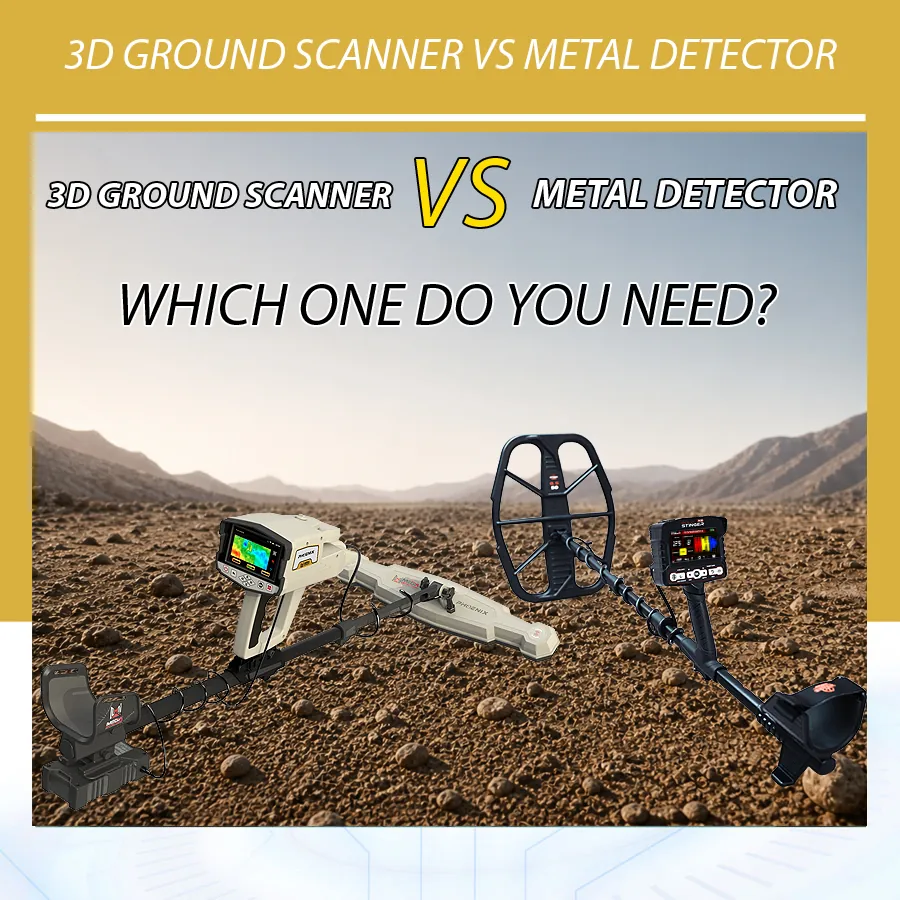
3D Ground Scanner vs Metal Detector: Which One Do You Need?
This guide compares 3D ground scanners and metal detectors using devices from Orient Detectors only. It explains how each category works, where each one performs best, and which models from the Orient Detectors catalog make sense for different users. Devices mentioned include GR-4 GroundTech, Gold Vision, Phoenix, Gold Star 3D Scanner, Infinity Max Pro, EXP 7000, The Legend, Gold Stinger X6, Gold Monster 2000, Garrett Axiom, GPX 6000, GPZ 8000, and other relevant models from the website.
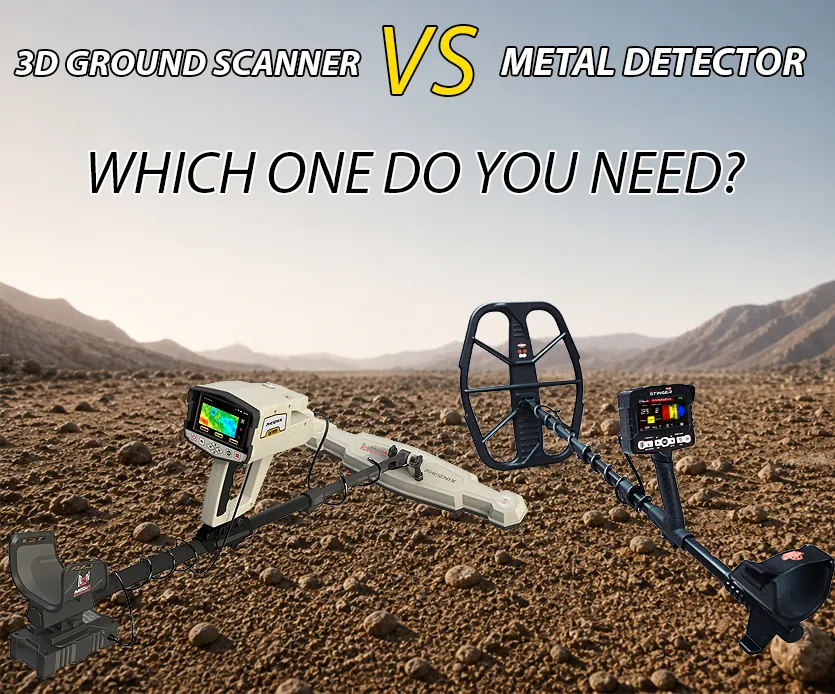
Quick Answer: Which One Do You Need?
Choose a metal detector if your main targets are coins, jewelry, relics, natural gold nuggets, small metal objects, or metallic targets that you want to locate directly. A metal detector is usually faster, lighter, easier to use, and better for everyday sweeping across ground. Devices such as The Legend, Gold Stinger X6, Gold Monster 2000, Garrett Axiom, GPX 6000, GPZ 8000, and Garrett Gold Master 24K are examples of detector-style choices listed on Orient Detectors.
Choose a 3D ground scanner if your main targets include underground cavities, tunnels, chambers, buried structures, larger treasures, tombs, basements, caves, walls, foundations, or deep anomalies that need visual analysis before excavation. Devices such as GR-4 GroundTech, Gold Vision, Phoenix Metal Detector from Mega Detection, Gold Star 3D Scanner, GEPARD GPR, EXP 7000, Rover C4, and Fusion Light are examples of 3D imaging and ground scanning choices listed on Orient Detectors.
Choose a multi-system device if you need both. Some devices blur the line between scanner and detector. Infinity Max Pro, Gold Vision, Mega Scan Pro, Gold Star 3D Scanner, Cobra GX-8000 Plus, and Gold Stinger X6 combine more than one search method. These are useful when the target could be metal, cavity, treasure, or structure and you need several confirmation stages.
What Is a Metal Detector?
A metal detector is a device that detects metallic objects by generating an electromagnetic field and reading the response from conductive materials under the ground. Depending on the technology, it may use VLF, simultaneous multi-frequency, pulse induction, zero voltage transmission, or other detection principles. The result is usually an audio tone, target ID, visual indicator, graph, depth estimate, or discrimination response.
Metal detectors are ideal for targets that are actually metal: coins, rings, bracelets, relics, small statues, swords, gold nuggets, jewelry, copper objects, silver objects, iron objects, and other conductive materials. They are also usually faster for covering ground because the operator sweeps the coil and listens for signals. For field users who want quick feedback, metal detectors remain essential.
However, a metal detector does not truly “see” underground. It detects the response of metal. If the target is a void, tunnel, room, or non-metallic structure, a conventional detector may not be the right tool. Some advanced detectors can indicate voids or changes in ground response, but this is different from a true 3D ground scan.
What Is a 3D Ground Scanner?
A 3D ground scanner is designed to measure variations beneath the surface and translate them into visual data. Depending on the model, it may use magnetic sensors, ground scanning probes, live scan sensors, GPR-style methods, geophysical readings, or specialized imaging technologies. The goal is not just to hear a signal, but to create a map or visual representation of underground anomalies.
3D ground scanners are especially valuable when the target is not only a metal object. They can help investigate cavities, tunnels, rooms, graves, caves, basements, buried walls, foundations, and larger treasure zones. They can also help estimate the position, shape, depth, and size of an anomaly before excavation. This is why professional treasure hunters and archaeological prospectors often use 3D scanners in serious projects.
The tradeoff is that 3D scanners usually require a more disciplined method. The operator must scan in lines or grids, maintain sensor height, choose proper scan dimensions, save data, analyze colors or 3D shapes, and often confirm results with another system. They are not as casual as swinging a coil over the ground.
Main Differences Between a 3D Ground Scanner and a Metal Detector
| Feature | Metal Detector | 3D Ground Scanner |
|---|---|---|
| Main Purpose | Detect metallic objects directly | Visualize underground anomalies, objects, cavities, and structures |
| Best Targets | Coins, jewelry, relics, gold nuggets, metal objects | Tunnels, cavities, chambers, buried structures, large treasures |
| Feedback | Audio tone, target ID, discrimination, graph, signal strength | 2D/3D image, colors, grid, depth estimate, anomaly shape |
| Ease of Use | Usually easier and faster | Requires scan discipline and analysis |
| Speed | Fast for sweeping large accessible ground | Slower because scanning grids must be organized |
| Best User | Hobbyists, coin hunters, gold prospectors, relic hunters | Treasure hunters, archaeological users, professional teams |
| Typical Price | From entry-level to professional | Usually mid-range to high-end |
When a Metal Detector Is the Better Choice
A metal detector is better when the target is metal and you need direct, fast, practical detection. If you want to search for coins, rings, chains, bracelets, relics, small iron objects, gold nuggets, or metallic artifacts, a detector-style device often makes more sense than a 3D scanner. It is easier to carry, faster to operate, and better suited to repeat scanning over wide ground.
For example, The Legend uses simultaneous multi-frequency technology and is suitable for coins, gold jewelry, relics, beach hunting, and small artifacts. It is a logical choice for users who want a versatile metal detector rather than a ground imaging device. Garrett Gold Master 24K and Gold Monster 2000 are more focused on gold prospecting. Garrett Axiom, GPX 6000, and GPZ 8000 are stronger professional gold detectors designed for more demanding ground and natural gold targets.
Gold Stinger X6 is also worth mentioning because it is not a simple single-mode detector. It includes multiple systems such as All Metals, Discrimination, Pin Pointer, Depth Detection, 2D Target Scan, and Cavity & Void Detection. For buyers comparing 3D ground scanner vs metal detector, Gold Stinger X6 is a bridge device: it feels closer to direct detection but includes more advanced search tools than a basic detector.
When a 3D Ground Scanner Is the Better Choice
A 3D ground scanner is better when you need to understand what may be under the surface before digging. If your site may contain a tunnel, room, grave, chamber, cave, foundation, bunker, wall, buried treasure container, or large underground anomaly, visual data becomes more important than a single audio tone. This is where devices such as GR-4 GroundTech, Phoenix, Gold Vision, Gold Star 3D Scanner, GEPARD GPR, Rover C4, Fusion Light, and EXP 7000 become relevant.
GR-4 GroundTech is a good example of an accessible 3D ground scanner. Orient Detectors lists it at $1,850 with MFS-2 technology, 15-meter listed depth, Android/iOS app control, and the ability to scan metals, treasures, and cavities. It is a strong entry point for users who want 3D imaging without immediately buying a premium OKM system.
EXP 7000 is on the opposite end of the category. It is listed as a premium OKM 3D ground scanner with advanced probes and operating modes such as 3D Ground Scan, Tunnel Scan, Mineral Scan, Live Scan, Magnetometer, Pin Pointer, and VLF Metal Detection. It is designed for professional users who need high-end imaging and deep analysis rather than casual detecting.
Important Middle Category: Multi-System Devices
Some devices on Orient Detectors cannot be placed neatly into only one category. They are not just metal detectors, and they are not only 3D scanners. These multi-system devices are designed to combine long-range search, 3D imaging, signal analysis, direct detection, pin pointing, and sometimes geophysical methods.
Gold Vision combines 3D Ground Scan, Long Range, Free Mode, Smart Depth, Ionic, and Bionic systems. Mega Scan Pro combines Ground Scan, Pin Pointer, Manual LRL, Auto LRL, Ionic, and Bionic. Gold Star 3D Scanner includes eight systems: Manual LRL, Auto LRL, Control LRL, Ionic, Bionic, Live Stream, Ground Scan, and Pinpointer. Infinity Max Pro goes further with 12 systems, including Ground Scan, Tunnel Scan, Geophysical, Auto LRL, Manual LRL, Control LRL, Ionic, Bionic, Live Stream, Pin Pointer, Pulse Induction, and Smart Detect.
These devices are useful when the search objective is uncertain. A buyer may suspect gold, but also need to identify cavities. A site may require long-range scanning first, then 3D imaging, then metallic confirmation. In such cases, a multi-system device gives more flexibility than either a simple detector or a scanner alone.
Best Metal Detector Options From Orient Detectors
The Legend: Best All-Purpose Metal Detector
The Legend is a strong all-purpose choice for users who want simultaneous multi-frequency performance. It is useful for coins, jewelry, relics, beach hunting, natural gold, and small artifacts. It is not a 3D scanner, but it is a practical choice when the target is metal and the user wants a lighter, faster, easier detector.
Gold Stinger X6: Best Multi-System Direct Detector
Gold Stinger X6 is one of the best choices for users who want direct metal detection with extra systems. Its dual-coil design, discrimination, depth detection, pin pointer, 2D target scan, and cavity/void detection make it more versatile than a standard detector. It is a smart option for buyers who want a practical field device before moving into full 3D scanning platforms.
Gold Monster 2000: Best Focused Gold Detector
Gold Monster 2000 is listed on Orient Detectors as a gold-focused detector designed for ultra-fine gold in mineralized ground. If your main goal is gold nuggets rather than cavities or buried rooms, a gold-focused detector can be more suitable than a 3D scanner. It is especially relevant for prospectors who know their target is natural gold.
Garrett Axiom: Best PI Option for Serious Gold Prospecting
Garrett Axiom is designed for natural gold prospecting and is listed on Orient Detectors at $6,400. It is not intended to visualize tunnels or rooms. Instead, it is a serious detector for gold in challenging ground. For the 3D ground scanner vs metal detector decision, Garrett Axiom belongs clearly on the detector side.
GPX 6000 and GPZ 8000: Professional Natural Gold Choices
GPX 6000 and GPZ 8000 are professional Minelab gold detectors listed on Orient Detectors. GPX 6000 uses GeoSense-PI technology and is built for natural gold nuggets. GPZ 8000 is positioned as a flagship advanced gold detector. These devices are best for gold prospecting, not cavity imaging. If the question is gold nuggets vs tunnels, these belong to the gold side of the decision.
Best 3D Ground Scanner Options From Orient Detectors
GR-4 GroundTech: Best Entry-Level 3D Ground Scanner
GR-4 GroundTech is one of the best starting points for 3D scanning. It offers MFS-2 technology, app-based operation, 3D visualization, Live Scan Mode, and 15-meter listed depth. It is suitable for gold, metals, cavities, and hidden treasures. For users who want an affordable scanner, GR-4 is one of the strongest choices in the catalog.
Gold Vision: Best Portable 3D Scanner + LRL Hybrid
Gold Vision is a hybrid device with 3D Ground Scan, long-range search, Smart Depth, Ionic, and Bionic systems. It is listed with 40-meter depth and 3000-meter front range. Gold Vision is best for users who need both visual ground scanning and large-area exploration in one portable device.
Phoenix Metal Detector: Best Professional 3D Ground Scanner From Mega Detection
Phoenix Metal Detector is listed as a professional ground scanner dedicated to treasure hunters and prospectors. It includes 3D Ground Scan, Live Stream, and Pin Pointer systems. It is useful for scanning cavities, treasures, metallic objects, and suspicious underground structures with a visual workflow.
Gold Star 3D Scanner: Best Advanced Multi-System 3D Choice
Gold Star 3D Scanner includes eight search systems and combines long-range detection, 3D imaging, live stream, ionic, bionic, and pinpointer methods. It is a more advanced choice for users who need several confirmation methods but do not necessarily need the full 12-system complexity of Infinity Max Pro.
Infinity Max Pro: Best All-in-One Professional System
Infinity Max Pro is the most complete option for users who want both sides of the comparison. It includes 3D scanning, LRL, Tunnel Scan, Geophysical, Live Stream, Pin Pointer, Pulse Induction, and Smart Detect. It can behave as a scanner, long-range system, direct detector, and confirmation platform. It is best for professional users who need multiple technologies in one device.
EXP 7000: Best Premium 3D Ground Scanner
EXP 7000 is a premium OKM ground scanner for professional imaging. It supports multiple probes and modes, including 3D Ground Scan, Tunnel Scan, Mineral Scan, Live Scan, Magnetometer, Pin Pointer, and VLF Metal Detection. It is the strongest choice in this article for users whose main priority is advanced 3D ground analysis.
Comparison Table: Which Device Type Fits Your Search?
| Search Goal | Better Category | Recommended Orient Detectors Devices |
|---|---|---|
| Modern coins and jewelry | Metal Detector | The Legend, Garrett Vortex, Garrett ACE Apex |
| Natural gold nuggets | Gold Metal Detector / PI Detector | Gold Monster 2000, Gold Monster 1000, Garrett Axiom, GPX 6000, GPZ 8000 |
| Relics and small artifacts | Metal Detector | The Legend, Gold Stinger X6, Garrett Gold Master 24K |
| Buried treasure containers | 3D Scanner or Multi-System Device | Gold Vision, Mega Scan Pro, Gold Star 3D Scanner, Infinity Max Pro |
| Tunnels and cavities | 3D Ground Scanner | GR-4 GroundTech, Phoenix, GEPARD GPR, EXP 7000, Infinity Max Pro |
| Large search areas | LRL / Multi-System Device | Gold Legend, Gold Vision, Mega Scan Pro, Gold Star 3D Scanner, Infinity Max Pro |
| Professional deep site analysis | Advanced 3D Ground Scanner | EXP 7000, GEPARD GPR, Rover C4, Gold Star 3D Scanner, Infinity Max Pro |
Depth: Why the Numbers Can Mislead Buyers
Depth is one of the most misunderstood parts of the 3D ground scanner vs metal detector comparison. Buyers often see a device listed with 15 meters, 25 meters, 40 meters, 50 meters, or more and assume every target can be detected at that depth. That is not how detection works.
A small coin is not the same as a large metal box. A tiny gold nugget is not the same as a deep tunnel. A cavity is not a metal object. Mineralized ground can reduce stability. Moisture, target orientation, target size, and sensor type all matter. A 3D scanner may identify a large underground anomaly deeper than a conventional detector can detect a small coin, but that does not mean it is better for tiny metallic targets.
For example, GR-4 GroundTech is listed with 15-meter depth for 3D scanning applications. EXP 7000 is listed with 25-meter depth on Orient Detectors. Gold Vision is listed with 40-meter depth and 3000-meter front range. Infinity Max Pro is listed with 50-meter depth and 3000-meter range. Meanwhile, Smart Detect in Infinity Max Pro is described for smaller targets around 3 meters or less in the user manual. These numbers are system-specific and target-specific.
Ease of Use: Which Is Easier?
Most metal detectors are easier to start using. You assemble the shaft and coil, choose a mode, ground balance if needed, and begin sweeping. The learning curve still exists, especially for discrimination, sensitivity, and target ID, but the workflow is direct. This is why metal detectors are better for beginners, coin hunters, beach hunters, and gold prospectors who want immediate feedback.
3D ground scanners take more patience. You may need to mark a grid, scan lines, maintain sensor height, save scan files, analyze colors, compare 2D and 3D views, and confirm results. A scanner may reveal more information, but only if the scan is performed correctly. A messy scan can create misleading results.
Multi-system devices such as Infinity Max Pro, Gold Star 3D Scanner, Mega Scan Pro, and Gold Vision require the most discipline because they offer many ways to search. The advantage is flexibility. The challenge is learning when to use each method.
Cost: Which Category Gives Better Value?
Metal detectors generally provide better value for simple metallic target search. If your main targets are coins, rings, relics, or gold nuggets, a dedicated metal detector may give stronger practical value for the price. The Legend, Gold Monster 1000, Gold Finder 2000, Garrett Gold Master 24K, Gold Stinger X6, Garrett Axiom, and GPX 6000 all serve specific metallic search needs.
3D ground scanners provide better value when visual underground analysis is necessary. If you need to inspect cavities, rooms, tunnels, walls, foundations, tombs, or large buried targets, paying more for imaging may save time and reduce random digging. GR-4 GroundTech is a low-cost entry into this category, while Phoenix, Gold Vision, Gold Star 3D Scanner, GEPARD GPR, and EXP 7000 move into more advanced territory.
The best value comes from matching the device to the problem. A $1,300 metal detector can outperform a $10,000 scanner for finding modern coins. A 3D scanner can outperform a coin detector when the question is whether there is a cavity or hidden structure under the ground. Price alone does not decide value; target fit does.
Best Workflow: Use Both When the Site Is Serious
Professional treasure hunters often use both categories. A 3D ground scanner can map the site and identify possible anomalies. A metal detector can confirm whether a target is metallic. A long-range system can help reduce the area. A pin pointer can narrow the final spot. This combination is stronger than relying on one tool.
For example, a team might use Gold Vision or Mega Scan Pro to identify a possible deep target area, then use Gold Stinger X6 or Garrett Axiom for metallic confirmation. Another team might use EXP 7000 for imaging, then use a dedicated detector to inspect smaller nearby targets. A user with Infinity Max Pro can perform several of these steps within one platform.
This staged workflow is the main reason advanced users invest in multi-system devices. The goal is not only detecting something. The goal is reducing uncertainty before excavation.
Buyer Scenarios
Beginner Coin Hunter
If you are new to detecting and want coins, jewelry, or relics, choose a metal detector. The Legend is a more logical starting point than a 3D scanner. It is easier, faster, and better suited to shallow metallic targets.
Gold Nugget Prospector
If you search for natural gold nuggets, choose a gold detector or PI detector. Gold Monster 2000, Gold Monster 1000, Garrett Axiom, GPX 6000, and GPZ 8000 are better choices than a pure 3D scanner for small natural gold.
Treasure Hunter Looking for Buried Containers
If you search for buried treasure containers or larger metal targets, consider a 3D scanner or multi-system device. Gold Vision, Mega Scan Pro, Gold Star 3D Scanner, and Infinity Max Pro are more suitable than a simple coin detector.
User Searching for Tunnels or Cavities
If the goal is a tunnel, room, cave, chamber, or void, choose a 3D ground scanner. GR-4 GroundTech, Phoenix, GEPARD GPR, EXP 7000, Gold Star 3D Scanner, and Infinity Max Pro are relevant choices.
Professional Team
If you work professionally across varied sites, a multi-system device or a combination of scanner and detector is best. Infinity Max Pro, Gold Star 3D Scanner, EXP 7000, Gold Vision, and Mega Scan Pro are strong candidates depending on budget and workflow.
Common Mistakes to Avoid
The first mistake is buying a 3D scanner for small targets. If the main goal is tiny gold nuggets, small coins, or jewelry, a detector-style device is usually more efficient. A scanner may be powerful, but it is not automatically better for every target.
The second mistake is buying a basic metal detector for cavities. A conventional metal detector is not designed to visualize voids. If your target is a tunnel or chamber, a 3D ground scanner is the proper category.
The third mistake is choosing only by depth. Depth claims are not universal. Always ask: depth for what target, in what soil, using what system, and with what level of operator skill?
The fourth mistake is skipping confirmation. If a 3D scan shows an anomaly, confirm it from another direction or with another system. If a detector gives a signal, check it from different angles. Professional results come from repeated evidence.
FAQ
Is a 3D ground scanner better than a metal detector?
Not always. A 3D ground scanner is better for cavities, tunnels, structures, and large anomalies. A metal detector is better for coins, jewelry, relics, and gold nuggets. The right choice depends on the target.
Can a 3D ground scanner detect gold?
Yes, many 3D scanners can detect metallic anomalies including gold, especially larger targets. However, for small natural gold nuggets, a dedicated gold detector such as Gold Monster 2000, Garrett Axiom, GPX 6000, or GPZ 8000 is usually more suitable.
Can a metal detector find tunnels?
A conventional metal detector is not designed primarily for tunnels. Some advanced devices may detect void-related responses, but a 3D ground scanner such as GR-4 GroundTech, Phoenix, GEPARD GPR, EXP 7000, or Infinity Max Pro is more appropriate.
Which is easier for beginners?
A metal detector is generally easier. 3D scanners require organized scanning and analysis. Beginners should start with a detector unless their target specifically requires underground imaging.
Which device should I buy for treasure hunting?
If treasure hunting means coins and relics, choose a metal detector. If it means buried containers, chambers, tunnels, or deep anomalies, choose a 3D scanner or multi-system device such as Gold Vision, Mega Scan Pro, Gold Star 3D Scanner, or Infinity Max Pro.
What is the best all-in-one option?
Infinity Max Pro is the strongest all-in-one option from Orient Detectors because it includes 3D scanning, LRL, geophysical, live stream, pin pointer, pulse induction, and Smart Detect systems.
Final Recommendation
The decision between 3D ground scanner vs metal detector depends on your target. If you want coins, jewelry, relics, or natural gold nuggets, choose a metal detector. Devices like The Legend, Gold Stinger X6, Gold Monster 2000, Garrett Axiom, GPX 6000, and GPZ 8000 are practical options from Orient Detectors. They are faster, more direct, and usually easier to learn.
If you want tunnels, cavities, chambers, buried structures, deep anomalies, or visual underground analysis, choose a 3D ground scanner. Devices like GR-4 GroundTech, Phoenix, Gold Vision, Gold Star 3D Scanner, GEPARD GPR, Rover C4, and EXP 7000 are better suited to that work. They require more discipline, but they provide information a simple detector cannot.
If you want both categories in one solution, choose a multi-system device. Infinity Max Pro is the strongest all-in-one professional option, while Gold Vision, Mega Scan Pro, Gold Star 3D Scanner, and Gold Stinger X6 cover different points between direct detection and ground imaging. The smartest purchase is not always the most expensive device. It is the device that answers your real field question.
SEO Title: 3D Ground Scanner vs Metal Detector: Which to Choose? SEO Description: Compare 3D ground scanners vs metal detectors for gold, coins, relics, treasures, tunnels, cavities, and professional prospecting. Focus Keyword: 3D ground scanner vs metal detector Permalink: 3d-ground-scanner-vs-metal-detector