Why Detection Depth Is Misunderstood
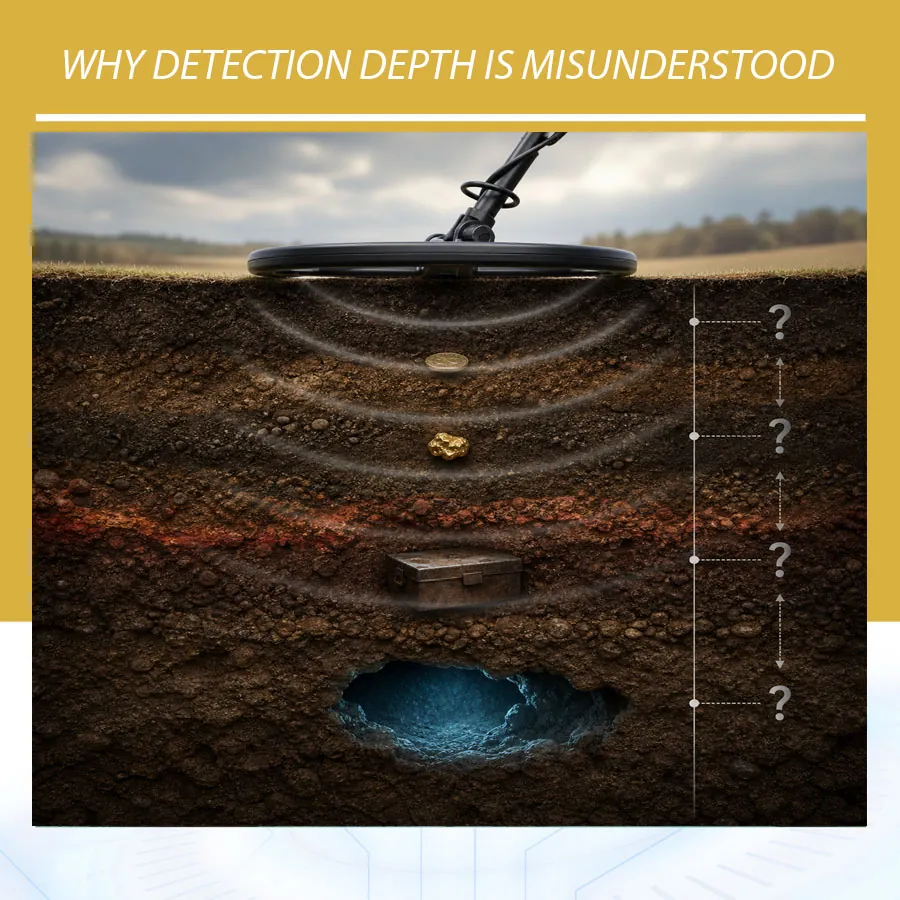
Detection depth is one of the most searched, most asked, and most misunderstood topics in gold and metal detecting. Buyers want a simple number: How deep can this detector go? Sellers often answer with impressive maximum figures. Field users, however, quickly discover that depth is not a fixed number. It changes with the target, soil, detector technology, settings, search method, and even the operator’s movement.
The problem is not that depth specifications are useless. The problem is that many people read them as guarantees. A detector may have a stated maximum range or depth under certain conditions, but that does not mean every coin, nugget, relic, cavity, or treasure cache will be found at that depth in every location. Detection depth is better understood as a performance window, not a promise.
This article explains why depth is so often misunderstood, what actually affects it, and how advanced devices such as the Gold Stinger X6, Mega Scan Pro New Edition, and Gold Vision 3D Ground Scanner should be evaluated in real field use.
Detection Depth Is Not One Number
The first mistake is treating detection depth as a single specification. In reality, a detector has different depth performance for different targets. A large metal box, helmet, or cache can be detected much deeper than a small coin or thin gold chain. Scientific and manufacturer guidance both point to the same idea: target size, surface area, shape, orientation, and depth all affect signal strength.
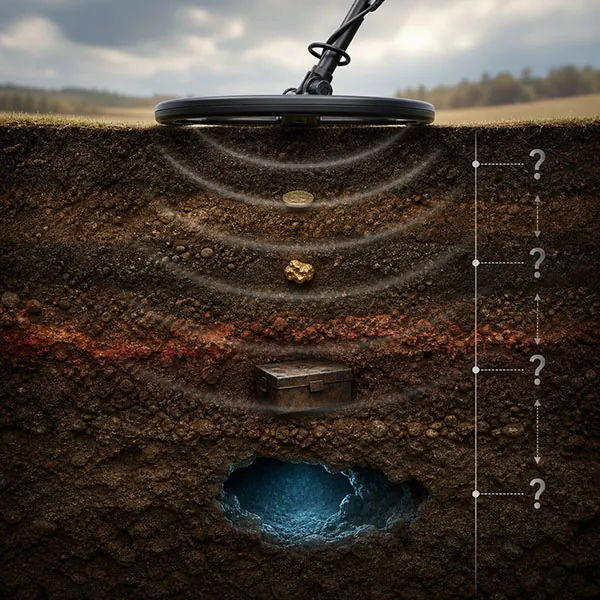
This is why comparing detectors only by maximum advertised depth can be misleading. One device may perform very well on large deep objects but miss small shallow gold. Another may be excellent for tiny nuggets near the surface but unsuitable for large-area treasure search. The right question is not only “How deep does it go?” but “How deep can it detect the target I am actually searching for, in this ground, with this method?”
Target Size and Surface Area Matter More Than People Think
A metal detector responds to the signal produced by a target, not to the romance of the target. A large bronze object, jar lid, or buried container offers more signal response than a small gold ring. A flat target may respond differently from a narrow object standing on edge. A chain is especially difficult because each link can behave like a tiny separate target.
This is why professional detector users separate “coin depth,” “nugget depth,” “cache depth,” and “void or cavity indication” instead of using one universal number. When brands discuss deep detection, the target category matters. A deep-seeking treasure detector is not automatically the best detector for small gold flakes, and a sensitive gold detector is not automatically the best tool for large buried cavities.
Soil Mineralization Can Reduce Detection Depth Dramatically
Ground conditions are one of the biggest reasons real-world depth differs from brochure depth. Mineralized soil, hot rocks, black sand, salt, and wet conductive ground can create background signals that reduce detector stability. When the detector becomes noisy, the user often has to reduce sensitivity, change ground settings, or rebalance the device. Those adjustments may improve stability but can reduce usable depth.
This is why experienced users care so much about ground balance and soil settings. A detector that is quiet and stable at moderate sensitivity may outperform a detector running at maximum sensitivity but producing unstable signals. Depth is not only about power. It is about usable signal clarity.
Coil Size, Frequency, and Technology Change the Result
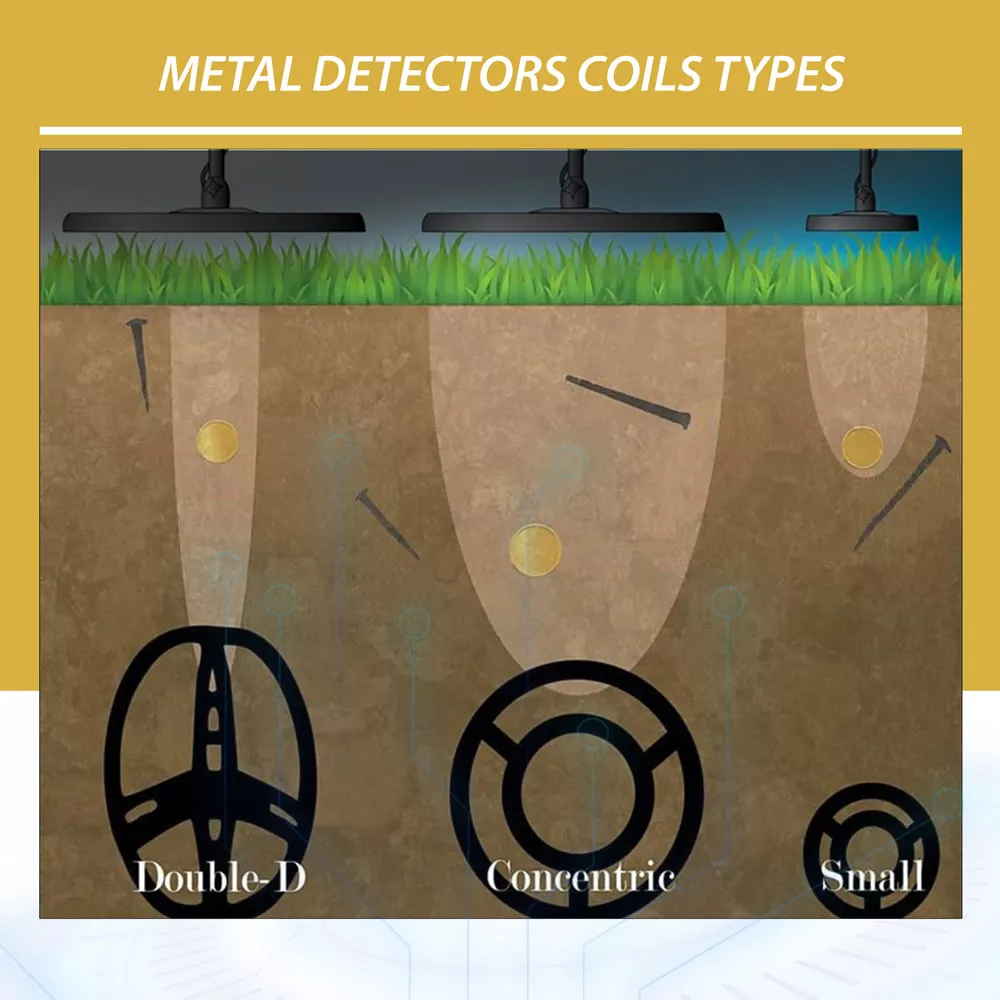
For conventional coil-based metal detectors, coil size is a major depth factor. Larger coils generally cover more ground and can reach deeper on larger targets, but they may lose sensitivity to small targets and become more affected by electromagnetic interference. Smaller coils are better for small shallow targets, trashy areas, and precise separation.
Frequency also matters. Lower frequencies often favor larger and deeper conductive targets, while higher frequencies are more sensitive to small or low-conductive targets such as small gold. Pulse induction, VLF, multi-frequency systems, long-range locator concepts, and 3D ground scanning all approach the depth question differently. That is why two devices can both be called “deep detectors” while being designed for very different jobs.
See more in following article : Metal Detectors Coil Types
Why Long Range and 3D Scanner Depth Claims Need Context
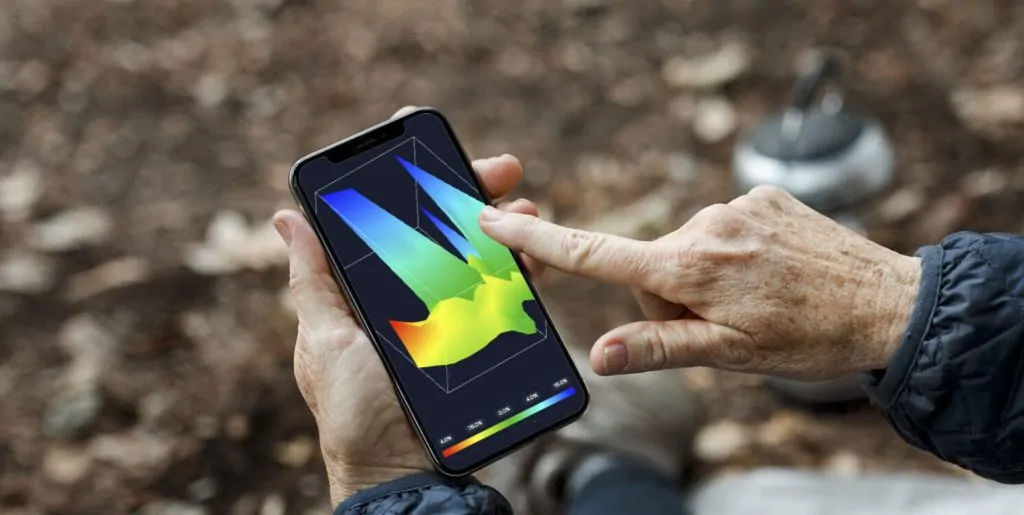
Advanced devices such as Mega Scan Pro New Edition and Gold Vision 3D Ground Scanner are not simple coin detectors. They use multiple systems to investigate a search area. Mega Scan Pro includes systems such as Ground Scan, Auto LRL, Manual LRL, Ionic, Bionic, and Pin Pointer. Gold Vision uses 3D Ground Scan, Long Range, Free Mode, Smart Depth, Ionic, and Bionic systems. These devices are designed around a workflow: locate a promising area, visualize or analyze the ground, estimate depth, then confirm with closer investigation.
That workflow is important. A long-range system may help narrow a wide area, while a 3D ground scan can help visualize anomalies. A smart depth or ground scan estimate can support decision-making. But none of these should be treated as a magic number that replaces site verification. Depth estimates are strongest when the scan area is prepared, movement is consistent, interference is controlled, and results are repeated from more than one direction.
How Gold Stinger X6 Fits Into the Detection Depth Discussion
Gold Stinger X6 is a good example of why depth should be discussed by search purpose. It is marketed toward gold, treasures, metals, and underground targets, but users should still ask what target size and field condition the depth expectation refers to. A small gold target requires different sensitivity and signal interpretation than a larger buried object.
For any detector in this category, practical depth comes from matching the system to the task. If the user is searching for small gold, sensitivity and ground handling become critical. If the goal is a larger target or cache, coverage, stability, and target confirmation become more important. The same detector can feel excellent or disappointing depending on whether the user’s depth expectation matches the target type.

Operator Technique Is Part of Detection Depth
Many depth problems are not caused by the detector alone. Coil height, sweep speed, sensor angle, calibration, balance, and search pattern can all affect results. If the search head is lifted too high, moved too quickly, or held inconsistently, depth suffers. In structured ground scanning, poor grid spacing or inconsistent sensor height can make a target appear weaker, displaced, or harder to interpret.
This is especially true with devices that use 3D scan or directional search methods. Mega Scan Pro and Gold Vision both depend on correct assembly and deliberate movement. Their deeper-search value appears when the operator follows the method carefully. Rushing the process reduces the benefit of advanced technology.
Depth vs Accuracy: The Trade-Off Buyers Ignore
More depth is not always better if it comes with unstable signals, poor target identification, or too many false positives. In difficult ground, a slightly lower sensitivity setting may produce fewer but more reliable signals. In trashy ground, a smaller coil may find valuable targets that a larger coil masks. In long-range work, repeated confirmation may matter more than chasing the deepest possible reading.
The best detector is not simply the one with the biggest depth number. It is the one that gives the most useful information for the search goal. For a prospector, that may mean sensitivity to small gold. For a treasure hunter, it may mean wide-area search and depth estimation. For a site investigator, it may mean 3D visualization and the ability to distinguish possible metal from possible cavities.
Best Practices for Understanding Real Detection Depth
- Ask what target size the depth claim refers to.
- Separate coin depth, gold nugget depth, cache depth, and cavity detection.
- Consider soil mineralization before comparing devices.
- Use ground balance, soil settings, and calibration correctly.
- Keep the coil or sensor low, steady, and consistent.
- Repeat suspicious signals from different directions.
- Use 3D scan and smart depth systems as confirmation tools, not as automatic proof.
- Choose the device based on target type, not only maximum advertised depth.
FAQ: Detection Depth Questions
Why do two detectors with similar depth claims perform differently?
Because depth depends on more than the detector. Target size, metal type, soil, coil or sensor design, frequency, settings, interference, and user technique all change the result.
Can a detector always reach its maximum advertised depth?
No. Maximum depth usually refers to favorable conditions and often larger targets. Real field depth is usually lower and varies by site.
Do 3D ground scanners guarantee exact depth?
No. 3D ground scanners and smart depth systems can provide useful estimates and visual analysis, but results should be confirmed with repeated scans and practical field judgment.
Which matters more: depth or target identification?
It depends on the search. Deep detection is useful only if the signal is reliable enough to act on. In many real sites, stable interpretation is more valuable than maximum depth.
Final Verdict: Depth Is a System, Not a Promise
Detection depth is misunderstood because people want a simple number for a complex field problem. The real answer depends on the target, ground, technology, settings, and operator. Devices such as Gold Stinger X6, Mega Scan Pro New Edition, and Gold Vision 3D Ground Scanner should be judged by how well their systems match the search goal, not only by the deepest number attached to them.
For serious users, the smartest approach is to think in layers: wide-area search, ground analysis, depth estimation, and close confirmation. When depth is treated as part of a complete workflow, expectations become more realistic and results become more reliable.