
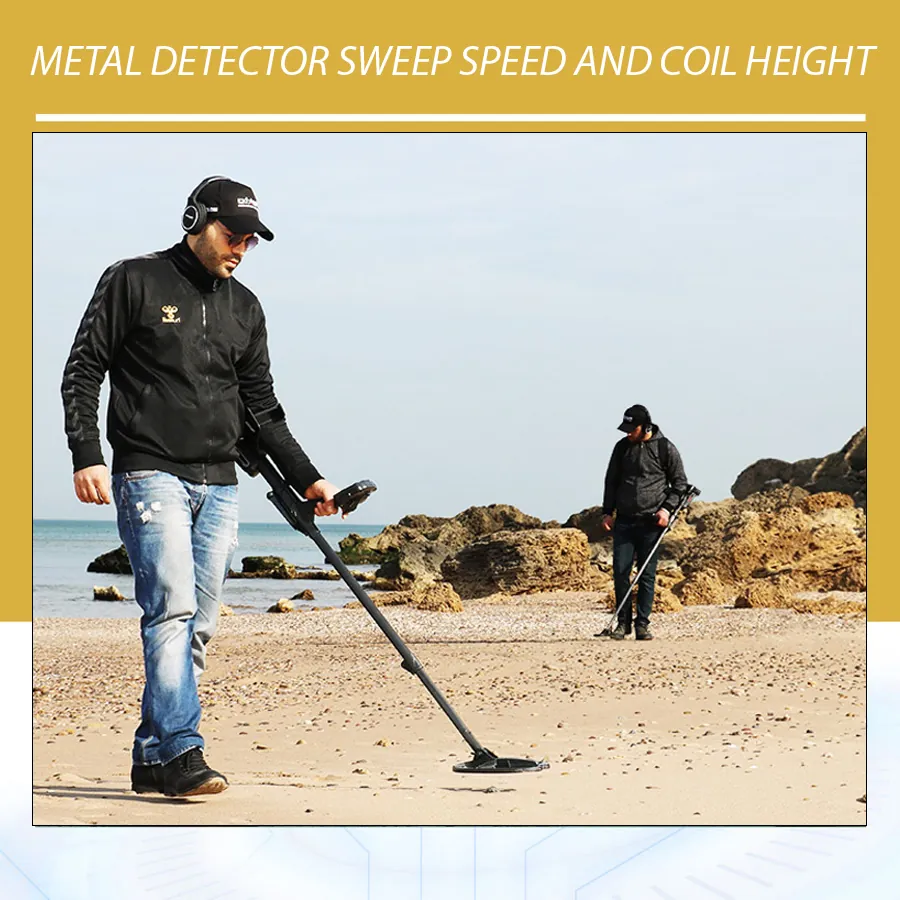
Metal Detector Sweep Speed and Coil Height: Techniques That Affect Your Finds
Metal detector sweep speed and coil height shape every signal you hear. A detector may have sophisticated target identification, ground handling, and recovery controls, but it can only analyze the ground that its coil passes over. Swing too quickly for the detector and conditions, and a small or closely spaced target may produce only a clipped response. Move unpredictably or lift the coil at each end, and you create gaps in coverage while changing the signal for reasons unrelated to the buried object.
The goal is controlled movement, not simply “slow” movement. The correct pace depends on the detector, search mode, recovery setting, coil, soil, target density, and terrain. The useful coil height is likewise the lowest stable clearance that lets you keep the coil level without striking the surface. This guide explains how to find that combination and test it. Examples from the Gold Stinger X6, Minelab MANTICORE, Minelab GPX 6000, and Garrett ACE 400i show why one memorized speed cannot apply to every machine.
Why sweep technique changes what your detector can report
A search coil transmits an electromagnetic field and senses changes associated with conductive objects and the ground. The detector processes that changing response over time. Your arm controls both the path through space and the time available for the response to develop. That is why swing technique is part of the detection system rather than a cosmetic detail.
Three variables work together:
- Speed determines how long a target remains within the coil’s useful detection field and how quickly one response follows another.
- Height changes the distance between the coil, target, and mineralized surface. More distance usually weakens response to small or deep objects.
- Path determines whether the effective detection areas of consecutive sweeps meet, overlap, or leave strips unsearched.
The detector’s audio, target ID, and depth estimate are interpretations of the received response. A clipped pass, changing height, or collision with vegetation can make that interpretation less stable. A steady technique does not guarantee a find, but it removes avoidable variation and makes ambiguous signals easier to investigate.
Sweep speed is not the same as Recovery Speed
Physical sweep speed is the motion of the search coil across the ground. Recovery Speed, Reactivity, or a similarly named control is an electronic setting on some detectors. It changes how quickly the detector resets or responds between nearby targets. The two interact, but they are not interchangeable.
A higher electronic Recovery Speed can help separate a desirable response from nearby iron and may tolerate a faster physical swing. The tradeoff can include less detection depth or less stable target identification, depending on the detector and conditions. A lower setting may give a longer, fuller response and can favor depth in mild ground, yet close targets may blend and ground noise may become more prominent.
| Variable | If increased | Possible benefit | Possible cost |
|---|---|---|---|
| Physical sweep speed | The coil crosses each point sooner | Faster area coverage when the detector and site permit | Brief responses, poorer investigation, and missed coverage if control declines |
| Electronic Recovery Speed | The detector resets sooner between responses | Better separation of nearby targets | Reduced depth or Target ID stability on some models |
| Walking speed | Each new sweep advances farther | More ground covered per hour | Wider unsearched strips unless overlap and sweep width remain controlled |
A common mistake is to raise Recovery Speed and then rush every site. The setting may help the detector report two close targets, but it does not correct a coil that skips around roots, rises at the ends, or advances farther than its effective field covers. Adjust the electronic control for the site, then choose a physical pace at which you can hear and verify short responses.
What happens when you sweep too fast?
A fast pass can turn a weak target into a short tick that resembles ground noise, electrical interference, or an iron edge. In a trashy area, several targets may enter and leave the detection field in quick succession. The detector may report a blended response, while the operator has too little time to recognize the sequence and stop over the correct spot.
Speed also affects human attention. If each swing covers a large arc and you walk quickly, the target is already behind you when the sound reaches conscious attention. You then reverse from a different angle or height and conclude that the signal disappeared. Shorter, repeatable passes make the recheck more meaningful.
Fast does not always mean wrong. Some detectors and settings respond well to a moderately brisk swing, and an excessively slow pass can be unhelpful in a motion search mode. The relevant question is whether the signal repeats at the same point from controlled directions. If reducing the pace turns a click into a repeatable compact signal, the original rate was too fast for that target and setup.
Can you sweep too slowly?
Yes. Motion detectors rely on a changing response as the coil moves relative to the target. Creeping at an extreme pace can soften or stretch the audio, especially if the model’s filtering expects more movement. Very slow swinging also reduces area coverage and may tempt the user to dwell over mineralized patches until ordinary ground variation sounds significant.
Slow down for dense trash, uneven terrain, and questionable signals, but keep the coil moving smoothly. If you need to stop directly over a response, use the model’s documented Pinpoint function or another non-motion procedure. A search mode that requires motion and a non-motion Pinpoint function answer different questions, so follow the activation procedure supplied for the detector.
Coil height: close, level, and safely clear
For ordinary ground searching, manufacturers commonly advise keeping the coil close and parallel to the surface. Close coupling helps retain response to small and deep targets. Parallel movement keeps distance more consistent across the sweep, so an increase or decrease in signal is more likely to come from the ground or a target than from your arm.
“Close” does not mean dragging the coil. Scraping can create impact noise, move the cable, damage a coil cover, and shorten the useful life of the equipment. It can also make the operator raise the coil abruptly after every collision. Maintain enough clearance for stones, stubble, and soil clods while keeping that clearance as even as practical.
A fixed number cannot suit every surface. Garrett specifies 2–3 cm in the ACE 400i Quick Start procedure, but that is a model-specific instruction. On rough goldfields, the clearance may vary moment by moment. The practical objective is to follow the terrain without hitting it and without allowing the coil to float far above every low spot.
The “pendulum swing” and why the ends lose coverage
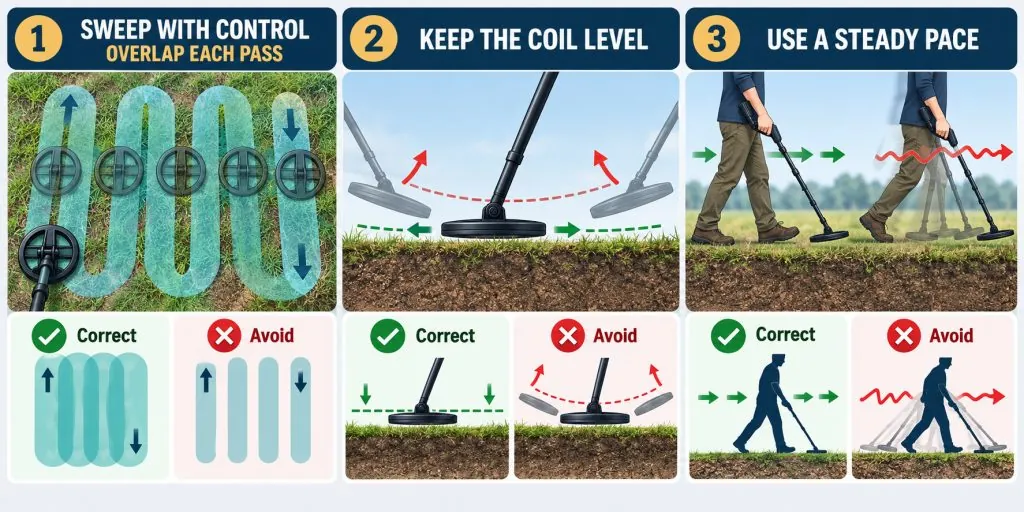
When the shaft pivots only from the shoulder, the coil often follows an arc: low in front of the operator and high at the left and right ends. Those raised ends have less sensitivity to small or deep targets. The visible sweep may look wide, yet the useful close-to-ground portion is narrow. This is sometimes called a pendulum or rainbow swing.
Correct it by shortening the sweep until you can keep the coil level. Bend the elbow, rotate the torso slightly, and allow the wrist to maintain the coil’s angle without forcing it. Adjust the shaft so the coil reaches the ground comfortably in front of your feet. An overlong shaft encourages a broad arc; an overly short shaft encourages stooping and fatigue.
Test the result visually. Sweep beside a flat path edge or ask a partner to view the coil from the front. The bottom of the coil should remain nearly parallel to the local ground through the useful part of the swing. On a slope, “level” means following the surface contour, not remaining horizontal to the horizon.
Overlap determines whether you searched the whole lane
Each forward step moves the next sweep into new ground. If you advance too far, the useful fields of adjacent sweeps may not meet at depth, even when the physical coil paths appear to touch. Deliberate overlap reduces those gaps. Targets near the edge of one pass then receive another opportunity nearer the coil’s central, stronger region.
There is no honest universal overlap percentage. Search fields differ among concentric, Double-D, monoloop, and specialized coils. Effective width also changes with target size and depth. A deep tiny target may respond only near a limited part of a coil that easily detects a shallow can across most of its width.
Use tighter overlap when seeking small targets, revisiting a productive patch, working mineralized ground, or using a coil whose deep detection footprint is narrow. Wider spacing may be acceptable for reconnaissance aimed at larger objects, provided the operator understands that it is a lower-density search. Grid a promising area from a second direction when coverage matters more than speed.
| Condition | Sweep approach | Coil-height priority | Reason |
|---|---|---|---|
| Open, mild ground | Use the manufacturer’s general pace and consistent overlap | Low and parallel | Establishes efficient baseline coverage |
| Dense iron or modern trash | Shorter passes; slow enough to hear separate responses | Constant height | Supports target separation and accurate rechecks |
| Strong mineralization | Controlled passes with ground balance and sensitivity set first | Follow the surface closely without contact | Reduces height-driven ground-response changes |
| Rocks, roots, or stubble | Use small sections and change direction around obstacles | Use safe clearance; avoid bobbing | Prevents collisions and unsearched shadows |
| Beach or shallow water | Steady pace with resistance anticipated | Keep the coil plane stable | Water drag can twist or lift the coil |
| Faint repeatable signal | Short cross-sweeps at several angles | Do not change height during comparison | Separates target behavior from movement error |
Device example: Garrett ACE 400i gives a measurable starting point
The Garrett ACE 400i manual offers unusually specific beginner guidance. Its Quick Start section says to lower the search coil to 2–3 cm above the ground and scan left and right at approximately 1 metre per second. It also states that the coil must move for target detection, although it may remain stationary during Pinpoint.
Those figures are a starting procedure for the ACE 400i, not a universal law. The standard 8.5-by-11-inch Double-D coil, site obstacles, and target density still affect the useful path. A beginner can practise the documented pace on clean ground, then shorten and slow the swing when a response needs separation or confirmation.
The official ACE 400i owner’s manual is the controlling source for the model. It illustrates a valuable habit: start from your manual’s measurable guidance before copying the cadence of another detectorist.

Device example: MANTICORE connects swing rate with Recovery Speed
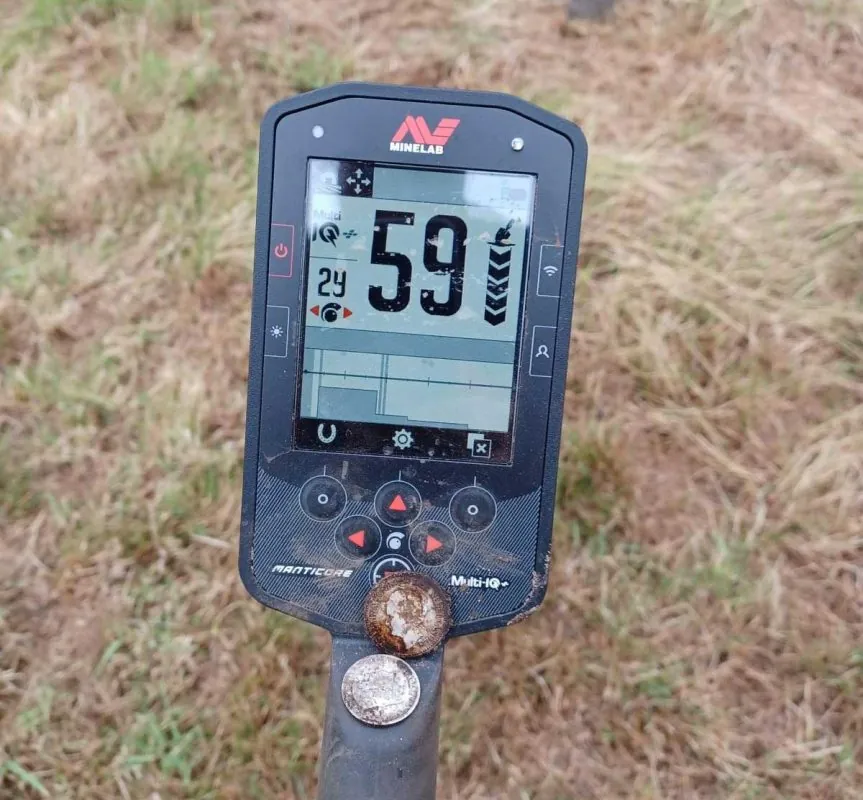
Minelab’s MANTICORE provides a direct example of physical and electronic speed working together. The current official manual gives a general swing rate of about 2–3 seconds for a complete right-to-left-to-right cycle. It says a higher Recovery Speed generally allows faster swinging without missing many targets.
The same manual explains the tradeoff. A higher Recovery Speed can improve the separation of close targets, but may reduce depth and Target ID accuracy. A lower setting may improve depth in mildly mineralized soil, while low Recovery Speed in strongly mineralized soil can reduce discrimination performance. In other words, “higher” and “lower” are tools, not quality rankings.
A practical MANTICORE test begins at the documented general cadence. Place two known targets on clean ground, listen at the current Recovery Speed, and then change only that setting. Repeat with the same path and height before changing your physical pace. This prevents a faster arm movement from being mistaken for an improvement caused by the setting.
Use Minelab’s official manuals catalog to obtain the current MANTICORE Instruction Manual for the controls and mode behavior. Orient Detectors’ MANTICORE review provides additional model context.
Device example: Gold Stinger X6 coil choice changes the workflow
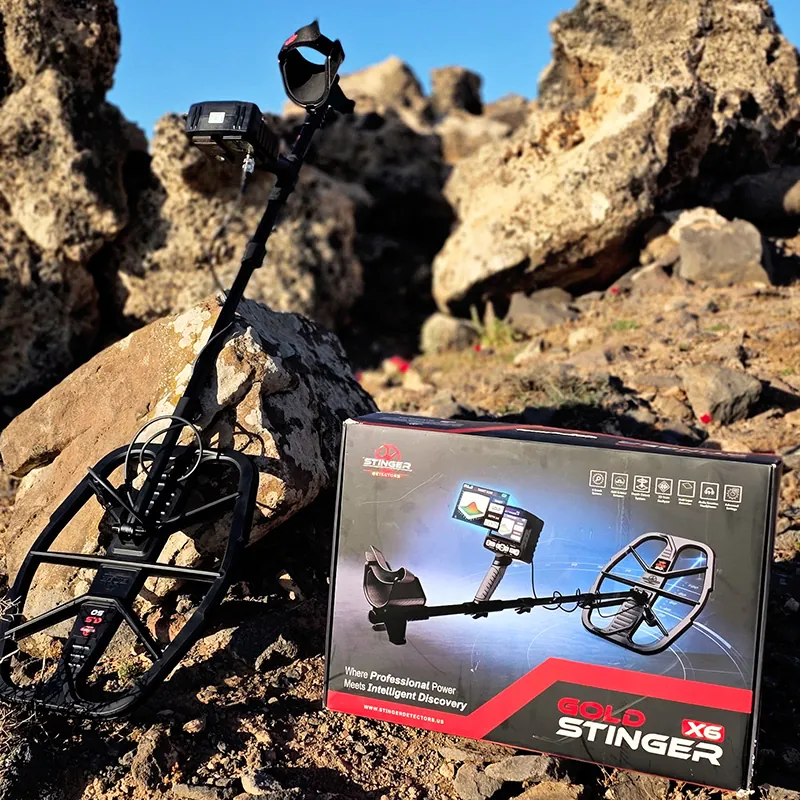
The Gold Stinger X6 includes two coils with different priorities. Orient describes the GS50 as intended for greater depth and wider ground coverage, while the GS30 is intended for higher precision and small-target detection. That makes the X6 a useful example of why coil footprint and search objective should influence the sweep plan.
With the GS50, the operator can plan broad, orderly lanes during initial coverage, but must still overlap and maintain a level plane. A larger physical footprint does not grant permission to leave gaps. With the GS30, shorter passes can fit between rocks or trash responses, and the operator can investigate a compact area with more precise positioning.
The public X6 listing does not publish a universal seconds-per-swing instruction. Therefore, no exact pace should be invented for either coil. Ground balance the selected setup, begin at a controlled moderate pace, and use known targets to find the range that produces stable, repeatable responses. If changing from GS50 to GS30, repeat that baseline test instead of assuming the same walking speed and overlap will give the same coverage.
Device example: GPX 6000 in variable and mineralized ground
The Minelab GPX 6000 demonstrates how coil height, ground procedure, and coil selection meet in gold prospecting. Its manual’s Quick-Trak procedure calls for raising and lowering the coil through a specified range, then sweeping side to side after ground noise has reduced. Those raising and lowering measurements belong to ground balancing; they are not a normal search height.
For searching and sensitivity assessment, the manual repeatedly emphasizes keeping the coil close and parallel to the ground. This matters in mineralized terrain because bobbing the coil changes its relationship to the ground as well as to any nugget. A false or uneven ground response can then mask the subtle target sound the user is trying to recognize.
Coil choice also changes the plan. Minelab describes the GPX 11 monoloop as a versatile fine-gold coil, the GPX 14 Double-D for salt-affected ground, and the larger GPX 17 for broader coverage and larger nuggets. The operator should set overlap according to the target objective and actual response footprint rather than physical diameter alone.
Consult the official GPX 6000 user manual and Orient Detectors’ GPX 6000 review. Use the manual’s exact Ground Balance and Noise Cancel sequences because they answer different questions from ordinary sweeping.
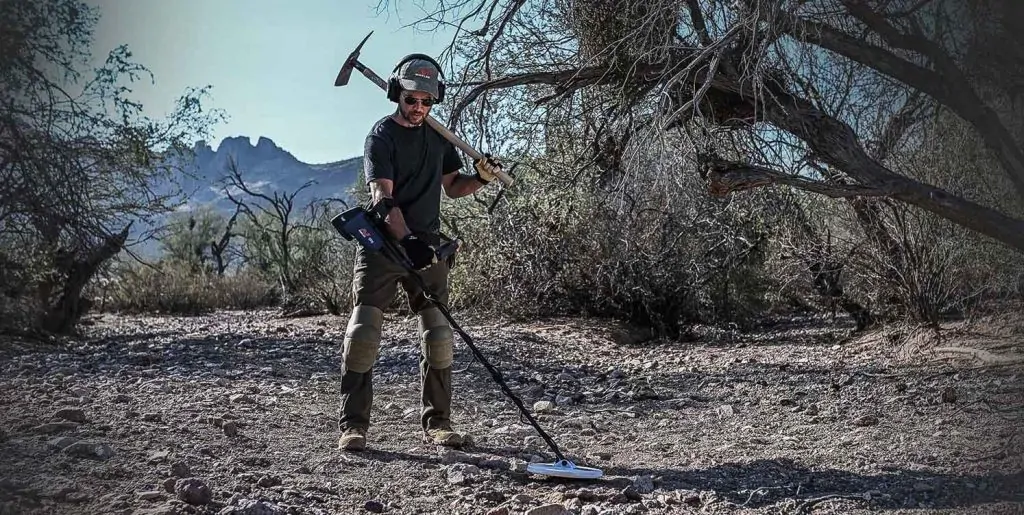
How terrain changes the correct movement
Slopes
On a slope, sweeping straight across may cause the downhill edge to float and the uphill edge to strike. Reduce the arc and follow a contour. Search very steep ground in narrow horizontal lanes, then check promising areas from another direction where footing is safe. Stable body position is more valuable than maximum width.
Rocks and vegetation
Do not wave high above an entire area because one branch blocks the coil. Work around individual obstacles with short passes and return from the opposite side. A smaller compatible coil may reach gaps that a large one cannot. Keep a mental or physical grid so convenient open strips do not become the only strips you actually search.
Ploughed or furrowed soil
Follow the model’s guidance for furrowed ground rather than swinging at one high plane above every ridge. The ACE 400i manual, for example, recommends sweeping parallel to plough lines and the water’s edge to reduce false signals caused by abrupt ground changes. A carefully controlled cross-check can expose coverage gaps only where stable clearance and the detector’s ground behavior permit it.
Shallow water
Water resistance encourages the coil to lag, tilt, or rise during direction changes. Slow the reversal and keep the shaft connection secure. Avoid accelerating abruptly; the aim is a smooth plane. Follow the detector and coil’s waterproof ratings and connection instructions.
Target size, orientation, and depth change the ideal pace
A shallow large object may respond through a broad part of the sweep even with imperfect technique. A small or deep object may produce a narrow signal near the coil’s most sensitive region. That difference explains why a quick field demonstration with a large exposed target does not prove that the same sweep will detect fine gold or a deep coin.
Orientation matters too. A coin lying flat can couple differently from the same coin on edge. A chain is not one solid target; individual links and the clasp may create broken responses. Long iron can produce a good-sounding edge from one direction. Cross questionable signals, reduce the sweep length, and keep height constant before interpreting them.
When testing, include targets that resemble the real search goal. Do not tune a gold-prospecting pace only with a large coin or optimize a relic setup only with tiny foil. Test several sizes and orientations while remembering that air tests do not reproduce mineralized soil or burial effects.
A repeatable field test for your own detector
- Choose a clean test patch. Scan it from two directions and move away from known metal, reinforced concrete, and electrical interference.
- Use known targets. Select at least one small and one larger object relevant to your search. Place them on the surface first, separated well enough to produce individual responses.
- Set a baseline. Ground balance, select a normal search mode, and record the coil, sensitivity, recovery setting, and audio settings.
- Mark a straight lane. Use nonmetallic markers outside the sweep. Keep the coil at one practical clearance and use equal-length passes.
- Compare three paces. Try deliberately slow, moderate, and brisk passes without changing height or settings. Record repeatability, audio shape, and ID stability rather than relying on one pass.
- Test height separately. At the best pace, repeat at low stable clearance and then higher. Do not scrape the target or ground.
- Add nearby iron. Move an iron object closer in measured steps and repeat. Change Recovery Speed only after documenting the baseline.
- Use a blind check. Ask another person to place a target somewhere along the lane, or turn your back while its location changes. This reduces expectation bias.
- Confirm in real soil. Where lawful and responsible, compare with naturally recovered signals. Do not claim an air-test distance as field depth.
| Record | Example | Why it matters |
|---|---|---|
| Detector and coil | MANTICORE with M11 | Results belong to the fitted setup |
| Mode and settings | Search mode, sensitivity, Recovery Speed | Prevents hidden setting changes |
| Sweep cycle | Seconds for right-left-right | Makes pace repeatable |
| Clearance and surface | Low/level over flat grass | Documents height and terrain |
| Target arrangement | Coin flat; nail 10 cm away | Defines separation challenge |
| Observed response | Two-way audio, ID range, clipped edge | Captures evidence without guessing value |
Common sweep and coil-height mistakes
Copying another detector’s cadence: the model, mode, coil, and settings may differ. Start with your own manual and test.
Swinging wider to cover ground faster: an uncontrolled wide arc usually raises the ends. Shorten the pass and keep the useful footprint close to the surface.
Confusing speed with productivity: hectares walked are not hectares searched thoroughly. Coverage requires deliberate forward spacing and overlap.
Dragging the coil: contact can produce false responses and wear. Maintain safe, consistent clearance.
Changing several settings at once: if sensitivity, Recovery Speed, ground mode, coil height, and physical pace all change, the result teaches nothing about cause.
Trusting one direction: a target masked by iron or aligned on edge may respond differently after a 90-degree turn. Cross-check.
Watching the display instead of the coil: a stable number is not useful if the coil is striking rocks or leaving gaps. Control the path, then interpret the audio and display together. Orient’s target ID guide explains why identification values are estimates rather than chemical analysis.
A practical rhythm for real searches
Begin each site by setting the detector up according to its manual, including Noise Cancel and Ground Balance where applicable. Walk one short lane at a comfortable, repeatable cadence. Check that the coil remains parallel and that each step advances by an amount that preserves overlap.
When the site becomes busy, shorten the swing before changing settings. Listen to how many distinct responses occur in one pass. If they blend, reduce pace and test a suitable higher Recovery Speed if your detector provides it. If a weak signal appears, stop advancing, cross it at constant height, and compare its behavior from several directions.
Review technique whenever fatigue appears. Tired operators often shorten overlap, raise the coil, and exaggerate the arc without noticing. A harness, adjusted shaft, lighter coil, or short rest may recover more performance than increasing sensitivity.
Good metal detector sweep speed is therefore a controlled range, not a magic number. It lets the detector respond, gives the operator time to notice, and maintains a level path with honest coverage. Combine that pace with consistent coil height and documented settings, and your results become easier to understand and repeat.
Frequently asked questions
1. What is the best metal detector sweep speed?
There is no universal best speed. Follow your model’s manual, then adjust for its search mode, recovery setting, coil, ground, target density, and terrain. A good pace produces repeatable responses while you keep the coil level and maintain overlap.
2. How high should a metal detector coil be above the ground?
Keep it as close and parallel as the manufacturer recommends while maintaining enough clearance to avoid impacts. Garrett specifies 2–3 cm in the ACE 400i Quick Start procedure, but rough ground and other models require their own guidance.
3. Does swinging faster make a detector go deeper?
Not as a general rule. Some motion detectors respond better within a certain pace range, but excessive speed can clip weak signals and reduce operator control. Depth also depends on the target, coil, soil, settings, and interference.
4. Is Recovery Speed the same as swing speed?
No. Sweep speed is physical coil movement. Recovery Speed is an electronic response setting on some detectors. They interact, but changing one does not automatically correct poor control of the other.
5. Why do I get signals at the end of my swing?
The coil may be rising, tilting, striking vegetation, or moving its cable. Shorten the arc, secure the cable as instructed, and keep the coil parallel. Recheck the same point from another direction before assuming there is a target.
6. How much should each sweep overlap?
Use enough overlap that targets near the edge of one effective detection path pass nearer the center on the next. The amount varies with coil design, target size, depth, and search objective, so a universal percentage would be misleading.
7. Should I slow down in trashy ground?
Usually, shorter and more deliberate passes help you hear separate responses. You may also test a higher Recovery Speed or a smaller compatible coil, while accepting the model-specific tradeoffs documented by its manufacturer.
8. Should the coil touch the ground?
Avoid striking or scraping the coil. Repeated impacts can create false audio, disturb the cable, and wear the coil cover. Light contact with vegetation is different from dragging across stones or soil, so follow the model’s instructions and maintain the most stable practical clearance for the surface.
9. Does a larger coil require less overlap?
Not automatically. A larger coil covers more physical area, but its effective field at depth is not identical to its outline. Small or deep targets may still require deliberate overlap and a slower investigation pace.
10. How can I tell whether my sweep is too fast?
Repeat a questionable signal with the same height and a shorter, slower pass. If a clipped tick becomes a stable response, or nearby targets separate more clearly, the original pace was too fast for that setup and situation.