Focus keyword: metal detector frequency
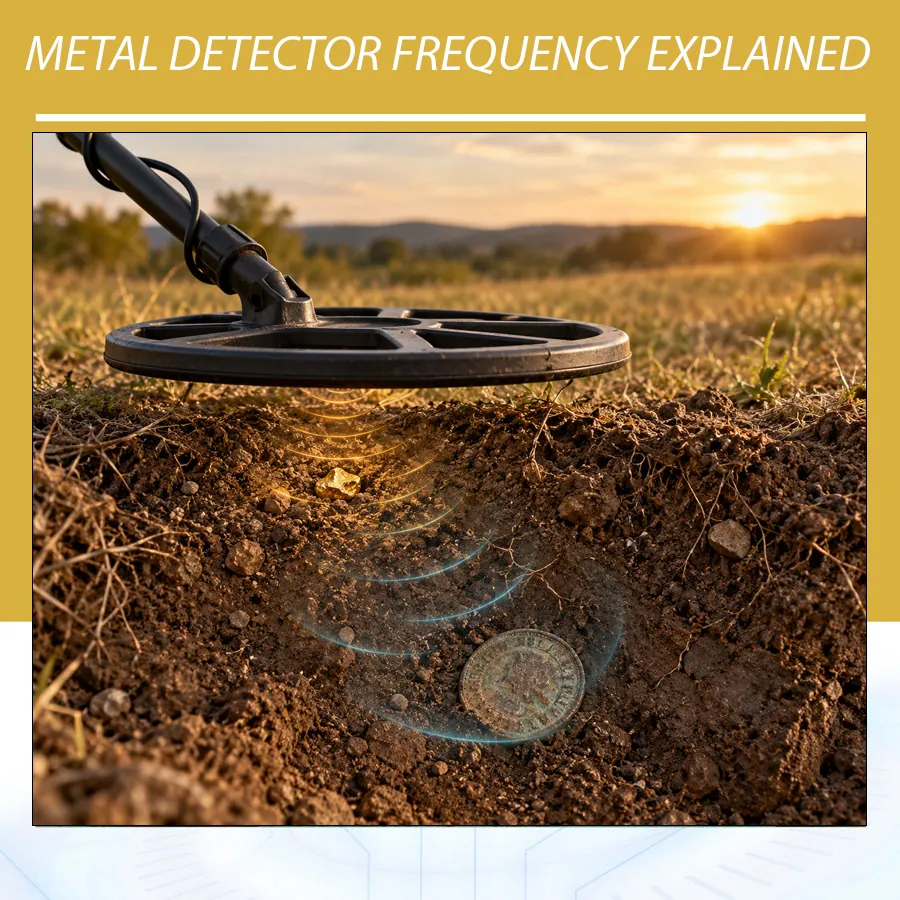
Frequency influences how a VLF detector responds to different targets. Lower single frequencies often suit larger, higher-conductive targets in relatively mild ground. Higher single frequencies can be more responsive to small, low-conductive targets such as fine jewellery or small natural-gold pieces. These are tendencies, not guarantees. A tiny shallow item may respond well at many settings; a large deep item can be difficult at any frequency when the ground is highly mineralized.
Single frequency and simultaneous multi-frequency
| Approach | What it does | Useful situation | Important limit |
|---|---|---|---|
| Low single frequency | Uses one lower-frequency channel | Larger, higher-conductive targets in calmer soil | Does not automatically ignore mineralization or find every deep target |
| High single frequency | Uses one higher-frequency channel | Small targets, fine jewellery, and selected prospecting work | Can become noisy in difficult ground and may be less efficient for some larger targets |
| Simultaneous multi-frequency | Processes multiple frequencies together | Mixed targets, changing ground, beaches, and general hunting | Still needs ground balance, sensible sensitivity, and careful target checking |
Do not confuse simultaneous multi-frequency with rapidly switching one frequency after another. Manufacturers use different methods and names, so read the manual for the actual model. The result should be judged by signal repeatability from more than one sweep direction, not by a marketing label.
Examples from Orient Detectors
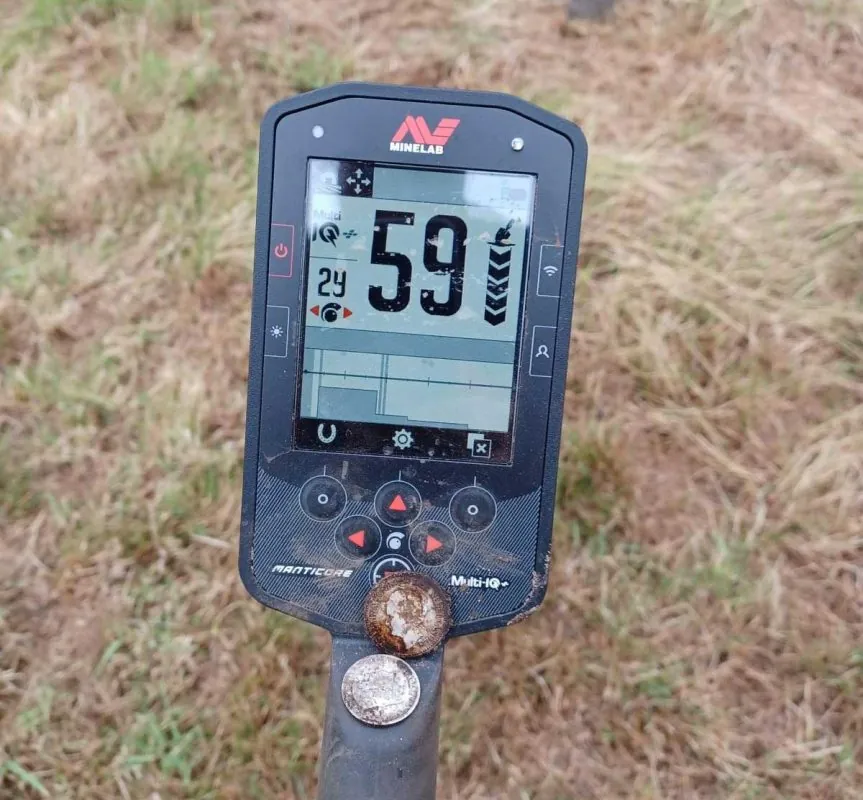
The Minelab MANTICORE offers Multi-IQ+ alongside selectable single frequencies. Its official specifications list 5, 10, 15, 20, and 40 kHz, as well as a multi-frequency option. That gives an experienced user a way to compare a stable multi-frequency response with a single-frequency response, while keeping target trace, audio, and ground conditions in view.
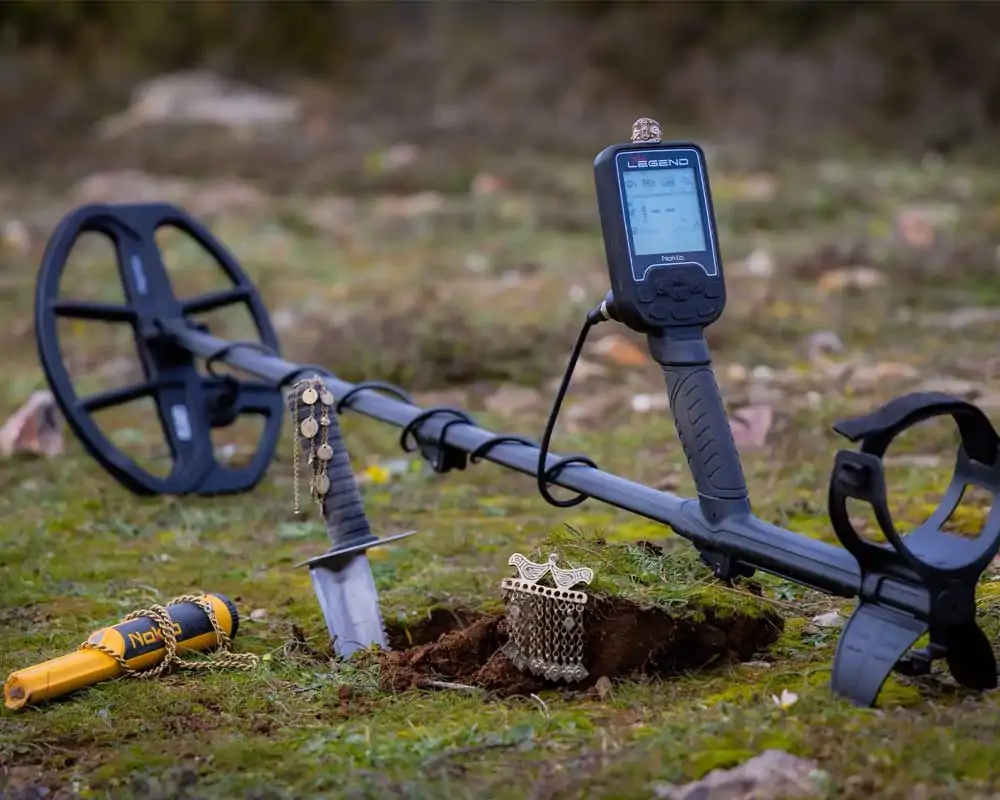
The Nokta The Legend uses simultaneous multi-frequency technology and selectable frequencies. It is a useful example of why a frequency setting belongs in a complete setup: choose a search mode, cancel electrical noise, balance the ground, set sensitivity below instability, then test a doubtful response from two directions.
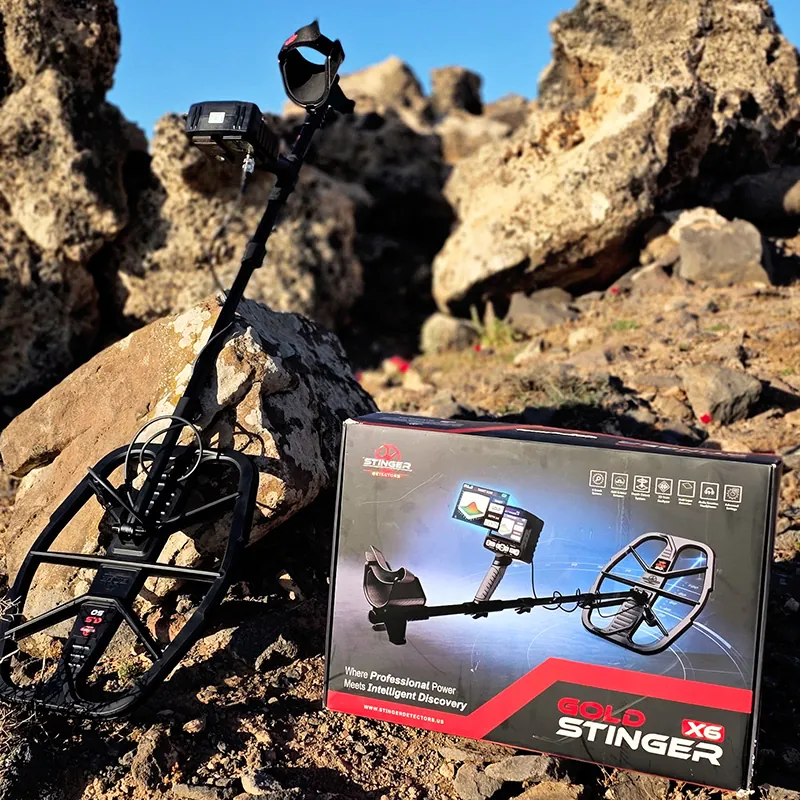
The Gold Stinger X6 is a different type of multi-system detector. Its product page lists All Metals, discrimination, pinpointer, estimated-depth, target-scan, and cavity/void functions. Compare like with like: frequency discussions apply chiefly to VLF-style coil detection; they should not be used to assume that every operating system produces the same kind of target ID or depth behavior.
How to choose a setting in the field
- Start with the mode recommended for the site and use automatic or manual noise cancellation when available.
- Balance the ground. A poor ground setting can disguise the benefit of a frequency choice.
- Use a known test target only as a reference, not as a promise of buried performance.
- Sweep a questionable target north–south and east–west. Record whether audio, ID, and pinpoint location agree.
- Change one variable at a time. If you change frequency, sensitivity, recovery speed, discrimination, and coil at once, the comparison is meaningless.
Common mistakes
| Myth | What to do instead |
|---|---|
| Higher kHz always means more depth | Match the setting to target size, conductivity, ground, and stability. |
| Multi-frequency eliminates bad soil | Ground balance and reduce sensitivity until the machine is controlled. |
| One clean target ID proves the metal type | Use repeatable audio, ID range, target size clues, and recovery only after permission to dig. |
| A frequency chart works on every brand | Learn each detector’s scale and modes with its own manual and a test garden. |
How Metal Detector Frequency Affects Different Targets
The relationship between frequency and target response is easiest to understand when target size and conductivity are separated. Conductivity describes how readily a target carries induced electrical current. Size and shape influence how much signal the target can return. A small thin gold chain, a compact nickel, a broad silver coin, and a large iron plate therefore behave differently even when buried at the same depth.
Lower-frequency operation is commonly associated with stronger response to larger and more conductive objects. Higher-frequency operation is commonly associated with increased sensitivity to small or lower-conductive targets. This is a useful starting rule, but it is not a depth chart. Orientation, corrosion, alloys, surrounding iron, and soil can reverse what a simple chart predicts. A coin on edge presents less area to the coil than a flat coin, while an open gold chain may behave like several tiny disconnected conductors rather than one large target.
| Target example | Useful starting approach | Reason | What can change the result |
|---|---|---|---|
| Large silver or copper coin | Low-to-mid single frequency or balanced multi-frequency | Relatively high conductivity and useful target area | Edge orientation, depth, mineralization, and nearby iron |
| Thin gold ring | Mid-to-high frequency or multi-frequency | Lower conductivity and modest target mass | Alloy, shape, saltwater, and target angle |
| Fine chain or tiny earring | Higher frequency with a suitable small coil | Very small conductive sections produce a weak response | Chain link design, ground noise, coil height, and sensitivity |
| Large relic or metal container | Lower frequency or appropriate pulse-induction system | Large target may remain detectable through a broader field | Target depth, soil, iron content, and detector architecture |
| Small natural-gold specimen | Gold mode, high frequency, or purpose-built prospecting detector | Small low-conductive target requires strong sensitivity | Hot rocks and magnetic mineralization can dominate the signal |
Why Frequency Does Not Equal Guaranteed Depth
Searchers often ask which metal detector frequency goes deepest. That question omits the target. A frequency that responds well to a large coin may be less responsive to a tiny flake, and a setting that detects the flake in an air test may become noisy in mineralized soil. Depth is the point at which the target signal remains distinguishable from ground response, electromagnetic interference, electronic noise, and the detector’s own processing limits.
Coil diameter also affects the measurement volume. A larger coil generally covers more ground and can improve response to some larger deep targets, but it also sees more soil and more targets at the same time. A smaller coil can improve separation and stability in iron or mineralized ground. Pairing the appropriate coil with a stable frequency strategy is usually more productive than choosing a frequency number in isolation.
Search mode is another hidden variable. A detector may weight its multi-frequency processing differently in Park, Field, Beach, or Gold modes. Filters, recovery speed, audio, and ground algorithms can also change. Two modes on the same detector may therefore respond differently even though both display a multi-frequency symbol. Consult the current manual rather than assuming that every multi mode is identical.
Frequency and Soil Mineralization
Soil is part of the signal path. Iron-bearing minerals can produce magnetic responses, while dissolved salts and wet beach sand can create conductive responses. The detector must identify a comparatively small target signal while processing the much larger volume of soil under the coil. This is why a theoretically sensitive frequency can be less useful when it makes the ground sound like a continuous target.
Start by selecting the correct site mode, then perform ground balance where the manufacturer recommends it. Reduce sensitivity if the ground response remains unstable. A quieter detector is not necessarily losing useful performance; it may be improving the signal-to-noise ratio, which is the practical separation between a target response and everything that is not the target.
At a saltwater beach, simultaneous multi-frequency processing is often valuable because the detector can model salt and target behavior across more information than a single channel provides. That does not make every multi-frequency detector equally suitable for every beach. Waterproof rating, beach modes, coil behavior, and current software still matter. On dry inland soil, a selected single frequency may be helpful for diagnosis because it lets the user compare stability and target response.
Metal Detector Frequency and Target ID
Target identification is an estimate derived from the received signal. Changing metal detector frequency can shift the target ID or change how stable it appears, particularly for difficult targets near the detection limit. A number is not a laboratory analysis of metal composition. Different brands use different scales, and even two models from the same manufacturer may process the signal differently.
Use target ID as one layer of evidence. Combine it with the tone shape, repeatability, pinpoint size, sweep direction, and site context. A compact repeatable target that stays in a narrow ID range from two directions is generally easier to interpret than a long smeared signal that changes dramatically with coil direction. Iron objects can produce attractive high tones at their edges, while desirable non-ferrous targets can read poorly when close to nails.
When comparing frequencies, do not demand an identical number. Instead, ask whether the response becomes more repeatable and whether the target separates more clearly from nearby objects. This is especially useful in a controlled test garden where the target type, spacing, and depth are known.
Single Frequency: When It Is Still Useful
Simultaneous multi-frequency is versatile, but selectable single frequency remains a practical diagnostic and specialist tool. In mild soil, a lower single frequency may provide a clean response on high-conductive coins. A higher single frequency can highlight small targets. If electrical interference affects part of the frequency spectrum, another single frequency may operate more quietly.
A single-frequency comparison is most useful when every other setting remains unchanged. Keep the same coil, search mode where possible, recovery speed, discrimination pattern, and sweep path. Mark the target position and compare multiple passes. If one setting produces a louder but less repeatable response, it may simply be amplifying noise.
Single frequency can also help explain a mixed target. Suppose a high frequency produces a strong response while a low frequency barely responds. That pattern can suggest a small or lower-conductive target, but it does not prove gold. Small foil, thin aluminium, and irregular fragments can behave similarly. The target must still be recovered legally and examined before its identity is known.
Simultaneous Multi-Frequency: What It Offers
A simultaneous multi-frequency detector transmits or processes more than one frequency as part of one operating system. The purpose is not merely to add several single-frequency results. Manufacturers combine frequency information using proprietary weighting and ground-processing methods. This can improve versatility across mixed targets and changing conditions.
The MANTICORE is a clear example. Minelab’s official specification lists Multi-IQ+ and five selectable single frequencies. The detector also combines the frequency system with target trace, ferrous indication, ground balance, noise cancel, and mode-specific processing. The practical advantage comes from the complete platform rather than from the word “multi” alone.
The Legend and Legend 2 provide another useful comparison. Nokta lists selectable 4, 10, 15, 20, and 40 kHz frequencies plus several multi-frequency options. The Legend 2 official page also lists automatic noise cancel and manual frequency-shift channels. These settings allow adaptation, but the user must still learn which mode and multi option the manual recommends for park soil, fields, conductive beach conditions, relic work, or gold prospecting.
Frequency, Recovery Speed, and Target Masking
Frequency cannot be separated from target separation. When a coin lies near a nail, the coil receives overlapping responses. Recovery speed affects how quickly the detector can report separate targets, while coil size and sweep speed affect how much overlap reaches the electronics. A high-frequency setting alone will not unmask a coin if the coil is too large, the sweep is too fast, or the discrimination pattern rejects part of the blended signal.
Begin with the detector’s normal recovery setting. Use a smaller coil in dense trash and shorten the sweep. Test the signal from opposite directions. Increase recovery speed only enough to improve separation because excessively fast processing can make deeper responses sound shorter or weaker. Read the related guide, Metal Detector Recovery Speed Explained, before treating frequency as the only control.
How to Run a Useful Metal Detector Frequency Test
An air test is useful for learning tones and checking that a detector responds, but it does not reproduce soil. A buried comparison is more realistic when it uses undisturbed or properly settled ground. For repeatable results, document the test rather than relying on memory.
- Choose a metal-free test area and check it with an all-metal pattern.
- Select two or three representative targets rather than a large collection of random objects.
- Measure target depth and orientation. Include one adjacent-iron test if masking is important.
- Use the same coil, shaft length, sweep height, sweep path, and audio volume.
- Noise-cancel and ground-balance before the first test and after a major mode change.
- Record audio repeatability, target-ID range, and whether the response survives a 90-degree cross-sweep.
- Change only the frequency option. Repeat at least three passes.
- Repeat the test on another day if moisture or electrical conditions may have changed.
| Test field | What to record | Why it matters |
|---|---|---|
| Target | Metal, shape, size, orientation, depth | Prevents unlike targets from being compared |
| Ground | Dry/wet, mineral indicator, ground-balance value | Explains changes caused by soil |
| Detector setup | Mode, frequency, sensitivity, recovery, coil | Makes the test repeatable |
| Response | Tone strength, ID spread, two-way repeatability | Measures usable information rather than one lucky pass |
Recommended Starting Points by Search Scenario
For coin hunting in parks, begin with the manufacturer’s general or park multi-frequency mode. It usually balances mixed conductors and changing ground. If interference is severe, run noise cancel and then compare a quieter single frequency. Do not increase sensitivity until the machine becomes unstable.
For relic hunting, target sizes can range from buttons to large iron tools. A field or relic mode with balanced multi-frequency operation is a sensible baseline. Use all-metal checks and lower discrimination around uncertain targets. Large iron can produce convincing edge responses, so pinpoint footprint and cross-sweep behavior are important.
For natural-gold prospecting, use the detector’s Gold mode or a purpose-built gold detector. Higher frequencies can favor small gold, but hot rocks and mineralization demand accurate ground balance and disciplined threshold listening. The best setup is the one that maintains a stable response to the smallest test target relevant to the site.
For wet salt beaches, start with a Beach multi-frequency mode. Keep the coil height constant at the wet/dry transition, where changing salinity can cause noise. Lower sensitivity if necessary. Never infer that a detector is fully submersible from its beach mode; confirm the published waterproof rating for the control unit, coil, and headphones.
Quick Metal Detector Frequency Decision Checklist
Before leaving the default mode, define the actual problem. If the detector is stable and the target response is repeatable, changing frequency may add complexity without improving the search. If the target is extremely small, the site contains conductive salt, or EMI prevents stable operation, a frequency comparison becomes more useful.
- For mixed coins and jewellery, begin with the general simultaneous multi-frequency mode.
- For tiny low-conductive targets, compare the high-frequency or Gold option while watching ground noise.
- For larger high-conductive targets in mild soil, compare a lower or mid single frequency.
- For wet salt, use the dedicated Beach multi-frequency mode before experimenting.
- For severe EMI, run noise cancel first, then test an alternative frequency if necessary.
- For iron masking, prioritize coil size, recovery speed, and cross-sweep technique alongside frequency.
Save a user profile only after it works across more than one target and more than one section of the site. Name the profile by purpose, such as “wet beach stable” or “iron patch small coil,” rather than by an assumed depth. This makes the setting easier to evaluate later.
Before changing metal detector frequency, listen to the current setup over clean soil and one repeatable target. Record the target-ID range and two-way audio. After the change, repeat the same sweep at the same height. If the new setting only sounds louder but produces more random ground responses, it has not improved the usable result. Prefer the configuration that makes the target easier to locate and classify under normal field movement.
Additional Questions About Metal Detector Frequency
Is 40 kHz always better for small gold?
It is often more responsive to small low-conductive targets than a lower single frequency, but mineralized ground and hot rocks may limit usable sensitivity. Compare it with the detector’s Gold multi-frequency mode.
Can frequency overcome target masking?
It may change the blended response, but coil size, recovery speed, sweep direction, and discrimination are usually equally important.
Why does the target ID change when I change frequency?
The detector is measuring the target and ground through a different frequency response. Near-limit targets, alloys, and adjacent objects can therefore produce a different estimate.
Is a pulse-induction detector measured the same way?
Pulse-induction systems are normally described through pulse timing and related parameters rather than the single-frequency kHz comparison used for many VLF detectors.
Can I use an air test to select frequency?
Use it to learn responses, then verify in representative soil. Air tests exclude mineralization, moisture, masking, and ground balance.
Does coil size change the best frequency?
It changes the amount of ground and target seen by the detector. The most useful setup is a combination of coil, frequency strategy, mode, and stable sensitivity.
FAQ
What is the best metal detector frequency for coins?
There is no universal best number. Moderate single frequencies and simultaneous multi-frequency modes are common choices, but ground and nearby iron may matter more than the nominal kHz.
Does a higher metal detector frequency find gold better?
Higher frequencies can help with small, low-conductive gold targets, but mineralized ground, coil choice, and accurate ground balance remain decisive.
Should beginners use single or multi-frequency?
A stable multi-frequency search mode is often a practical starting point. Learn its audio and IDs before using single-frequency comparisons.
Can I identify metal type from metal detector frequency?
No. Frequency changes the response; it does not chemically identify a buried object.