
This guide explains the tradeoff without prescribing one universal number. It uses documented examples from the Minelab MANTICORE and Nokta The Legend, both available from Orient Detectors, and gives you controlled tests that can be repeated with other adjustable detectors.
What is metal detector recovery speed?
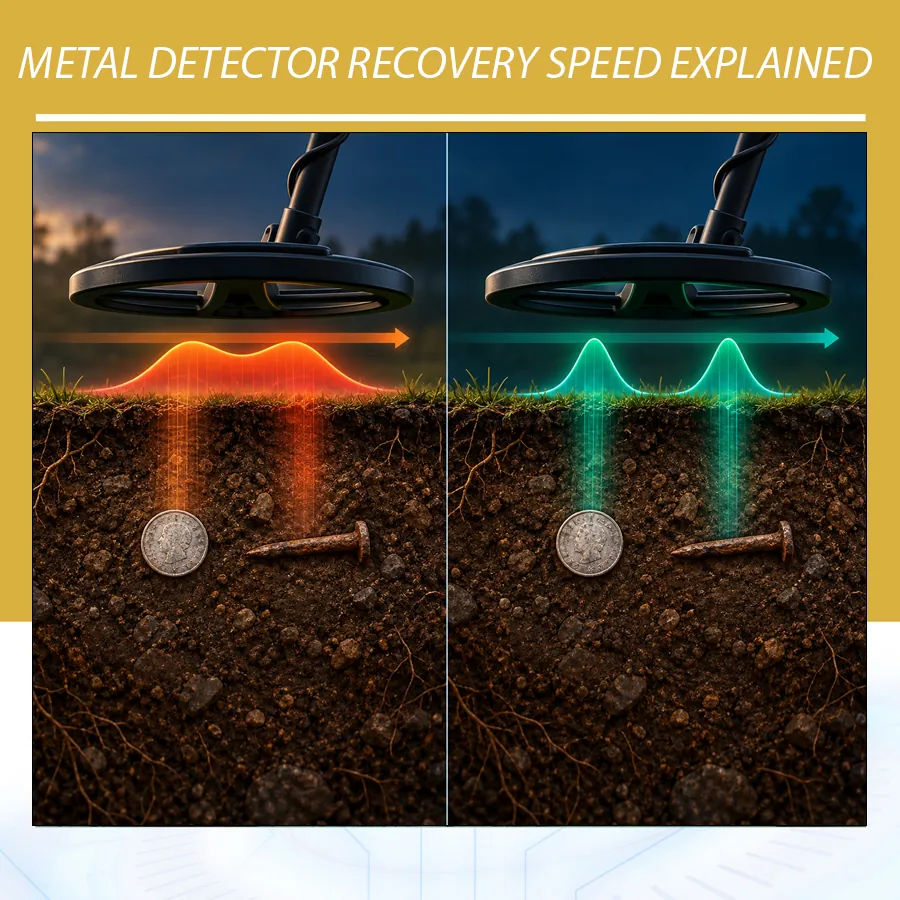
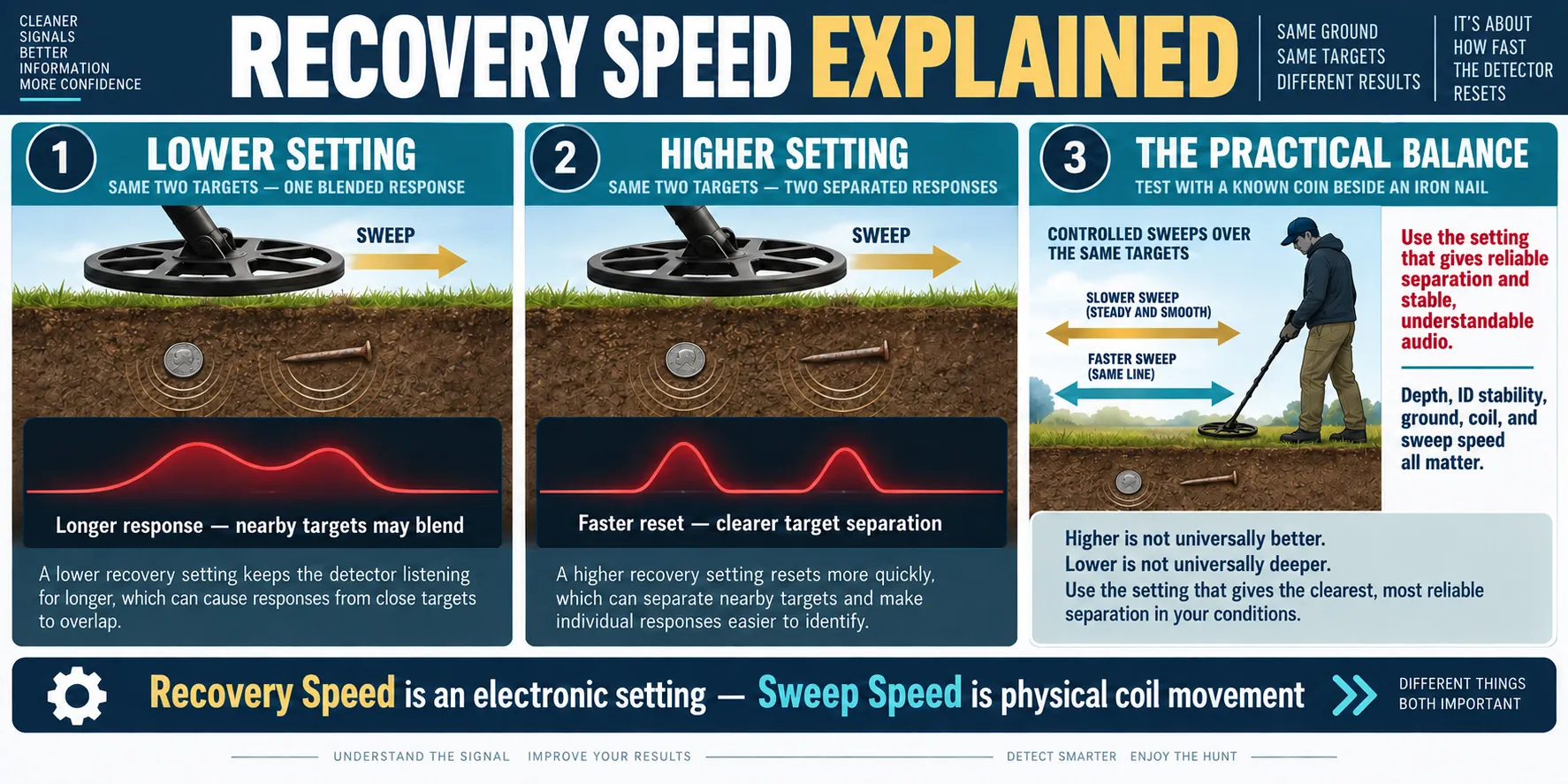
When a search coil passes over metal, the detector processes the received signal and produces audio, Target ID, and sometimes a visual trace. If another object lies close to the first, its signal arrives before the first response has fully finished. Recovery speed determines how rapidly the detector resets or transitions between those consecutive responses.
At a faster setting, the audio response is usually shorter. That can create a clearer break between a nail and a nearby coin. At a slower setting, the response lasts longer and may blend with the next object. The longer response can be useful when the desired target is isolated, but it can also let an unwanted target dominate the audio window.
Manufacturers may use names such as Recovery Speed, Reactivity, or Response Speed. Their scales are not interchangeable. A value of 5 on one detector does not equal 5 on another, and a software update can change available ranges or defaults. Always use the manual written for the exact model and software version.
| Area | Slower recovery | Faster recovery | Practical meaning |
|---|---|---|---|
| Response length | Longer, broader audio | Shorter, more clipped audio | Your ear must learn both styles |
| Adjacent targets | Responses can merge | Targets can sound more separate | Faster often helps in dense trash |
| Isolated-target depth | May preserve more depth in suitable soil | Can reduce maximum depth | The tradeoff must be tested on site |
| Ground noise | More ground response may blend into audio | Can reject or shorten some ground noise | Balance and mineralization matter |
| Target ID | May allow more sampling time | Very fast settings can reduce ID accuracy | Audio and repeatability remain important |
| Sweep tolerance | Usually favors a deliberate sweep | Can tolerate a faster sweep better | It does not make rushed technique ideal |
Recovery speed is not sweep speed
Sweep speed is how quickly you move the coil across the ground. Recovery speed is how quickly the detector processes successive target responses. You control the first with your arm and the second through a detector setting, where available. Confusing them leads to poor comparisons. A user may raise electronic recovery, swing faster, and attribute every change to the menu setting even though two variables changed together.
Keep your movement constant when testing. Use the same sweep width, coil height, path, and approximate pace. Change only the recovery setting. Then repeat the exercise at a deliberately slower physical sweep. This separates the influence of the control from the influence of technique.
A faster recovery setting may allow a faster physical sweep with less chance of merging nearby responses. Minelab says the MANTICORE can generally be swung faster as Recovery Speed rises. Nokta makes a similar point for The Legend. Neither statement means that the fastest arm movement is best. Coil coverage, overlap, target orientation, and the time needed to interpret audio still set practical limits.
For a detailed guide to arm movement and coil control, see Metal Detector Sweep Speed and Coil Height. That guide and this one address connected variables, but they should remain separate in your tests.
Why nearby targets can mask each other
Target masking occurs when the response from one object prevents another from being recognized clearly. Imagine a coin several centimeters from an iron nail. The coil does not view the ground as a camera with sharp object outlines. Its detection field receives overlapping signals whose strength changes during the sweep. The nail may produce a dominant ferrous response, a rejected response, or a blank in the audio while the coin’s useful signal is brief.
Slow recovery can stretch the first response across the point where the second target would otherwise sound. Raising recovery may shorten the first response enough to expose a separate chirp. A smaller coil can also reduce the amount of ground and the number of objects under the detection field at once. Changing sweep direction may alter which target enters the field first. That is why recovery speed is only one part of separation.
Masking is not limited to iron. Aluminum fragments, bottle caps, foil, multiple coins, and even two accepted targets can overlap. Discrimination settings also shape what you hear. If the detector suppresses the first target, the transition around that rejected object can affect the next response. Test with both accepted and rejected objects instead of assuming one nail-and-coin layout represents every site.
The separation-versus-depth tradeoff
The most useful way to understand recovery speed is as a time tradeoff. A slower response gives the detector more time to develop the signal from an isolated object. A faster response reduces that window so the machine can report another object sooner. The faster setting may reveal a desirable target that was hidden beside trash even if its maximum isolated-target depth is lower.
This is why “Which setting goes deepest?” is incomplete. In a clean field with one target and mild soil, a slower value may produce the best fringe response. In an old settlement containing nails every few centimeters, a theoretical deep signal is irrelevant if iron masks it. More finds can come from improved separation even when isolated-air-test depth falls.
Minelab explicitly states that a higher MANTICORE Recovery Speed may improve the ability to find difficult targets while reducing Target ID accuracy and detection depth. Its manual also notes that a lower setting may improve depth in low-mineralization soil. Nokta documents the same broad relationship for The Legend: low values increase depth but reduce the ability to detect close targets, while high values improve close-target separation but decrease depth.
These are manufacturer descriptions of system behavior, not guaranteed depth percentages. The change you experience depends on the target, soil, mode, frequency choice, coil, sensitivity, and audio. Never convert a menu step into an invented number of centimeters.
Recovery speed in iron and modern trash
Dense iron is the classic reason to try a faster value. Begin in a stable search mode with ground balance, noise cancellation, sensitivity, and discrimination configured according to the manual. Sweep a suspicious zone from at least two directions. If a desirable response appears only as one short repeatable edge next to iron, raise recovery one step and repeat the identical path.
Listen for separation rather than a prettier single tone. Can you hear two distinct events? Does the non-ferrous response repeat at the same location? Does it survive a shorter sweep centered over the suspected object? Watch Target ID or a target map as supporting information, but remember that a very fast setting can make identification less stable.
Modern trash creates another challenge: many targets are non-ferrous and accepted. Recovery speed can distinguish their responses, but it cannot decide which one you want. Aluminum foil, pull tabs, coins, and jewelry can occupy overlapping conductive regions. Use location, repeatability, audio shape, Target ID behavior, and careful recovery. Fast processing is not a substitute for digging representative signals and learning the site.
Do not automatically select the maximum. If the response becomes too short for your hearing, or deep targets lose useful clarity, step back. A moderate setting often provides a practical balance. A useful starting choice is the lowest value that provides reliable separation while keeping the detector stable and isolated responses understandable.
How mineralized ground changes the choice
Soil can behave like a broad unwanted signal. Iron minerals, hot rocks, black sand, and salt conditions add responses that the detector must process along with metal. Ground balance and an appropriate search mode are the first tools. Recovery speed can then affect how long ground noise remains in the audio.
The MANTICORE manual says a higher setting at the same swing rate can help reject ground noise, including high noise at the beach or underwater, but it also decreases depth. It says lower recovery in highly mineralized soil may reduce discrimination performance and make difficult targets harder to detect. This is a reason to test a higher value, not a guarantee that every noisy beach needs maximum recovery.
If noise continues with the coil held still, electromagnetic interference is more likely than ground response. Run the model’s noise-cancel or frequency-shift procedure and move away from electrical sources before sacrificing depth through recovery or sensitivity changes. If noise appears mainly while the coil moves over the soil, revisit ground balance, coil height, sensitivity, and recovery.
The Metal Detector Ground Balance Guide explains manual, automatic, and tracking balance. Recovery speed should refine an already sensible setup, not compensate for a detector that has never been balanced to the site.
How coil size and shape interact with recovery
A coil’s detection field affects how many targets contribute to the signal at one time. A smaller coil often gives better spatial separation in crowded ground because it covers less ground on each pass. A larger coil covers more area and may suit larger or deeper isolated targets, but it can place several pieces of trash within the response zone.
Fast recovery cannot completely turn a large coil into a small one. It can shorten consecutive responses, while the smaller coil changes the physical sampling area. In a nail bed, combining a suitable smaller coil with a moderate or fast response can be more effective than using the largest coil and pushing recovery to its maximum.
Coil orientation matters too. Two objects aligned with the sweep may enter the field one after another and sound separate. Turn ninety degrees and they may enter together. Test from multiple directions. Keep the coil level and close to the surface without touching it, because lifting at the end of a sweep changes signal strength and undermines comparison.
Documented example: Minelab MANTICORE
The Minelab MANTICORE provides a clear documented example. Its current instruction manual lists Recovery Speed from 0 to 8. The adjustment is local, meaning a change affects the current Search Mode rather than every mode. Record the mode whenever you record a value.
Minelab explains that increasing Recovery Speed helps distinguish close targets and can expose a smaller good target among larger iron trash. It also warns that higher speed may reduce Target ID accuracy and depth. Lower speed may improve depth in low-mineralization soil and reduce susceptibility to electromagnetic interference, while high-mineralization soil can make slow recovery less effective for discrimination.
The manual gives a general physical swing reference of about two to three seconds for a complete right-to-left-to-right movement. Treat that as manufacturer guidance for the MANTICORE, not a universal metronome for every coil and detector. Your sweep still has to match terrain, overlap, target density, and recovery setting.
A practical MANTICORE exercise is to compare one isolated coin with a coin placed near an iron object. Choose a stable mode, keep Ferrous Limits and other settings unchanged, and test a low, middle, and higher Recovery Speed. The 2D ID Map can help show how target information changes, but judge whether the audio gives two repeatable events. Do not claim that a particular value is “best” without stating the mode, coil, ground, and layout.
Documented example: Nokta The Legend
The Nokta The Legend is another current Orient Detectors example with an official adjustable response control. Nokta’s software version 1.17 manual lists Recovery Speed from 1 to 10, where 1 is slowest and 10 fastest. The setting affects only the selected mode, so Park, Field, Beach, and Goldfield can retain different values.
Nokta states that lower numbers increase depth while reducing the ability to detect targets close together. Higher numbers improve close-target detection and reduce depth. The manual also says faster recovery allows a faster sweep with less chance of missing targets and can help with ground noise on beach sand or underwater.
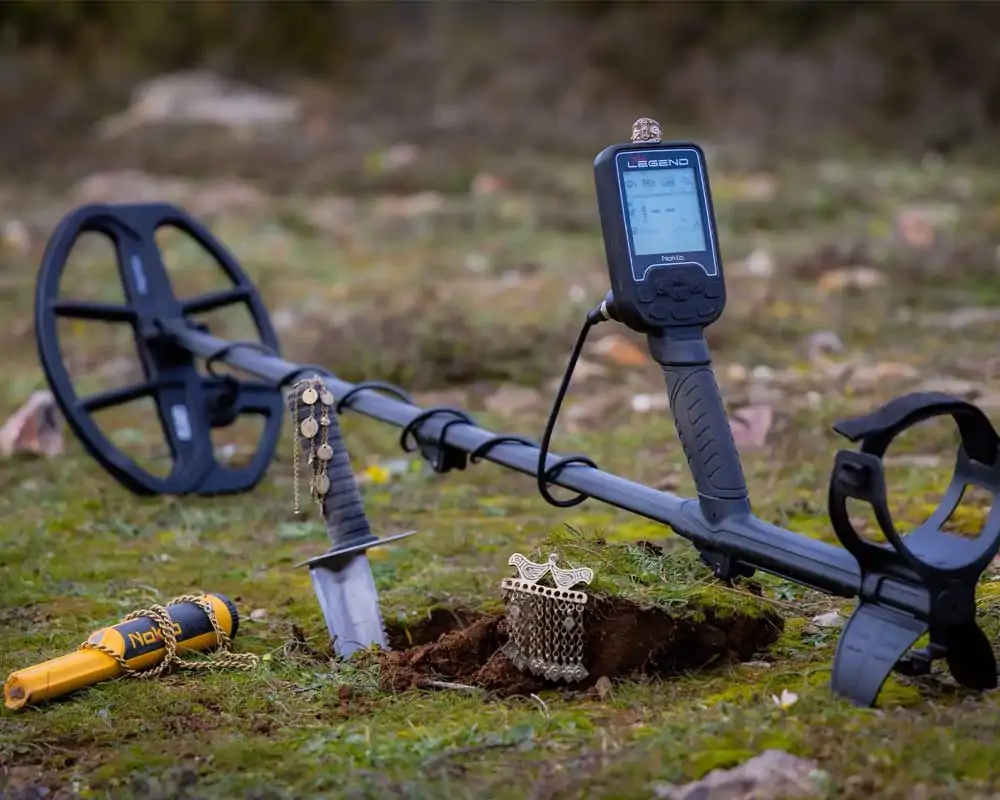
The manual recommends practicing with different metals placed close together before relying on the control. That is sound advice for any detector. Its published defaults are starting points tied to modes and software, not permanent recommendations for every user. Confirm the software version on your own detector before copying a number from any article.
Do not transfer The Legend’s 1–10 scale to the MANTICORE’s 0–8 scale. An apparent midpoint has no cross-brand equivalence. Compare results within one detector, mode, and setup. If considering the newer The Legend 2, consult its own current manual rather than assuming that every control or range is inherited from the original model.
| Detector | Documented range | Setting scope | Manufacturer-described tradeoff |
|---|---|---|---|
| Minelab MANTICORE | 0–8 | Local to current Search Mode | Faster improves adjacent-target separation; can reduce depth and ID accuracy |
| Nokta The Legend, software 1.17 manual | 1–10 | Only current mode | Faster improves close-target detection; slower may increase isolated-target depth |
A controlled recovery-speed test
A useful test garden does not need to be elaborate. Use representative objects that you can handle safely: one coin or other non-ferrous target, one iron nail, and perhaps one common piece of site trash. Check the surface and local rules before placing anything. For an air test, use nonmetallic supports and move the coil rather than waving objects at inconsistent angles.
- Stabilize the detector. Select the intended mode and coil, complete noise cancel and ground balance as directed, and set sensitivity to stable operation.
- Establish an isolated baseline. Sweep the desirable target alone from a fixed height. Note audio length, Target ID behavior, and repeatability.
- Add an adjacent object. Place iron several centimeters away. Record exact spacing, orientation, and whether iron is accepted or rejected.
- Lock your technique. Mark coil path, sweep width, height, and pace. Use the same direction for every comparison.
- Change one step at a time. Start at the mode default, then compare one lower and one higher recovery value.
- Reverse the sweep. Approach the iron first, then the non-ferrous target first. Masking can be directional.
- Cross at ninety degrees. This changes how the objects enter the coil field and reveals orientation effects.
- Repeat in real ground. Air tests teach timing, while soil adds mineralization, moisture, depth, and target orientation.
Write down what changed instead of relying on memory. “High sounded better” is not enough. Record whether there were one or two audible events, whether the desired response repeated, whether ID appeared, and whether the isolated target weakened. The aim is to identify a usable operating window, not make a dramatic demonstration.
| Variable to record | Why it matters | Example format |
|---|---|---|
| Detector, software, mode | Controls differ by model and version | MANTICORE, current firmware, All-Terrain mode |
| Coil | Field size changes separation | Model and dimensions |
| Target layout | Spacing and orientation govern masking | Coin 5 cm from nail, parallel |
| Ground and depth | Air results do not reproduce soil | Mild soil, surface or measured depth |
| Recovery and sweep | Electronic and physical speeds interact | Value 4; one complete pass in 3 seconds |
| Observed result | Makes the comparison useful | Two repeatable tones from two directions |
Choosing a starting point for different sites
Start with the manufacturer’s mode default. Defaults are usually designed as balanced entry points. Scan representative ground before changing anything. If targets are isolated and the detector is stable, there may be no reason to increase recovery. If responses overlap constantly in dense trash, move upward one step and retest.
In a clean field, compare the default with one slower value using a known isolated target. Listen for a clearer weak response without excessive ground blending. In an iron-contaminated site, compare the default with one faster value over a repeatable mixed signal. At a mineralized beach, stabilize the detector first, then assess whether a faster value reduces ground noise enough to justify any loss of depth.
| Site condition | First comparison | What to evaluate | Reason to reverse course |
|---|---|---|---|
| Clean, mild ground | Default versus slightly slower | Weak isolated-target clarity | Ground response grows or separation suffers |
| Dense nails | Default versus slightly faster | Two distinct repeatable events | Useful signal becomes too short or unstable |
| Modern park trash | Default versus moderate-fast | Ability to hear individual accepted targets | Audio becomes too clipped to classify |
| Mineralized ground | Balance first, then default versus faster | Ground noise against target clarity | Depth loss exceeds stability benefit |
| Unknown site | Mode default | Target density and stability during a survey | No change needed until evidence supports it |
Common recovery-speed mistakes
Using the maximum everywhere
The highest value is not an upgrade. It prioritizes rapid separation and may shorten or weaken deep isolated responses. Use it only when testing shows that its separation benefit matters more than the cost.
Copying a number across detectors
Scales are manufacturer-specific. Even models from the same brand can use different ranges, defaults, and processing. Copy the testing method, not the number.
Changing recovery and swing rate together
This hides the cause of the result. Hold technique steady during the first comparison, then run a separate sweep-rate test.
Judging only with one air-test target
An isolated air test cannot demonstrate masking, ground noise, mineralization, or buried-target behavior. Include adjacent targets and repeat the result in representative ground.
Ignoring audio length
Fast recovery can make a real target sound brief. Operators who expect a long rounded tone may dismiss it. Practice with known objects so short repeatable responses become recognizable.
Using recovery to fix every unstable signal
Instability can come from EMI, bad ground balance, excessive sensitivity, loose connectors, coil impacts, or nearby metal. Diagnose the source before changing the response control.
A practical field workflow
Begin with the correct mode and complete the detector’s recommended startup procedures. Survey a small representative area at the default recovery setting. Note whether the limiting problem is merged targets, ground noise, or weak isolated responses. A setting should solve an observed problem.
If trash masks targets, shorten your sweep over one mixed response and raise recovery by a single step. Recheck from both directions without changing sensitivity, discrimination, coil height, or speed. Keep the new setting only if separation improves consistently. If the signal becomes too clipped or Target ID less useful, return one step.
If the site is quiet and targets appear isolated, compare one slower step. Mark a faint repeatable signal before changing the control, then rescan it. Do not dig until both settings have been tested. After recovery, note the actual object and depth; this prevents selective memory from favoring one setting.
Reassess when the ground or target density changes. A field edge full of iron may require a different response from the open center. Because MANTICORE and The Legend store recovery by mode, check the active mode before assuming yesterday’s value is still in use.
Frequently asked questions
Does faster recovery speed find deeper targets?
Usually it prioritizes separation rather than maximum isolated-target depth. A faster value may find a desirable target that was masked beside trash, which can feel like a depth gain. In a clean isolated-target test, manufacturers generally describe a depth cost at higher settings.
What is the best metal detector recovery speed?
There is no universal best value. Start at the mode default, then test slightly faster for close targets or slightly slower for isolated targets in mild ground. Keep the value that produces repeatable, understandable responses at your site.
Is recovery speed the same as sweep speed?
No. Recovery speed is electronic processing between responses. Sweep speed is physical coil movement. They interact, so control one while testing the other.
Should I use maximum recovery in iron?
Not automatically. Maximum recovery may improve separation but reduce depth, ID accuracy, or audible response length. Increase in steps and stop when the nearby targets are sufficiently distinct.
Can a small coil replace fast recovery?
No. A smaller coil reduces the area sampled at once, while faster recovery shortens response timing. They can complement each other, but each changes a different part of the problem.
Why does a target sound shorter after I raise recovery?
The detector is completing each response sooner so it can report the next one. Practice with known targets; a short repeatable response can still be important.
Can recovery speed reduce ground noise?
On some detectors, a faster setting can shorten or reject more ground response. Minelab and Nokta document this possibility for the examples in this guide. Ground balance, mode, sensitivity, and coil control still need attention.
Does high recovery make Target ID less accurate?
It can. Minelab specifically warns that higher MANTICORE Recovery Speed may reduce Target ID accuracy. Confirm a signal through repeatable sweeps, audio, visual information, and recovery rather than relying on one number.
Should beginners adjust recovery speed?
Beginners should first learn the default. Then a simple two-target test makes the control easy to understand. Change one step at a time and keep notes rather than copying an advanced user’s value.
Do recovery settings carry across modes?
That depends on the detector. MANTICORE and The Legend document recovery as local to the current mode. Check your manual because other models can store settings differently.
Conclusion
Metal detector recovery speed is a balance between time and separation. Faster processing can expose close responses in iron, modern trash, or difficult ground. Slower processing can preserve a fuller isolated-target response and may improve depth in suitable quiet soil. Neither extreme is universally superior.
Start with the correct mode default, stabilize the detector, and test one variable at a time. Use representative adjacent targets, repeat the sweep from multiple directions, and keep the coil path consistent. The best setting is the one that makes real targets at your site repeatable and understandable while preserving enough depth and identification quality for the search.