
Best Gold Detector for Beginners: Compare Current Options
The best gold detector for beginners is the one matched to the target, ground, and learning support available. For a newcomer focused on small natural gold, Gold Monster 2000 is a sensible starting point to investigate. For jewelry and mixed recreational detecting, The Legend 2 deserves a different kind of comparison. Gold Stinger X6 belongs on the shortlist when you want its coil-based search functions and are prepared to learn the controls through a relevant demonstration.
Beginners working difficult goldfields may also need to compare specialist PI equipment such as GPX 6000 or MAGNETAR 9000. Those machines address different conditions and ownership requirements; they are not automatic upgrades for every new user. MANTICORE is another option for buyers who want advanced mixed-target information, although its additional controls require learning.
This guide explains those choices with current device examples, practical comparison tables, a demonstration checklist, and a first-month learning plan. Recommendations are based on documented features and task suitability, not a claimed hands-on performance ranking. No detector guarantees gold or identifies every target correctly.
Best Gold Detector for Beginners: Quick Answer by Search Goal
Start with the job you want the detector to do most often. A person searching rocky ground for natural nuggets needs a different shortlist from someone looking for lost gold rings among park rubbish. Both are searching for gold, but target size, site conditions, and useful discrimination differ.
| Beginner’s main goal | First options to investigate | Main decision |
|---|---|---|
| Small natural-gold prospecting | Gold Monster 2000 | Does the compact setup handle your local ground and target form? |
| Configurable coil-based metal searching | Gold Stinger X6 | Can you learn its search functions and compare the supplied coils? |
| Jewelry, coins, and mixed sites | The Legend 2 | Will discrimination and multiple site modes serve most of your detecting? |
| Difficult mineralized nugget ground | GPX 6000, MAGNETAR 9000 | Does the ground justify a specialist platform and its ownership requirements? |
| Mixed detecting with advanced target information | MANTICORE | Will you learn and use the additional display and audio controls? |
If two categories fit, estimate where you will spend most of your actual search time. A secondary capability is useful only when the machine still serves the primary task. Avoid making the decision around a rare hypothetical trip while ignoring the places you can visit regularly.
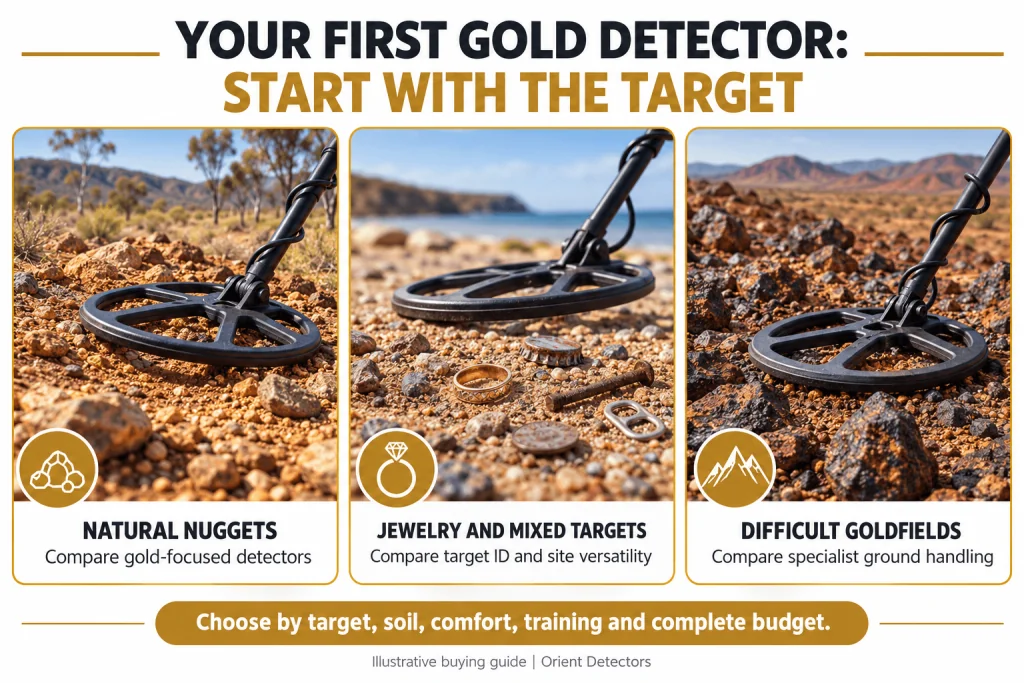
The search goal determines the shortlist. Illustrative categories, not a measured device ranking.
1. Define Your Target Before Choosing a Detector
Natural nuggets are different from gold jewelry
Natural gold occurs in different forms, including fine particles, nuggets, and material associated with rock. Some gold is too small, dispersed, or inaccessible for a handheld detector. A district that produces fine gold by panning does not necessarily contain suitable detector targets.
Jewelry presents a different search problem. A ring in a littered park may require interpreting several nearby responses, while a small nugget in mineralized ground may require careful attention to subtle audio. Do not assume that a large ring demonstration proves fine-nugget sensitivity.
Write a specific goal: “I want to search accessible shallow goldfield ground for small nuggets,” or “I mainly want rings, coins, and other finds on permitted recreational sites.” The supplier can then explain why a configuration matches that goal instead of offering a general promise about gold.
Know which ground you can actually search
Describe the likely surface: rocky, open, iron-rich, salty, wet, obstructed, or heavily littered. Include how long you expect to walk and whether the coil must fit between vegetation or exposed bedrock. Practical access influences the usable configuration.
Also check that you can lawfully search the intended site. Owning a detector does not establish permission to detect, remove targets, or excavate. Verify local requirements and the rights holder’s agreement before treating a destination as part of your buying plan.
If you have not yet identified a plausible site or target form, start with our gold prospecting guide for beginners. Better site knowledge can prevent an expensive purchase that solves the wrong problem.
2. What Makes a Gold Detector Beginner-Friendly?
A clear setup routine
Beginner-friendly does not simply mean few buttons. The important question is whether you can assemble the equipment, select a suitable mode, complete the documented setup, and recognize when something needs adjustment. A simple-looking interface can still require practice on difficult ground.
Ask the seller to teach the startup routine, then repeat it yourself without prompts. Can you explain what ground balance does and how it differs from interference management? Can you return to the agreed starting setup after an experiment? These are more useful ownership checks than counting menu items.
Usable signals and appropriate controls
A beginner needs signals that remain understandable in the intended conditions. Maximum sensitivity is not helpful when noise hides the response you are trying to hear. Automatic functions can reduce routine adjustments, but they do not remove the need to learn the sound of ordinary ground.
Target information can help with decisions, especially on mixed sites, but more information does not automatically make a detector easier. Compare what you can understand from the audio and display rather than choosing the screen with the most graphics.
Comfort and a workable package
Try the complete setup with the intended coil and battery. Adjust the shaft and armrest, then follow a short search path. Front-heavy balance, an uncomfortable grip, or a coil that catches constantly on obstacles can reduce useful practice time.
Consider transport, charging, headphones, and support alongside the detector itself. A comfortable machine with a clear manual and relevant training may be a better first purchase than a more advanced platform that is difficult to carry or service.
3. Compare Current Beginner Gold Detector Options
The table below compares intended roles and learning considerations. It does not assign numerical performance scores because no common controlled field test was conducted for this article. Confirm the exact package, software version, and regional specifications before ordering.
| Detector | Useful buying direction | Learning consideration | Main caution |
|---|---|---|---|
| Gold Monster 2000 | Focused natural-gold searching | Learn goldfield audio and local ground response | Rainproof control pod differs from a submersible detector |
| Gold Stinger X6 | Several coil-based search and analysis functions | Learn functions separately and compare GS30/GS50 use | Displayed indications do not prove identity or target geometry |
| The Legend 2 | Versatile mixed-target detecting | Learn site modes, tones, and discrimination choices | A Gold mode does not make all targets gold |
| GPX 6000 | Dedicated PI prospecting | Learn the supplied coil and model-specific ground routine | Specialist cost and role require justification |
| MAGNETAR 9000 | PI goldfield comparison | Learn Easy/Expert controls and coil handling | Assess assembled weight during realistic use |
| MANTICORE | Advanced mixed-target information | Learn audio choices and conductive/ferrous indications | Additional controls may exceed a new user’s immediate needs |
Use this comparison to reduce the shortlist to two or three configurations. Comparing six machines indefinitely is less useful than trying two suitable setups on representative ground and asking specific questions about the differences.
4. Gold Monster 2000: A Starting Point for Natural-Gold Beginners
Gold Monster 2000 is a first option to investigate for a new user whose main purpose is small natural-gold prospecting. That recommendation concerns its focused role and manageable configuration, not a claim that it will outperform every alternative in your ground.
Minelab specifies Multi-Au simultaneous multi-frequency operation from 12 to 76 kHz, a five-inch DD coil, and a weight of approximately 1.25 kg including the battery. These documented features make it relevant to a compact gold-focused shortlist.
Why a beginner might choose it
A focused machine can simplify the buying brief. Instead of trying to cover every kind of detecting, you can concentrate practice on the targets and terrain that matter most. A compact coil can also be practical where access around rocks is central to the task.
Request a demonstration using relevant small targets, representative soil, and a controlled sweep. Ask to hear ordinary ground and unwanted responses as well. The best gold detector for beginners must be usable when the demonstration target is absent, not just convincing when it is present.
What to verify before buying
The control pod is IP55 rainproof, while the coil is waterproof to one meter. It is therefore important to distinguish wet-ground use from full submersion. Confirm the charging arrangements, included accessories, and the exact setup procedure with the supplied manual.
Do not treat a probability indication or target number as chemical identification. Plan to investigate plausible responses and learn what they prove to be. A compact specialist detector can still recover unwanted metal and respond to difficult ground.
5. Gold Stinger X6: Compare Its Functions and Dual-Coil Setup
Gold Stinger X6 is a relevant option for beginners who want a configurable coil-based detector and are willing to learn its functions with support. It should be considered through a demonstration of the intended task rather than chosen solely because the package lists several systems.
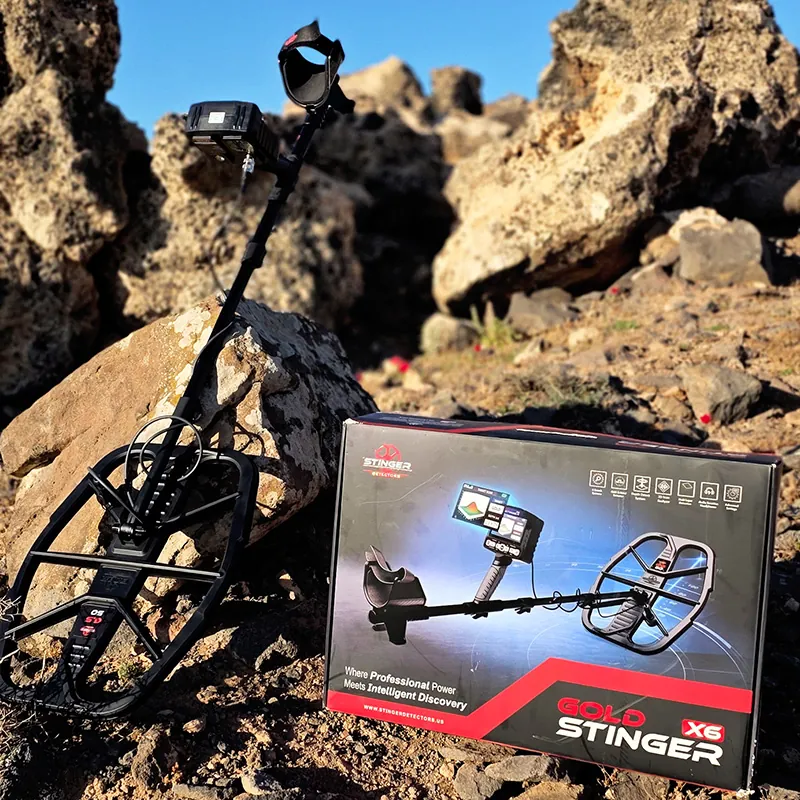
The manufacturer’s Gold Stinger X6 information and Orient listing describe GS30 and GS50 coils, target-discrimination controls, localization, depth estimation, and visual analysis functions. These provide several ways to examine a response, but they do not establish a universal advantage over dedicated nugget machines.
Why it belongs on the shortlist
For a learner who wants to understand different search functions, the X6 provides a reason to compare how each changes the workflow. Ask to start with the basic search routine before adding analysis controls. Confidence should come from being able to repeat the procedure yourself.
The two coils also make package selection a practical topic. The manufacturer positions GS30 around smaller-target work and access, and GS50 around wider coverage and larger targets. Those intended roles should be checked on the actual surfaces and targets you expect to search.
| Topic | Ask the trainer to show |
|---|---|
| Initial setup | Assembly, reference-ground selection, and the model’s balancing routine |
| Coil choice | The same practical access task with GS30 and GS50 |
| Basic response | Known desirable targets, unwanted metal, and target-free positions |
| Analysis functions | What each display represents and which interpretation limits remain |
| Independent operation | Your own repeat of the search and recovery routine |
What a beginner should not assume
A depth estimate is not a measured excavation depth. A visual scan is not a photograph of the buried object, and a discrimination label does not guarantee gold. Additional cavity-related functions should not become proof of a void or a reason to excavate without appropriate assessment.
Do not transfer a claimed maximum depth to small nuggets, and do not assume that “multi-system” means long-range locating, PI, or 3D scanning unless the exact function is documented. Confirm water limits, package contents, and compatibility directly rather than inferring them from another model.
Choose the X6 when its demonstrated workflow fits your needs and the learning support is convincing. Explore the Stinger Detectors range for the brand context, while making the purchase decision about the actual model and package.
6. The Legend 2: A Different Choice for Jewelry and Mixed Detecting
The Legend 2 is a strong option to investigate when most of your detecting will involve coins, jewelry, relics, and varied recreational sites. It addresses a broader mixed-target brief than a machine selected only for natural nuggets.
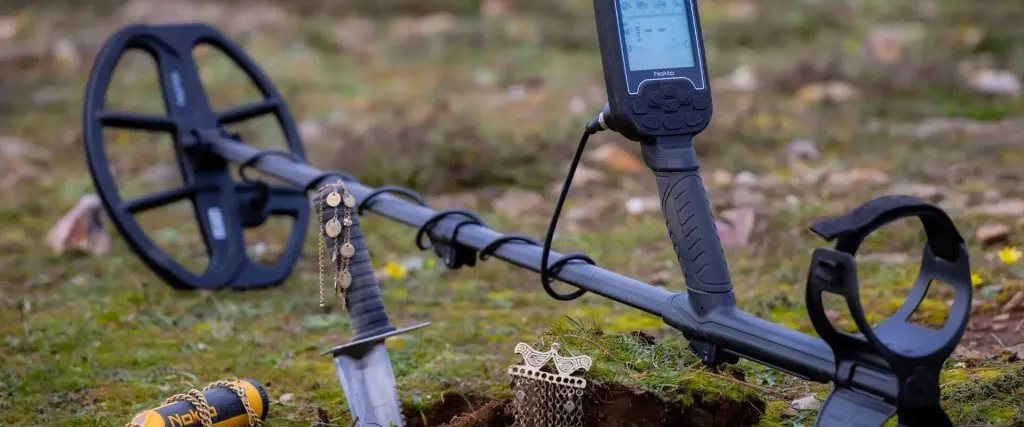
Nokta documents simultaneous multi-frequency operation, 99 target IDs, and Park, Field, Beach, Relic, and Gold modes. The listed weight is approximately 1.2 kg, and the detector is rated for submersion to five meters under the manufacturer’s requirements.
Why a beginner might prefer this direction
If you can visit parks, fields, and beaches more often than goldfields, a versatile platform may provide more relevant practice. Learning how different objects respond among common rubbish is part of that task, and site modes can provide useful starting configurations.
Its Gold mode does not mean that the detector responds exclusively to gold. Likewise, discrimination settings can reject desirable objects when their responses overlap rejected categories. Learn the behavior of representative jewelry and trash before deciding what to ignore.
Compare the package, not just the control unit
Confirm which coils, headphones, and charging accessories are included. Check that the offered package is actually The Legend 2 and that any accessories are compatible with that model. Similar product names should not substitute for an itemized quotation.
Compare it with a dedicated gold-focused option if nugget hunting will be a major part of your use. The useful question is how each suits your regular sites, not whether one machine can be described as capable of finding gold in some circumstances.
7. When Should Beginners Consider Specialist or Advanced Detectors?
GPX 6000: when nugget ground justifies a PI comparison
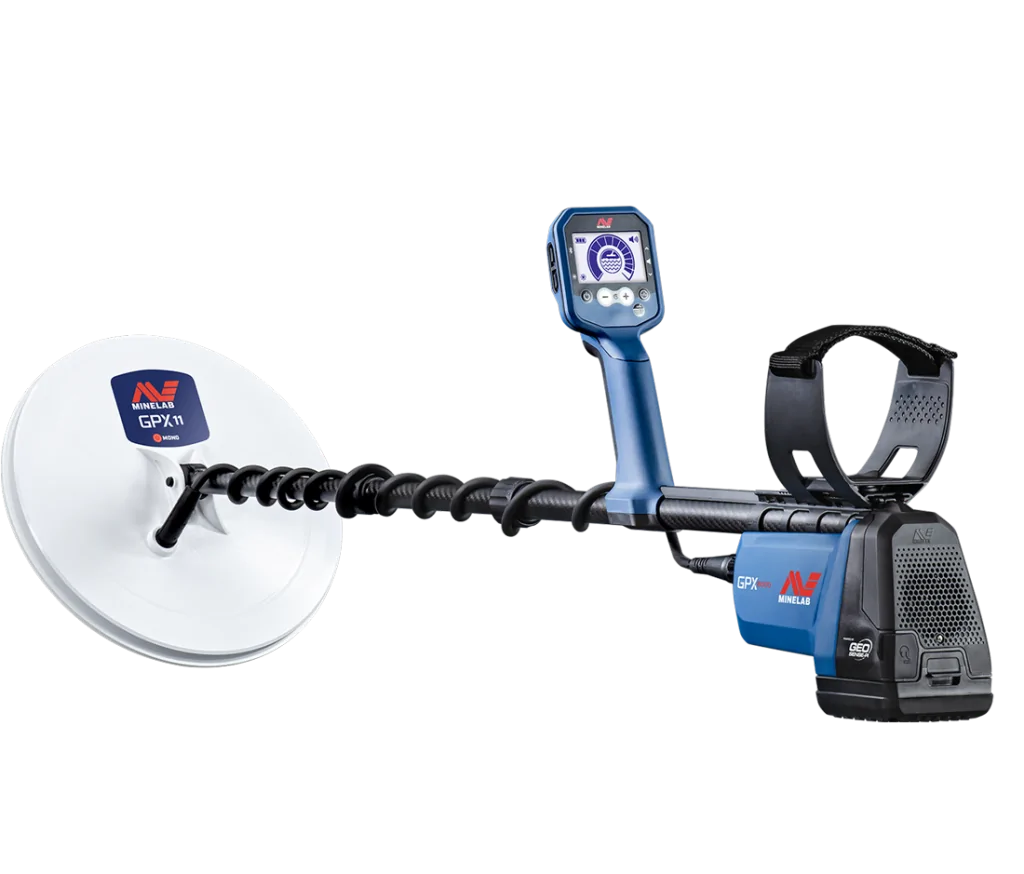
GPX 6000 is relevant when natural-gold prospecting is the main job and difficult ground justifies comparing a specialist PI platform. Minelab documents GeoSense-PI technology, automatic ground balance, noise cancellation, and an approximately 2.1 kg configuration.
A beginner can learn specialist equipment, but automatic functions do not replace instruction. Ask the trainer to show ordinary ground, uncertain responses, and the procedure for changed conditions. Check the supplied regional coil package and confirm whether its cost leaves room for training and field preparation.
MAGNETAR 9000: compare ground capability and carrying demands
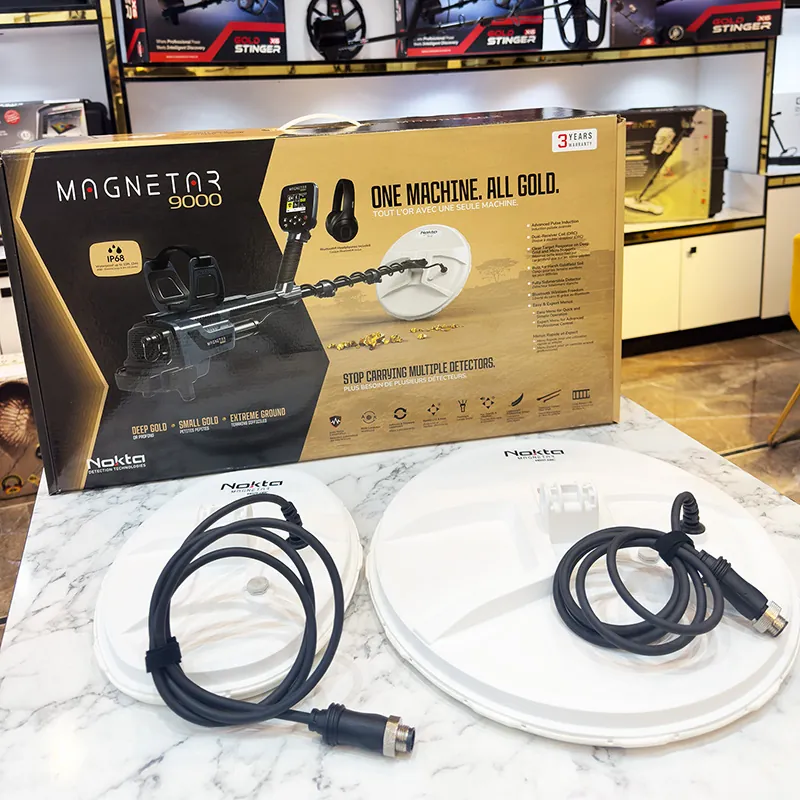
MAGNETAR 9000 offers another specialist comparison. Nokta identifies advanced PI, dual-receiver coils, and Easy and Expert menus. The official weights are 2.4 kg with the smaller coil and 2.8 kg with the larger coil, including the battery.
Try the assembled configuration rather than judging comfort from a photograph. An Easy menu can make controls more approachable, but the coil weight and target interpretation remain real ownership considerations. Investigate this direction when you have a credible reason to prioritize goldfield ground handling.
MANTICORE: more information for mixed-target learners
MANTICORE is relevant to buyers who want advanced recreational detecting functions and are prepared to learn them. Minelab lists Multi-IQ+, conductive and ferrous target information, approximately 1.3 kg weight, and IP68 waterproofing to five meters.
That information can support decisions, but it is not a material certificate or a reason every beginner needs the platform. Compare what you can interpret after instruction. A simpler suitable setup may serve you better if its additional controls would go unused.
8. Understand Technology, Mineralization, and Realistic Depth
VLF, simultaneous multi-frequency, and PI
VLF and simultaneous multi-frequency detectors include both specialist and general-purpose models. Some use a single operating frequency at a time; others use multiple frequencies simultaneously. A frequency list alone does not tell you which behavior the machine supports.
Dedicated PI prospecting machines offer another approach, particularly relevant when ground conditions dominate the buying problem. The shared label does not make their coils, settings, identification functions, or learning routines interchangeable. Evaluate the exact configuration rather than assuming every PI behaves alike.
The best gold detector for beginners is therefore not decided by a technology slogan. Ask what that technology changes at your likely site and whether you can recognize a useful response with the recommended settings.
Ground response is part of the decision
Mineralized soil, hot rocks, conductive salt, nearby metal, and electrical interference can complicate a signal. One symptom does not establish one cause. A useful demonstration includes ordinary ground so that you can hear the baseline before a target is introduced.
A higher-frequency setting does not alone establish greater depth, and a larger coil is not universally better. Target size, geometry, ground, coil design, and operating settings interact. Connect each specification to the task rather than ranking machines by one number.
Reject universal depth promises
Ask which target, orientation, coil, ground, and test method support any claimed depth. A large object detected deeply does not establish performance on a small nugget. An indoor air test is useful for learning responses but does not recreate burial conditions.
Also separate detection from identification. Hearing a marginal response and reliably deciding what caused it are different achievements. Do not choose a first detector on an average-depth claim, a percentage comparison without context, or a target image that appears more certain than the underlying measurement.
9. Budget for the Complete Beginner Setup
Set the total working budget before choosing the detector. Include the equipment required for your actual sites, enough support to learn it, and a practical way to power and transport it. The least expensive control unit may not be the least expensive usable package.
| Cost area | What to confirm | Common oversight |
|---|---|---|
| Detector and coils | Exact model, included coils, covers, shafts, and fittings | Assuming photographs show everything included |
| Power | Charging equipment and supported spare-power arrangements | Discovering charging problems on the first trip |
| Audio and recovery | Suitable headphones and appropriate recovery tools | Buying incompatible accessories |
| Training | Instruction for your model, target, and local conditions | Using the whole budget before learning support |
| Service | Warranty process, repair route, and replacement parts | Confusing a warranty period with convenient local support |
| Field use | Transport, access arrangements, and essential outdoor kit | Ignoring costs beyond the purchase |
Compare itemized quotes in the same currency and check their dates and terms. Prices and stock can change, so this guide does not use a fixed price table to decide the winner. Ask which additions are essential now and which can wait until you identify a genuine limitation.
Decide what support must be included
Ask what happens after the demonstration. Is there a named support contact? Can you obtain the correct manual, replacement fittings, and compatible accessories? Will the trainer help you distinguish an unfamiliar response from an assembly or operating problem? These questions turn a general promise of support into an arrangement you can evaluate before paying.
For example, request a short written handover covering the supplied configuration, starting routine, charging method, water limitations, and where to seek help. It should identify the exact model rather than provide generic detecting advice. Keep that information with the quotation and warranty documents so that package details remain clear after delivery.
Compare current models without dismissing every older option
An updated recommendation should replace inaccurate claims and evaluate relevant equipment, not imply that every older detector has stopped working. An established model can still suit a defined task when its condition, compatibility, and support are satisfactory. The important comparison is the complete usable setup and the problem it solves for you.
If considering an older or previously owned unit, ask to inspect the assembly, power arrangements, coil behavior, and documented service position. Do not assume that a similar-looking accessory or a new model’s software applies. A lower purchase price may be worthwhile, but unresolved condition and support questions make it difficult to compare fairly with a current package.
For broader recreational use, browse the metal detectors category alongside the nugget-focused shortlist. Compare the listed purpose with your regular sites, then request current package details. A relevant shortlist reduces unnecessary spending more effectively than choosing solely by age or discount.
Explore the Minelab gold detectors and Nokta metal detectors ranges for package context. The broader gold detector buying guide explains ownership comparisons beyond this beginner shortlist.
10. Test the Shortlist Before Paying
A demonstration should answer whether you can use the configuration, not simply show an experienced operator finding a known target. Agree on the intended job and ask for enough time to repeat the routine yourself.
- Inspect the full setup. Adjust the shaft, fit the intended coil, and confirm the package.
- Learn the baseline. Listen to suitable reference ground before comparing targets.
- Use relevant examples. Include target sizes and unwanted metal typical of your search.
- Keep the test controlled. Record the mode and settings and change one factor at a time.
- Include empty locations. A concealed-target comparison with blanks is more informative than one rehearsed pass.
- Repeat uncertain responses. Check from another direction without treating repeatability as proof of gold.
- Operate it yourself. Explain the response and follow the recovery routine with guidance.
- Confirm the follow-up. Know whom to contact when your own ground behaves differently.
Ask the demonstrator to explain a failure or ambiguous result. Clear limits and a repeatable procedure are more useful than calling every response a valuable target. If two setups both meet your needs, comfort, training, and ownership cost can become the deciding factors.
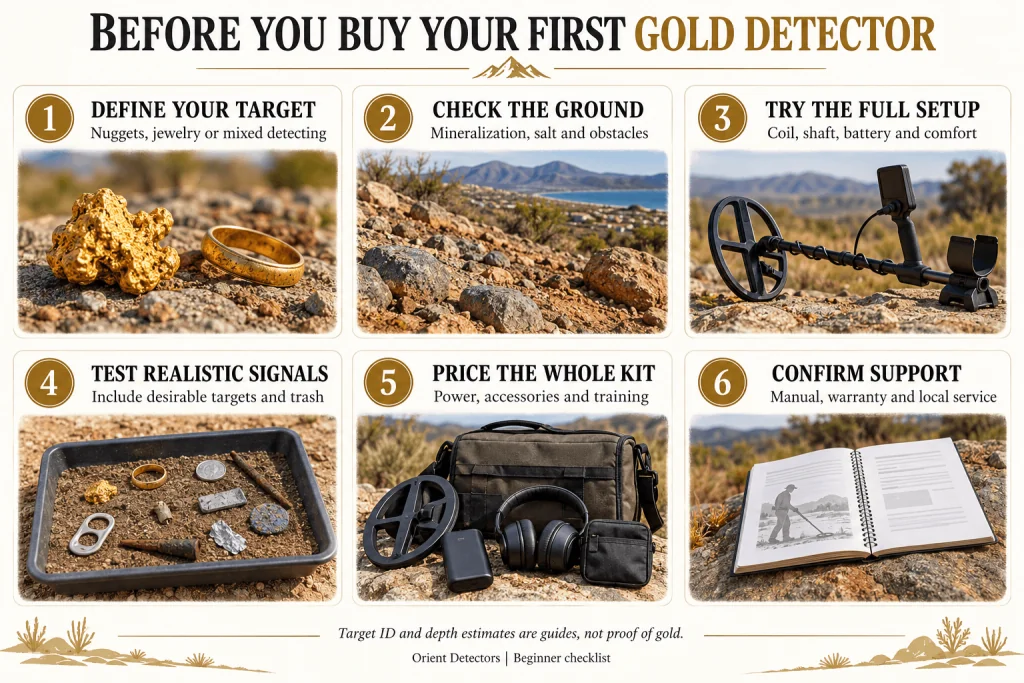
Choose a complete setup you can understand and use. Target information remains an indication requiring assessment.
11. A First-Month Learning Plan for Your New Detector
First stage: assembly and repeatable setup
Read the supplied manual and practice the documented starting procedure. Learn the battery, connectors, coil fitting, audio, and safe carrying arrangement. Identify how to return to an agreed baseline without repeatedly changing unrelated settings.
Use clearly labeled practice objects and a secured sample where appropriate. Keep them separate from genuine finds, and confirm they are retrieved after a check. Your aim is to connect a known setup with an understandable response.
Second stage: controlled movement and target checks
Practice maintaining coil height, level passes, and suitable forward steps. Search a small defined area and note any gaps. Learning a machine includes learning the path you move it through, not only the options on its screen.
Record how different objects respond without turning those examples into universal identification rules. The same object can behave differently with orientation, depth, and surroundings. Use practice to improve recognition while remaining willing to investigate uncertain signals.
Third stage: a suitable field session and review
Choose an authorized location relevant to your target and complete a manageable block. Record ground conditions, configuration, time, uncertain responses, and actual recoveries. A day without gold can still reveal whether you maintained usable operation and controlled coverage.
Before buying an extra coil or upgrading, identify the limitation in those records. Was the problem access, fatigue, unfamiliar controls, uncertain ground, or an unsuitable target assumption? Equipment changes are most useful when they address an observed problem.
12. Common Beginner Buying Mistakes
- Choosing one universal winner. Match the recommendation to your target and ground.
- Assuming all gold is detectable. Fine or dispersed gold can require other methods.
- Buying for maximum advertised depth. Request target-specific conditions and a relevant test.
- Confusing water-resistant and submersible. Check the whole setup and required accessories.
- Choosing by the number of systems. Understand what each function measures and whether you need it.
- Spending the whole budget on hardware. Leave room for learning and actual field use.
- Rejecting every trash-like response. Desirable targets can overlap unwanted categories.
- Upgrading before learning. Use recorded limitations to justify the next purchase.
If you are ready to compare packages, contact Orient Detectors with your main target, likely ground, water-use needs, experience, and complete budget. Ask for two or three suitable configurations and a demonstration plan rather than the detector with the largest advertised number.
Best Gold Detector for Beginners: Frequently Asked Questions
What is the best gold detector for beginners searching for nuggets?
Gold Monster 2000 is a sensible first option to investigate for focused small-natural-gold use. The decision still depends on local ground, access, budget, and instruction. Difficult goldfields may justify comparing specialist equipment before buying.
Is Gold Stinger X6 suitable for beginners?
It can be considered by beginners prepared to learn its coil-based functions with relevant support. Ask for a demonstration of setup, GS30 and GS50 use, target checking, and interpretation limits. Choose it for a demonstrated fit rather than the number of listed systems.
Should I choose a nugget detector or a general-purpose detector?
Choose for your main search. Natural-gold prospecting and finding rings among recreational-site rubbish require different priorities. If mixed detecting will occupy most of your time, compare versatile options such as The Legend 2 before committing to a specialist.
Can a detector identify only gold?
No ordinary target number, discrimination label, probability indication, or audio tone proves gold. Other objects can produce similar responses. Use the information to guide investigation and confirm identity after recovery when appropriate.
Do beginners need pulse induction?
Not automatically. PI deserves comparison when the intended goldfield conditions make specialist ground handling important. The operator’s experience alone does not decide the technology; target, ground, budget, and support matter together.
Does a larger coil always find deeper gold?
No. Larger coils can help coverage and certain targets, but terrain access, ground behavior, small-target response, and separation also matter. Compare compatible coils for the specific job rather than treating size as a universal advantage.
Can I use my gold detector underwater?
Only within its documented limits and with the required accessories. A waterproof coil does not make a control pod submersible. Confirm the exact model, connectors, headphones, and manufacturer requirements before water use.
How much should I spend on my first gold detector?
Set a complete working budget and choose the least complex suitable configuration within it. Include accessories, power, training, service, and field costs. Request current itemized quotes instead of relying on an old price comparison.
Should I buy the newest detector available?
Newer features matter when they solve a relevant problem. They do not guarantee an easier learning experience or more gold. Compare suitability, support, condition, package, and ownership cost rather than model age alone.
Will a more expensive detector guarantee better results?
No. A more specialized machine may address particular conditions, but site selection, access, technique, and recoverable targets still matter. Buy an identifiable capability you need and can learn, rather than expecting price to replace practice.