
Gold Prospecting Guide: How to Prospect for Gold
Gold prospecting starts with research, lawful access, and a method suited to the form of gold you expect to find. Identify a credible gold-bearing area, understand whether the likely targets are fine particles, detectable nuggets, or mineralized rock, and test a manageable location. Record the results before deciding whether to expand the search.
This gold prospecting guide explains the complete process for beginners: finding useful information, reading the landscape, choosing between panning and metal detecting, preparing equipment, investigating signals, collecting meaningful samples, and planning the next visit. It also covers current detector examples and the limitations that matter before spending money.
The purpose is to help you make informed field decisions. Neither an attractive rock nor an expensive detector guarantees gold. A few recovered particles also do not establish an economic deposit. Treat each observation as evidence to evaluate, and keep the difference between discovery, identification, and commercial viability clear.
1. What Is Gold Prospecting?
Gold prospecting is the search for evidence of natural gold and an assessment of where further investigation may be worthwhile. Activities range from researching a district and testing small sediment samples to detecting individual nuggets or examining mineralized rock. The appropriate method depends on the deposit and the question being asked.
It differs from mining, which involves extracting material under an appropriate operating and regulatory framework. Finding a target does not automatically grant extraction rights, establish a resource, or justify larger disturbance. A beginner should first learn to collect reliable observations at a manageable scale.
Placer gold and lode gold
Lode gold occurs within its host rock. Placer gold has been released and concentrated in loose sediments through weathering, transport, and related processes. The USGS overview of gold deposits explains this distinction and how gold can accumulate within sedimentary environments.
This matters because a pan, a metal detector, and a rock sample answer different questions. A pan helps concentrate heavy particles from loose material. A detector responds to targets within its capabilities. A properly selected rock sample may require laboratory analysis to establish gold content. None replaces every other method.
Gold is not one uniform target
Natural gold may occur as fine particles, flakes, nuggets, or material associated with rock. Some particles are too small or dispersed for a handheld detector. A specimen may contain visible gold yet differ substantially from a solid nugget in its detector response. Avoid treating the word “gold” as a single target size or signal.
Before selecting equipment, finish this sentence: “I want to test this type of material for this form of gold.” That simple statement prevents a common mistake: buying a machine first and discovering later that it does not answer your actual prospecting question.
2. Gold Prospecting for Beginners: Where to Start
A useful beginner plan limits uncertainty. Choose an accessible area with credible records, a small objective, and equipment you can learn. Your first successful session may be one in which you understand the material, use the method correctly, and leave with clear notes, even if you recover no gold.
| Your situation | Sensible first step | What to learn |
|---|---|---|
| Interested but unsure where gold occurs | Research local geological and historical records | Whether a credible and accessible opportunity exists |
| Access to known placer ground with suitable water | Learn controlled panning with small samples | Material handling and recognizing heavy concentrates |
| Known nugget ground and suitable detector access | Learn detector setup and controlled coverage | Ground response, plausible signals, and target recovery |
| Interesting mineralized rock | Document its setting and seek sampling guidance | How to obtain meaningful identification or analysis |
| No confirmed permission | Resolve land status before fieldwork | Which activities are actually authorized |
Consider an introductory session with a reputable local club, trainer, or permitted operator. Ask whether instruction covers the local ground, access requirements, recovery technique, and realistic outcomes. A good lesson should improve your method rather than depend on a promised discovery.
Practice separately from prospecting when possible. Learning to handle a pan or recognize a secured test target in a controlled setting reduces the number of unfamiliar tasks on your first visit. Keep practice material clearly identified so it cannot be confused with a genuine field find.
3. How to Prospect for Gold: Research Before You Travel
Move from a district to a specific question
Start with geological surveys, mining histories, maps, and documented gold occurrences. Identify the relevant district, then narrow your research to accessible locations and material types. A broad reputation is useful for orientation, but it does not identify a legal parking place, a searchable surface, or the form of gold present.
Check what a historical record actually describes. A mine that extracted gold-bearing rock from depth is different from shallow coarse-gold ground. Records of fine gold do not necessarily justify a detector purchase. Note the date, original source, location precision, and any uncertainty before turning a report into a travel plan.
The USGS introduction to prospecting emphasizes research, geological understanding, and access. It is a historical educational source, not a current permit directory or a current price guide. Use up-to-date local information for changing requirements.
Build a simple site brief
For each candidate location, record the evidence for gold, expected target form, ground cover, proposed method, access status, and a fallback plan. Choose a first test small enough to complete. “Compare two accessible gravel samples” is a clearer objective than “find gold somewhere in this valley.”
Satellite imagery can help you understand routes and surface disturbance, but it does not establish ownership, current access, gold content, or ground safety. Cross-check it with authoritative mapping and local conditions. Download necessary navigation information before travelling where connectivity may be unreliable.
Interpret old workings cautiously
Old pits, spoil, processing areas, and disturbed gravel may reveal where people worked. They can also contain hazardous openings, unstable material, and large amounts of metal rubbish. Do not enter abandoned workings or assume that a historical mining site remains open to recreational prospecting.
Previously worked ground may contain missed material, but it is not automatically productive. Ask what the original method recovered and what accessible material remains. A return visit should test a specific possibility rather than rely on the idea that old miners always left worthwhile gold behind.
4. Read Geology and Natural Gold Indicators
Learn the local geological pattern rather than memorizing a universal list of “gold rocks.” Quartz, iron staining, dark sands, and color boundaries can occur without gold. Their usefulness depends on the district, deposit type, and supporting evidence.
| Clue | Useful question | Limit |
|---|---|---|
| Quartz veins or fragments | Do verified local occurrences involve this host rock and structure? | Much quartz is barren |
| Iron staining | Does local mapping associate this weathering with mineralized material? | Color does not identify gold |
| Bedrock cracks and shallow gravel | Could accessible material contain concentrated particles? | A potential trap is not a confirmed deposit |
| Heavy-mineral or black-sand concentration | Does it match a documented placer setting? | Gold may be absent or too fine to detect |
| A rock-unit boundary | Is the contact relevant to the local mineralized system? | Not every contact is gold-bearing |
A contact is a boundary between rock units; it is not automatically a dyke or intrusion. Similarly, loose fragments may have moved away from their original source. Photograph exposures and compare them with maps before drawing conclusions from isolated pieces.
Keep alternative explanations in your notebook. A color change might represent weathering, imported fill, or transported material. A rough nugget does not specify a source distance, and a smooth piece does not prove a long transport route. Use observations to propose a test, not to declare a discovery.
For a deeper discussion of these clues and how to compare field conditions, read our gold detecting tips. This pillar guide brings the overall process together; the supporting article develops the geological and operational comparisons.
5. Check Permissions and Plan Responsible Fieldwork
Identify the landowner or manager, relevant mineral rights or claims, and the authority responsible for the intended activity. Permission to enter land may differ from permission to detect, sample, dig, remove material, or use powered equipment. Resolve those distinctions before the trip.
Requirements differ by country, region, land designation, and method. Check current official information and obtain any necessary agreement from the rights holder. A map marking public land or a historical mine does not by itself establish permission to prospect there.
Keep the activity within its authorized scope. Do not enlarge a sample hole, disturb stream banks, move substantial material, or introduce machinery simply because a small initial test seemed promising. Larger work can require a different assessment and authorization.
Plan navigation, weather protection, water, communication, and a return arrangement. Stay away from shafts, unstable banks, and hazardous material. Restore permitted disturbances as required, remove rubbish, and keep sensitive location information consistent with any agreement you made.
6. Choose a Prospecting Method That Matches the Gold
The central decision in this gold prospecting guide is choosing a method that can answer your question. Detecting is one option, not the definition of prospecting. Panning, controlled sampling, and geological observation can remain useful even when a detector is available.
| Method | Main purpose | Practical limitation | Beginner priority |
|---|---|---|---|
| Panning | Concentrate heavy particles from loose sediment | Technique and sampling location affect what is recovered | Learn consistent material handling |
| Metal detecting | Locate detectable metal targets, including suitable nuggets | Target size, depth, ground, and configuration affect response | Learn ground handling and controlled coverage |
| Rock sampling | Investigate composition of selected rock material | A visually attractive specimen may not represent the wider material | Document context and obtain qualified sampling advice |
| Sluicing or other processing | Process suitable loose material using an appropriate recovery system | Setup, losses, water, environmental conditions, and permissions matter | Do not scale up before understanding the sample results and rules |
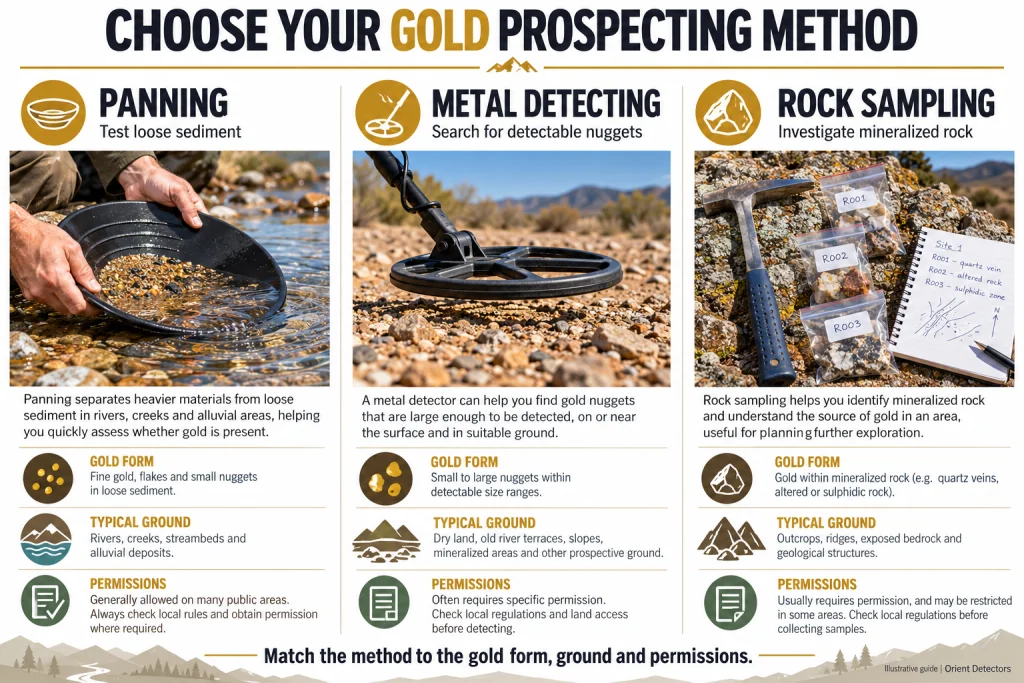
Methods can complement one another. Sediment observations may help define a question for further investigation, while a detector can test accessible ground for suitable individual targets. However, finding fine gold in a pan does not prove that detectable nuggets occur nearby.
Avoid purchasing equipment to solve a problem you have not defined. If the material contains very fine gold, a specialist nugget detector may still miss it. If your interest is rock grade, a detector response is not a substitute for appropriate analysis.
7. How to Pan for Gold as a Beginner
Practice the movement before judging a location
Panning separates material through differences in physical behavior, including density. The aim is to keep the heavier concentrate while gradually removing lighter material. A rushed first attempt can lose particles and produce an unreliable impression of the sample.
The US Forest Service recreational panning guide describes basic preparation, agitation, and gentle washing. Follow appropriate local access and water-use rules; the document’s location-specific rules should not be applied elsewhere.
- Choose a safe working position. Use suitable calm conditions and an amount of material you can control.
- Prepare the sample. Break up clay gently in water and inspect larger material before separating it.
- Agitate while the pan is submerged. Allow heavier material to settle through the loose contents.
- Wash gradually. Use controlled movement to remove lighter material while retaining concentrate.
- Slow down near the finish. Examine the remaining heavy material carefully rather than dumping it.
- Label the result. Connect any concentrate or recovered particles with the original sample location.
Make comparisons consistent
Use comparable sample amounts when comparing locations, and record where each sample came from. A large sample from one place and a small handful from another cannot support a simple recovery comparison. Changes in technique also make results harder to interpret.
Retain material for review when learning so that a more experienced person can assess your technique. A practice concentrate can help, provided it is clearly labeled and kept separate from field samples. Do not introduce purchased practice gold into natural ground.
Black sands are a concentrate, not a gold certificate. If you cannot confidently identify a particle, photograph and retain it rather than reporting it as confirmed gold. Seek appropriate identification help before using an uncertain recovery to justify a larger search.
8. How to Prospect for Gold with a Metal Detector
Establish usable ground handling
Begin with the correct assembly, compatible coil, and the manufacturer’s startup procedure. Check cable routing and external fittings. Keep recovery tools away from the coil during setup, and choose reference ground without an obvious localized target response.
Ground balance reduces the detector’s response to local ground. Noise cancellation addresses certain interference effects. Neither procedure identifies gold. Follow the exact model’s instructions, and reassess when the surface material or background response changes.
Use sensitivity that allows you to recognize plausible responses. More noise does not necessarily mean more useful information. Make controlled adjustments and compare them over the same reference ground instead of changing several settings while moving to a new site.
Control the coil path
Keep the coil at a controlled working height and avoid lifting it sharply at the ends of the arc. Match your forward steps to the sweep so that adjacent passes overlap. Obstacles can leave gaps even when a search looks thorough.
Choose a coil that can follow the terrain. A smaller coil may help with access or response isolation; a larger coil may help coverage and certain larger targets. Compatibility, ground behavior, and your control matter more than diameter alone.
Investigate plausible responses
Mark an uncertain response and repeat short controlled passes from another direction where practical. A target number, high tone, low tone, or gold-probability indication does not establish material identity. Use the response to decide what requires investigation.
Where recovery is permitted, separate removed material from the original location and check each independently. Isolate small responses using suitable nonmetallic tools, avoid blind contact with sharp material, and rescan the recovery area before restoring it.
For the detailed operating sequence, see our natural gold prospecting with a metal detector guide. It develops sweep technique, ground balance, patches, and find recording without turning this overview into a machine manual.
9. Current Gold Detector Examples and How to Compare Them
Start with the gold nugget detectors category, then compare a small shortlist suited to your target and ground. The following current examples have documented manufacturer information. They are not ranked by measured field performance, and listing presence does not confirm stock.
| Device | Documented direction | What to check before buying |
|---|---|---|
| Gold Monster 2000 | Gold-focused Multi-Au simultaneous multi-frequency platform | Small-target workflow, supplied coil, and control-pod water limits |
| GPX 6000 | Dedicated GeoSense-PI prospecting platform | Ground handling and the actual regional coil package |
| Garrett Axiom | PI prospecting with Ultra-Pulse and TERRA-SCAN features | Coil choice, settings, and weather-resistance limits |
| MAGNETAR 9000 | Advanced PI with dual-receiver coils | Assembled weight, coil access, and learning requirements |
| GPZ 8000 | Dedicated advanced goldfield platform | Included coil pack, carrying arrangement, and task suitability |
Gold Monster 2000: focused small-gold searching
Gold Monster 2000 is worth investigating when the main task is natural-gold detecting with a compact coil. Minelab lists simultaneous operation from 12 to 76 kHz, a five-inch DD coil, and approximately 1.25 kg including the battery.
The control pod is rainproof IP55, while the coil is waterproof to one meter. That distinction matters around water. Ask for instruction in the machine’s own ground and sensitivity controls, and evaluate it over representative soil rather than assuming that a lightweight design handles every site equally.
GPX 6000 and Garrett Axiom: specialist PI options
GPX 6000 is documented by Minelab with GeoSense-PI technology, automatic ground balance, and noise cancellation. Compare the actual coil package and carrying comfort, not only the platform name. A coil suited to one goldfield task may be less convenient on another surface.
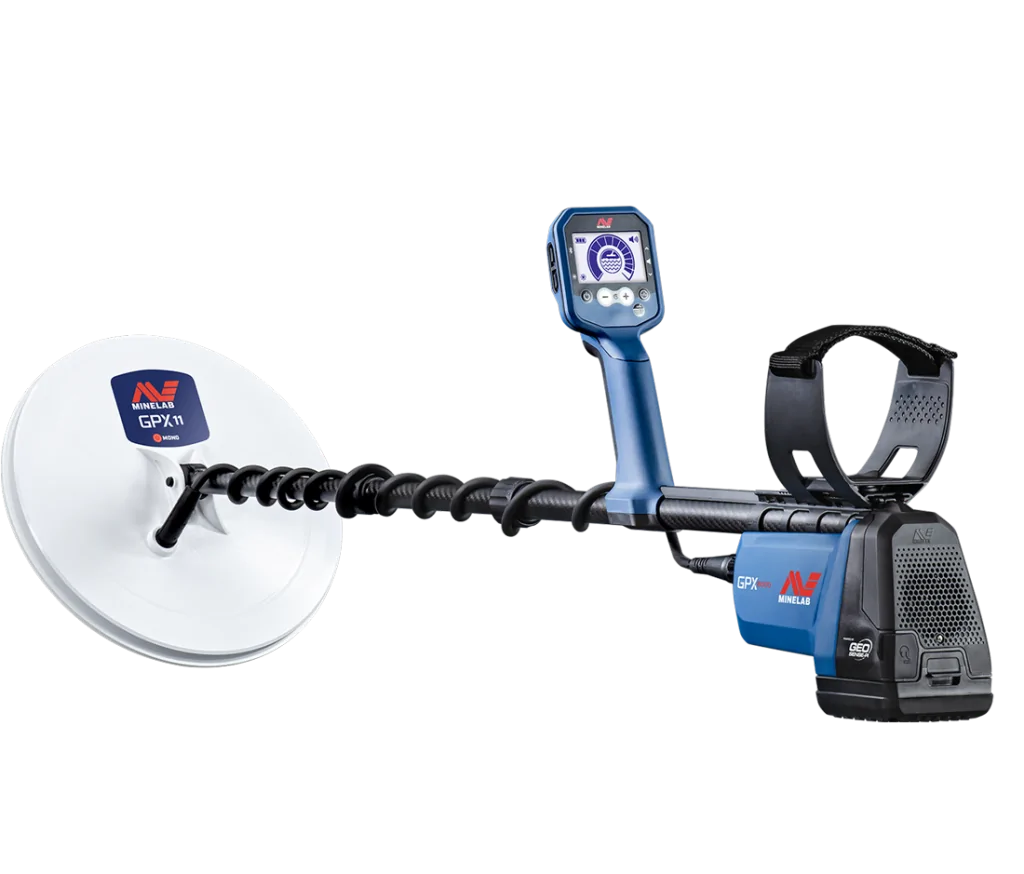
Garrett Axiom provides another PI comparison. Garrett describes Ultra-Pulse technology and TERRA-SCAN ground balance. Ask how the offered coil and settings fit your likely mineralization. Waterproof coils do not automatically make the entire detector submersible.
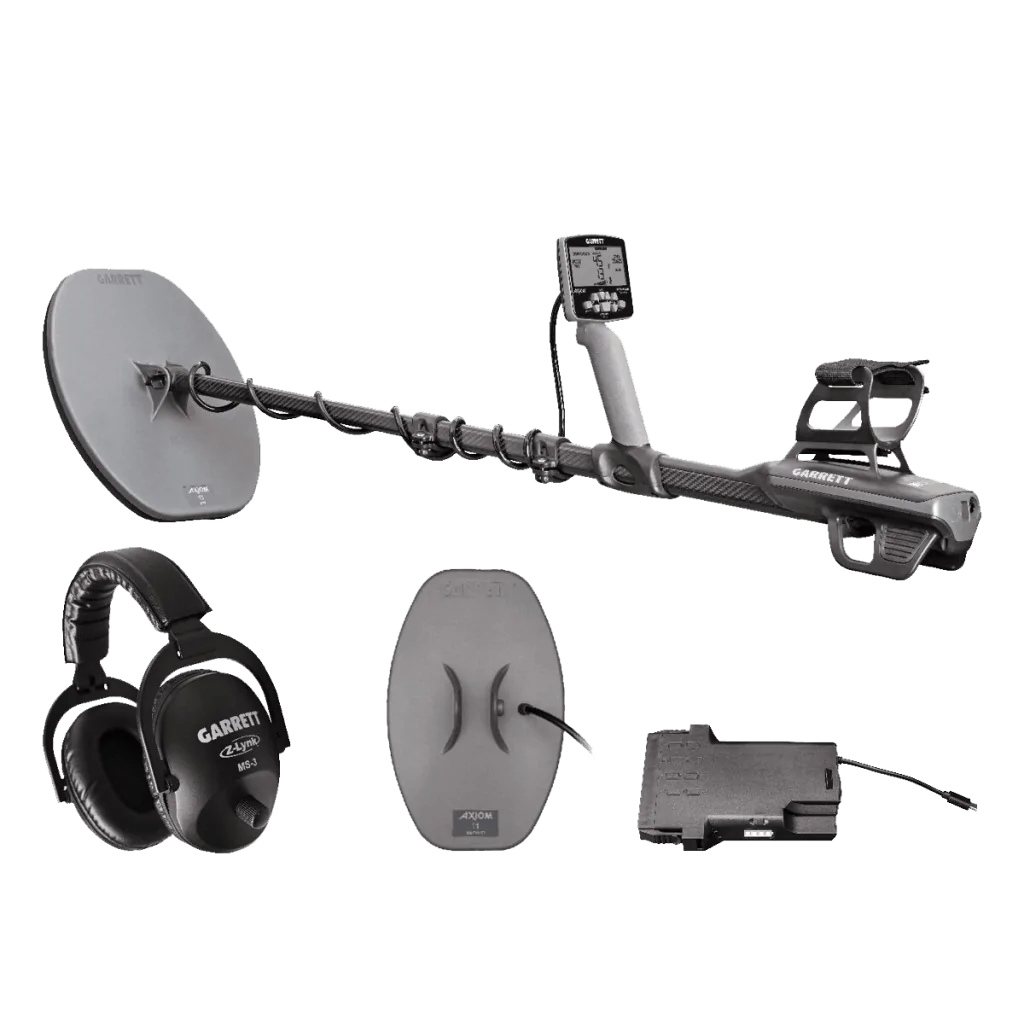
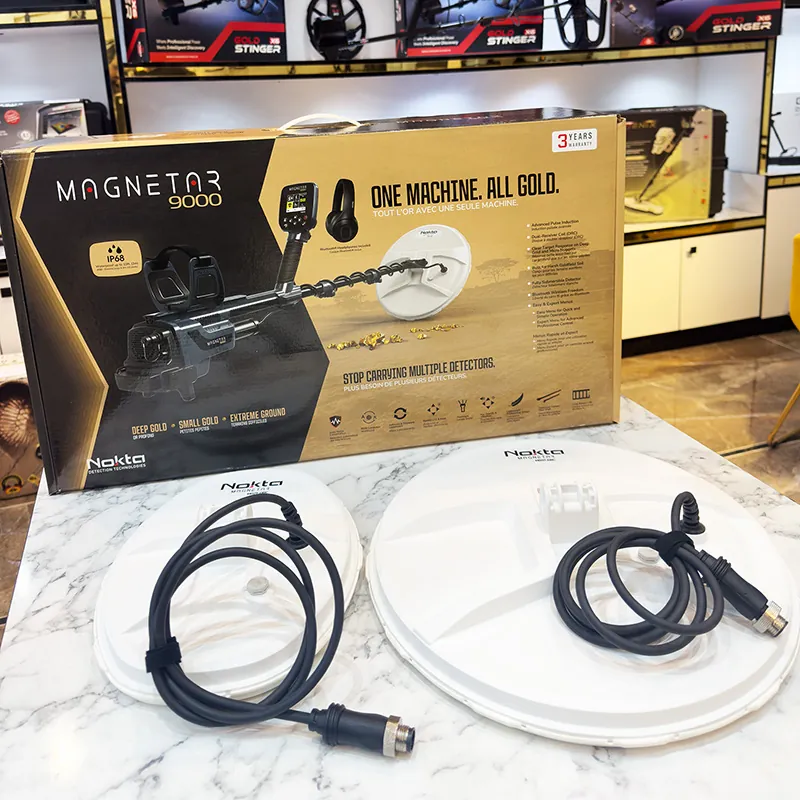
MAGNETAR 9000 and GPZ 8000: advanced goldfield comparisons
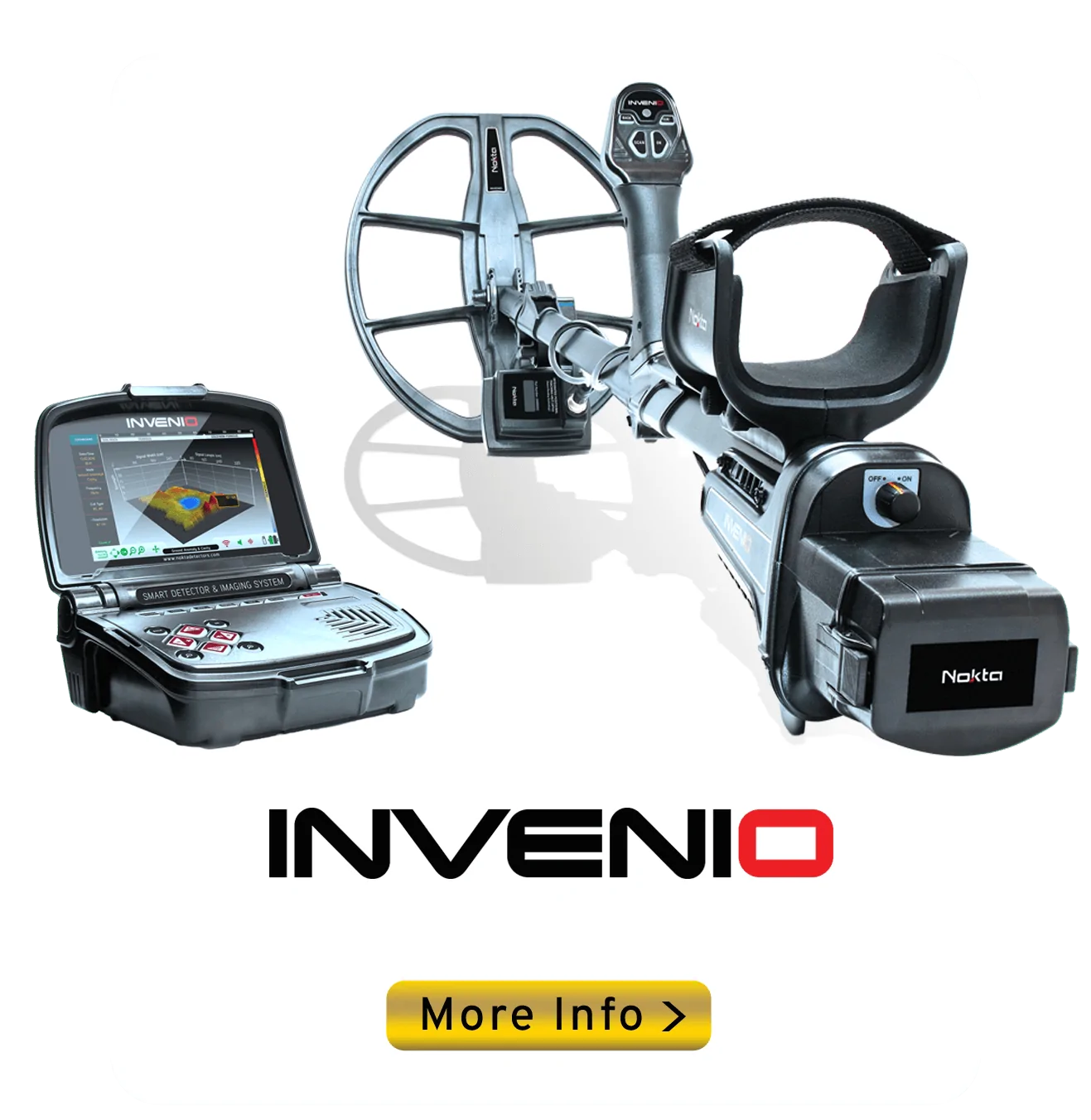
MAGNETAR 9000 is documented on Nokta’s official page as advanced PI with dual-receiver coils and Easy and Expert menus. The manufacturer lists IP68 waterproofing to three meters. Compare the assembled weight with your intended coil and try the carrying setup.
GPZ 8000 belongs on a specialist shortlist rather than a universal beginner recommendation. Minelab’s specifications identify model-specific search modes and package details. Ask which coil pack is included and what practical problem it solves for your terrain.

Explore the Minelab gold detectors, Garrett metal detectors, and Nokta detectors ranges for relevant options. For an extended feature comparison, use our gold detector buying guide. Do not choose a flagship merely because it is newer or more expensive.
10. Build a Beginner Kit and a Complete Budget
Buy for the method you can actually use. A basic panning kit may include a suitable pan, classifier, sample containers, labels, and appropriate hand tools. A detecting setup needs a suitable detector and coil, power, audio if required, and safe recovery tools.
Both methods also require field essentials: navigation, water, weather protection, communication, and a way to record observations. The exact kit depends on terrain and conditions. Avoid reducing essential preparation simply to carry more prospecting equipment.
| Budget item | What to confirm |
|---|---|
| Main equipment | Exact model, included tools, coil, and package contents |
| Power and accessories | Charging options, approved spare power, headphones, and compatibility |
| Learning | Training, local instruction, and time for practice |
| Travel and access | Transport, authorized access arrangements, and practical trip costs |
| Sampling and records | Containers, labels, suitable analysis if needed, and backups |
| Support | Warranty route, repair arrangements, and replacement-part availability |
Request an itemized quote rather than comparing headline prices alone. A cheaper package may omit a useful coil, necessary charger, or training. Conversely, an expensive bundle can include equipment you will not use. Start with the least complex setup that can answer your main field question.
Keep costs separate from recovered-gold value. Learning trips involve time and expense, and small recoveries do not establish profitability. This guide intentionally avoids a fixed gold price or daily-income promise because neither would tell you whether your own plan is worthwhile.
11. Sample Consistently and Record What the Evidence Shows
Keep each sample connected to its location
Give every sample or find a unique reference. Link it to the location, date, method, material, amount tested where relevant, and photographs. Use separate labeled containers and avoid mixing samples from different places before you understand what each result means.
For location records, save the coordinate system or datum and available accuracy information. Add a local sketch where a GPS point alone cannot relocate a small feature. Keep sensitive coordinates private when appropriate and respect any agreement with the landholder.
Separate observations from conclusions
“Several yellow particles retained, identity uncertain” is a different statement from “gold confirmed.” Similarly, a rock selected for its appearance is not necessarily representative of the surrounding material. Qualified identification or analysis may be needed before drawing a stronger conclusion.
If laboratory work is justified, ask the laboratory or an appropriately qualified professional how to collect, prepare, and submit samples for the question you need answered. Do not assume that one attractive specimen establishes the average grade, size, or economic value of an area.
This beginner guide does not prescribe chemical extraction or improvised rock-processing methods. Those require separate technical, environmental, and safety assessment. Keep early work focused on observation, lawful small-scale testing, and meaningful records.
Record effort and empty results
Log the search block, time, coverage quality, sample method, and configuration. “No gold recovered” is informative only when you know what was tested and how. An unfinished reconnaissance and a completed controlled search should not receive the same label on a map.
After a verified find, expand in manageable blocks or compare a clearly defined neighboring sample. Change one important variable at a time. A second result can support a pattern, but neither a single positive nor a single empty test proves the full extent of a deposit.
12. A First-Trip Plan: How to Prospect for Gold Step by Step
Use this gold prospecting guide as a sequence rather than a shopping list. A first trip should combine a credible location, confirmed access, a limited test, and enough time to understand the result.
- Choose the question. Define the target form and the material or ground you want to investigate.
- Check the evidence. Identify the original records and their limitations.
- Confirm access and conditions. Verify the permitted activity, route, weather, and return arrangements.
- Prepare the method. Practice the pan or detector procedure and check the essential kit.
- Inspect before starting. Compare the actual surface with your plan and note hazards or inaccessible ground.
- Complete a small test. Keep the method consistent and record the area or material tested.
- Verify the result. Identify recoveries carefully and preserve uncertainty where necessary.
- Restore and review. Leave the site as required, back up notes, and choose an evidence-based next step.
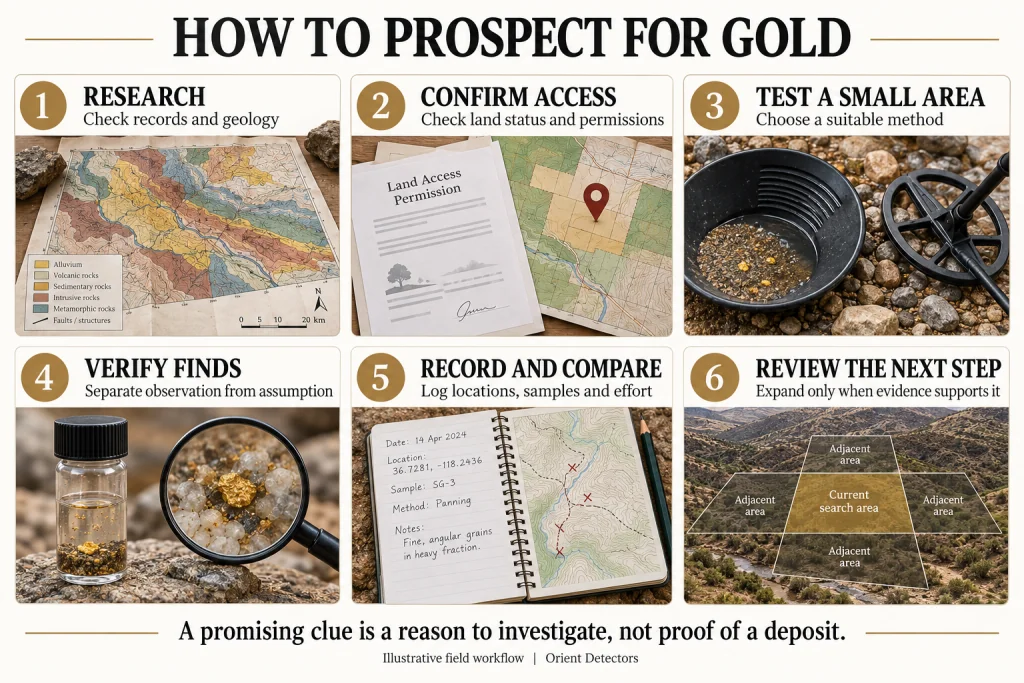
A repeatable prospecting workflow helps turn a single outing into useful evidence. Illustrative process, not a guarantee of discovery.
For example, imagine that two permitted sample locations are available. Use comparable sample amounts and record their material and position separately. If one appears more promising, first confirm the particles and technique before committing to a much larger test. The example illustrates a decision process, not a prediction of recovery.
For detecting, the equivalent is a defined block with usable operation and documented coverage. If terrain prevents complete passes, record the gaps rather than reporting the whole block as searched. Your next visit may need better access or instruction rather than a larger machine.
13. Common Gold Prospecting Mistakes to Avoid
- Confusing gold-bearing country with an accessible deposit. Check the specific surface and target form.
- Buying equipment before defining the task. Match the method to the material and permissions.
- Trusting one geological clue. Combine local context with controlled observations.
- Assuming all recovered yellow particles are gold. Confirm identity before reporting a find.
- Using a detector as an assay tool. A response cannot establish rock grade.
- Changing several settings or methods together. Make comparisons you can interpret.
- Ignoring sample amount and search effort. Record what was actually tested.
- Scaling up after one encouraging result. Verify the result and reassess authorization and method first.
- Declaring ground exhausted after a quick pass. Describe coverage and limitations honestly.
- Measuring success only by recovered weight. Evaluate what you learned and whether the next decision is clearer.
Good prospecting becomes more efficient when you can explain your choices. Before another purchase or trip, name the problem it will solve. If the answer is vague, improve the research or practice first.
Gold Prospecting Guide: Frequently Asked Questions
What is the best way to start gold prospecting for beginners?
Research an accessible area with credible records, confirm permission, and choose a small task matched to the likely gold form. Learn a consistent method before expanding. A pan can suit sediment testing; a detector suits appropriate individual targets.
Can I prospect for gold without a metal detector?
Yes. Research, geological observation, panning, and suitable sampling are prospecting methods. A detector is useful when the targets and ground suit it, but it is not required to investigate every type of natural gold occurrence.
Where should I look for gold?
Begin with documented gold-bearing districts and narrow the search to lawful, accessible material. Do not assume that every river, quartz vein, or old mine offers detectable gold. The local deposit type and surface conditions determine the useful next test.
Can a detector find microscopic gold?
Dispersed microscopic gold can be beyond handheld detector capabilities. Detectable size depends on target form, ground, depth, and configuration. Geological sampling or other methods may be required for questions about fine gold or rock composition.
Which detector should a beginner buy?
Choose for the intended ground, target, carrying comfort, support, and total budget. Gold Monster 2000 is a current gold-focused example; specialist PI platforms may suit different conditions. A local demonstration and training are more useful than a universal “best” label.
Do black sands or quartz guarantee gold?
No. They can provide geological context but occur without gold. Use them to formulate a question alongside documented local evidence. Verify recovered particles rather than assuming that a promising-looking concentrate proves a deposit.
How much does gold prospecting cost?
The cost depends on the method, equipment, travel, training, and any justified analysis. Build a complete budget and request current itemized quotations. Start with a manageable setup rather than treating the most expensive detector as a requirement.
Can I make money prospecting for gold?
Possible recovery does not establish profit. Account for time, access, equipment, travel, processing or analysis, and the uncertainty of results. Treat commercial development as a separate assessment rather than a conclusion from a recreational find.
Do I need permission to pan or detect?
Check the rules for the precise location and activity with the relevant authority and rights holder. Land access, mineral rights, detecting, sampling, and extraction can have different requirements. Do not rely on general statements about public land.
What should I do after finding gold?
Verify and record the find, preserve its location and context, and plan a controlled follow-up. Expand only where permitted, compare results consistently, and avoid assuming that one piece proves the extent or value of a wider deposit.