Gold Prospecting Equipment Guide: Tools Every Beginner Needs
Introduction: Start With the Right Tools, Not the Biggest Promise
Buying your first set of gold prospecting equipment can feel exciting and confusing at the same time. A beginner sees gold pans, classifiers, pinpointers, shovels, rock hammers, GPS apps, nugget vials, headphones, and metal detectors with very different prices. Then comes the difficult question: what do you really need on your first trip, and what can wait until later?
The honest answer is that successful gold prospecting does not begin with one magical device. It begins with a practical field kit that matches your target, your soil, your climate, and your level of experience. A beginner searching dry desert ground needs a different kit than someone sampling gravel in a stream. A person hunting tiny natural nuggets needs different detector performance than someone looking for old coins or large buried metal objects. This is why the best gold prospecting equipment is not always the most expensive equipment; it is the gear that helps you work safely, test ground correctly, and learn from every signal.
This guide explains the tools every beginner should understand before spending money. It covers gold detectors, coils, gold pans, classifiers, hand tools, safety gear, navigation tools, sample containers, headphones, spare batteries, and field workflow. It also includes practical examples from devices available through Orient Detectors, including Gold Stinger X6, Gold Monster 2000, Garrett Axiom, and GPX 6000-related resources.
By the end, you should know how to build a beginner kit without buying unnecessary items, how to match your detector to goldfield conditions, and how to avoid the common mistake of asking only about maximum depth. A good beginner does not carry every tool. A good beginner carries the right gold prospecting equipment for the day’s ground and uses it with a repeatable method.
Quick Checklist: Essential Gold Prospecting Equipment
| Category | Beginner Tool | Why It Matters | Priority |
|---|---|---|---|
| Detection | Gold detector or multi-purpose detector | Finds metal targets, nuggets, relics, and buried signals depending on the model | Essential |
| Coils | Small coil and larger coil if available | Small coils help with tiny gold and tight ground; larger coils improve coverage | High |
| Recovery | Pick, hand digger, scoop, and gloves | Helps recover targets safely without damaging gear or hands | Essential |
| Sampling | Gold pan, classifier, snuffer bottle, vial | Useful for checking gravel, concentrates, and visible fine gold | High |
| Navigation | Offline maps, GPS, compass, notebook | Records locations, tracks grids, and helps return safely | Essential |
| Power | Spare batteries, power bank, charging cables | Prevents field trips from ending early | Essential |
| Comfort | Headphones, knee pads, water, sun protection | Improves signal hearing and reduces fatigue in long sessions | High |
| Safety | First-aid kit, boots, communication device | Protects the prospector in remote terrain | Essential |
What Does a Beginner Really Need First?
The first mistake beginners make is buying scattered tools without a system. They may buy a detector, then a random shovel, then a gold pan, then several accessories that do not fit their search area. A better approach is to divide gold prospecting equipment into three groups: tools that find targets, tools that recover and verify targets, and tools that keep you safe and organized.
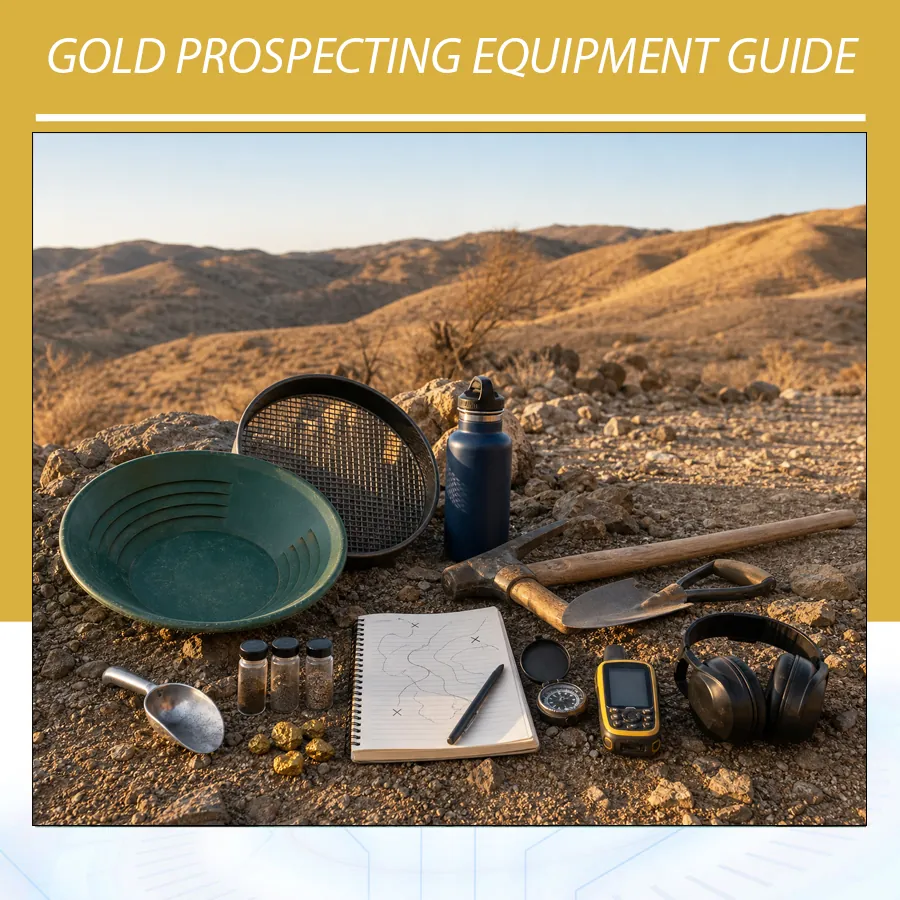
Finding tools include your detector, search coil, pinpointer, headphones, and sometimes a simple long-range or scan tool for advanced users. Recovery tools include a digging pick, small shovel, scoop, brush, magnet for iron trash, gloves, pan, classifier, and containers. Safety and organization tools include maps, GPS, notebook, water, sun protection, spare power, first aid, and communication.
If you are starting from zero, build a lean kit. A gold-focused detector, a small digging tool, gloves, headphones, water, offline maps, a notebook, and a small sample kit are enough for a careful first trip. As your experience grows, you can add specialized gold prospecting equipment such as extra coils, advanced pulse induction detectors, 3D ground scanners, or more complete sampling tools.
The Gold Detector: The Core of Modern Prospecting
For many beginners, the detector is the most expensive and most important piece of gold prospecting equipment. It is also the easiest place to make a bad purchase. A detector should be chosen according to target size, ground mineralization, depth expectations, and user experience. No detector is best for every beginner.
Small natural gold creates weak signals, especially in mineralized ground. For that reason, many gold hunters prefer detectors designed specifically for nuggets rather than general coin machines. A gold detector should offer stable ground balance, sensitivity to low-conductive targets, useful audio feedback, and a coil that fits the terrain. The detector must also be light enough to use for several hours, because good prospecting depends on slow, patient coverage.
If the beginner wants a focused gold machine, Gold Monster 2000 is a strong example because it is built around small-gold prospecting, automatic operation, and simplified field use. If the beginner wants a more flexible platform that can also handle coins, relics, depth checking, 2D target scan, and cavity/void scenarios, Gold Stinger X6 is a broader option. If the user is moving into more demanding goldfields and has the budget for professional pulse induction performance, Garrett Axiom and GPX-class devices become more relevant.
VLF, PI, and Multi-System Detectors: Which Should a Beginner Choose?
Detector technology is one of the most important decisions in gold prospecting equipment. VLF detectors are common, sensitive, and often easier to understand. They can be excellent for small shallow nuggets, especially with the right frequency and coil. Their limitation is that highly mineralized soil can make them noisy, which forces the user to reduce sensitivity or adjust ground balance carefully.
Pulse induction detectors are often chosen for difficult mineralized goldfields. PI detectors can handle ground noise better than many VLF machines and may reach deeper on certain targets. The tradeoff is usually cost, weight, and a learning curve. They are not always the cheapest beginner choice, but they are important for serious goldfields.
Multi-system detectors sit in a different category. Gold Stinger X6, for example, is attractive because it gives the user several workflows in one platform: all-metal search, discrimination, pinpointing, depth detection, 2D scan, and cavity/void detection. This makes it useful for beginners who do not want their first serious detector to be limited to one narrow purpose. In a complete gold prospecting equipment kit, a multi-system detector can serve as a learning bridge between simple detecting and advanced field analysis.
Recommended Detector Examples From Orient Detectors
| Device | Best Beginner Role | Why It Fits | Best For |
|---|---|---|---|
| Gold Stinger X6 | Flexible multi-purpose detector | Six search systems, GS50 and GS30 coils, depth detection, 2D target scan, discrimination | Beginners who want gold, coins, relics, and broader exploration |
| Gold Monster 2000 | Focused small-gold detector | Beginner-friendly gold prospecting design, lightweight use, fine-gold focus | Small nuggets, bedrock cracks, mineralized goldfields |
| Garrett Axiom | Professional goldfield upgrade | Pulse induction gold prospecting platform with modes for different ground conditions | Serious prospectors in mineralized or challenging terrain |
| GPX 6000 | Advanced gold prospecting detector | PI gold detector known for sensitivity and performance in difficult environments | Users ready for professional nugget hunting |
Search Coils: Small Coil, Large Coil, or Both?
Search coils are often underestimated by beginners. A detector and coil work together, so the coil is not just an accessory; it is part of your core gold prospecting equipment. A small coil is useful for tiny gold, rocky ground, tight areas, roots, bedrock cracks, and target separation. It sees less ground at once, which can make it quieter in difficult soil and more precise around small targets.
A larger coil covers more ground and may detect larger targets at greater depth, but it can be harder to use in rough terrain. It may also respond to more ground mineralization because it is reading a larger area under the coil. Beginners often assume a larger coil is always better. In gold prospecting, that is not true. The right coil depends on the expected target size and the shape of the search area.
Gold Stinger X6 is a useful example because it includes two coils with different purposes. The GS50 coil is suited for wider coverage and better depth on larger targets, while the GS30 coil is suited for precision and smaller targets. This makes the detector practical for a beginner who is still learning how coil size changes field performance. A good gold prospecting equipment kit should include at least one coil that matches your most likely target and terrain.
Gold Pan and Classifier: Simple Tools That Still Matter
Even in modern detector-based prospecting, a gold pan remains one of the most useful beginner tools. The U.S. Geological Survey describes panning as one of the simplest and least expensive ways to separate gold from sand, silt, and gravel in placer material. A pan helps you test whether an area contains fine gold or heavy minerals before you spend hours detecting nearby ground.
A classifier is a screen that sorts material by size before panning. This matters because gold recovery is easier when material is more consistent. Large rocks slow the process and hide fine material. A simple classifier, pan, snuffer bottle, and vial can turn a field trip into a learning session. Even if you mostly detect, this small set of gold prospecting equipment helps you understand the ground.
Beginners in dry desert areas may not always have water available for panning, but the pan still has value when used near water sources, at camp, or with collected samples. In areas where drywashing is common, the pan can confirm concentrates after dry material has been processed. The key is not to carry too much. A compact pan and small sample tools are usually enough at first.
Digging Tools: Recover Targets Safely and Efficiently
Digging tools are not glamorous, but they decide how quickly and safely you recover targets. For nugget hunting, a compact pick is often more practical than a large shovel. It can break hard ground, move stones, scrape soil, and help reach targets between rocks. A small hand scoop or plastic scoop helps pass soil over the coil without introducing extra metal. Gloves protect your hands from sharp rocks, hot ground, rusted metal, and thorns.
A magnet can be helpful for removing iron trash from loose soil. A small brush can clean rocks or reveal tiny targets. A finds pouch keeps trash and useful targets separate. Beginners should avoid leaving dug holes open or scattering trash. Responsible field behavior matters, especially when prospecting on permitted land or near areas used by other people.
This part of gold prospecting equipment should be chosen for the terrain. Soft soil needs lighter digging tools. Hard desert ground needs a stronger pick. Rocky areas require patience and durable gloves. If your detector is good but your recovery tools are poor, you will waste time and energy.
Pinpointer: Useful, But Not Always Mandatory
A pinpointer is a small handheld detector used to locate the exact position of a target inside a hole or loose soil. For coin and relic hunting, it can save a lot of time. For natural gold, its usefulness depends on target size and the type of detector being used. Very tiny nuggets may be difficult for some pinpointers, while larger targets are easier to locate.
Beginners should consider a pinpointer if they search mixed targets, coins, jewelry, or relics along with gold. If their entire focus is micro nuggets, they should test whether the pinpointer can actually detect the small targets they expect. For a broad gold prospecting equipment kit, a pinpointer is helpful but not always the first purchase after the detector.
Headphones: Hear More, Miss Less
Headphones are one of the most underrated pieces of gold prospecting equipment. Many beginner signals are weak. Tiny gold, deeper targets, and targets near mineralized rocks may not produce dramatic sounds. Headphones help you hear faint changes in tone and reduce outside noise from wind, traffic, insects, or other people.
Good headphones should be comfortable, reliable, and compatible with your detector. Wireless audio can be convenient, but wired headphones can be dependable in remote trips if battery management is a concern. In hot climates, lightweight headphones may be more comfortable than heavy closed-back models. The best choice is the one you will actually wear for hours.
Navigation and Mapping Tools
Gold prospecting is not only about swinging a detector. It is also about knowing where you have searched, where you found signals, and where you need to return. Offline maps, GPS, a compass, and a notebook are essential gold prospecting equipment for any beginner working away from easy roads.
Mark your starting point, vehicle location, promising areas, trash zones, and target finds. Record soil changes, hot rocks, dry washes, quartz veins, old diggings, and any place where the detector behaved differently. A notebook may feel old-fashioned, but field notes help you improve faster than memory alone. When you return to a site weeks later, notes can show where you already searched and where you should continue.
Beginners should also check legal access before detecting. USGS guidance on prospecting emphasizes that modern prospectors must understand where prospecting is permitted and obtain permission on private land. This is not a minor detail. No set of gold prospecting equipment is useful if the user is searching in a restricted or unsafe area.
Safety Gear for Desert, Mountain, and Remote Prospecting
Safety equipment is part of prospecting, not an optional extra. Beginners often focus on detectors and forget water, sun protection, boots, gloves, first aid, and communication. Remote prospecting can involve heat, sharp rocks, unstable ground, wildlife, poor phone signal, and long walks back to the vehicle. Your safety kit should match the seriousness of the location.
For hot dry regions, carry more water than you think you need. Use a hat, sunscreen, sunglasses, and breathable clothing. Wear boots that protect your feet from rocks and uneven ground. Carry a basic first-aid kit, whistle, flashlight, power bank, and emergency contact plan. If you search with a partner, agree on meeting points and time limits.
Professional prospectors understand that the best gold prospecting equipment includes the gear that helps you return safely. A detector can be replaced. A bad decision in remote heat can become serious quickly.
Sample Containers, Labels, and Field Notes
Small containers are easy to ignore until you need them. Nugget vials, sample bags, labels, and a marker help you keep finds organized. If you collect soil, gravel, or rock samples, label each one with location, date, and field notes. Do not mix samples from different spots unless you are deliberately creating a composite sample.
This is especially important when testing new ground. If one dry wash produces small gold and another does not, you need to know which sample came from where. Organized samples turn random trips into evidence. The beginner who records results will improve faster than the beginner who only remembers the excitement of the day.
Rock Tools and Hand Lens
A hand lens, small rock hammer, and magnet can help beginners understand mineral signs in the field. USGS rock-collecting guidance notes that a geologist’s hammer and hand lens are basic tools for examining specimens. For prospecting, a hand lens can help inspect mineral grains, quartz, black sands, and tiny metallic particles.
A rock hammer should be used carefully and legally. Do not damage protected areas, historical sites, or private property. Wear eye protection when breaking rock. A magnet can help separate some magnetic black sands or identify iron-rich material. These tools do not replace a detector, but they support a more complete gold prospecting equipment approach.
Beginner Kit by Budget Level
| Budget Level | Recommended Kit | Detector Direction | Best Use |
|---|---|---|---|
| Starter | Pan, classifier, gloves, scoop, notebook, water, basic detector | Simple VLF or beginner-friendly gold detector | Learning signals and sampling easy ground |
| Serious Beginner | Detector, headphones, two coils if available, pick, sample kit, GPS app | Gold Monster 2000 or Gold Stinger X6 | Small nuggets, mixed targets, field training |
| Advanced Beginner | Better detector, spare batteries, quality headphones, stronger pick, mapped workflow | Gold Stinger X6, Garrett Axiom, GPX-class detector | Mineralized ground and longer prospecting trips |
| Professional Path | Detector system, coils, field documentation, sample workflow, possible 3D scanner | PI detector plus multi-system or scanning tools | Serious goldfields, deeper targets, structured surveys |
How to Pack for a First Gold Prospecting Trip
A first trip should be simple. Choose a legal and accessible location. Charge the detector batteries. Test the detector at home with small metal targets and, if possible, a small gold sample. Pack water, gloves, headphones, a digging tool, a pan or sample kit, a notebook, and navigation tools. Do not overload yourself with every piece of gold prospecting equipment you own.
At the site, start by observing the ground. Look for bedrock, gravel traps, old workings, quartz pieces, black sand, iron trash, and changes in soil color. Then choose a small test area instead of wandering randomly. Move slowly, overlap your sweeps, and mark repeatable signals. Dig carefully, recheck the hole, and keep trash separate from finds. If you find nothing, that still teaches you something about the ground.
After the trip, clean your tools, recharge batteries, review notes, and update your plan. Prospecting improves through repetition. The best gold prospecting equipment helps you learn, but it does not replace disciplined field habits.
Common Beginner Mistakes
Buying for Maximum Depth Only
Depth is important, but it is not the only measure of a good detector. Small gold sensitivity, ground balance, coil choice, and audio clarity may matter more than advertised depth. Many beginners buy the deepest-sounding machine and then struggle with ground noise or complicated controls.
Ignoring Soil Conditions
Mineralized soil can change everything. A detector that performs well in mild ground may become noisy in hot rocks or iron-rich soil. Choose gold prospecting equipment that matches real ground conditions, not just brochure claims.
Using the Wrong Coil
A large coil is not always better. Small gold in tight rocky ground often needs a smaller coil. Open ground and larger targets may benefit from a larger coil. Beginners should learn both coil control and coil selection.
Skipping Practice Targets
Practice before the field trip. Bury small test targets at shallow depths and listen carefully. Learn what repeatable signals sound like from different angles. This builds confidence and reduces wasted digging.
Forgetting Safety and Permissions
Legal access, water, communication, and first aid are as important as the detector. Responsible prospecting protects the user, the land, and future access for everyone.
Best Beginner Setup for Different Goals
If Your Goal Is Small Natural Gold
Prioritize a gold-focused detector, small coil, headphones, pick, scoop, and sample containers. Gold Monster 2000 is a strong example for beginners who want small-gold focus. Add a pan and classifier if you can sample nearby material.
If Your Goal Is Gold Plus General Detecting
Choose a flexible detector such as Gold Stinger X6. It offers more than one search method, which helps a beginner explore gold, coins, relics, and buried targets. Add both coil practice and careful signal checking to your routine.
If Your Goal Is Difficult Mineralized Ground
Consider more advanced detectors such as Garrett Axiom or GPX-class devices when the budget and experience level justify them. PI technology may be more suitable for some difficult ground. However, beginners should still learn basics before expecting professional results.
FAQ: Gold Prospecting Equipment for Beginners
What is the most important gold prospecting equipment for a beginner?
The most important item is a detector or sampling method that matches your target and terrain. For detector-based prospecting, start with a gold-focused or beginner-friendly detector, headphones, a digging tool, gloves, water, navigation, and a small sample kit.
Do beginners need a gold pan if they use a detector?
Yes, a pan is still useful. It helps test gravel, concentrates, and fine material. Even detector users benefit from understanding whether an area contains fine gold or heavy minerals.
Is Gold Stinger X6 beginner-friendly?
Gold Stinger X6 can be beginner-friendly for serious users because it offers multiple systems, two coils, target scan, depth detection, and discrimination. It is best for beginners who want a flexible platform rather than a very basic detector.
Which detector is best for small nuggets?
Gold Monster 2000 is a strong small-nugget option because it is focused on gold prospecting and simplified operation. Advanced users in difficult ground may consider PI options such as Garrett Axiom or GPX-class detectors.
Should I buy a pinpointer first?
A pinpointer is helpful, especially for coins, relics, jewelry, and larger targets. For very tiny gold, test the pinpointer’s sensitivity before relying on it. It is useful but not always the first priority.
How much equipment should I carry on my first trip?
Carry a lean kit: detector, headphones, gloves, digging tool, water, map, notebook, power backup, and a small sample kit. Add more gold prospecting equipment only after you know what your field conditions require.
Final Verdict: Build a Practical Kit and Learn the Ground
The best gold prospecting equipment for a beginner is not the biggest collection of tools. It is a balanced kit that helps you search, recover, verify, document, and return safely. Start with a detector that matches your goal, choose coils intelligently, carry simple recovery and sampling tools, and treat maps, notes, water, and safety gear as essential.
If your goal is natural gold, choose equipment that respects the realities of goldfields: small targets, mineralized ground, faint signals, hot rocks, and long days outdoors. Gold Monster 2000 is a focused beginner-friendly option for small gold. Gold Stinger X6 is a flexible multi-system choice for users who want broader capability. Garrett Axiom and GPX-class detectors fit the professional path when ground conditions and budget demand more.
Gold prospecting rewards patience more than impulse buying. Build your kit step by step, test each tool, learn from every target, and keep your field process simple. With the right gold prospecting equipment and a disciplined method, a beginner can move from confusion to confidence much faster.
External Sources
- USGS – Prospecting for Gold in the United States
- USGS – Collecting Rocks: Collecting Equipment
- Minelab – Get Started in Detecting
- Geology.com – Gold Articles