Best Metal Detectors for Beginners: Complete Buying Guide
Introduction: Choosing Your First Detector Without Guesswork
Buying your first metal detector should feel exciting, not confusing. The problem is that most beginners enter the market through a wall of technical terms: VLF, PI, multi-frequency, ground balance, discrimination, depth, coils, target ID, sensitivity, waterproof rating, and scan systems. Every device sounds powerful, every brand promises performance, and every buyer wants the same thing: a detector that actually works in the field.
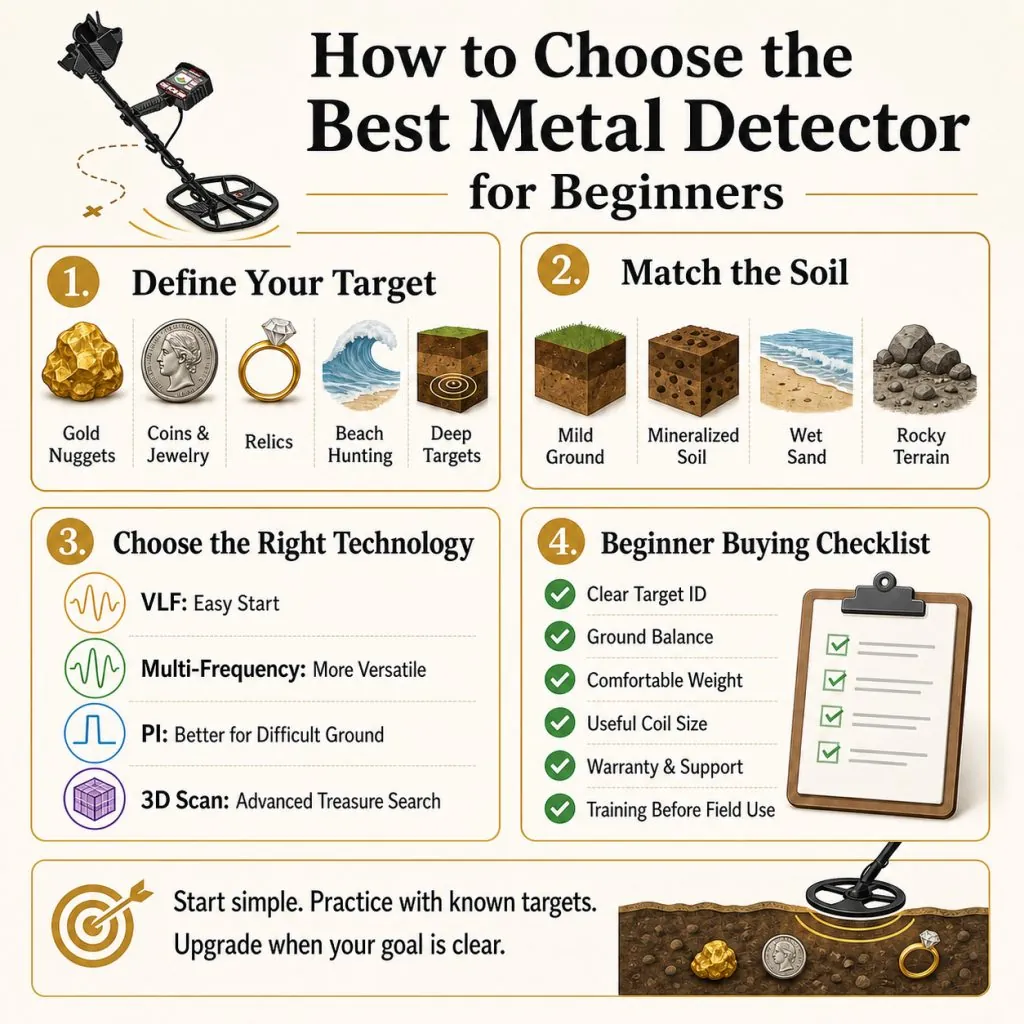
This guide is written to help new users choose the best metal detectors for beginners with a practical mindset. It is not a list of random devices, and it does not assume that the most expensive model is automatically the best first choice. A beginner detector should help you learn correct sweep technique, understand target signals, reduce frustration from false tones, and match your real search environment. If your goal is gold nuggets, you need a different machine than someone searching for coins in parks or relics in old fields. If your soil is mineralized, your priorities change again.
For product examples, this article uses devices available through Orient Detectors only, including Gold Stinger X6, Gold Monster 2000, Garrett ACE 400i, Garrett ACE Apex, Nokta The Legend 2, Simplex Ultra, Minelab Manticore, Gold Kruzer, Garrett Gold Master 24K, and selected advanced models that beginners may grow into later. The aim is to give new buyers a clear path from “I want to start detecting” to “this device fits my target, soil, and budget.”
What Makes a Metal Detector Beginner-Friendly?
The best metal detectors for beginners are not always the simplest in a cheap sense. They are beginner-friendly because they reduce the number of decisions a new user must make before hearing useful signals. A good first detector should power on quickly, balance well in normal ground, provide understandable audio, show target information clearly, and remain comfortable during long sessions.
Beginner-friendly does not mean weak. It means the detector gives you enough performance to find real targets while keeping the learning curve reasonable. Garrett’s beginner guidance emphasizes simplicity, clear target ID, adjustable sensitivity, preset modes, and lightweight handling as key factors for new detectorists. Minelab’s getting-started advice also recommends learning the basics, practicing with familiar targets, using slow overlapping sweeps, adjusting sensitivity and ground balance, and following local rules and permissions before hunting.
These principles matter more than hype. A detector with twenty advanced menus may be impressive, but if a new user cannot understand why it is noisy, why iron sounds like a good target, or why small gold disappears in difficult soil, the extra features can become a burden. The right first detector should create confidence.
Best Metal Detectors for Beginners by User Type
There is no single detector that is perfect for everyone. The best metal detectors for beginners depend on the type of beginner. Someone looking for small natural gold needs sensitivity and ground handling. Someone who wants coins and jewelry needs target ID and discrimination. Someone searching in wet sand needs waterproofing or salt stability. Someone interested in treasure and deeper targets may need a multi-system device that leaves room to grow.
Before choosing a model, answer four questions: What target do you want most? Where will you search most often? How much weight can you comfortably carry? How much time are you willing to spend learning settings? Your answers will narrow the field much faster than comparing depth numbers alone.
Quick Comparison Table: Beginner Detector Options
| Device | Best For | Beginner Level | Main Strength | Orient Detectors Link |
|---|---|---|---|---|
| Gold Stinger X6 | Gold, coins, relics, mixed targets | Beginner to intermediate | Six search systems, dual coils, practical depth | Gold Stinger X6 |
| Gold Monster 2000 | Small gold nuggets and mineralized ground | Beginner to developing prospector | Gold-focused sensitivity, light weight, clear audio | Gold Monster 2000 Review |
| Garrett ACE 400i | Coins, jewelry, casual treasure hunting | Beginner | Simple controls, affordable learning platform | Garrett ACE 400i Review |
| Garrett ACE Apex | Coins, jewelry, all-purpose detecting | Beginner plus | Multi-Flex technology and better target information | Electromagnetic Detectors |
| Nokta The Legend 2 | All-terrain detecting, coins, jewelry, beaches | Beginner with room to grow | Modern multi-frequency platform | Electromagnetic Detectors |
| Simplex Ultra | Entry-level all-purpose detecting | Beginner | Simple operation and strong value | Electromagnetic Detectors |
| Minelab Manticore | Advanced beginner who wants long-term growth | Intermediate-friendly | Multi-IQ+ and advanced target visualization | Minelab Devices |
| Gold Kruzer | Gold prospecting and small targets | Beginner to intermediate | Gold sensitivity and field flexibility | Gold Nugget Detectors |
1. Gold Stinger X6: Best Beginner Detector for Users Who Want Flexibility
Gold Stinger X6 is one of the strongest choices in this guide because it gives new users more than one way to search without jumping into an extremely complex professional scanner. Orient Detectors describes Gold Stinger X6 as a new-generation professional metal detector with six search systems, including All Metals Mode, Discrimination System, Pin Pointer Mode, Depth Detection System, 2D Target Scan, and Cavity & Void Detection. It also includes two coils: the GS50 coil for broader coverage and better depth, and the GS30 coil for precision and smaller targets.
That combination makes it one of the best metal detectors for beginners who are serious from the start. A pure entry-level coin detector may be easier, but it can become limiting if the user wants to search for gold, mixed metals, buried targets, and possible voids. Gold Stinger X6 gives a beginner enough simplicity to start while leaving space to learn more advanced workflows later.
The most useful feature for a new user is not only depth. It is adaptability. In a clean area, All Metals Mode can help you hear more targets. In trashy soil, discrimination can reduce iron signals. Pin Pointer Mode helps narrow the exact location before digging. The 2D Target Scan and depth indication give visual support that beginners often appreciate because audio signals can be difficult to interpret at first.
Gold Stinger X6 is best for beginners who want one detector for multiple purposes: gold prospecting, coin shooting, relic hunting, and practical field training. It is not the lowest-cost starting point, but it offers a more complete learning platform than many basic detectors.
2. Gold Monster 2000: Best Beginner Detector for Small Gold Nuggets
If your main goal is natural gold, the Gold Monster 2000 deserves special attention. Orient Detectors describes it as a gold-focused detector built for ultra-fine gold in mineralized ground using Minelab’s Multi-Au technology, Echo Wave Audio, and a Gold Chance Indicator. It is also light, compact, and designed to reduce confusion from hot rocks, iron trash, and ground interference.
For goldfields, the best metal detectors for beginners are not necessarily general-purpose coin machines. Small gold has a weak signal, and mineralized soil can make simple detectors unstable. A beginner who buys a general detector for serious nugget hunting may quickly become frustrated. Gold Monster 2000 helps because its identity is clear: it is made for gold.
The practical advantage is that a new prospector can focus on coil control, target response, and repeatable signals rather than constantly fighting complicated menus. Minelab’s own support guidance notes that random beeps can be caused by mineralization and that users may need to ground balance, reduce sensitivity, or use a difficult ground setting depending on the detector and soil. This is exactly why a gold-specific detector is valuable for beginners working difficult ground.
Gold Monster 2000 is best for beginners who want to search dry goldfields, rocky terrain, washes, exposed mineralized ground, and areas where tiny nuggets matter. It is not a deep cache detector and it is not a 3D ground scanner. Its strength is precision on small gold.
3. Garrett ACE 400i: Best Simple Start for Coins and Everyday Targets
Garrett ACE 400i is a familiar name for beginners because it follows the classic starter-detector formula: simple interface, useful discrimination, good target information, and accessible price. It is suitable for users who want to learn the hobby through coins, jewelry, parks, fields, and general metal detecting rather than specialized gold prospecting.
Garrett’s beginner guidance explains that new users should prioritize simplicity, solid performance, adjustable sensitivity, target ID, and comfortable weight. That is the right framework for ACE-style detectors. A beginner should learn what repeatable signals sound like, how target ID changes with angle and depth, and how iron differs from non-ferrous targets before moving into highly specialized machines.
The ACE 400i is not the best choice for extreme mineralized goldfields or deep professional treasure projects, but it can be one of the best metal detectors for beginners who want a clean, affordable entry into the hobby. For coins and jewelry, a detector like this can teach the fundamentals faster than a machine built for expert-level adjustment.
4. Garrett ACE Apex: Best Step-Up Beginner Detector
Garrett ACE Apex is a step up from basic beginner models because it offers more modern performance and better adaptability. Garrett positions the Apex as a more feature-rich option for users who want room to grow, with multiple detection modes, improved discrimination, high-resolution ground balance, backlit display, and more advanced target information than entry-level ACE models.
This matters because some buyers know from the beginning that they will not stay casual for long. If you plan to search parks, fields, beaches, and different ground types, a step-up detector may save you from replacing your first machine too quickly. The ACE Apex can be a smart choice if you want a detector that still feels approachable but offers more control than a very basic unit.
For buyers comparing the best metal detectors for beginners, Garrett ACE Apex sits in the “beginner plus” category. It is not overkill, but it is not the simplest path either. Choose it if you want more long-term value and are willing to spend time understanding modes, target IDs, and ground balance.
5. Nokta The Legend 2: Best Beginner-Friendly Multi-Frequency Detector
Nokta The Legend 2 is suitable for beginners who want a modern all-terrain detector with strong future potential. Multi-frequency machines can perform well across different environments because they are not limited to one fixed frequency. This helps when switching between coins, jewelry, wet sand, and mixed ground conditions.
The tradeoff is learning. Multi-frequency does not mean automatic success. A beginner still needs to understand sweep speed, target ID, iron bias or discrimination behavior, recovery speed, and how soil affects signals. But for a user who wants a detector that can remain useful after the first year, The Legend 2 is a strong candidate.
It belongs among the best metal detectors for beginners who want a detector with more room to grow than a simple starter machine. If you are willing to learn settings gradually, it can support many types of hunting without forcing an early upgrade.
6. Simplex Ultra: Best Value-Oriented Beginner Option
Simplex Ultra is the kind of detector that appeals to new users who want modern features without entering a high budget. It is designed for practical detecting, straightforward use, and good field value. For many beginners, this is exactly the right level: enough capability to take the hobby seriously, but not so much complexity that the first sessions become frustrating.
A value-oriented beginner detector should still feel solid. It should be easy to assemble, simple to charge or power, readable in daylight, and comfortable enough for long walks. It should also give the user a clear way to manage sensitivity and target signals. The beginner who learns on a good value detector often develops better habits than the beginner who starts with an advanced device and relies on settings they do not understand.
Simplex Ultra is best for general detecting, learning target responses, and building confidence before deciding whether your long-term interest is gold, coins, relics, beach hunting, or professional treasure search.
7. Minelab Manticore: Best Advanced Beginner Detector for Long-Term Growth
Minelab Manticore is not a basic beginner machine, but it can be suitable for an ambitious beginner who wants to buy once and grow into the detector. Orient Detectors lists Manticore in its electromagnetic detector category, and Minelab highlights technologies such as Multi-IQ+ and advanced target identification. This kind of platform is better for users who are comfortable learning and want a detector that can handle many environments.
The reason Manticore is not for every beginner is complexity. More target information is useful only if you practice enough to understand it. Advanced visualization and audio systems can be extremely helpful, but they can also distract a new user who has not yet learned the basics. If you enjoy learning technical equipment and want a premium general-purpose detector, Manticore can be a long-term choice. If you want the easiest first week possible, start simpler.
8. Gold Kruzer and Garrett Gold Master 24K: Good Beginner Choices for Gold-Focused Users
Gold Kruzer and Garrett Gold Master 24K fit a particular buyer: the beginner who already knows that gold prospecting is the main goal. High-sensitivity gold detectors are better at small targets than many general-purpose units, but they require patience. They may respond to tiny pieces of metal, hot rocks, and ground changes, so the user must learn what is worth digging.
These devices can be among the best metal detectors for beginners in gold areas because they teach important skills early: slow coil movement, careful overlap, listening for small repeatable changes, and adjusting sensitivity for stability. They are less ideal for someone who mainly wants coins in urban parks, but much better for users whose real dream is finding natural gold.
How to Choose by Target Type
For Gold Nuggets
Choose a gold-focused detector such as Gold Monster 2000, Gold Kruzer, Garrett Gold Master 24K, or step toward GPX 6000 later if your soil is difficult and your budget is higher. Small gold requires sensitivity and stable ground handling. Do not choose a coin detector as your main nugget machine unless your gold goals are casual.
For Coins and Jewelry
Choose Garrett ACE 400i, Garrett ACE Apex, Simplex Ultra, The Legend 2, or Minelab Manticore depending on your budget. For coins, target ID, discrimination, recovery speed, and comfort matter more than extreme depth. Parks and trashy areas require a detector that can separate good targets from nearby iron and aluminum.
For Relics and Old Sites
Relic hunters need depth, stable audio, and the ability to work around iron. Gold Stinger X6, The Legend 2, Manticore, and similar capable electromagnetic detectors make sense here. Smaller coils can help in trashy sites, while larger coils can cover open fields faster.
For Beaches and Wet Ground
Look for waterproof design or at least a waterproof coil, plus stable operation in wet conductive ground. Multi-frequency detectors often perform better around saltwater than simple single-frequency models. A beginner who plans to detect beaches often should not buy a device intended only for dry land.
For Deeper Buried Targets
Beginners interested in deep treasure should understand that deep searching is a different category. A practical starter like Gold Stinger X6 can teach target detection and depth estimation. Later, users may move toward 3D scanners or professional PI systems. Start with a detector you can understand before investing in advanced imaging or long-range systems.
How Soil Type Changes the Beginner Buying Decision
Soil is one of the biggest reasons two users can buy the same detector and get very different results. Clean, mild soil is easy for most modern detectors. Mineralized soil, wet salt sand, volcanic ground, iron-rich fields, and rocky gold areas are much harder. When comparing the best metal detectors for beginners, always think about where the detector will work most of the time.
In mild park soil, a beginner can focus on target ID, discrimination, and recovery speed. A simple detector may perform well because the ground itself is not fighting the signal. In mineralized soil, the detector must separate the target signal from the natural response of the ground. In wet salt sand, the machine must handle conductivity from saltwater. In rocky gold areas, hot rocks can sound like targets if the detector is not properly balanced.
This is why a beginner looking for coins in city parks may be happy with Garrett ACE 400i or Simplex Ultra, while a beginner looking for gold in difficult ground may need Gold Monster 2000, Gold Kruzer, Garrett Gold Master 24K, or a stronger goldfield option. A beginner who wants broad flexibility may choose Gold Stinger X6 because it gives more than one search approach. Soil is not a small detail; it is part of the purchase decision.
| Soil / Search Area | Main Challenge | Beginner-Friendly Direction | Suggested Device Examples |
|---|---|---|---|
| Parks and mild fields | Trash, iron, bottle caps, aluminum | Good target ID and discrimination | Garrett ACE 400i, Simplex Ultra, ACE Apex |
| Dry goldfields | Small gold and weak signals | High sensitivity to gold | Gold Monster 2000, Gold Kruzer, Gold Master 24K |
| Mineralized rocky ground | Ground noise and hot rocks | Strong ground balance and goldfield stability | Gold Monster 2000, GPX 6000 for later upgrade |
| Beaches and wet sand | Salt response and changing moisture | Waterproof or multi-frequency detector | The Legend 2, Manticore, compatible waterproof models |
| Open desert or wide land | Coverage and target uncertainty | Flexible detector or multi-system approach | Gold Stinger X6, Mega Scan Pro for advanced users |
Beginner Detector Technologies Explained Simply
Many beginners get stuck because they read technology names before understanding what they mean in real use. You do not need to become an engineer to choose correctly, but you should understand the practical difference between common detector types. This helps you choose the best metal detectors for beginners based on performance, not marketing language.
Single-Frequency VLF
Single-frequency VLF detectors transmit and receive at one main operating frequency. Lower frequencies are often better for larger, more conductive targets such as coins and relics, while higher frequencies can improve sensitivity to smaller targets such as tiny gold. Many starter detectors use this approach because it is affordable, lightweight, and easy to understand.
Multi-Frequency VLF
Multi-frequency detectors use multiple frequencies or advanced frequency processing to handle a wider range of targets and soils. For beginners, this can be helpful because the detector adapts better to varied locations. Models such as Nokta The Legend 2 and Minelab Manticore are stronger long-term choices for users who want one detector for parks, beaches, jewelry, coins, and relics.
Pulse Induction
PI detectors send powerful pulses into the ground and are known for performance in mineralized soil and goldfields. They can be excellent for serious prospecting, but they are not always the easiest first machine for casual users because target identification may be less simple than on VLF detectors. A beginner can grow into PI if gold prospecting is the main goal, but most casual users should not start there unless the need is clear.
Multi-System Detectors
Multi-system devices combine different search methods, such as audio detection, long-range detection, cavity search, depth systems, and scan modes. Gold Stinger X6 is a practical example for serious beginners, while Mega Scan Pro and Infinity Max Pro belong to more advanced categories. These machines can be powerful, but users should learn one system at a time instead of jumping between modes without a plan.
Device Recommendations by Beginner Scenario
I Want to Find Gold Nuggets
Choose Gold Monster 2000 if you want a focused, beginner-friendly gold detector. It is better suited for natural gold than a basic coin machine. Gold Kruzer and Gold Master 24K are also worth comparing if available in your market. If you later move into more difficult goldfields and have a higher budget, GPX 6000 becomes a logical professional upgrade.
I Want One Detector for Everything
Choose Gold Stinger X6 if you want a detector that covers more than one beginner pathway. It is useful for users who are not sure whether they will focus on gold, coins, relics, voids, or mixed targets. That flexibility is why it appears repeatedly in discussions of the best metal detectors for beginners who want more than a basic entry-level device.
I Want the Lowest Learning Curve
Choose Garrett ACE 400i or Simplex Ultra. These are better for learning target sounds, target ID, and recovery without too many advanced decisions. They are especially suitable for coins, jewelry, and casual searching in easier ground.
I Want a Detector I Will Not Outgrow Quickly
Choose Garrett ACE Apex, Nokta The Legend 2, or Minelab Manticore depending on budget. These devices give more advanced capability and may stay useful as your skills improve. They are not as simple as the cheapest starter machines, but they can be smarter purchases for users who know they will detect often.
How Beginners Should Read Product Pages
A good product page contains more than attractive photos. When checking Orient Detectors or any trusted seller, read the device name, technology, search systems, included coils, warranty, country of origin, price, accessories, and intended use. Do not stop at one headline claim. The best metal detectors for beginners usually become clear when you match all of these details to your personal goal.
For example, if a device page highlights small gold, mineralized soil, and automatic ground handling, it is probably better for gold prospecting than casual coin hunting. If the page highlights target ID, discrimination, and multiple modes for common targets, it may be better for parks and jewelry. If the page talks about 3D scan, cavity detection, and visual analysis, it may belong to a different category than a beginner coin detector.
Also check what comes in the package. A detector with multiple coils may offer more value than a cheaper detector that requires accessories later. A device with training videos, manuals, and responsive support can also be better for a beginner than a slightly cheaper device with no guidance. The first purchase is not just hardware; it is the beginning of your learning curve.
Safety, Permissions, and Responsible Detecting
Responsible detecting is part of choosing a beginner detector. Before using any machine, check local laws, land ownership, and permissions. Public parks, beaches, archaeological sites, protected areas, farms, and private land may have different rules. Professional organizations and experienced detectorists consistently advise beginners to get permission, fill holes cleanly, remove trash, and avoid protected historical sites.
This matters for practical reasons as well as legal ones. A respectful detectorist gets invited back. A careless beginner damages trust for everyone. If you are buying one of the best metal detectors for beginners, also learn the basic code of conduct: ask first, leave no mess, report finds when required, and do not disturb sensitive sites.
Key Features Beginners Should Understand
Target ID
Target ID is a number or visual indicator that estimates the target’s conductivity. It helps users decide whether a signal might be iron, foil, coin, jewelry, or another metal. It is useful but not perfect. Deep targets, angled targets, mineralized soil, and nearby trash can all distort ID values.
Discrimination
Discrimination allows the detector to ignore certain metals, usually iron. Beginners often overuse it because they want to avoid junk. The problem is that too much discrimination can hide good targets, especially if they are deep or mixed with iron. Use discrimination lightly at first.
Ground Balance
Ground balance helps the detector reduce signals from mineralized soil. Minelab’s FAQ explains that mineralized ground can make detectors noisy and that users may need ground balance, sensitivity reduction, or different ground settings. Beginners should learn this early because many false signals are caused by soil, not treasure.
Sensitivity
Higher sensitivity can increase detection response, but it can also create instability. Beginners often push sensitivity to maximum because they think it always means more depth. In real ground, the best setting is usually the highest stable sensitivity, not the highest number on the screen.
Coil Size
Larger coils cover more ground and can help with larger, deeper targets. Smaller coils improve precision and target separation in trashy areas or tight terrain. Gold Stinger X6 is useful here because its dual-coil setup gives beginners a clear example of why one coil does not do everything.
Waterproofing
Some detectors are fully waterproof; others only have waterproof coils. This distinction matters. If you plan to search rivers, beaches, or wet ground, check the waterproof rating before buying. Do not assume a detector can be submerged just because the search coil can handle water.
Beginner Buying Mistakes to Avoid
The first mistake is buying based only on depth. Depth depends on target size, metal type, soil, coil, settings, and operator skill. A small nugget cannot be compared with a large buried object. The second mistake is buying a detector that does not match your target. If you want gold nuggets, buy for gold. If you want coins, buy for target ID and separation. If you want cavities or deep treasure, understand that you may need a scanner, not just a standard detector.
The third mistake is choosing the cheapest device with no support. A low-quality detector may produce false signals, weak construction, poor ground handling, and unreliable target information. The fourth mistake is overbuying. A flagship detector can be excellent, but not if the user has no patience to learn it. The fifth mistake is ignoring accessories. A pinpointer, headphones, digging tool, pouch, spare batteries, and protective cover can make your first hunts far more productive.
Best Beginner Setup: What to Buy With the Detector
Garrett’s beginner guide recommends a pinpointer as one of the most useful first accessories because it speeds up recovery and helps keep digging cleaner. That advice applies broadly. A beginner with a decent detector and a pinpointer will usually recover targets faster than a beginner with a better detector but no recovery tools.
Your basic kit should include headphones, a pinpointer, a digging tool suitable for your soil, a finds pouch, a trash pouch, a coil cover, spare batteries or power bank if compatible, gloves, and a small container for fragile finds. If you search in hot climates, add water, sun protection, and a simple field notebook. Good field habits matter as much as the device.
First 30 Days: How a Beginner Should Practice
Do not take your detector to the hardest ground on day one. Start with controlled tests. Place common targets on the ground: iron nail, coin, ring, aluminum foil, bottle cap, small gold item if available, and copper object. Sweep from different directions. Listen to the tone, watch the target ID, and notice how distance changes the signal. Then bury targets at shallow depths and repeat.
During the first week, focus on repeatable signals. If a tone sounds clear from two directions, dig it. If it appears only once and disappears, investigate but do not assume it is valuable. During the second week, practice sensitivity changes. Raise it until the detector becomes noisy, then reduce it until stable. During the third week, learn discrimination carefully. During the fourth week, try a more difficult site and compare what changed.
This practice routine turns the best metal detectors for beginners into real tools. Without practice, even the best detector becomes a guessing machine.
Recommended Devices by Budget
| Budget Mindset | Recommended Direction | Good Examples | Why It Works |
|---|---|---|---|
| Affordable first detector | Simple VLF / all-purpose detector | Garrett ACE 400i, Simplex Ultra | Easy learning, lower risk, suitable for coins and casual targets |
| Serious beginner | Flexible multi-use detector | Gold Stinger X6, Garrett ACE Apex | More features without moving directly into expert-only equipment |
| Gold-focused beginner | Gold nugget detector | Gold Monster 2000, Gold Kruzer, Gold Master 24K | Better sensitivity to small gold and mineralized ground behavior |
| Advanced long-term buyer | Modern multi-frequency detector | Nokta The Legend 2, Minelab Manticore | Room to grow across coins, jewelry, beach, relics, and mixed soils |
When Should a Beginner Avoid Advanced 3D or Long-Range Devices?
Advanced scanners and long-range systems have their place, but they are not always the right first detector. Devices such as Phoenix, Gold Vision, Mega Scan Pro, Infinity Max Pro, and EXP 7000 are valuable for users who understand ground scanning, target interpretation, and organized survey methods. A beginner can buy them, but only if the goal is serious treasure search and the user is willing to learn a different workflow.
If your main goal is to learn metal detecting, start with an audio detector. If your main goal is to scan for larger underground anomalies, cavities, or deep structures, then a 3D scanner may be logical. The mistake is expecting a 3D scanner to behave like a coin detector or expecting a coin detector to map underground cavities. Different tools solve different problems.
Internal Links to Continue Learning
After reading this beginner guide, buyers can continue with deeper comparison articles on Orient Detectors. For goldfield conditions, read Best Gold Detectors for Mineralized Soil. For desert environments, read Best Gold Detectors for Desert Prospecting. To understand depth realistically, read Gold Detector Depth: Real Performance Factors and Metal Detector Depth Chart. For technology differences, see Pulse Induction vs VLF Metal Detectors and Metal Detector Frequency Guide.
For shoppers comparing product categories, start with electromagnetic system detectors, gold ore and nugget detectors, and devices with multiple systems.
FAQ: Best Metal Detectors for Beginners
What is the best metal detector for a complete beginner?
The best choice depends on your target. For coins and general detecting, Garrett ACE 400i, Simplex Ultra, or Garrett ACE Apex are practical. For gold nuggets, Gold Monster 2000 is a stronger fit. For a beginner who wants flexibility across gold, coins, relics, and deeper targets, Gold Stinger X6 is one of the best options.
Should beginners choose VLF or PI?
Most beginners should start with VLF or multi-frequency VLF because it is easier to learn and better for target ID. PI is excellent for mineralized soil and deeper gold, but it can be more expensive and less beginner-friendly for casual targets. Gold-focused beginners may eventually move to PI models such as GPX 6000, but not everyone needs that as a first detector.
How much depth should a beginner expect?
Depth depends on target size, soil, coil, settings, and metal type. Coins and small targets are usually detected at much shallower depths than large buried metal objects. Beginners should focus on stable signals and correct technique before chasing maximum depth.
Are expensive detectors better for beginners?
Not always. Expensive detectors can offer better performance, but they may also require more skill. A beginner should buy the simplest detector that fits the real target and environment, with enough room to grow.
What is the easiest mistake to avoid?
Do not buy based only on advertising depth. Match the detector to your target: gold nuggets, coins, relics, beaches, mineralized soil, or deep treasure. That single decision prevents most beginner buying mistakes.
Do I need a pinpointer?
Yes, if your budget allows it. A pinpointer helps locate the target inside the hole faster, reduces unnecessary digging, and makes recovery cleaner. It is one of the most useful accessories for beginners.
Can one beginner detector find everything?
One detector can find many things, but no detector is perfect for every task. A flexible device like Gold Stinger X6 covers many beginner needs, while Gold Monster 2000 is better for gold nuggets and ACE-style detectors are better for simple coin and jewelry hunting.
Final Verdict: Which Beginner Detector Should You Buy?
The best metal detectors for beginners are the devices that make learning easier while still matching your real goals. If you want a flexible detector that can handle gold, metals, coins, relics, and deeper practical searching, Gold Stinger X6 is one of the strongest all-around choices from Orient Detectors. If your main goal is small natural gold, Gold Monster 2000 is the better focused option. If you want affordable coin and jewelry hunting, Garrett ACE 400i or Simplex Ultra make sense. If you want a detector with more future potential, Garrett ACE Apex, Nokta The Legend 2, or Minelab Manticore can carry you further.
The smartest beginner does not ask, “What is the deepest detector?” The smarter question is, “Which detector fits my target, soil, budget, and learning style?” Answer that honestly, buy from a trusted source, practice with known targets, and give yourself time to understand the machine. That is how a first detector becomes a real field advantage.
Sources and Useful References
- Orient Detectors – Metal Detectors and Gold Detectors
- Orient Detectors – Gold Stinger X6
- Orient Detectors – Gold Monster 2000 Review
- Orient Detectors – Electromagnetic System Detectors
- Orient Detectors – Gold Ore and Nuggets Detectors
- Orient Detectors – Devices with Multiple Systems
- Minelab – Get Started Detecting
- Minelab – Frequently Asked Questions
- Garrett – How to Pick a Good Metal Detector for Beginners
- Garrett – Treasure Hunter’s Guide