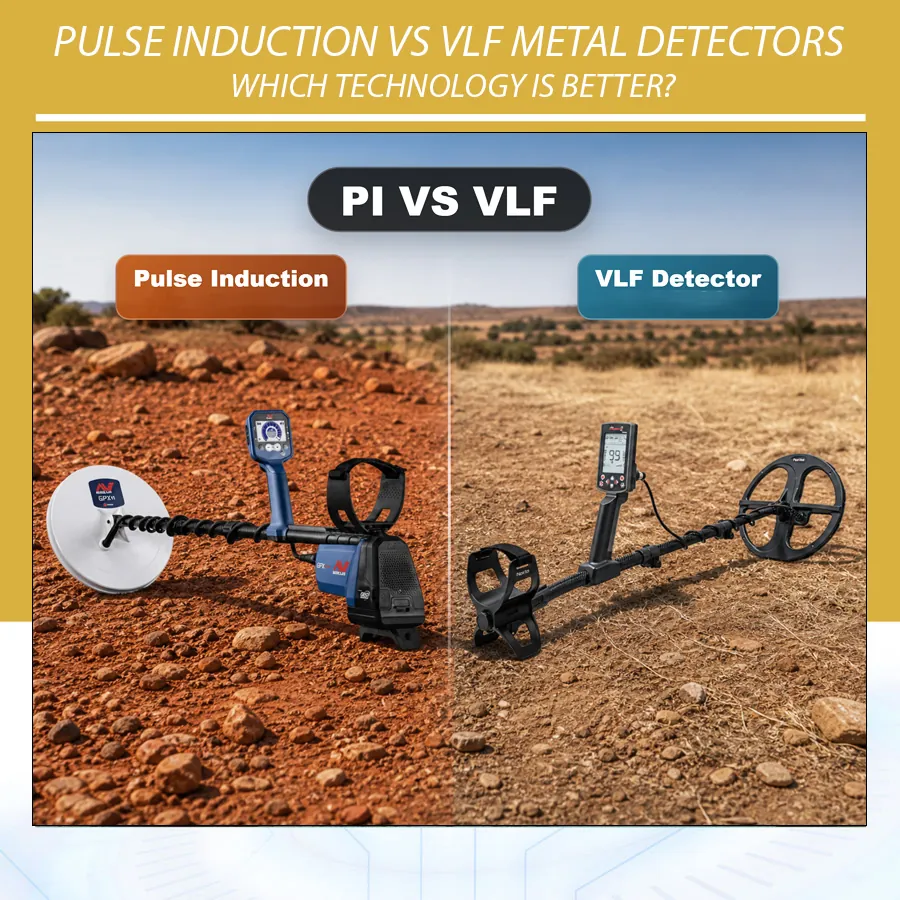
Pulse Induction vs VLF Metal Detectors: Which Technology Is Better?
The comparison between pulse induction vs VLF metal detectors is one of the most important questions buyers ask before choosing a serious detecting machine. It is also one of the easiest topics to misunderstand. Many new users hear that pulse induction detectors are “deeper,” while VLF detectors are “better for discrimination,” and they assume the decision is simple. In real field conditions, the better technology depends on the target, soil, budget, user skill, and the type of hunting you plan to do.
A gold prospector searching mineralized desert ground has different needs from a coin hunter working a park full of bottle caps. A relic hunter in iron-contaminated farmland needs different information than a treasure hunter searching for larger buried objects. Even two gold hunters may need different machines: one may be chasing tiny surface nuggets in bedrock cracks, while another is looking for larger nuggets or deeper gold-bearing targets in hot ground. That is why the question is not simply “Which technology is better?” The better question is: “Which technology is better for your ground and your target?”
This guide explains pulse induction vs VLF metal detectors in practical buyer language. It uses manufacturer information and examples of devices available through Orient Detectors, including Gold Monster 2000, The Legend 2, Gold Stinger X6, GPX 6000, Garrett Axiom, Nokta Magnetar 9000, and Minelab GPZ 8000. The goal is to help you choose confidently instead of buying based on one slogan about depth or frequency.
Quick Answer: Is Pulse Induction or VLF Better?
Pulse induction is usually better for highly mineralized soil, salt-affected ground, deep gold prospecting, and difficult goldfields where ordinary detectors become unstable. VLF is usually better for target identification, discrimination, coins, jewelry, relics, trashy areas, and small shallow targets when the soil is not too harsh. That quick answer is useful, but it is incomplete.
Modern VLF and simultaneous multi-frequency detectors have become much more capable than old single-frequency machines. A detector like the Gold Monster 2000 is not a basic VLF coin detector; it is a gold-focused simultaneous multi-frequency machine designed for fine gold and mineralized ground. A machine like The Legend 2 brings multi-frequency operation, Target ID, recovery speed, gold mode, and strong waterproof versatility into a lighter and more affordable package. Meanwhile, professional pulse induction detectors such as GPX 6000, Garrett Axiom, and Nokta Magnetar 9000 are built for harder ground and stronger depth performance, but they may not provide the same level of visual discrimination that a good VLF or multi-frequency detector provides.
So, when comparing pulse induction vs VLF metal detectors, the winner changes by scenario. If your main goal is natural gold in difficult mineralized ground, pulse induction often has the advantage. If your main goal is coins, jewelry, and relics in mixed trash, VLF or simultaneous multi-frequency is often the more practical choice. If you need one detector for many jobs, a multi-system detector such as Gold Stinger X6 may make more sense than limiting yourself to one technology category.
What Is a VLF Metal Detector?
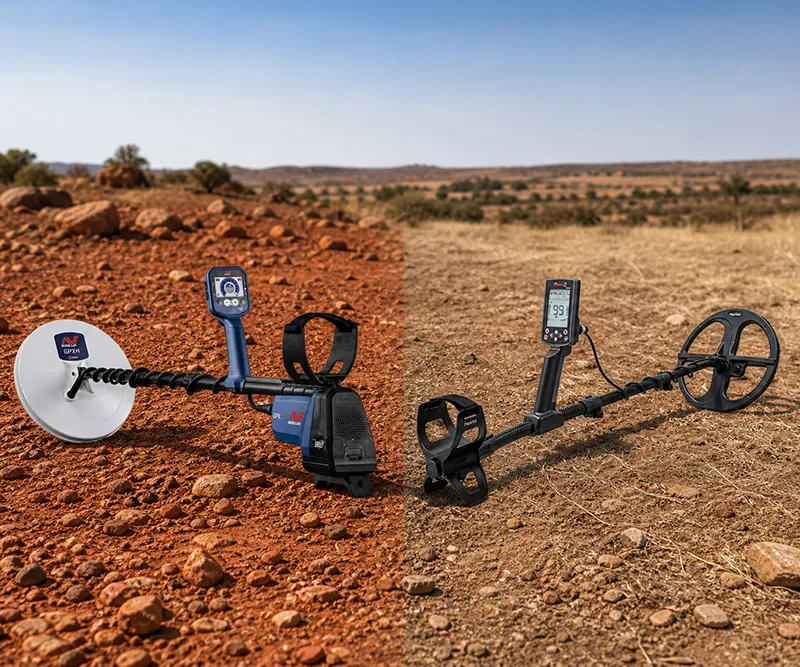
VLF means Very Low Frequency. A VLF metal detector transmits a continuous electromagnetic signal into the ground and receives the response from conductive or magnetic objects. By analyzing the phase shift and signal response, the detector can provide information about a target’s conductivity and, in many models, assign a Target ID number. This is why VLF detectors are common for coins, jewelry, relics, and general metal detecting.
VLF detectors are popular because they are responsive, relatively lightweight, energy efficient, and capable of useful target discrimination. They can often tell the difference between many types of unwanted iron and more desirable non-ferrous targets. They can also respond very well to small objects, especially when using higher frequencies or gold-focused operating modes.
Frequency matters. Lower frequencies generally penetrate better on larger conductive targets, while higher frequencies are more reactive to small low-conductive targets such as tiny gold nuggets. This is why a high-frequency gold VLF can be excellent for small gold, but may become noisy in mineralized ground if the ground balance and filtering are not strong enough. Modern simultaneous multi-frequency detectors improve on this by transmitting or processing multiple frequency ranges, giving the detector more information about both ground and target response.
Minelab explains in its education material that advanced detectors analyze conductivity and magnetic properties to produce target information, and that ground balancing helps reduce interference from soil minerals. That description matches the central strength of VLF-style detectors: they are not just “metal/no metal” machines. They are decision tools. When target ID and discrimination matter, VLF remains extremely important.
What Is a Pulse Induction Metal Detector?
Pulse induction, often shortened to PI, works differently. Instead of transmitting a continuous wave like a VLF detector, a pulse induction detector sends powerful bursts, or pulses, into the ground. After each pulse, the detector measures the decay response. Metal targets produce a response that can be detected during this decay period. Because the technology handles ground response differently, PI detectors can often operate more smoothly in mineralized ground, hot rocks, and salt conditions that may trouble standard VLF detectors.
This is the reason pulse induction has such a strong reputation among gold prospectors. Goldfields are often mineralized. Red soil, black sand, ironstone, volcanic rocks, salt flats, and variable ground layers can reduce VLF depth or produce constant false signals. A PI detector can ignore much of that ground response and maintain usable performance where a weaker detector becomes unstable.
However, PI is not magic. It does not automatically identify targets as accurately as the best VLF detectors. Many PI machines provide limited discrimination compared with VLF or simultaneous multi-frequency detectors. They can also be more expensive, heavier, more specialized, and less convenient for casual coin hunting in trashy public areas. Their strength is power and ground handling, not always target sorting.
This is where buyers often get confused. They hear that pulse induction is deeper, then assume it is better for everything. In reality, a deep signal is not always a useful signal. If you are working a trashy field and digging every deep nail, the deeper detector may cost you time. If you are prospecting in mineralized goldfields, that same deep and stable PI response can be exactly what you need.
Pulse Induction vs VLF Metal Detectors: Main Differences
| Factor | VLF / Multi-Frequency Detectors | Pulse Induction Detectors |
|---|---|---|
| Best general use | Coins, jewelry, relics, parks, fields, beaches, small gold | Gold prospecting, mineralized soil, salt ground, deeper larger targets |
| Target ID | Usually stronger and more detailed | Often limited compared with VLF |
| Discrimination | Generally better for rejecting iron and trash | Usually weaker; many targets require digging |
| Mineralized soil | Can struggle unless advanced ground balance or multi-frequency is used | Usually more stable in difficult mineralization |
| Small gold | Excellent with high-frequency or gold-focused models | Excellent on many goldfield PI models, especially modern designs |
| Deep gold | Good in mild soil, but more limited in harsh ground | Often stronger, especially on medium to large targets |
| Learning curve | Often easier for beginners, especially with target ID | Can require more audio discipline and digging judgment |
| Typical price | From entry-level to professional | Usually mid-range to premium professional |
Depth: Why PI Often Wins, but Not Always
Depth is the most common reason buyers compare pulse induction vs VLF metal detectors. Pulse induction detectors often have a real advantage in mineralized ground because they can maintain a more stable response while reducing ground noise. When the ground itself is loud, a detector does not lose performance only because the target is deep; it loses performance because the target signal is buried inside soil signal. PI technology can help separate the useful response from the ground better in many difficult goldfield conditions.
That said, depth depends on target size, target shape, soil, coil size, frequency or timing, sweep speed, and operator skill. A tiny gold flake does not respond like a large nugget. A coin on edge does not respond like a flat coin. A large buried object creates a stronger signal than a small isolated target. The same detector can produce very different results across different ground types.
A VLF detector can be impressively deep in mild soil, especially on coin-sized targets where good target ID remains usable. In clean farmland, parks, and low-mineral areas, a modern VLF or simultaneous multi-frequency machine may provide enough depth with better discrimination than a PI. But in hot rocks, red mineralized soil, black sand, and salt-affected areas, the VLF advantage may fade quickly.
Minelab’s material on mineralized soils explains that minerals can create excessive ground noise, distort target signals, and reduce detection depth. This is a crucial point. The deeper detector on paper may not be the deeper detector in your ground. A stable detector that lets you hear a repeatable target is often better than a powerful detector running too noisy to interpret.
Target Identification and Discrimination: Where VLF Usually Wins
Target ID is one of the main reasons VLF detectors remain so popular. A good VLF can assign a numerical ID based on the target response. It may also offer tone IDs, iron rejection, notch discrimination, recovery speed adjustment, and visual feedback. This allows a user to make better decisions before digging.
For coin hunting, jewelry hunting, and relic hunting, that information matters. In public parks, old home sites, farm fields, and beaches with trash, digging every target is not always practical. A user may want to reject small iron, identify coin ranges, listen for non-ferrous tones, and separate good targets from junk. A VLF detector will usually make that job easier.
The Legend 2 is a good example of this advantage. Nokta’s official product information highlights simultaneous multi-frequency detection, expanded 99 Target IDs, multiple search modes including Park, Field, Beach, Relic, and Gold, automatic/manual/tracking ground balance, frequency shift, noise cancellation, recovery speed, and advanced discrimination settings. Those features are exactly why VLF and multi-frequency machines remain strong for users who need target information, not just raw depth.
Gold Monster 2000 is another interesting example, although it is more gold-focused than general coin-focused. Minelab lists a 0-99 Target ID, 25 discrimination segments, Echo Wave Audio, high tones for gold, low tones for hot rocks or iron, and 12 to 76 kHz simultaneous multi-frequency operation. That makes it easier for beginners and developing prospectors to interpret small gold responses while managing mineralized ground.
Pulse induction detectors can identify some target behavior through audio strength, shape, repeatability, and response characteristics, but most do not match the fine target ID experience of modern VLF detectors. For professional prospecting, that may be acceptable because many gold hunters dig nearly every repeatable non-ground signal. For trashy coin hunting, it can be frustrating.
Mineralized Soil, Hot Rocks, and Salt: The Real Test
Mineralized soil is where the comparison becomes serious. In clean soil, many detectors look good. In difficult soil, the technology difference becomes more visible. Goldfields often contain iron-rich minerals, magnetic rocks, black sand, and conductive salts. These materials can imitate target signals, mask real targets, and reduce depth.
In a simple explanation, a VLF detector is constantly listening to both target response and ground response. Good ground balance reduces the ground signal, but extreme mineralization can still cause noise and target ID instability. A pulse induction detector samples the response after transmitted pulses and can ignore many types of mineral response more effectively. That is why PI is often preferred for serious gold prospecting in harsh ground.
Garrett Axiom is a useful PI example. Orient Detectors describes it as a gold prospecting detector using Garrett’s Ultra Pulse technology, with search modes such as Fine, Large, Normal, and Salt. The Salt mode is designed for mineralized areas with wet salt content and may also be useful in inland salt lakes and goldfields with high salt concentration. This kind of mode structure shows how PI machines are designed around difficult ground, not just “more depth.”
GPX 6000 is another strong example. Minelab describes its GeoSense-PI technology as analyzing ground and target signals in real time to reduce noise and maintain stable threshold and sharp responses to fine gold and large nuggets in mineralized soils. Orient Detectors also lists GPX 6000 as a professional gold detector for natural gold prospecting, small nuggets, buried relics, and gold treasure applications.
Nokta Magnetar 9000, as presented on Orient Detectors, is positioned as a professional pulse induction detector for serious gold prospecting, heavily mineralized soils, hot rocks, wet saltwater sand, deep gold caches, and micro-nuggets. Its listed package includes two DRC coils for different search priorities, which fits the professional PI pattern: one setup for sensitivity and another for deeper or broader coverage.
Small Gold Nuggets: VLF Sensitivity vs PI Stability
Small gold is one of the most interesting parts of the pulse induction vs VLF metal detectors debate. VLF detectors, especially high-frequency gold detectors, can be extremely sensitive to tiny gold. Small nuggets, flakes, and specimen gold often produce a sharper response at higher frequencies. This is why many prospectors still carry a small gold VLF, even if they also own a PI detector.
The Gold Monster 2000 is a strong example of a gold-focused VLF-style machine. Minelab’s official tech specs list 12 to 76 kHz simultaneous multi-frequency operation, Normal, Benign, and Difficult modes, automatic noise cancel, manual and automatic sensitivity, a 5-inch round DD coil, and very light 1.25 kg weight. The official FAQ clarifies that Gold Monster 2000 does not use pulse induction; it uses Multi-Au simultaneous multi-frequency technology. Minelab says Multi-Au uses higher frequencies that are more reactive to gold nuggets and ground balances mineralized soil better than Multi-IQ.
For shallow small gold, this type of detector is practical and efficient. A small coil can get close to bedrock cracks, exposed quartz, dry washes, and tight spaces between stones. The detector is light enough for long searching, and the user gets useful audio and visual information. In mild to moderately difficult ground, a gold-focused VLF can be a very smart choice.
Pulse induction detectors also detect small gold, especially modern goldfield PI machines. GPX 6000 is marketed around finding gold big or small, from sub-gram pieces to large nuggets, and Garrett Axiom includes Fine mode for small low-conductivity targets. The difference is that PI may hold stability better as ground gets more difficult. So the real decision is not only “small gold equals VLF.” It is “small gold in what ground?”
If the ground is mild and the gold is tiny, a high-frequency or gold-focused multi-frequency VLF can be excellent. If the ground is severe, hot, salty, or full of mineralized rocks, a PI may be easier to run and may hear more real gold through the noise.
Large Nuggets and Deep Targets: Why PI Becomes Attractive
When the target becomes larger and deeper, pulse induction often becomes more attractive. Larger nuggets, deep relics, gold-bearing masses, and buried metal objects require the detector to maintain signal strength at depth. In mineralized ground, a PI detector can often keep a clearer response than many VLF detectors.
GPX 6000, Garrett Axiom, and Nokta Magnetar 9000 all belong in this discussion. They are not casual park detectors. They are more relevant for users who are serious about goldfields, difficult terrain, and deeper or more challenging targets. A user who expects to dig repeatable signals and spend time interpreting audio may benefit more from a PI platform.
Minelab GPZ 8000 should also be mentioned carefully. It is not a conventional VLF detector and not described simply as ordinary PI. Minelab positions GPZ 8000 around GeoZVT technology, ground-optimized detection, and Z-Set concentric toroidal coils. The company describes it as a flagship gold prospecting detector for challenging ground, with superior performance on small to larger nuggets and strong performance in highly mineralized or conductive soils. For buyers comparing PI and VLF, GPZ 8000 represents a professional advanced goldfield category beyond a simple two-box comparison.
This matters because serious buyers should not force every detector into only two categories. Some modern gold detectors use proprietary technologies that are related to the same field problem: how to hear gold through mineralized ground. The practical buyer question remains the same: does the detector match your target size, soil conditions, depth needs, and budget?
Coins, Jewelry, and Relics: Why VLF Often Makes More Sense
If your main goal is coins, jewelry, and relics, VLF or simultaneous multi-frequency will usually be the better first choice. These targets are often found in places with trash. You need target ID, iron rejection, tone options, recovery speed, and the ability to decide what to dig. A PI detector may detect deeply, but it may also make you dig too much unwanted metal.
For coin and relic hunting, The Legend 2 is a more practical example than a pure PI gold detector. It has Park, Field, Beach, Relic, and Gold modes, waterproof construction, multiple frequency options, 99 target IDs, adjustable tones, discrimination settings, and recovery speed. This is the kind of feature set that helps users hunt selectively.
Minelab Manticore is another advanced multi-frequency option listed by Orient Detectors in the electromagnetic detector category. It is more relevant when the user wants sophisticated target information, strong separation, and a general-purpose detector that can handle many environments. In a trashy area, target ID and separation may matter more than maximum raw depth.
This is the part many buyers overlook. Better technology is not the technology that detects every piece of metal. Better technology is the one that helps you make the right digging decisions for your site. In trashy locations, discrimination is productivity. In goldfields, sensitivity and stability may be productivity. In deep treasure hunting, large-target detection and ground analysis may be productivity.
Beach and Salt Conditions
Salt introduces another layer to the pulse induction vs VLF metal detectors discussion. Wet salt sand and saltwater are conductive. Many simple VLF detectors become unstable in wet salt because the salt behaves like a broad conductive target. Multi-frequency VLF detectors can perform much better than older single-frequency machines because they can handle salt response more intelligently. Pulse induction detectors can also perform very well in salt conditions, especially when designed with salt modes or salt timing options.
If you mostly hunt beaches for jewelry, a waterproof simultaneous multi-frequency detector may be ideal because it offers target ID, discrimination, and salt handling in one practical package. The Legend 2, for example, is waterproof to 5 meters according to Nokta’s official specification and includes Beach mode and simultaneous multi-frequency operation. That makes it very attractive for beach users who still want target ID.
If you are searching difficult salt flats, mineralized wet ground, or goldfield salt conditions, a PI detector may make more sense. Garrett Axiom’s Salt mode and GPX 6000’s ability to handle salt-affected and mineralized ground are relevant examples. In short, beach jewelry and salt goldfields are not the same job. Choose technology based on the job, not the word “salt” alone.
Device Comparison from Orient Detectors
| Device | Technology Category | Best For | Buyer Notes |
|---|---|---|---|
| Gold Monster 2000 | Gold-focused simultaneous multi-frequency VLF-style technology | Fine gold, small nuggets, beginners, mineralized goldfields | Lightweight, simple, sensitive to small gold, stronger target information than many PI units |
| The Legend 2 | Simultaneous multi-frequency VLF platform | Coins, relics, jewelry, beach, small nuggets, general use | Excellent all-round choice when target ID and discrimination matter |
| Gold Stinger X6 | Multi-system detector | Mixed gold, metals, cavities, target scan, versatile field use | Useful for buyers who want more than one detection approach in one device |
| GPX 6000 | Pulse induction gold detector | Natural gold, mineralized soil, fine to large nuggets | Professional goldfield detector with strong ground handling and lightweight design |
| Garrett Axiom | Pulse induction gold detector | Gold prospecting, hot rocks, salt, mineralized ground | Multiple modes including Fine, Large, Normal, and Salt for varied conditions |
| Nokta Magnetar 9000 | Pulse induction professional detector | Serious gold prospecting, deep targets, harsh ground | Positioned for mineralized soil, hot rocks, saltwater sand, micro-nuggets, and deep gold |
| Minelab GPZ 8000 | Advanced GeoZVT goldfield technology | Professional gold prospecting, small to larger nuggets, difficult soil | Flagship-level option beyond simple VLF vs PI categories |
When to Choose a VLF Detector
Choose a VLF or simultaneous multi-frequency detector when you need target information. If your search area includes modern trash, iron, aluminum, bottle caps, pull tabs, foil, and mixed targets, target ID and discrimination can save hours. VLF detectors are also a strong choice for beginners because the screen and tones help users learn target behavior.
A VLF detector is also practical when budget matters. Many VLF and multi-frequency detectors cost less than professional PI gold machines, while still offering excellent performance for general detecting. If you want one detector for coins, jewelry, beach hunting, relics, and occasional gold prospecting, a versatile multi-frequency detector may be a smarter purchase than a specialized PI.
Choose VLF if your priorities include:
- Strong target ID and discrimination.
- Coins, jewelry, relics, and mixed metal detecting.
- Trashy search locations where selectivity matters.
- Lightweight everyday detecting.
- Lower to mid-range budget options.
- Small gold in mild to moderate ground.
- Waterproof beach versatility with simultaneous multi-frequency models.
For buyers on Orient Detectors, good VLF or multi-frequency directions include Gold Monster 2000 for gold-focused small nugget work and The Legend 2 for a broader all-terrain detecting style. Gold Stinger X6 is also relevant for users who want a broader multi-system approach rather than a conventional single-purpose detector.
When to Choose a Pulse Induction Detector
Choose a pulse induction detector when difficult ground is the main obstacle. If you prospect in red soil, black sand, basalt, ironstone, hot rocks, salt flats, or old goldfields where VLF machines chatter constantly, PI can be a better tool. It is especially important when you are searching for gold and are willing to dig more signals to avoid missing valuable targets.
PI detectors are also useful when deeper larger targets are part of the mission. A professional detector with the right coil can provide strong performance on medium to large nuggets and deeper metal objects. The tradeoff is that target discrimination may be limited, and the machine may cost more than a general-purpose VLF.
Choose pulse induction if your priorities include:
- Serious gold prospecting in mineralized ground.
- Better stability around hot rocks and black sand.
- Searching salt-affected goldfields or difficult wet ground.
- Medium to large nuggets at greater depth.
- Professional field use where digging repeatable signals is acceptable.
- Maximum practical performance in difficult soil over refined target ID.
On Orient Detectors, PI-relevant choices include GPX 6000, Garrett Axiom, and Nokta Magnetar 9000. GPZ 8000 belongs in the same professional goldfield conversation, although its GeoZVT technology should be understood as a specialized advanced system rather than a standard VLF or standard PI detector.
What About Multi-System Detectors?
Some buyers do not want a single technology answer. They want one device that covers multiple search styles: gold prospecting, general metal detection, long-range locating, target scan, cavity detection, or 3D-style support. This is where a detector like Gold Stinger X6 becomes part of the buying conversation.
Gold Stinger X6 is not best understood as a simple VLF alternative or PI alternative. It is a multi-system detector designed for users who want flexibility across different target types and search methods. For example, a user may want to search for natural gold in one location, larger buried metal in another, and potential cavities or voids in a third. A conventional VLF or PI machine may be excellent in its specialty but limited outside it.
Multi-system detectors require realistic expectations. They are not automatically better than a dedicated goldfield PI for gold nuggets or better than a premium VLF for target ID in trash. Their value is breadth. If the user’s work is varied and the targets are not limited to one category, a multi-system device can be a practical investment.
Price and Value: Do You Need to Spend More?
Price is another major factor in the pulse induction vs VLF metal detectors decision. Professional PI detectors usually cost more than many VLF detectors because they are built for demanding conditions and serious field performance. But a higher price does not guarantee better results for every buyer.
A beginner coin hunter may get more real value from a well-equipped VLF detector than from an expensive PI. The VLF will be easier to learn, easier to interpret, and better suited to target selection. A desert gold prospector in mineralized ground may waste time and miss gold with a cheap general-purpose detector, making a PI or advanced gold detector the better long-term value.
The right budget strategy is to match the machine to the job. If you hunt mostly parks, fields, farms, and beaches, buy target ID and versatility. If you hunt goldfields, buy ground handling and sensitivity. If you hunt deep treasure or mixed target classes, consider multi-system or advanced scanning options. The cheapest wrong detector is still expensive if it does not match your ground.
Beginner Recommendations
For beginners, the safest choice depends on the target. If the user wants coins, jewelry, and general detecting, a VLF or simultaneous multi-frequency detector is usually the best starting point. It teaches target ID, tones, discrimination, recovery speed, and ground balance without forcing the user to dig every signal. The Legend 2 is a strong example because it covers many search environments and has enough advanced controls to grow with the user.
If the beginner is specifically interested in small natural gold, Gold Monster 2000 is more targeted. It is light, automatic, gold-focused, and designed to simplify prospecting. It gives beginners useful information while still focusing on gold response. It is a better first gold detector for fine nuggets than many general-purpose entry detectors.
If the beginner’s ground is extremely mineralized and the budget allows, a modern PI with simplified controls may be considered. GPX 6000 is designed to make expert-level gold detecting easier through automatic features, while Garrett Axiom offers mode choices for different ground and target conditions. Still, a beginner should understand that PI detecting often depends more heavily on audio discipline and digging judgment.
Professional Recommendations
Professional users should begin with ground conditions and target class. For deep goldfields, mineralized desert terrain, and serious nugget work, PI and advanced goldfield technologies become more attractive. GPX 6000 is strong for users who want a lightweight professional PI focused on gold big or small. Garrett Axiom is strong for users who want mode flexibility, especially in mineralized and salt-influenced environments. Nokta Magnetar 9000 fits buyers looking for a professional PI system aimed at difficult ground and deeper work.
GPZ 8000 is relevant for high-end users who want flagship-level goldfield performance and are willing to invest in a specialized platform. Minelab’s official information emphasizes GeoZVT technology, ground-optimized detection, Z-Set coils, and performance in challenging mineralized and conductive soils. For serious prospectors, it is a premium category choice.
Professional relic hunters or coin hunters may still prefer advanced VLF or simultaneous multi-frequency machines. The reason is simple: professional does not always mean “deepest.” Professional means efficient for the job. In a trashy relic site, target separation, iron handling, and recovery speed may produce better results than raw PI depth.
Common Mistakes Buyers Make
Assuming PI Is Always Better
PI is powerful, but not automatically better for every task. If you hunt trashy areas, a PI may make you dig too much unwanted metal. For coins and jewelry, VLF target ID can be more valuable than PI depth.
Assuming VLF Cannot Find Gold
Many VLF and simultaneous multi-frequency detectors are excellent for gold, especially small gold. Gold Monster 2000 is designed specifically around gold response. The limitation is harsh mineralization, not the word VLF itself.
Buying for Maximum Depth Only
Depth without stability and target clarity is not useful. A detector that gives a faint false signal all day will not help you recover more good targets. Ground balance, coil choice, and audio quality matter.
Ignoring Coil Selection
A small coil can outperform a large coil in tight, rocky, or trashy ground. A larger coil can cover open ground and respond better to larger deep targets. The detector technology matters, but the coil shapes the field result.
Using the Wrong Detector for the Site
A park detector, nugget detector, deep PI, and multi-system scanner are not interchangeable tools. Each has a purpose. Start from the site and target, then choose technology.
Decision Guide: Which Technology Should You Buy?
| Your Main Goal | Better Technology Direction | Examples to Consider |
|---|---|---|
| Coins and jewelry in parks | VLF / simultaneous multi-frequency | The Legend 2, Manticore |
| Beach jewelry | Waterproof simultaneous multi-frequency VLF | The Legend 2, Manticore |
| Small natural gold in moderate ground | Gold-focused VLF / multi-frequency | Gold Monster 2000 |
| Gold in mineralized ground | Pulse induction or advanced goldfield technology | GPX 6000, Garrett Axiom, Nokta Magnetar 9000, GPZ 8000 |
| Hot rocks and salt-affected goldfields | Pulse induction | Garrett Axiom, GPX 6000, Nokta Magnetar 9000 |
| Mixed gold, metals, cavities, and varied targets | Multi-system detector | Gold Stinger X6 |
| Professional deep gold prospecting | Advanced PI or GeoZVT-style goldfield system | GPX 6000, GPZ 8000, Garrett Axiom, Nokta Magnetar 9000 |
Practical Field Tips for VLF Users
If you choose VLF, learn ground balance first. Many disappointing results come from users running sensitivity too high, ignoring ground noise, or trusting target ID too much at depth. In mineralized soil, target ID can become less stable, and a good target may not sound perfect. Reduce sensitivity until the detector is stable, use the correct search mode, and listen for repeatability.
Use smaller coils in trashy or highly mineralized areas. A smaller coil sees less ground at once, separates targets better, and can fit into tight places. Use larger coils when the ground is clean and you need coverage or depth on bigger targets. Keep the coil close to the ground, sweep slowly, and overlap your swings.
For gold-focused VLF detecting, pay attention to faint changes in threshold and repeatable tiny signals. Small gold may not produce a strong loud response. Practice with real test targets if possible. The more you understand your detector’s audio, the less dependent you become on screen numbers alone.
Practical Field Tips for PI Users
If you choose PI, be ready to dig more. This is not a weakness when gold prospecting; it is part of the method. Many PI users recover more gold because they are not rejecting uncertain signals too aggressively. However, that also means patience matters.
Start with the mode recommended for your ground. If the detector has Normal, Difficult, Fine, Large, or Salt modes, do not choose the most aggressive setting just because it sounds powerful. A stable mode can outperform a hotter mode if the hot mode produces too much noise. Minelab’s FAQ for advanced gold detectors repeatedly emphasizes that maximum-depth ground types are useful only in quieter soils; if the detector becomes unstable, switching to a difficult or salt-related setting may be better.
Coil control is critical. Keep the coil level. Avoid bumping rocks. Maintain consistent height. Investigate repeatable signals from more than one direction. Learn the difference between broad ground changes and compact target responses. A PI detector can be extremely capable, but the operator still makes the final decision.
FAQ: Pulse Induction vs VLF Metal Detectors
What is the main difference between pulse induction and VLF?
VLF detectors transmit a continuous electromagnetic signal and analyze phase and conductivity information, which helps with target ID and discrimination. Pulse induction detectors send powerful pulses and analyze decay responses, which often gives better stability in mineralized ground and better depth on certain targets.
Are pulse induction detectors deeper than VLF detectors?
Often, yes, especially in mineralized ground and on medium to large targets. But depth depends on target size, soil, coil, settings, and user skill. In mild soil, a good VLF can provide excellent usable depth with better target ID.
Are VLF detectors good for gold?
Yes. High-frequency and gold-focused simultaneous multi-frequency VLF detectors can be excellent for small gold. Gold Monster 2000 is a strong example of a gold-focused machine designed for fine gold and mineralized soil.
Why do many gold prospectors prefer pulse induction?
Goldfields are often mineralized. Pulse induction detectors usually handle hot rocks, black sand, salt, and harsh soil better than many VLF detectors, allowing users to hear targets more clearly in difficult ground.
Which is better for coins and relics?
VLF or simultaneous multi-frequency is usually better for coins and relics because target ID, discrimination, recovery speed, and tone options help users separate good targets from trash.
Which is better for beginners?
For general detecting, VLF is usually easier for beginners. For beginner gold prospecting, a gold-focused detector like Gold Monster 2000 can be a good starting point. PI can work for beginners too, but it usually requires more digging and audio learning.
Is GPZ 8000 a VLF or PI detector?
GPZ 8000 should not be treated as a standard VLF or standard PI detector. Minelab positions it around GeoZVT technology and ground-optimized detection for professional gold prospecting in challenging ground.
Can one detector do everything?
No detector is best at everything. Some multi-frequency and multi-system detectors are very versatile, but a specialized PI gold detector, a coin VLF, and a 3D scanner each solve different field problems.
Final Verdict: Which Technology Is Better?
The honest answer is that neither technology is universally better. In the debate of pulse induction vs VLF metal detectors, VLF wins when target ID, discrimination, affordability, lightweight handling, and general-purpose detecting matter most. Pulse induction wins when mineralized soil, hot rocks, salt-affected ground, and deeper goldfield performance matter most.
For coins, jewelry, relics, and mixed trashy locations, start with a VLF or simultaneous multi-frequency detector such as The Legend 2 or Manticore. For small gold and beginner-friendly prospecting, Gold Monster 2000 is a focused and practical choice. For serious mineralized goldfields, consider PI options such as GPX 6000, Garrett Axiom, or Nokta Magnetar 9000. For high-end professional gold prospecting beyond the simple PI/VLF comparison, GPZ 8000 belongs on the shortlist. For buyers who want a wider set of search systems in one unit, Gold Stinger X6 offers a different path.
The best detector is not the one with the most impressive technology name. It is the one that stays stable in your ground, responds to the targets you actually want, gives you enough information to make good dig decisions, and remains comfortable enough to use for long field sessions. Choose from the ground up: soil first, target second, technology third, brand and budget after that. That approach will lead to a better purchase than any simple claim about depth.
Suggested Links
- Best Gold Detectors for Desert Prospecting
- Gold Detector Depth: Real Performance Factors
- Best Gold Detectors for Mineralized Soil
- Metal Detector Depth Chart
- Best Metal Detectors for Ancient Coins and Relics