
KS-700 Review: Professional Ground Penetrating Radar for Cavities, Metal and Subsurface Surveying
This KS-700 Review examines the KS-700 ground radar from KS Analysis, a German ground penetrating radar system designed for subsurface investigation rather than ordinary hobby metal detecting. The device is promoted for cavity detection, archaeology, construction-related underground surveying, old tunnels, pipes, cables, manholes, mining-related voids, and metal detection in the ground. In other words, the KS-700 is not a simple coil detector. It is a radar-based survey instrument intended to visualize underground anomalies and help users make decisions from measurement data.
The most important thing to understand before evaluating the KS-700 is that ground radar behaves differently from a standard gold detector or metal detector. A typical metal detector responds to conductive targets through electromagnetic induction. A ground penetrating radar sends radar energy into the ground and reads reflections created by changes in material, density, structure, moisture, voids, and buried objects. This means a GPR can be useful for cavities and underground structures, but it also means interpretation is more technical. A radar image is not the same as a photograph of a buried object.
KS Analysis states that the KS-700 is designed especially for cavity localization and works according to the FMCW radar principle. The official product page describes it as a portable ground radar with 2D analysis on site, 3D analysis on site, simple control, battery operation, USB interface, and up to 40 m depth location in suitable conditions. The same page notes that in limestone, tunnels from World War II were located at up to 60 m, while also explaining that these were large tunnels. That distinction matters. Depth claims for GPR systems depend heavily on soil, rock, target size, moisture, conductivity, and the physical contrast between the target and the surrounding ground.
The purpose of this KS-700 Review is to present the device as an independent professional review, not as a sales brochure. the KS-700 has interesting strengths for users who need a portable ground radar, but it also requires careful measurement technique, realistic depth expectations, and proper data interpretation. For the right buyer, it can be a serious tool. For a casual treasure hunter expecting instant images of gold, it may be misunderstood.

What Is the KS-700?
the KS-700 is a portable ground penetrating radar system manufactured by KS Analysis in Germany. The company presents KS Analysis as a ground penetration radar specialist using German technology for construction, archaeology, geology, environmental studies, and subsurface exploration. The KS-700 sits below newer KS models such as the KS-800 and KS-900, but it remains a known model because of its focus on cavity detection and portable field use.
The device is described by KS Analysis as an FMCW ground radar. FMCW means frequency modulated continuous wave. In practical terms, this radar principle transmits a signal whose frequency changes over time, then compares transmitted and received signals to analyze reflections from underground structures. the KS-700 does not require different antennas for different depth ranges according to the manufacturer’s product page. Its antenna is described as shielded in all directions, directing signals toward the ground.
That design is important because many ground radar systems use different antennas depending on depth and resolution. Lower-frequency antennas usually penetrate deeper but offer lower resolution. Higher-frequency antennas show more detail near the surface but do not penetrate as deeply. KS Analysis presents the KS-700 as a system that avoids antenna exchange for different depths by using its FMCW approach. In review terms, that makes the device simpler to deploy, though users should still understand that resolution and depth are physical tradeoffs in all radar systems.
KS-700 Review: Quick Verdict
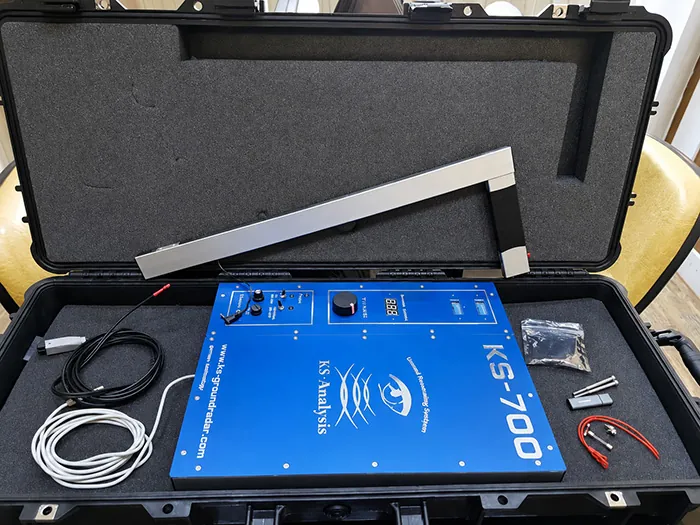
the KS-700 is best viewed as a professional portable ground radar for cavity detection, tunnel search, underground structure investigation, and survey-style work. It is most appropriate for archaeologists, construction survey teams, geophysical service providers, serious treasure hunters, and users who need to detect voids or underground features rather than only metallic targets.
Its strongest advantages are portability, one-person operation, 2D analysis, optional 3D visualization workflow, USB data transfer, a fixed shielded antenna, battery-powered field use, and a manufacturer support structure that includes analysis service and technical support. The ability to view measurement profiles during or shortly after the survey gives field teams faster feedback than purely offline systems.
The limitations are equally important. the KS-700 is not a magic imaging device. Ground radar performance depends strongly on geology. Wet clay, highly conductive soil, reinforced concrete clutter, shallow junk, and poor measurement grids can reduce usefulness. The device also requires disciplined scanning. If the operator does not mark the field, keep correct spacing, hold the unit straight, and repeat faulty scans, the data can become misleading. This is a professional instrument that rewards method.
Manufacturer Background
KS Analysis lists its address as Mühlgraben 13, D-99880 Waltershausen, Germany, with contact details on the official KS Groundradar website. The company website positions its systems around ground penetration radar, subsurface exploration, and German technology. The website also warns against counterfeit KS-700 products and says that counterfeit devices did not meet specifications and led to incorrect measurements. That warning should be taken seriously by any buyer considering this category.
From a professional review perspective, the counterfeit warning is important because high-value ground radar devices can attract imitation products. A buyer should verify the seller, warranty, training, and source before purchase. A GPR system is not just hardware. It is measurement method, software, support, and data interpretation. Buying an unsupported or counterfeit unit can make the device almost useless, even if it looks similar externally.
KS Analysis also advertises analysis service and technical support. The service page says the company can help evaluate measurement data, create measurement diagrams, coordinate measurement data, and position materials, caves, tunnels, lines, and similar underground objects on measurement diagrams. The same page mentions remote assistance, software installation, driver installation, configuration help, and settings help. This support layer is a major part of the value proposition because many GPR users need expert help interpreting the first projects.
Specifications Table
| Specification | KS-700 Details |
|---|---|
| Product name | KS-700 Ground Radar |
| Manufacturer | KS Analysis, Germany |
| Technology | FMCW ground penetrating radar |
| Main purpose | Cavity localization, metal detection, archaeology, utilities, tunnels, pipes, manholes, underground spaces |
| Depth claim | 0-40 m in solid ground according to KS Analysis; up to 60 m in limestone for large tunnel examples |
| Display / analysis | 2D analysis on site; 3D analysis workflow available through compatible software |
| Software | 2D visualization included; data can be exported to 3D software such as Voxler |
| Interface | USB |
| Power supply | 12 V / 18 Ah battery according to KS Analysis product page |
| Antenna | Fixed shielded antenna, described as shielded in all directions |
| Dimensions | Approx. 445 x 334 x 120 mm without handle according to technical index data |
| Weight | Approx. 5.1 kg according to technical index data |
| Portability | Person-portable |
| Training | Technical index lists training required as less than one week |
How the KS-700 Works
the KS-700 works as a ground penetrating radar rather than a conventional metal detector. The system transmits radar energy into the ground and evaluates reflections from subsurface changes. These reflections may come from cavities, old rooms, tunnels, geological boundaries, pipes, cables, metal objects, or other material changes. The result is a measurement profile that must be interpreted by the user or by a trained analyst.
KS Analysis says the KS-700 works according to the FMCW radar principle. FMCW radar is different from the impulse radar systems many people associate with GPR. Instead of sending short pulses and measuring return time directly, an FMCW system changes frequency over time and derives range-related information from the difference between transmitted and received signals. For buyers, the technical detail matters less than the practical result: the KS-700 is intended to create subsurface data without changing antennas for different depth ranges.
The manufacturer highlights that the KS-700 does not need different antennas. That simplifies field operation. A user can focus on grid design, measurement spacing, and software interpretation instead of changing antenna hardware. This is attractive for one-person field work or treasure-hunting teams that need a compact system.
Still, physics does not disappear. Deep penetration and fine resolution are always in tension. Large underground spaces are easier to recognize at depth than small objects. Conductive or wet ground can limit radar penetration. Dense clutter can confuse interpretation. A KS-700 Review must therefore treat depth claims as conditional, not guaranteed.
Depth Performance and Realistic Expectations
Depth is the most sensitive subject in any KS-700 Review because the manufacturer and reseller pages often mention large numbers. KS Analysis states that the KS700 can locate from 0 to 40 m in solid rock bodies. The official page also says tunnels from World War II were located in limestone up to 60 m, while clarifying that these tunnels were large, approximately 5 m wide and 7 m high.
That clarification is valuable. A large tunnel in limestone is not comparable to a small box, a single coin, or a narrow pipe in wet clay. Ground penetrating radar depends on contrast. A large air-filled void in limestone can produce a strong reflection. A small metal object in conductive soil may be harder to interpret. A buried pipe near other utilities may be visible, but classification still requires experience.
A professional buyer should read the 40 m claim as a best-case or suitable-condition working range for certain targets, not as a universal guarantee. For many real projects, useful depth may be less. That does not make the device weak. It simply means GPR should be used honestly. The goal is not to promise impossible certainty but to provide meaningful subsurface information where conditions allow.
The best way to evaluate depth is with a test site, known targets, and similar ground conditions to the intended search area. If the user wants to detect large tunnels, caves, or rooms in limestone or dry ground, the KS-700 may be a relevant tool. If the user wants to find very small items in wet, conductive soil, expectations should be conservative.
2D and 3D Analysis Workflow
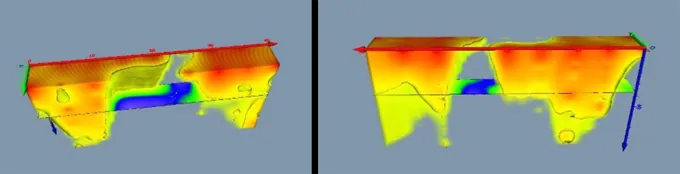
KS Analysis states that the KS-700 includes 2D visualization software and that measured data can be transferred into 3D software such as Voxler from Golden Software. The official product page explains that the software provides immediate representation of measurement images and that measurement profiles are shown in two dimensions. This helps the user understand the scan quickly on site.
For field work, 2D profiles are often the first useful layer. A user scans along lines, then looks for changes, reflections, patterns, and anomalies. If a suspicious feature appears consistently across multiple lines, the user can build confidence that it is not just noise. The 3D workflow is used when multiple profiles are collected across a grid and converted into a volume or surface-style visualization.
3D analysis can be helpful, but it can also create false confidence if the original data is poor. A beautiful 3D image does not guarantee a real target. Correct grid spacing, consistent movement, straight measurement lines, enough battery power, and proper data export are essential. The KS Analysis support page gives practical advice about marking the measurement field, remembering the starting point, maintaining correct spacing such as 2 m x 2 m or 5 m x 5 m, restarting after measurement errors, keeping the device straight, and ensuring adequate battery power.
This advice is important because it reveals the true nature of the KS-700. It is not a point-and-shoot treasure camera. It is a measuring system. The user creates the quality of the data by measuring correctly. The software can only visualize what the operator collects.
Applications: Where the KS-700 Makes Sense
KS Analysis lists several application areas for the KS-700, including archaeology with metal detection, contaminated site investigation, underground surveying for construction projects, cable and pipe surveying, manholes, mining-related damage and sinkholes, old underground rooms, galleries, tunnels, old corridors, and more. These are realistic GPR-style applications because they involve underground structures or material contrasts rather than only isolated small metal targets.
In archaeology, the KS-700 can help identify buried rooms, walls, voids, graves, corridors, or former construction lines. The advantage is non-destructive investigation. Instead of digging first, the team can scan, analyze, and choose excavation points more carefully. This can reduce damage and save time.
In construction, the KS-700 may support underground surveying before digging or building. Finding old pipes, cables, shafts, and manholes can prevent costly mistakes. A GPR scan is not a replacement for full engineering due diligence, but it can be an important investigation layer.
For treasure hunting, the KS-700 is most logical when the target is large or structural: tunnels, cellars, buried rooms, chambers, caches, old passages, or deep anomalies. It is less logical for someone searching for tiny gold nuggets or shallow coins. A conventional gold detector or metal detector is better for that job.
Field Procedure and Measurement Discipline
The KS Analysis support page provides useful field procedure guidance. It advises users to mark the measurement field, keep the starting point clear, maintain correct distances, restart if measurement errors occur, keep the measuring device straight, and monitor battery power. For first measurements in larger fields, the page mentions a larger measuring point distance, ideally 5 m measurement spacing and 2 m row spacing, while smaller fields under 20 m can begin with 2 m spacing.
This kind of detail matters because the best GPR system can produce weak results if the operator scans carelessly. If spacing changes from line to line, if the device is tilted, if the start point is lost, or if battery voltage drops too low, the resulting image may be inaccurate. Professional GPR is as much about procedure as hardware.
A practical review recommendation is to treat every KS-700 project as a survey. Before scanning, draw the area, mark the grid, decide line spacing, record field conditions, note soil type, and identify surface obstacles. During scanning, keep consistent movement and avoid changing method halfway through. After scanning, compare multiple profiles before making excavation decisions.
Strengths of the KS-700
The first strength is portability. the KS-700 is described as person-portable, and technical data from CBRNE Tech Index lists a weight of about 5.1 kg. That makes it manageable for one operator compared with larger cart-based GPR systems. For rough terrain, archaeology sites, fields, and remote locations, portability is a real advantage.
The second strength is the fixed antenna concept. KS Analysis emphasizes that the KS-700 does not require different antennas. For users who are not geophysical specialists, this makes the equipment easier to manage. Fewer hardware changes mean fewer chances for setup mistakes.
The third strength is application breadth. the KS-700 is promoted for cavities, metals, archaeology, cables, pipes, manholes, tunnels, old rooms, mining-related hazards, and construction investigations. A standard metal detector cannot cover all of those tasks.
The fourth strength is support and analysis service. KS Analysis says it can help analyze measurement data and create diagrams. For buyers who are new to GPR, support can be the difference between useful results and confusion. GPR interpretation is not always intuitive, so access to experienced help is valuable.
Limitations and What to Watch
The first limitation is interpretive complexity. the KS-700 creates measurement data, not automatic certainty. A scan may show an anomaly, but the operator must interpret whether it is a cavity, pipe, rock change, moisture boundary, metal object, or noise. Training is essential.
The second limitation is ground dependency. GPR works best in favorable conditions such as dry sand, limestone, rock, and lower-conductivity ground. It can struggle in wet clay, salty ground, highly conductive soil, or cluttered urban fill. Buyers should not assume that a 40 m claim applies to every site.
The third limitation is software workflow. 2D software is included according to KS Analysis, but 3D visualization may require additional software such as Voxler. Users should confirm exactly what is included in the purchased package, especially if they expect full 3D presentation.
The fourth limitation is authenticity risk. The manufacturer warns about fake KS-700 products. Buyers should verify they are buying from authorized channels and confirm warranty, training, support, and documentation.
Pros and Cons
| Pros | Cons |
|---|---|
| Portable FMCW ground radar suitable for one-person field use | Requires measurement discipline and interpretation skill |
| Designed for cavities, tunnels, underground rooms, utilities, archaeology, and metal-related searches | Depth depends heavily on soil, target size, moisture, and geological contrast |
| 2D analysis on site with export path to 3D visualization software | 3D software may not be included and should be confirmed before buying |
| Fixed shielded antenna avoids changing antennas for different depth ranges | Not a replacement for a small-target gold detector or casual metal detector |
| Manufacturer support includes data analysis and technical assistance | Counterfeit products are a known risk according to the manufacturer |
KS-700 Compared with Metal Detectors
Compared with a traditional metal detector, the KS-700 has a different purpose. A metal detector is usually better for coins, gold nuggets, jewelry, relic fragments, and small metallic objects. It gives fast audio response and can be used while walking naturally. the KS-700 is better for structural investigation, voids, tunnels, underground rooms, large features, and systematic scan data.
If a buyer wants to find gold nuggets in mineralized soil, the KS-700 is not the first tool to choose. A specialized gold detector is more practical. If a buyer wants to investigate whether an underground chamber, tunnel, pipe system, or cavity exists below a site, the KS-700 becomes more relevant.
Some professional treasure hunters may use both tools. A metal detector can confirm metallic signals near the surface or in accessible areas. A ground radar can investigate larger underground structures and voids. The two technologies answer different questions.
Who Should Buy the KS-700?
the KS-700 is suitable for users who need ground radar data and are prepared to learn proper scanning technique. Archaeology teams, survey contractors, serious treasure hunters, construction investigators, utility detection professionals, and geophysical service providers are the most realistic buyers.
It is less suitable for beginners who want instant treasure results. If a user is not willing to mark grids, scan methodically, interpret profiles, and possibly request expert analysis, the KS-700 may feel frustrating. It should be purchased as a professional measurement system, not as a shortcut.
A strong buyer profile is someone who already knows the search target type: a suspected underground room, tunnel, shaft, cavity, buried structure, old mine feature, or infrastructure line. The clearer the search question, the better the KS-700 can be used.
Frequently Asked Questions
Is the KS-700 a metal detector?
the KS-700 is better described as a ground penetrating radar. It can be used in searches involving metal, but its main value is subsurface imaging and cavity or structure detection rather than simple beep-and-dig metal detection.
How deep can the KS-700 detect?
KS Analysis states that the KS-700 can locate from 0 to 40 m in solid ground and mentions up to 60 m in limestone for large tunnel examples. Real depth depends on soil, moisture, target size, geological contrast, and measurement quality.
Does the KS-700 show 3D images?
the KS-700 includes 2D visualization according to KS Analysis. Data can be exported to 3D visualization software such as Voxler, but buyers should confirm exactly which software is included in their package.
Can one person operate the KS-700?
Yes, the device is presented as portable and suitable for field use by one person. However, larger survey areas are easier with a second person to help mark grids, record notes, and maintain measurement spacing.
Is the KS-700 good for treasure hunting?
It can be useful for serious treasure hunting when the target is a cavity, tunnel, buried room, cache area, or large underground anomaly. It is not the best choice for small nuggets, coins, or casual detecting.
What should buyers verify before purchase?
Buyers should verify authenticity, seller authorization, included software, training, warranty, battery package, data export options, and support access. The manufacturer warns about counterfeit KS-700 devices, so source verification is essential.
Final KS-700 Review Verdict
This KS-700 Review finds a device with a clear professional identity. the KS-700 is a portable FMCW ground penetrating radar designed for subsurface investigation, not a simple consumer metal detector. Its best use cases are cavity location, underground room and tunnel detection, archaeological scanning, construction investigation, utility-related searches, and serious survey-style treasure hunting.
The device’s value depends on using it correctly. When the site has favorable ground conditions, the target is large enough, and the operator follows a disciplined measurement method, the KS-700 can provide useful 2D and 3D-ready scan data. When the ground is difficult, the target is small, or the operator expects automatic certainty, results may disappoint.
For professionals and serious users, the KS-700 is worth considering because it combines portability, radar-based subsurface investigation, on-site analysis, USB data workflow, and manufacturer support. For casual hobbyists, it is probably too technical and too specialized. The best buyer is someone who understands that ground radar is a decision-support instrument: it does not remove the need for experience, but it can reveal underground patterns that ordinary detectors cannot see.