Metal Detector Discrimination Guide:
How to Filter Trash Without Missing Good Targets
Introduction: Discrimination Is Useful, But It Is Not Magic
Metal detector discrimination is the detector’s ability to accept or reject certain target responses. It helps users reduce iron trash, avoid some foil and pull tabs, and focus on the signals most likely to be coins, jewelry, relics, or gold. For beginners, discrimination sounds like the perfect solution: turn off bad targets and dig only good ones. In real detecting, it is more complicated.
The detector does not see an object the way your eyes do. It reads conductivity, size, shape, depth, orientation, nearby metals, soil minerals, and signal behavior. A rusty nail, gold ring, small nugget, thin coin, and aluminum trash can sometimes overlap. This means metal detector discrimination is a guide, not a guarantee.
This article explains how discrimination works, when to use it, when to avoid too much filtering, and how to match settings to your target. It includes examples from Orient Detectors devices such as Gold Stinger X6, The Legend 2, Minelab Manticore, Garrett ACE/Vortex-style detectors, Gold Monster 2000, and professional gold detectors such as Garrett Axiom.
What Is Metal Detector Discrimination?
Metal detector discrimination is a filtering system. The detector evaluates the target signal and decides whether to report it clearly, assign a tone, show a target ID, or silence/reject it. On many VLF and multi-frequency detectors, the user can reject iron ranges, accept coin ranges, or create custom notch patterns.
Discrimination works best in mild soil with isolated targets. It becomes less reliable when targets are deep, tilted, corroded, close to iron, or hidden in mineralized ground. A clean shallow coin may show a stable ID. The same coin near a nail may sound broken. A small gold ring may fall near foil. A nugget may sound weak and irregular. This is why experienced users listen to tone quality and repeatability, not just the number on the screen.
Discrimination, Target ID, Notch, and Iron Audio
| Feature | Meaning | Best Use |
|---|---|---|
| Discrimination | Rejects or accepts target ranges | Reducing iron and unwanted targets |
| Target ID | Numeric estimate of target conductivity | Judging coins, jewelry, and trash patterns |
| Notch | Accepts or rejects a specific ID segment | Filtering common trash ranges carefully |
| Iron Audio | Lets the user hear rejected iron tones | Understanding mixed targets and rusty iron |
A good user does not simply reject everything annoying. A good user adjusts metal detector discrimination according to the site. In a modern park, rejecting iron and some trash may save time. At an old relic site, too much rejection may cause missed artifacts. In goldfields, aggressive discrimination can be risky because natural gold signals are often weak and irregular.
Why Gold and Jewelry Make Discrimination Difficult
Gold is difficult because it appears in many forms. A large gold ring, thin chain, small nugget, earring, and natural flake can all respond differently. Some gold targets appear near foil, small aluminum, or low-conductive trash. If a beginner uses metal detector discrimination to reject all low IDs, they may reject gold too.
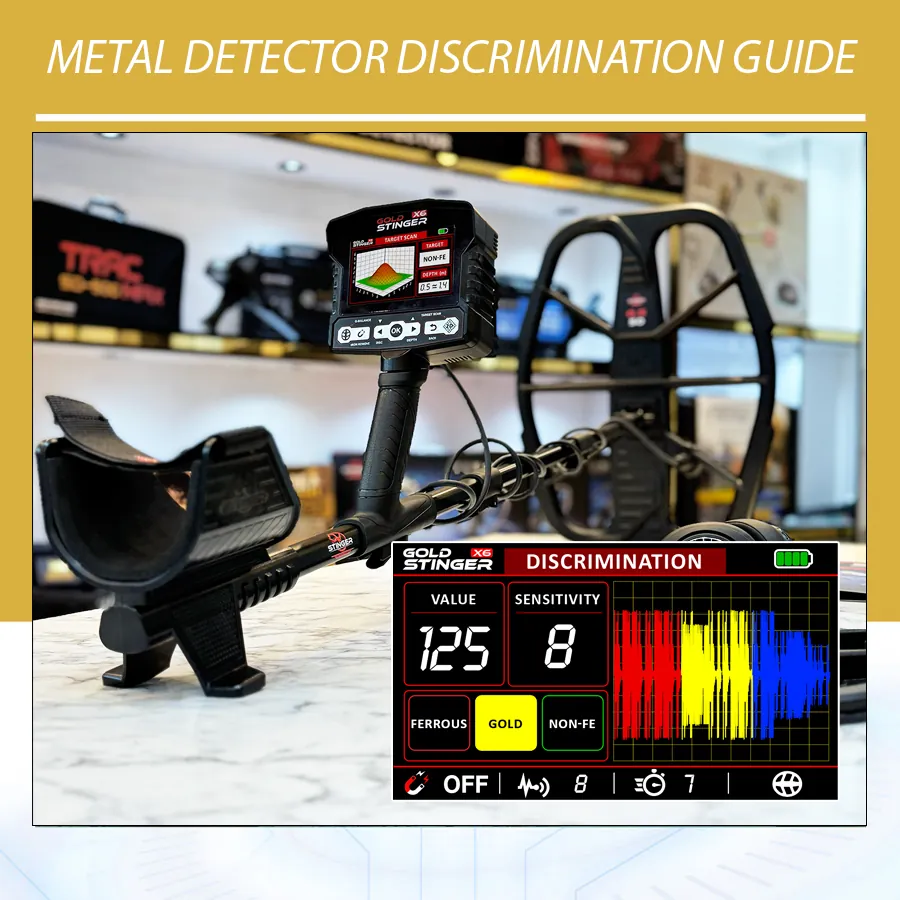
This is especially important for raw gold prospecting. Many nugget hunters prefer all-metal or minimal discrimination because small gold can sound weak, and mineralized ground can distort target response. Detectors such as Gold Monster 2000 focus on gold response and simplified operation. Gold Stinger X6 gives users all-metal search, discrimination, pinpointing, depth detection, and 2D target scan, making it more flexible when the user wants to compare signals.
When to Use More Discrimination
Use stronger metal detector discrimination when the site has heavy modern trash and your goal is mostly coins or common jewelry. Parks, picnic areas, sports fields, and modern beaches may contain pull tabs, bottle caps, foil, and iron. In these areas, a smart discrimination pattern can make the hunt more efficient.
Coin hunters often use tones and ID ranges to decide what to dig. Multi-frequency detectors such as The Legend 2 and Minelab Manticore can be useful because they provide detailed target information and modes for different environments. Beginners should still dig some uncertain signals at first. This builds a mental library of how trash and good targets sound in their local soil.
When to Use Less Discrimination
Use less discrimination when targets are old, deep, small, valuable, or surrounded by iron. Relic hunting, ancient coins, raw gold, and old settlement sites often reward patience. In these places, metal detector discrimination should be conservative. You may accept more trash because valuable targets can sound imperfect.
In mineralized soil, target ID may become unstable. In iron-infested sites, a coin can be masked by nearby nails. In goldfields, tiny nuggets may not give a clean signal. Reducing discrimination and using careful coil control can reveal targets that a heavily filtered program would miss.
How to Test Discrimination Before the Hunt
Create a simple test garden. Place coins, pull tabs, foil, nails, gold jewelry if available, and small brass or lead targets on the ground. Listen to each target in all-metal mode, then try discrimination. Change the target angle. Add a nail near a coin. Bury a target shallow. This shows how metal detector discrimination changes with depth, orientation, and nearby trash.
Do not memorize one number as always good or always bad. Target ID ranges shift between detector brands, frequencies, soil conditions, and target size. Instead, learn patterns: repeatable two-way signals, clean tone edges, consistent IDs, and how iron falses behave when checked from different angles.
Device Examples by Target Type
| Target Goal | Discrimination Strategy | Useful Device Direction |
|---|---|---|
| Modern coins | Moderate discrimination and target ID | The Legend 2, Minelab Manticore, Garrett coin detectors |
| Jewelry | Keep lower conductive ranges open | Multi-frequency detectors with beach and jewelry modes |
| Raw gold | Use minimal filtering and listen carefully | Gold Monster 2000, Gold Stinger X6, Garrett Axiom |
| Relics | Low iron rejection, dig uncertain repeatable targets | Gold Stinger X6, The Legend 2, Manticore |
| Deep targets | Avoid over-filtering weak signals | Gold Stinger X6, PI detectors, 3D scanners when needed |
Gold Stinger X6 and Discrimination
Gold Stinger X6 is relevant because it gives users a balanced set of search tools. It includes all-metal search for maximum signal awareness, discrimination for filtering, pinpointing for target location, depth detection for estimating depth, and 2D scan for visual checking. For users who search gold plus other targets, this is more flexible than a detector with only one basic mode.
The smart workflow is to begin with broader acceptance, then use discrimination to understand the signal. If the goal is raw gold, avoid rejecting too much. If the goal is coins in trash, use more filtering. If the site is mixed, compare all-metal and discrimination responses before making the dig/no-dig decision.
Common Mistakes
Rejecting Low Conductors
Many gold items and small jewelry targets can fall in low ranges. Rejecting all low signals may cost valuable finds.
Trusting Target ID Too Much
Target ID is useful but affected by depth, soil, angle, and nearby trash.
Using Park Settings in Goldfields
A program designed for modern trash may be too aggressive for natural gold.
Ignoring Audio Quality
Numbers matter, but tone repeatability, shape, and direction changes often tell a deeper story.
Discrimination Strategy by Search Environment
The best metal detector discrimination setting depends on where you are detecting. A clean field, a modern park, an old battlefield, a beach, and a goldfield all require different thinking. In a modern park, the user may want to reject obvious iron and listen for coin-like signals. In an old relic site, the same filtering can hide valuable targets because relics may be made of brass, bronze, lead, iron, or mixed alloys. On a beach, jewelry can fall across a wide ID range, so too much notch rejection may remove rings and earrings. In a goldfield, minimal filtering is usually safer because small natural gold may not sound perfect.
| Environment | Discrimination Level | Reason |
|---|---|---|
| Modern parks | Moderate | Useful for reducing iron and common trash while searching coins |
| Old relic sites | Low to moderate | Old targets may sound irregular or fall outside perfect coin ranges |
| Beach jewelry areas | Low | Gold rings, chains, and earrings can overlap with foil and pull tabs |
| Goldfields | Very low | Small nuggets can be weak, low-conductive, and affected by minerals |
| Heavy iron sites | Careful iron rejection | Too much rejection can mask good targets near nails |
How Coil Size Affects Discrimination
Coil size changes how the detector reads targets. A large coil sees more ground at once. That can improve coverage, but it can also blend signals when several targets are close together. In a trashy site, a large coil may hear a coin and nail at the same time, causing unstable target ID. A smaller coil can improve separation because it reads a smaller area under the coil. This often makes metal detector discrimination more useful in iron trash.
For Gold Stinger X6, the GS50 coil is useful for coverage and larger targets, while the GS30 coil is better for precision and tight ground. In a mixed site, the user may search with the larger coil first, then return with the smaller coil to inspect strong or confusing areas. The same principle applies to many VLF and multi-frequency detectors: match coil size to target density, not just desired depth.
How Soil Type Affects Discrimination
Mineralized soil can make metal detector discrimination less reliable. Red clay, black sand, volcanic rocks, and hot rocks can distort target signals. A target ID that is stable in mild ground may jump in mineralized soil. A deep coin may sound lower than expected. A rusty iron object may produce a high-tone false from one direction. This is why discrimination should be combined with ground balance and signal testing.
If the soil is difficult, use fewer assumptions. Sweep from multiple directions, raise the coil slightly, compare the signal in all-metal mode if available, and check whether the target has a consistent center. When the audio and ID disagree, dig some test targets to learn the site. In difficult soil, experience is more important than a perfect discrimination pattern.
Advanced Tip: Build a Local Target Library
Every region has its own common trash and valuable targets. A pull tab in one country, a bottle cap in another, and a certain coin alloy in another can behave differently. Beginners should build a small target library: coins, aluminum pieces, nails, foil, brass, lead, gold jewelry, and any local objects commonly found in the field. Test each item and record its tone and ID.
This local target library makes metal detector discrimination practical. Instead of copying settings from another user online, you create settings based on your soil, detector, and common targets. This is especially useful for dealers and training teams because it helps customers understand realistic performance before going to the field.
FAQ
Should beginners use discrimination?
Yes, but lightly at first. Beginners should dig a variety of signals to learn how their detector behaves.
Can discrimination identify gold?
No detector can guarantee gold by discrimination alone. Gold overlaps with many target types, especially foil and small aluminum.
Is all-metal mode better?
All-metal is useful for raw gold and deep targets because it gives more signal information. It also means more noise and more digging.
Final Verdict
Metal detector discrimination is best used as a decision aid, not a replacement for experience. Use it to reduce obvious trash, but do not let it hide weak, deep, or valuable targets. For coins and modern sites, discrimination is a time-saver. For gold, relics, and deep targets, use it carefully and confirm signals from multiple angles.