Best Gold Detectors for Small Nuggets: Complete Buyer Guide
Introduction: Small Gold Needs a Different Kind of Detector
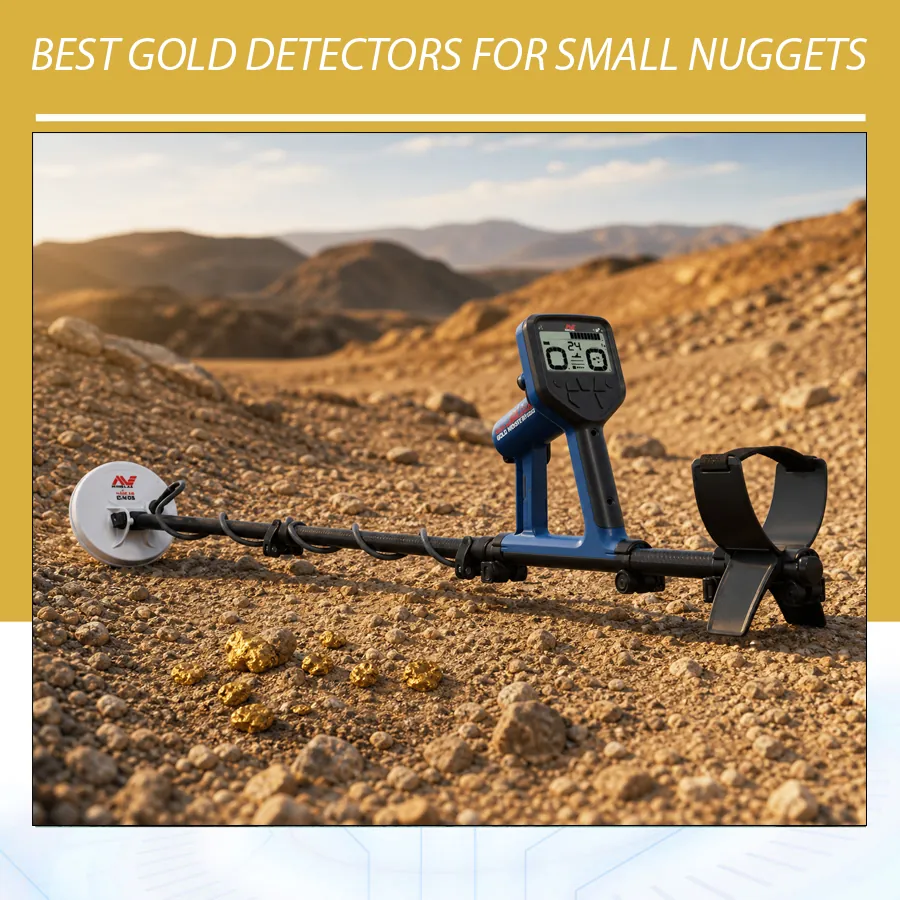
Searching for tiny gold is one of the most demanding forms of metal detecting. A large coin, ring, relic, or buried metal object can produce a strong response, but a sub-gram nugget or fine piece of natural gold gives a much weaker signal. That signal may be hidden by mineralized soil, hot rocks, salt, electromagnetic noise, poor coil control, or the wrong detector technology. This is why choosing the best gold detectors for small nuggets is not the same as choosing a general metal detector.
Many buyers ask, “Which gold detector goes deepest?” That question is understandable, but it can be misleading when the target is small natural gold. For small nuggets, the better question is: “Which detector gives the clearest response to low-mass gold in difficult ground?” Depth still matters, but sensitivity, frequency, ground balance, coil size, audio response, and operator control matter even more.
This guide compares small-nugget detectors using examples available through Orient Detectors only. We will focus on devices such as Gold Monster 2000, Gold Kruzer, Garrett Gold Master 24K, Minelab GPX 6000, Garrett Axiom, GPZ 8000, Gold Stinger X6, and selected multi-purpose detectors that can serve beginners or developing prospectors. The goal is to help buyers choose a device that fits real goldfields, not just product-page promises.
Quick Answer: What Are the Best Gold Detectors for Small Nuggets?
The best detector depends on your soil, experience, and budget. For beginners focused on fine gold, Gold Monster 2000 is one of the strongest choices because it is lightweight, automatic, gold-focused, and designed for small target sensitivity. For high-frequency VLF performance, Gold Kruzer and Garrett Gold Master 24K are strong options because they operate at high frequencies that respond well to small gold. For more difficult mineralized ground, GPX 6000 and Garrett Axiom are better choices because pulse induction technology handles challenging soil more effectively. For advanced users who want premium goldfield performance, GPZ 8000 sits in a higher professional category.
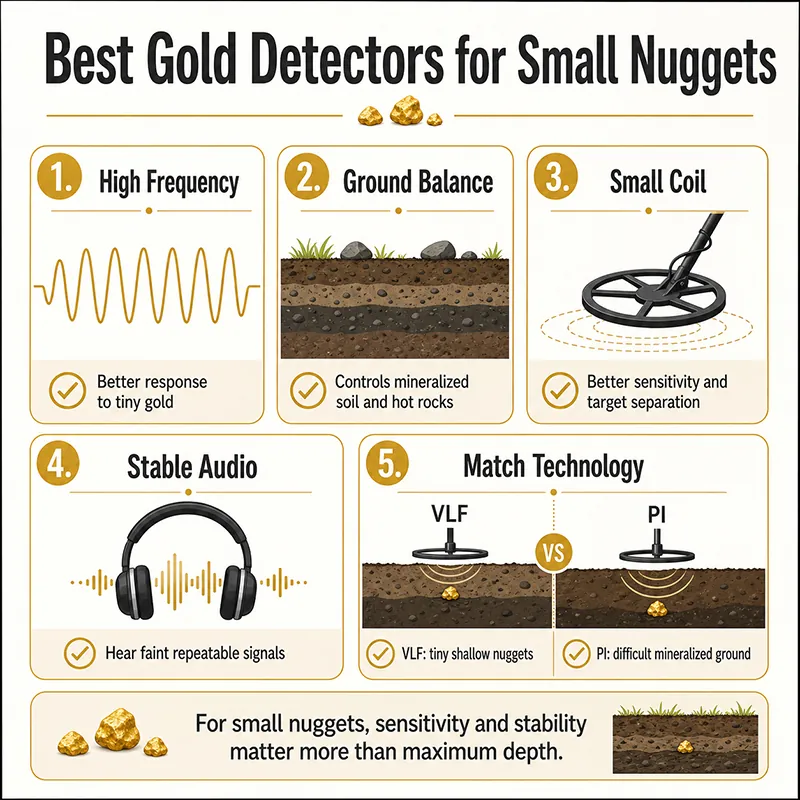
In practical terms, the best gold detectors for small nuggets are usually the detectors that combine three things: high sensitivity to tiny targets, stable ground handling, and clear audio that helps the user hear weak repeatable signals. A detector that is unstable will make small gold harder to recognize, even if its specifications look powerful.
Why Small Nuggets Are Hard to Detect
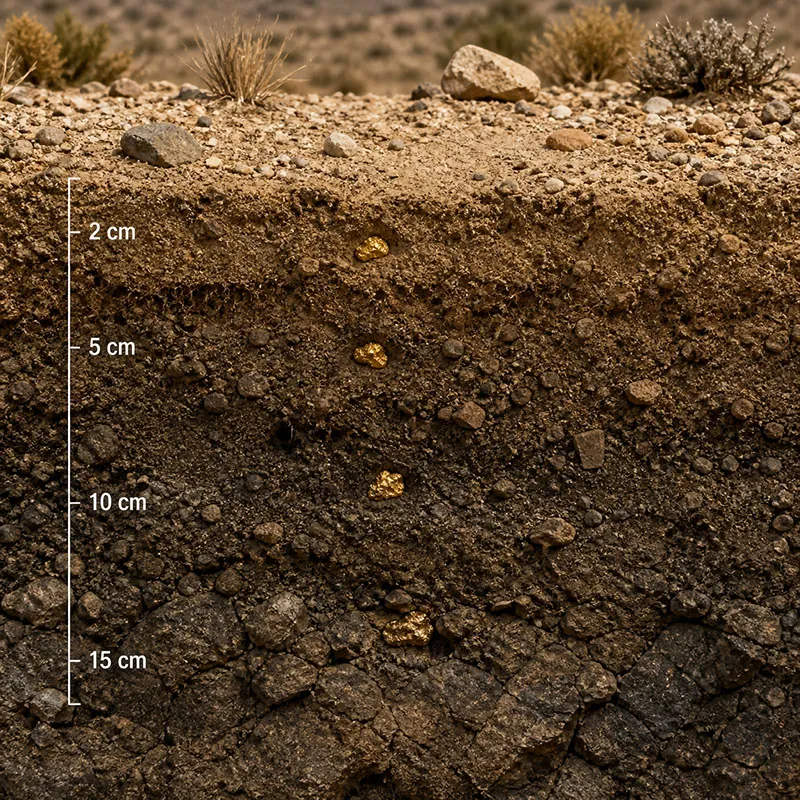
Small gold is difficult because it has low mass. The less metal there is, the less electromagnetic response the detector receives. A half-gram nugget, a wiry flake, or a porous piece of gold trapped in quartz can produce a very different response than a solid coin. Shape also matters. A flat flake may respond differently from a round nugget of the same weight. Orientation in the ground matters too; a target standing edge-on may sound weaker than the same target lying flat.
Soil makes the challenge harder. Gold-bearing areas often contain iron minerals, black sand, hot rocks, magnetic soil, or variable ground conditions. These natural minerals can produce signals of their own. A detector must separate the target response from the ground response. If it cannot, the operator hears noise instead of useful information.
This is why tiny gold prospecting rewards patience. The best gold detectors for small nuggets do not magically turn every tiny flake into a loud signal. They improve the odds by giving you a stable threshold, sensitive response, useful ground balance, and coils that can work close to rocks, cracks, washes, and exposed bedrock.
The Main Features That Matter for Small Gold
1. High Frequency or Gold-Focused Multi-Frequency
Higher frequencies are usually more sensitive to smaller gold. A high-frequency VLF detector can respond well to sub-gram targets, flakes, and small nuggets that lower-frequency coin detectors may miss. Nokta lists the Gold Kruzer at 61 kHz, while Garrett highlights the Gold Master 24K at 48 kHz. Minelab lists Gold Monster 2000 with 12 to 76 kHz simultaneous multi-frequency using Multi-Au technology, designed specifically for gold response.
However, frequency alone is not enough. A very high-frequency detector can become noisy if ground balance is weak or if the soil changes constantly. The best performance comes from high sensitivity plus good mineral handling. That is why buyers should avoid judging a detector by frequency alone.
2. Ground Balance and Tracking
Ground balance is essential for nugget hunting. If the detector is constantly reacting to soil minerals, the operator may miss the faint signal of small gold. Automatic tracking ground balance can help beginners because the detector adapts as soil changes. Manual ground balance is useful for experienced users who want more control.
Gold Monster 2000 uses automatic and manual ground balancing systems, while Garrett Gold Master 24K uses XGB auto-tracking ground balance. Gold Kruzer offers automatic, manual, and tracking ground balance. GPX 6000 uses GeoSense-PI technology to analyze ground and target signals in real time. These systems are not marketing extras; they are central to making small-nugget signals readable.
3. Small and Sensitive Coils
Small coils are extremely useful for tiny gold. They can work closer to rocks, bedrock cracks, shrubs, tight spaces, and uneven ground. They also improve target separation and can make very small signals easier to isolate. Gold Monster 2000 includes a 5-inch round Double-D coil, which is especially relevant for small gold work. Gold Kruzer includes compact waterproof coils, including a 19 x 10 cm DD coil, useful for tight mineralized ground.
Large coils are not always better for small nuggets. They cover more ground and may improve depth on larger targets, but they can be less sensitive to tiny shallow gold and harder to control in rough terrain. The best gold detectors for small nuggets often perform best with smaller coils because small gold is usually found by careful, slow searching rather than fast coverage.
4. Clear Audio and Stable Threshold
Small gold often sounds faint. A tiny nugget may not produce a bold, obvious tone. Instead, it may create a small break in the threshold or a short repeatable response. Clear audio helps the user recognize those signals. Good headphones also matter because wind, footsteps, and outdoor noise can hide weak targets.
Minelab’s Gold Monster 2000 uses Echo Wave Audio with high tones for gold and low tones for iron or hot rocks. GPX 6000 emphasizes clear audio and sharp response in mineralized soils. Garrett Gold Master 24K offers audio modes that help users hear subtle target changes. For small nuggets, audio quality is not a luxury. It is part of the detection system.
5. Lightweight Design
Small nugget hunting requires slow, patient coil control. You may spend hours sweeping close to the ground, checking bedrock cracks, and re-scanning weak signals from different angles. A heavy detector causes fatigue, and fatigue causes bad technique. Bad technique misses small gold.
Gold Monster 2000 weighs about 1.25 kg according to Minelab’s technical specifications. Gold Kruzer is listed by Nokta at 1.4 kg. GPX 6000 weighs 2.1 kg, which is still light for a professional PI detector. The best detector is the one you can swing correctly for long sessions.
Comparison Table: Small Nugget Detector Options
| Detector | Technology | Best For | Small Nugget Strength | Best Buyer Type |
|---|---|---|---|---|
| Gold Monster 2000 | Multi-Au simultaneous multi-frequency | Fine gold, small nuggets, beginner prospecting | Excellent fine-gold sensitivity, automatic handling, 5-inch DD coil | Beginner to intermediate gold prospector |
| Gold Kruzer | 61 kHz VLF | Tiny nuggets, micro jewelry, hot-rock areas | Very high frequency, waterproof design, multiple search modes | Gold-focused user who wants high-frequency control |
| Garrett Gold Master 24K | 48 kHz VLF | Small nuggets, flakes, mineralized river gravel | High frequency, XGB ground balance, strong small gold response | Entry to intermediate nugget hunter |
| Minelab GPX 6000 | GeoSense-PI | Small to large gold in mineralized ground | PI stability, fine-gold response, strong performance in difficult soil | Serious prospector |
| Garrett Axiom | Pulse induction | Goldfields, mineralized soil, difficult terrain | Better mineral handling than most VLF detectors | Professional or advanced gold hunter |
| GPZ 8000 | Advanced goldfield detector | Professional gold prospecting | Premium goldfield performance for varied target sizes | Advanced professional buyer |
| Gold Stinger X6 | Multi-system metal detector | Gold, coins, relics, mixed targets | Good flexible option, especially when user wants more than nugget hunting | Beginner who wants versatility |
1. Gold Monster 2000: Best Overall for Beginners Hunting Small Nuggets
Gold Monster 2000 is one of the most practical choices for small natural gold because it is built around fine-gold sensitivity and simplified operation. Minelab lists the detector with Multi-Au technology, 12 to 76 kHz simultaneous multi-frequency operation, Normal, Benign, and Difficult search modes, automatic noise cancel, manual and automatic sensitivity, 0-99 target ID, 25 discrimination segments, Echo Wave Audio, and a 5-inch round Double-D coil.
Those specifications matter because beginners often struggle with exactly the conditions small gold creates: faint responses, noisy ground, hot rocks, and uncertainty about whether a target is worth digging. Gold Monster 2000 does not remove the need for practice, but it reduces the burden of constant adjustment. Automatic operation helps the user focus on sweep control and signal repeatability.
Gold Monster 2000 is among the best gold detectors for small nuggets because it is specialized without being intimidating. Its small coil is useful around bedrock, narrow washes, shallow gullies, and tight rocky ground. Its light weight makes it realistic for long sessions. Its target ID and audio feedback give new users more confidence than a detector that only produces vague tones.
The limitation is depth on larger targets. Gold Monster 2000 is not a deep treasure detector, a 3D scanner, or a replacement for professional PI systems in extreme ground. Its strength is small-gold hunting, especially for users who want to start correctly.

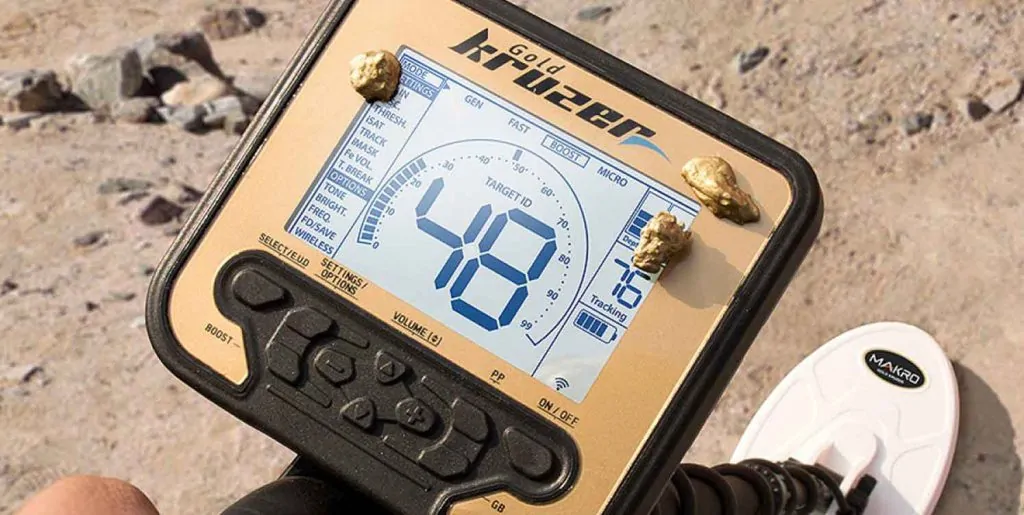
2. Gold Kruzer: Best High-Frequency VLF Detector for Tiny Gold
Gold Kruzer is a strong small-gold option because Nokta designed it around high-frequency VLF performance. The official Nokta page lists a 61 kHz operating frequency, IP68 waterproof rating up to 5 meters, four search modes, automatic/manual/tracking ground balance, target ID, frequency shift, pinpoint, and lightweight 1.4 kg build. Nokta describes it as a gold and micro-jewelry detector with sensitivity to tiny nuggets.
This makes Gold Kruzer a good choice for users who want more hands-on control than a highly automatic beginner detector. It can be useful in harsh ground and around hot rocks, but like all high-frequency VLF machines, it rewards careful tuning. The user must learn gain, ground balance, search modes, and audio response.
Gold Kruzer belongs on any list of the best gold detectors for small nuggets because 61 kHz is highly relevant to tiny gold. It is especially attractive for prospectors who want a compact, waterproof, gold-focused VLF detector that can also work on micro jewelry. If your terrain includes wet ground, river edges, or rough field conditions, its waterproof design is a useful advantage.
3. Garrett Gold Master 24K: Best High-Frequency Option with XGB Ground Balance
Garrett Gold Master 24K is another excellent high-frequency choice. Garrett’s river prospecting guidance highlights the 48 kHz operating frequency, XGB auto-tracking ground balance, waterproof DD coil, and audio modes for identifying subtle gold signals in mineralized riverbed gravel and sand. Orient Detectors also lists it in the electromagnetic detector category as a prospecting detector from Garrett.
The 48 kHz frequency gives the detector strong sensitivity to small gold, while XGB tracking helps manage changing mineral conditions. This combination is exactly what small-nugget hunters need. Fine flakes and small nuggets can disappear into ground noise if the machine is not stable.
Gold Master 24K is one of the best gold detectors for small nuggets for users who want a focused VLF detector with professional-style ground handling at a more accessible level than larger PI platforms. It is particularly suitable for prospectors working river gravels, dry washes, shallow bedrock, and areas where tiny gold is more common than large nuggets.

4. Minelab GPX 6000: Best Upgrade for Mineralized Goldfields
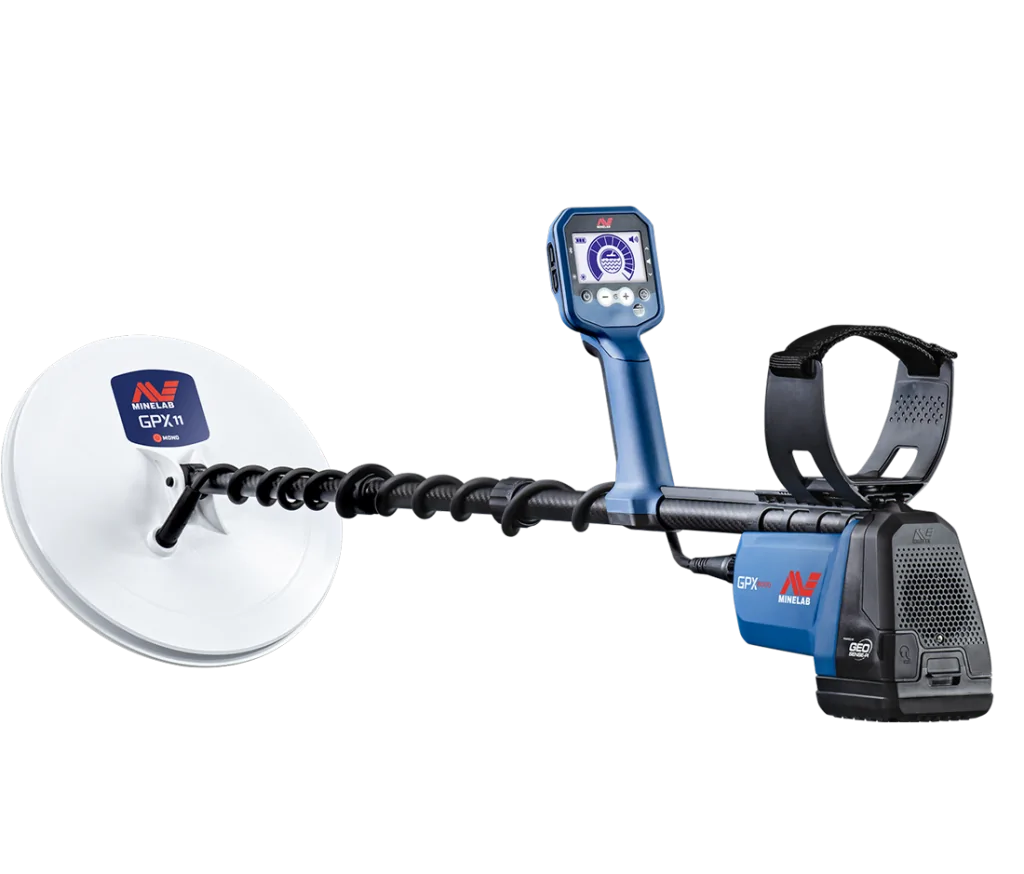
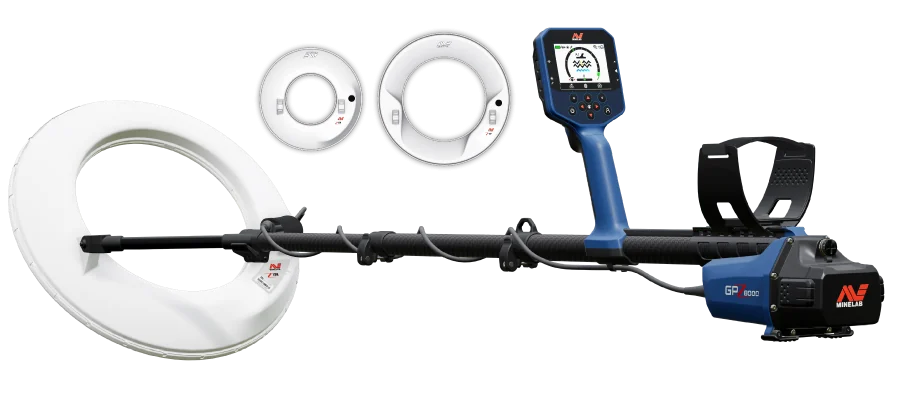
GPX 6000 is a different kind of machine. It is not simply a small gold VLF detector; it is a professional pulse induction gold detector built for difficult environments. Minelab describes GPX 6000 as using GeoSense-PI technology for real-time ground analysis, improved stability in mineralized soils, automatic ground balance, automatic noise cancel, and detection of sub-gram gold through larger deeper nuggets. It weighs about 2.1 kg and uses waterproof coil options.
For small nuggets in mild ground, a high-frequency VLF detector can be excellent. But in more severe mineralized ground, PI technology often becomes the better choice because it handles mineralization more effectively. GPX 6000 is especially useful when the user wants to keep sensitivity to fine gold while reducing the instability that difficult soil creates.
GPX 6000 is one of the best gold detectors for small nuggets for serious users who have the budget and field commitment to justify it. It is easier to use than many older professional gold machines, but it is still a major investment. Beginners should consider it if they are committed to gold prospecting and know they will work difficult goldfields often.
5. Garrett Axiom: Strong PI Choice for Difficult Ground
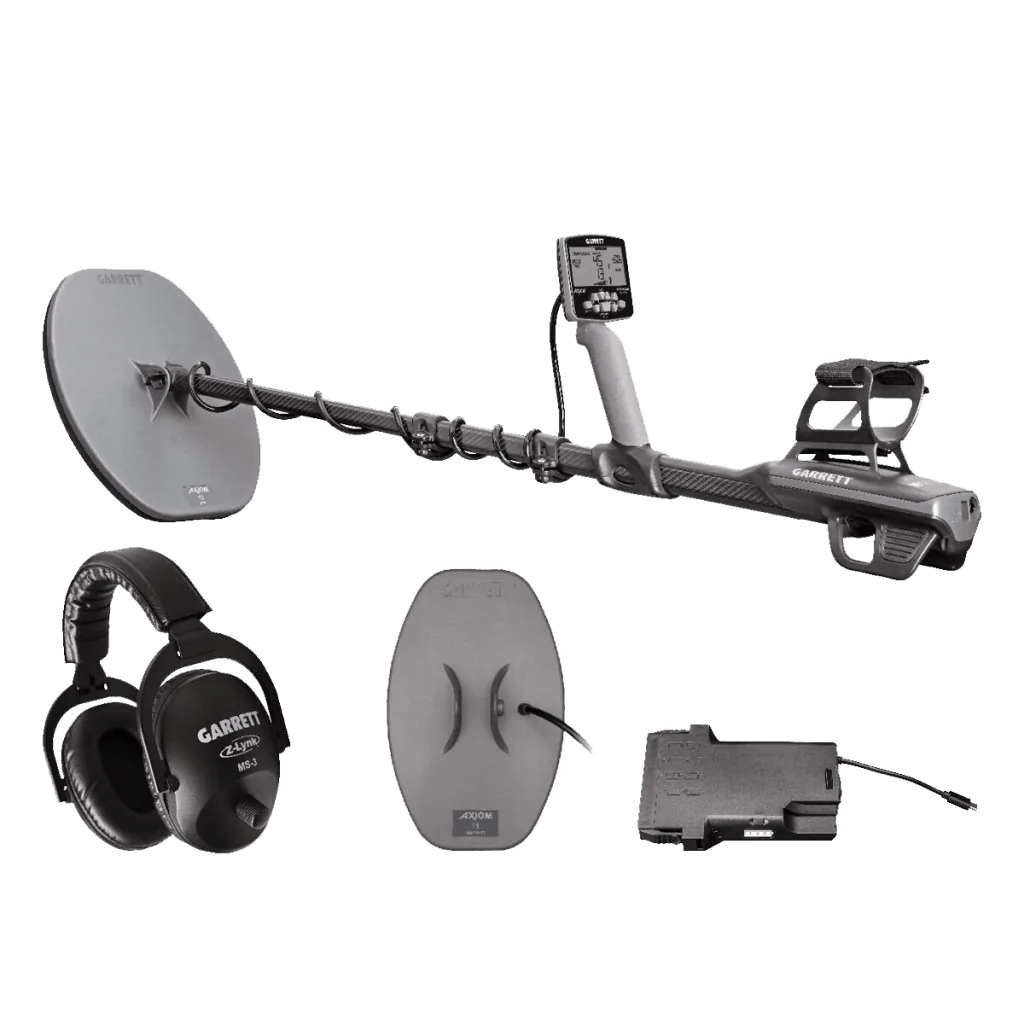
Garrett Axiom is a professional PI detector designed for gold prospecting and mineralized conditions. It fits users who want a high-performance goldfield detector that can handle soil where standard VLF machines struggle. While high-frequency VLF detectors are excellent for tiny shallow gold, Axiom is more appropriate when the soil itself is the biggest problem.
The value of a PI detector for small gold is not that it always beats high-frequency VLF on the tiniest shallow pieces. Its value is stability in difficult ground. A faint gold response that remains clear in bad soil is more useful than a theoretically sensitive detector that chatters constantly. For advanced prospectors, this is a major reason to consider PI technology.
6. GPZ 8000: Premium Choice for Advanced Prospectors
GPZ 8000 belongs in the professional category. It is not the first machine most beginners should buy, but it is relevant for serious gold hunters who want top-tier capability across different nugget sizes and ground conditions. Advanced machines like this make sense when the buyer has field experience, a strong prospecting plan, and enough budget to justify a premium detector.
For tiny nuggets specifically, the user still needs correct coil choice, ground settings, and careful technique. A premium detector is not a shortcut around field skill. It is a tool that becomes more valuable as the operator becomes more skilled. For professional buyers comparing the best gold detectors for small nuggets, GPZ 8000 is best considered a long-term investment rather than a casual starter device.
7. Gold Stinger X6: Best Versatile Option for Beginners Who Want More Than Nuggets
Gold Stinger X6 is not a dedicated high-frequency gold-only detector in the same way as Gold Monster 2000, Gold Kruzer, or Gold Master 24K. Its appeal is versatility. Orient Detectors presents it as a multi-system metal detector with six search systems, including all-metal, discrimination, pinpointer, depth detection, 2D target scan, and cavity/void detection. It also includes two coils, including a larger GS50 coil and a smaller GS30 coil.
This makes Gold Stinger X6 useful for buyers who want to search for gold but also want one device for coins, relics, mixed metal targets, and practical depth work. If your only goal is the smallest flakes of natural gold, choose a more specialized gold detector. If you want a broader first machine that can cover multiple field goals, Gold Stinger X6 deserves consideration.
In other words, Gold Stinger X6 is not the narrow winner for micro nuggets, but it may be the better overall purchase for a beginner whose interests are not yet fixed. The best gold detectors for small nuggets should always be matched to the user, not only to the target.

VLF vs PI for Small Gold Nuggets
VLF detectors and PI detectors solve different problems. High-frequency VLF detectors are very sensitive to small targets, which makes them excellent for tiny gold in mild to moderate soil. They usually offer target ID and discrimination, making them easier for beginners to understand. Their weakness is that mineralized soil can reduce stability and depth.
PI detectors are stronger in mineralized ground and can perform better on larger, deeper gold. Modern PI machines such as GPX 6000 and Garrett Axiom can also detect small gold well, especially compared with older PI units, but they are more expensive and may not provide the same style of target ID as VLF detectors.
For most beginners looking for tiny gold, a gold-focused VLF or gold-focused multi-frequency detector is the most logical start. For serious prospectors in difficult goldfields, PI becomes more compelling. The best gold detectors for small nuggets are not always from one technology category; they are the devices that match the ground you actually search.
How Coil Size Affects Small Nugget Detection
Coil size has a direct effect on small nugget performance. A small coil concentrates the detection field and can respond more clearly to tiny targets near the surface. It also improves control in tight ground. If you are searching bedrock cracks, dry washes, rocky slopes, or exposed mineralized patches, a compact coil is often better than a large coil.
A larger coil covers more ground and may detect larger nuggets deeper, but it can miss tiny shallow gold or make it harder to isolate weak targets. Many beginners assume the largest coil is the most powerful coil. That is only true for certain targets. For small nuggets, the best coil is often the one that lets you keep the coil low, level, slow, and close to the ground.
This is why Gold Monster 2000’s 5-inch coil is important, and why detectors with multiple coil options can be more useful over time. If the ground is open and targets are larger, use a larger coil. If the ground is tight and the gold is small, use a smaller coil.
Search Technique: How to Find More Small Gold
The detector is only half of the result. Technique matters. Small nuggets are easy to miss if the coil is too high, the sweep is too fast, or the user ignores faint repeatable signals. Keep the coil close to the ground without scraping aggressively. Sweep slowly. Overlap each pass. Re-check weak signals from different directions. When the signal is faint but repeatable, investigate it.
Use controlled tests before field hunting. Place tiny pieces of lead shot, small gold if available, or very small non-ferrous targets on the ground and learn how your detector responds. Then bury them shallowly in similar soil. Change sensitivity, ground balance, and coil speed. Learn what a weak target sounds like before you are standing in a real goldfield.
When using the best gold detectors for small nuggets, the goal is not to make every signal loud. The goal is to understand which faint signals are worth attention. Experienced nugget hunters often find gold because they dig signals beginners dismiss as ground noise.
Mineralized Soil and Hot Rocks
Hot rocks are one of the most frustrating parts of gold detecting. They are rocks with mineral content that can produce a detector response. In goldfields, they are common enough that users must learn how to identify them. Some detectors give low tones or iron/hot rock indicators, while others require more experience with repeatability, shape, and response strength.
Ground balance helps, but it does not remove every hot rock. Sometimes reducing sensitivity slightly gives a clearer result than running the detector at maximum power. Beginners often think maximum sensitivity means maximum gold. In reality, the highest stable sensitivity is usually better than the highest available setting.
The best gold detectors for small nuggets help manage mineralization, but they do not replace judgment. If an area is full of hot rocks, slow down, balance carefully, test suspicious signals, and learn the sound pattern of the local ground.
Which Detector Should You Choose by Budget?
Entry to Mid-Level Budget
Gold Monster 2000, Gold Kruzer, and Garrett Gold Master 24K are the most relevant options for buyers who want serious small-gold sensitivity without jumping immediately into high-cost professional PI devices. These detectors are specialized enough for nugget work and still approachable for new or developing users.
Higher Professional Budget
GPX 6000 and Garrett Axiom become stronger choices when the ground is difficult, the search time is serious, and the buyer wants a professional goldfield detector. They cost more, but they handle conditions that can make VLF detectors noisy or limited.
Premium Long-Term Budget
GPZ 8000 is for advanced buyers who want a high-end platform and have the field experience to benefit from it. This category is less about casual small nuggets and more about serious long-term prospecting performance across varied target sizes and ground types.
Best Devices by Buyer Profile
| Buyer Profile | Recommended Direction | Best Device Examples |
|---|---|---|
| Beginner searching for fine gold | Automatic gold-focused detector | Gold Monster 2000 |
| VLF user who wants maximum small-target sensitivity | High-frequency VLF | Gold Kruzer, Garrett Gold Master 24K |
| Prospector in mineralized goldfields | Modern PI detector | GPX 6000, Garrett Axiom |
| Professional long-term gold hunter | Premium goldfield platform | GPZ 8000 |
| Beginner who wants gold plus general detecting | Versatile multi-system detector | Gold Stinger X6 |
Common Mistakes When Buying a Small Nugget Detector
The first mistake is choosing a detector based only on depth. Tiny gold does not behave like a large target. A detector that reaches deep on a large object may not be the most sensitive option for small nuggets. The second mistake is buying a general coin detector for serious nugget hunting. Some general detectors can find gold, but dedicated gold detectors are better for fine natural gold.
The third mistake is ignoring soil mineralization. If your search area is difficult, a high-frequency VLF may need careful tuning, and a PI detector may be a better investment. The fourth mistake is using the wrong coil. Large coils are not automatically better for small gold. The fifth mistake is expecting automatic settings to replace practice. Automatic systems help, but you still need to learn how real targets sound.
The sixth mistake is buying from an unclear source without warranty, training, or product support. Small-gold detectors require correct setup and interpretation. A trusted supplier such as Orient Detectors helps buyers compare devices, understand product categories, and choose based on target and terrain.
Internal Links to Support the Article
For readers who want to go deeper, this article should link naturally to related Orient Detectors pages. Buyers comparing difficult soil conditions can read Best Gold Detectors for Mineralized Soil. Readers searching desert terrain can continue with Best Gold Detectors for Desert Prospecting. Buyers comparing detector technologies can read Pulse Induction vs VLF Metal Detectors and Metal Detector Frequency Guide. For realistic depth expectations, link to Gold Detector Depth: Real Performance Factors and Metal Detector Depth Chart.
Product and category links should include gold ore and nugget detectors, electromagnetic system detectors, Gold Monster 2000 Review, and Minelab GPX 6000 Review.
FAQ: Best Gold Detectors for Small Nuggets
What is the best detector for small gold nuggets?
Gold Monster 2000 is one of the best choices for beginners and intermediate users because it is designed for fine-gold sensitivity, automatic ground handling, and simple operation. Gold Kruzer and Garrett Gold Master 24K are strong high-frequency VLF options, while GPX 6000 and Garrett Axiom are better for difficult mineralized goldfields.
Is high frequency better for small gold?
In many cases, yes. Higher frequencies are generally more responsive to small, low-conductive targets such as tiny gold nuggets. However, frequency must be supported by good ground balance and stable operation. A high-frequency detector that is unstable in mineralized soil may miss targets.
Are PI detectors good for small nuggets?
Modern PI detectors such as GPX 6000 can be very good for small gold, especially in mineralized soil where VLF detectors struggle. High-frequency VLF detectors may still be excellent for very tiny shallow gold in milder ground, so the best choice depends on soil conditions.
What coil is best for tiny gold?
Small DD or small elliptical coils are often best for tiny gold because they improve sensitivity, target separation, and control in tight ground. Larger coils are better for coverage and larger deeper targets, but not always for small nuggets.
Can a beginner find small nuggets?
Yes, but beginners need the right detector and patient technique. Start with a gold-focused detector, practice with tiny test targets, keep the coil low and slow, and learn how weak repeatable signals sound.
Does more depth always mean better small-gold performance?
No. Depth depends on target size, shape, soil, coil, settings, and technology. For small nuggets, sensitivity and stability are usually more important than maximum advertised depth.
Which is better for small nuggets: Gold Monster 2000 or Gold Stinger X6?
Gold Monster 2000 is more specialized for fine natural gold and small nuggets. Gold Stinger X6 is more versatile for users who want gold, coins, relics, target scan, depth detection, and cavity/void detection in one device. Choose Gold Monster 2000 for small gold focus and Gold Stinger X6 for broader use.
Final Verdict: Start with the Target, Then Match the Ground
The best gold detectors for small nuggets are not chosen by brand name alone. They are chosen by target size, soil mineralization, coil control, detector technology, and user experience. If you want the easiest gold-focused start, Gold Monster 2000 is the strongest first recommendation. If you want high-frequency VLF control, Gold Kruzer and Garrett Gold Master 24K are excellent options. If your goldfields are mineralized and demanding, GPX 6000 or Garrett Axiom may be the better long-term investment. If you want a premium professional platform, GPZ 8000 belongs on the shortlist. If you want one flexible detector for more than nuggets, Gold Stinger X6 is worth considering.
Small gold rewards the user who listens carefully, moves slowly, understands the ground, and chooses a detector built for fine signals. Buy for your real terrain, practice with small targets, and remember that the smallest nuggets are often found by the most patient operators.
Sources and Useful References
- Orient Detectors – Metal Detectors and Gold Detectors
- Orient Detectors – Gold Ore and Nuggets Detectors
- Orient Detectors – Gold Monster 2000 Review
- Orient Detectors – Minelab GPX 6000 Review
- Minelab – Gold Monster 2000 Tech Specs
- Minelab USA – Gold Monster Family
- Minelab USA – GPX 6000
- Nokta – Gold Kruzer
- Garrett – How to Find Gold in a River