
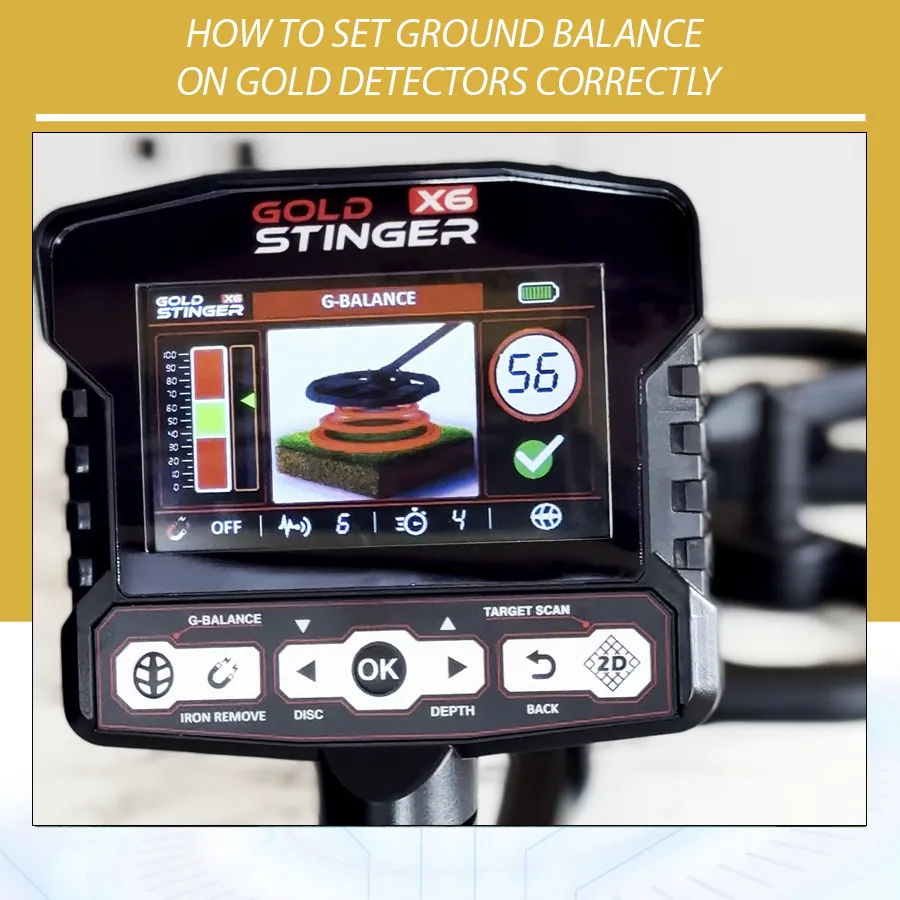
How to Set Ground Balance on Gold Detectors Correctly
Ground balance is one of the most important skills in gold detecting. It is also one of the most misunderstood. Many beginners focus on depth, sensitivity, and coil size, but forget that mineralized ground can sound like a target. If your detector is not balanced to the soil, it may chatter, false on hot rocks, lose depth, or hide weak gold signals inside ground noise.
This guide explains how to set ground balance on gold detectors correctly. It uses practical field logic, general manufacturer guidance from Minelab, and internal educational resources such as the Metal Detector Ground Balance Guide and Gold Detector Buying Guide from Orient Detectors.

What Ground Balance Actually Does
Ground contains minerals. Iron oxides, magnetite, basalt, black sand, salt, clay, and other minerals can create signals. A detector sees changes in electromagnetic response. Without ground balance, the detector may respond to the soil itself instead of the target. Ground balance helps the detector ignore the normal soil response so real metal targets stand out more clearly.
Minelab’s FAQ explains that if a detector is noisy while sweeping but becomes quiet when you stop moving the coil, it may be receiving signals from mineralized ground. The recommended response is ground balancing, selecting an appropriate soil or timing mode, and reducing sensitivity if needed.
Why Ground Balance Matters More for Gold
Gold prospecting often happens in mineralized ground. Gold-bearing areas may include ironstone, hot rocks, red soil, black sand, quartz zones, volcanic rocks, or salt-affected soil. Small gold nuggets produce weak signals. If the ground is noisy, those weak signals disappear. Correct ground balance does not only make the detector quieter; it protects usable depth and signal clarity.
For coin hunting in mild parks, automatic ground balance may be enough most of the time. For goldfields, ground balance becomes a core skill. A prospector who understands ground balance can often get better results from a mid-range detector than a beginner using an expensive detector poorly.
Types of Ground Balance
| Type | How It Works | Best Use |
|---|---|---|
| Automatic Ground Balance | Detector adjusts itself | Beginners, changing soil, quick setup |
| Manual Ground Balance | User adjusts value until ground response is neutral | Advanced users and difficult goldfields |
| Tracking Ground Balance | Detector continuously follows ground changes | Variable ground and long prospecting sessions |
| Quick Ground Balance | Short procedure to update ground response | When moving to a new soil patch |
| Ground Modes | Normal, Difficult, Severe, Salt, etc. | Handling different mineralization levels |
Step-by-Step Ground Balance Procedure
Step 1: Move to clean ground
Always ground balance away from obvious metal targets. If you balance over a buried metal object, the detector may learn the wrong response. Sweep the area first or choose a clean patch.
Step 2: Set sensitivity conservatively
Do not ground balance with sensitivity pushed too high. Start moderate. A noisy detector is harder to balance and may mislead the user.
Step 3: Keep the coil close and level
Hold the coil near the ground in the same way you will search. Some detectors require pumping the coil up and down. Others require sweeping or pressing a quick-track button. Follow the manual for your detector.
Step 4: Listen for ground response
If the detector makes a strong sound when the coil rises or falls, it is not balanced yet. A properly balanced detector should respond less to normal ground movement.
Step 5: Recheck with a normal sweep
After balancing, sweep naturally. If the detector is stable, start searching. If it remains noisy while sweeping but quiet when stopped, adjust ground balance, ground mode, or sensitivity.
How to Ground Balance Manual Detectors
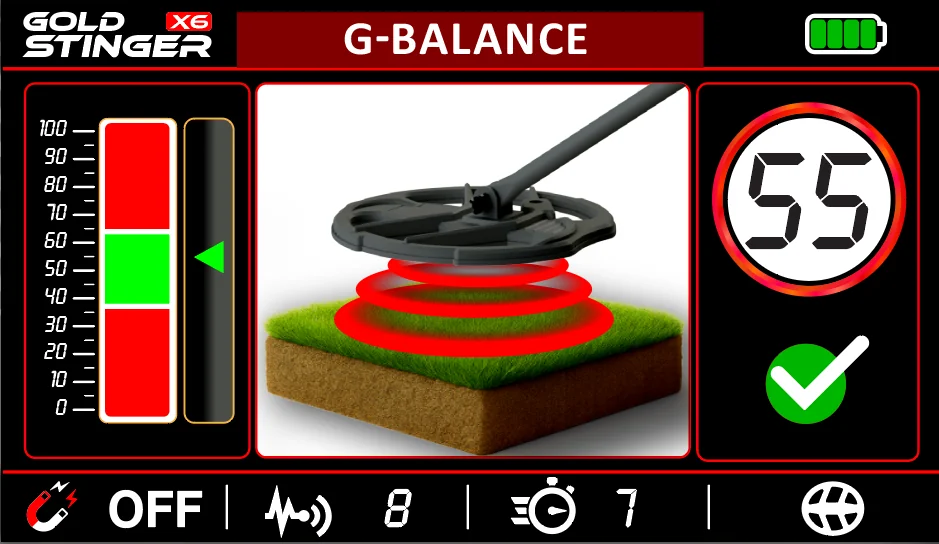
Manual ground balance usually involves adjusting a number or setting until the ground response becomes neutral. If the detector gives a louder response when lowering the coil, adjust one direction. If it responds when raising the coil, adjust the other direction. The exact control depends on the detector, so always use the manual.
Manual control is powerful but requires patience. Do not chase a perfect number if the ground changes every few meters. In variable goldfields, tracking or frequent rebalance may be more practical.
How to Use Tracking Ground Balance
Tracking ground balance continuously updates as soil changes. It is useful in variable mineralized ground, especially for beginners. However, in some situations, tracking may slowly tune out a very weak target if the coil is repeatedly swept over it. A common workflow is to use tracking while searching, then pause or lock tracking when investigating a faint repeatable signal, depending on the detector’s design.
Ground Balance for Hot Rocks
Hot rocks are stones that respond differently from the surrounding ground. They can sound like metal targets. If many hot rocks produce false signals, try a difficult ground mode, rebalance near the hot rock area, reduce sensitivity, or use a different coil. Do not assume every hot rock can be eliminated completely. Sometimes the best strategy is learning their sound and checking repeatability.
Ground Balance for Salt and Conductive Soil
Salt and conductive ground can create a different type of noise. Minelab’s GPX 6000 documentation explains that conductive ground noise may appear in salty ground or wet ground after rain, and may require a Double-D coil and Conductive Ground Cancel mode on that detector. Other detectors may use beach mode, salt mode, or lower sensitivity.
Do not treat wet salt ground like normal dry mineralized ground. If the detector remains noisy after ground balance, conductivity may be the problem.
How Often Should You Ground Balance?
Ground balance at the start of every session, whenever you move to a different soil type, after crossing from dry to wet ground, when entering red soil or hot rock zones, and whenever the detector becomes noisy for no clear reason. Minelab’s FAQ recommends balancing on clean ground away from metal objects and rebalancing periodically as required.
Ground Balance vs Sensitivity
Many users increase sensitivity when they cannot hear targets well. But if ground balance is wrong, higher sensitivity only increases noise. Balance first, then adjust sensitivity. Use the highest stable sensitivity, not the highest possible number. A smooth detector with moderate sensitivity often finds more gold than a noisy detector at maximum sensitivity.
Ground Balance by Detector Type
| Detector Type | Ground Balance Behavior | User Advice |
|---|---|---|
| VLF gold detector | Often manual/auto/tracking balance | Balance carefully for small gold |
| Multi-frequency detector | May use auto balance and soil modes | Use correct mode for mineralization or beach |
| Pulse induction detector | May use tracking and ground timings | Use appropriate ground type/timing |
| 3D ground scanner | May use calibration or soil type settings | Scan cleanly and avoid surface metal |
| Multi-system detector | Ground balance may affect several modes | Balance before serious operation |
Common Ground Balance Mistakes
Balancing over metal
This can cause the detector to calibrate incorrectly. Always choose clean ground.
Using maximum sensitivity first
High sensitivity can make ground balance harder. Start stable.
Never rebalancing
Ground changes. If the detector becomes noisy, rebalance before blaming the device.
Confusing EMI with ground noise
If the detector is noisy while held still, the issue may be electromagnetic interference. Run noise cancel or move away from interference.
Ignoring hot rocks
Hot rocks require technique, not just settings. Check repeatability and target location.
Practical Field Checklist
- Start away from vehicles, fences, and power lines.
- Find clean ground before balancing.
- Use moderate sensitivity first.
- Perform the detector’s recommended balance procedure.
- Sweep normally and listen for stability.
- Rebalance when soil changes.
- Lower sensitivity if stable balance is not possible.
- Use difficult/salt/ground modes when needed.
Ground Balance in Real Goldfield Scenarios
Scenario 1: Red iron-rich soil
Red soil often contains iron oxides that can make a detector noisy. Start with a clean patch, ground balance carefully, and use moderate sensitivity. If the detector is still unstable, switch to a difficult or mineralized ground mode if your detector offers one. Do not assume every small sound is a target.
Scenario 2: Black sand in dry washes
Black sand can be highly mineralized. If your detector chatters in concentrated black sand, rebalance in the same material and slow down. Small gold may occur near heavy mineral concentrations, so do not avoid the area automatically. Instead, stabilize the detector and learn the ground response.
Scenario 3: Basalt and hot rocks
Hot rocks may produce sharp responses. Ground balance may reduce some of the effect, but it may not eliminate every hot rock. Use repeatability, target location, and sound quality. If the signal moves with the rock, it is not a buried target.
Scenario 4: Wet salt ground
Salt response can be conductive rather than simply mineralized. Use salt or beach modes when available. On some PI detectors, a Double-D coil or special conductive ground cancel mode may be needed. Lowering sensitivity may also help.
How to Know Your Ground Balance Is Wrong
Incorrect ground balance often shows itself through unstable audio while sweeping, signals that appear everywhere, difficulty hearing faint targets, and target responses that change dramatically with coil height. If the detector is stable when held still but noisy when moving over the ground, check ground balance first. If it is noisy even when held still, check EMI with noise cancel or move away from power sources.
| Symptom | Likely Cause | Fix |
|---|---|---|
| Noise only while sweeping | Ground not balanced or mineralized soil | Rebalance and use correct ground mode |
| Noise while coil is still | EMI or electrical interference | Noise cancel or move location |
| Weak targets disappear | Sensitivity too high or bad balance | Rebalance and lower sensitivity |
| Hot rocks sound like targets | Strong mineral response | Use difficult mode or learn hot rock sound |
| Detector changes behavior every few meters | Variable soil | Use tracking or rebalance often |
Ground Balance and Coil Control
Good ground balance cannot compensate for poor coil control. If you lift the coil at the end of every swing, scrape rocks inconsistently, or swing in a high arc, the detector may respond to height changes rather than targets. Keep the coil level and close to the ground. Maintain consistent speed. Overlap your sweeps. Ground balance works best when the coil movement is consistent.
This is especially important for small gold. A tiny nugget may produce only a faint change in audio. If the coil is moving unevenly, that faint response can be lost inside ground variation. Stable coil control and stable ground balance work together.
Ground Balance and Target Testing
When evaluating a faint signal, do not immediately change many settings. First, shorten the sweep and confirm repeatability. Then scrape a small layer of soil and rescan. If the signal becomes clearer, it may be a target. If it disappears or spreads, it may be ground noise. Rebalancing directly over a weak target can sometimes reduce the response, so move slightly away to clean ground before balancing again.
Training Exercise for Beginners
Choose clean ground and bury several test objects: a small lead piece, a small brass piece, a nail, a hot rock, and a small non-ferrous target. Balance the detector, then listen to each target. Next, intentionally misbalance the detector if your unit allows manual control, and compare the difference. This exercise teaches why ground balance matters and how target signals become harder to hear when the detector is fighting the soil.
Ground Balance Across Popular Gold Detectors
Different detectors handle ground balance differently. Some, like the Gold Monster 2000, are designed to simplify the process with automatic ground handling. Detectors such as the GPX 6000 use GeoSense-PI with tracking and Quick-Trak. Professional detectors may include ground types, timings, or manual settings. Multi-system devices may require calibration per search mode.
Do not copy settings blindly from another detector. Understand the principle: the detector must learn the normal ground response, then separate targets from that response. The controls differ, but the goal is the same.
FAQ
Does ground balance increase depth?
It can increase usable depth by reducing ground noise and making weak targets clearer. It does not magically add power, but it helps the detector perform properly.
Should beginners use automatic ground balance?
Yes, if available. Automatic or tracking ground balance is often the easiest starting point. Advanced users may benefit from manual control.
Can wrong ground balance make gold disappear?
It can make weak gold signals harder to hear or cause instability that masks targets.
Is ground balance needed on every detector?
Some detectors handle it automatically. Others require manual or quick procedures. Always check the detector manual.
Conclusion
Setting ground balance on gold detectors correctly is not a small technical detail. It is one of the foundations of successful gold prospecting. Balance on clean ground, use stable sensitivity, understand your detector’s ground modes, and rebalance when the soil changes. A well-balanced detector gives clearer signals, fewer false targets, and better practical depth.