
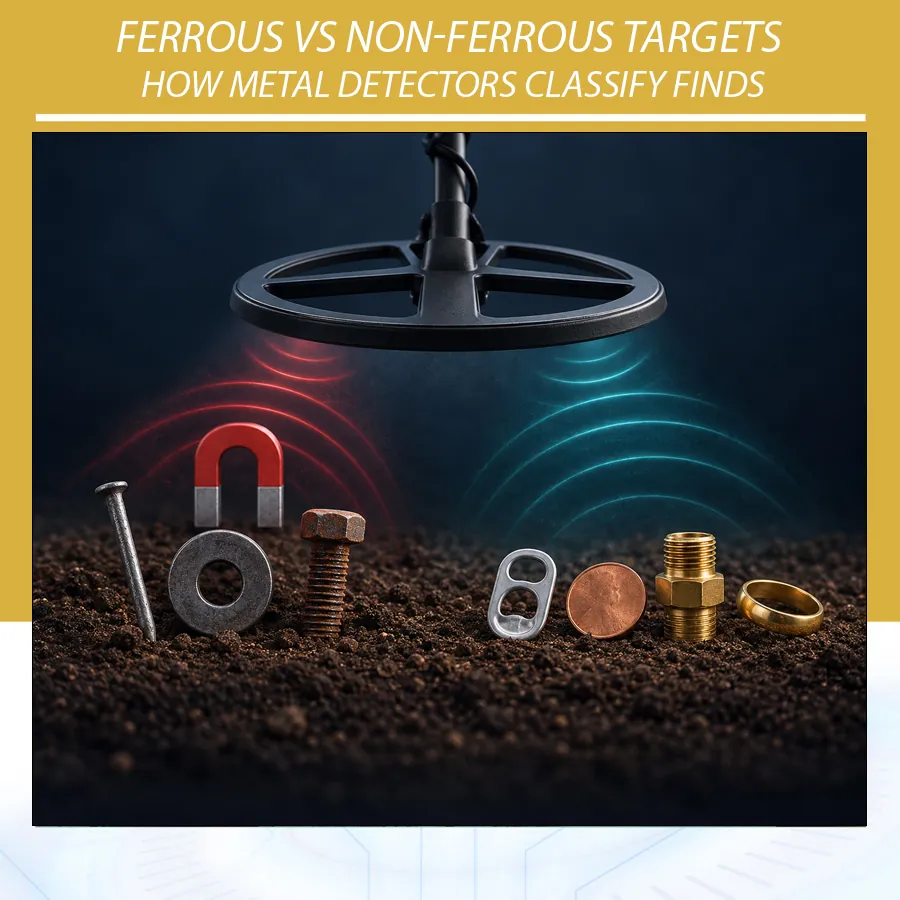
This complete guide connects the material science with practical search decisions. It explains magnetism and electrical conductivity, shows why target identification can change with depth and orientation, and examines iron falsing, corrosion halos, mixed targets, discrimination, audio, and controlled testing. Examples are drawn from detectors currently listed by Orient Detectors, including the Minelab MANTICORE and Nokta The LEGEND, and are limited to functions documented by their manufacturers.
What ferrous and non-ferrous actually mean
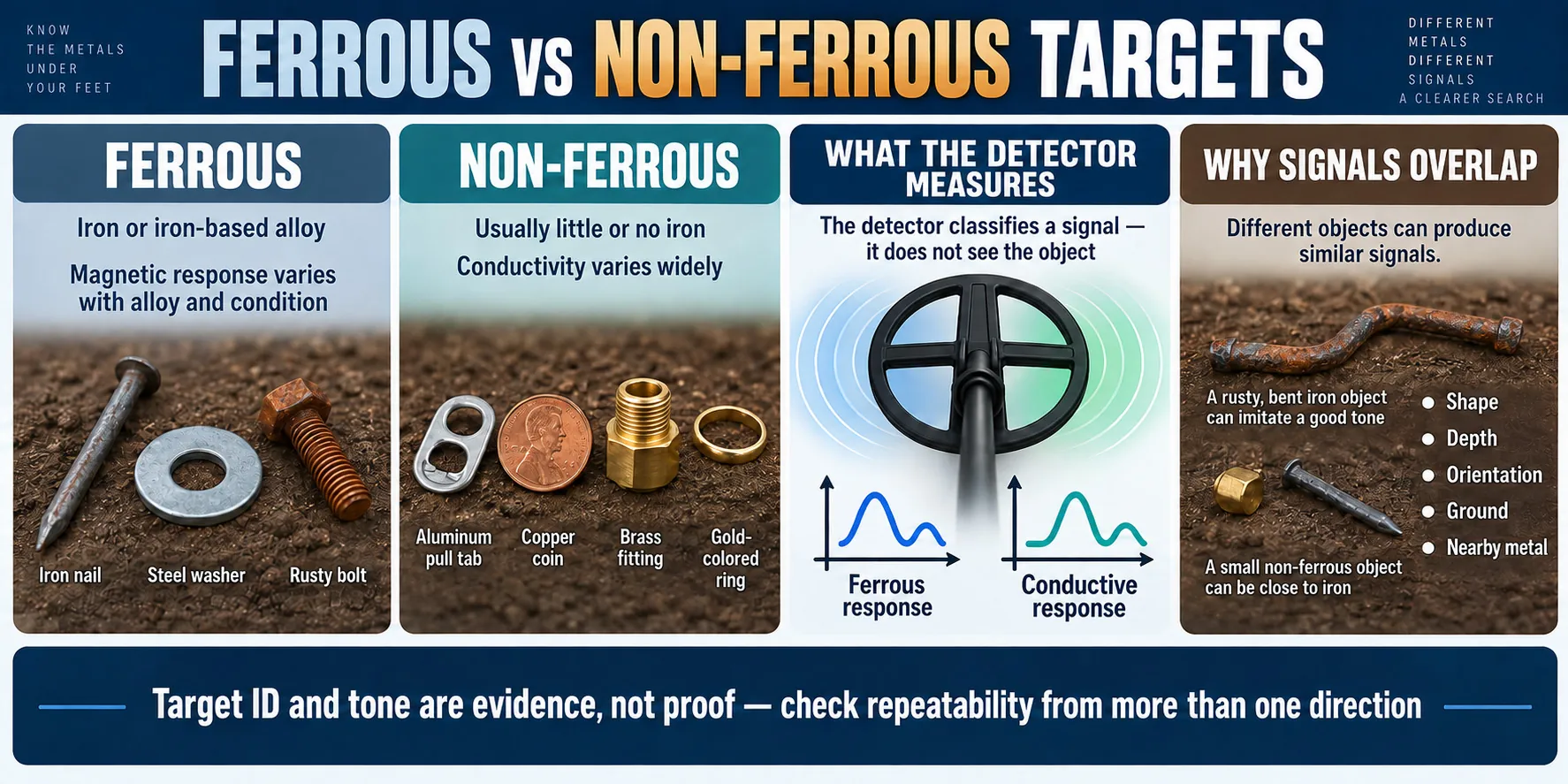
“Ferrous” comes from the Latin word for iron. In everyday detecting language, it usually describes iron and iron-rich alloys such as many steels and cast iron. Common examples include nails, screws, horseshoes, bolts, wire, tool fragments, steel bottle caps, and parts of agricultural machinery. Their age, shape, alloy, corrosion, and position all affect the signal.
Non-ferrous metals are metals and alloys that are not iron-based. Copper, brass, bronze, aluminum, lead, silver, and gold belong to this broad group. The category therefore includes valuable coins and jewelry as well as pull tabs, foil, can fragments, shotgun pellets, and other waste. “Non-ferrous” is not a synonym for precious, and “ferrous” is not always unwanted. Archaeological iron, military relics, historic tools, meteorites, and iron coins can be important finds.
The boundary describes composition rather than value. Stainless steel also shows why simple labels require care. Stainless alloys contain iron, but their magnetic behavior varies with alloy family and manufacturing history. Some are strongly attracted to a magnet, some weakly, and some practically nonmagnetic. A detector response depends on the complete electromagnetic properties and geometry of the object, not just the label printed on a metallurgy chart.
| Group | Common examples | Typical field importance | Important caution |
|---|---|---|---|
| Iron and common steel | Nails, bolts, wire, tools, horseshoes | Often modern waste; sometimes historic evidence | Long, bent, rusty, or flat pieces can produce convincing false responses |
| Copper and copper alloys | Copper coins, brass buttons, bronze artifacts | Frequent coin and relic targets | Identification changes with size, alloy, corrosion, and depth |
| Aluminum | Foil, pull tabs, cans, modern tokens | Common trash but also useful test material | Overlaps many small gold items in conductive response |
| Gold and silver | Rings, coins, pendants, small natural gold | Common high-interest targets | No exclusive numerical range identifies either metal with certainty |
| Lead | Projectiles, seals, fishing weights | Can be modern trash or significant historic evidence | Toxic; handle carefully and wash hands after recovery |
| Stainless steel | Cutlery, fasteners, jewelry, watch parts | Mixed modern and collectible uses | Alloy and shape can produce highly variable magnetic and detector behavior |
Magnetism and conductivity are different properties
Iron is familiar because many iron-rich objects are attracted to a magnet. Ferromagnetic materials can become strongly magnetized in an applied magnetic field. That property influences their detector response, but magnetism is only part of the picture. A metal detector transmits an alternating electromagnetic field from its search coil. A nearby conductive object develops circulating electrical currents, commonly called eddy currents, which produce a secondary field. The receiver measures the timing, strength, and character of that response.
Electrical conductivity describes how readily current flows. Silver and copper are excellent conductors; aluminum and gold are also conductive. Iron conducts electricity too, although its magnetic permeability and signal timing help many modern detectors distinguish typical iron from typical non-ferrous targets. The detector is interpreting a combined response. It is not simply asking whether a magnet would stick.
Conductivity is not the same as a target ID number. The number is a device-specific presentation derived from the measured signal. Size, thickness, shape, orientation, alloy, depth, soil, frequency, mode, coil, adjacent metal, and signal strength can all move the displayed value. A large low-conductivity object may identify higher than expected, while a small high-conductivity object may identify lower. Nokta explicitly warns in The LEGEND manual that large targets can ID higher than expected even when their conductance is lower.
A hand magnet remains useful after recovery or during test-garden preparation, but it does not predict every detector classification. Magnetite-rich rocks can be magnetic without being manufactured iron targets. Some stainless steels can be weakly magnetic or nonmagnetic. A small gold item and a piece of aluminum foil are both nonmagnetic and may overlap electronically. Treat the magnet as one observation, not a replacement for detector testing or material analysis.
How detectors classify ferrous vs non-ferrous targets
A discrimination-capable detector processes the received response and compares it with boundaries defined by its search mode and settings. It may then produce a low iron tone, a higher non-ferrous tone, a target ID, a color or icon, a two-dimensional trace, or a combination of those cues. The classification is a probability-based field aid. It becomes less certain when the signal is weak, distorted, or combined with another response.
Very low frequency and simultaneous multi-frequency detectors commonly use phase-related information to estimate ferrous character and conductivity. Pulse-induction machines work differently and may offer less detailed discrimination, depending on the model. In both cases, the displayed division between ferrous vs non-ferrous targets reflects signal processing under the current conditions. Neither operating principle changes the basic caution: the detector can report how a buried object responded, but it cannot certify chemical composition before recovery.
The active search mode matters. Modes can use different frequencies, ground processing, target separation, audio regions, and acceptance patterns. A target ID learned in one mode should not automatically be expected in another. Software versions can also change classification behavior. Nokta’s published updates for The LEGEND, for example, describe changes intended to improve ferrous and non-ferrous classification in certain difficult conditions. When creating a personal ID chart, record the mode and software version as well as the object.
| Variable | Possible effect | Useful field response |
|---|---|---|
| Depth and weak signal | ID may become less stable or disappear | Listen for repeatability and investigate from controlled directions |
| Target orientation | Edge-on coins, vertical nails, and bent wire can shift or fragment a response | Cross-sweep at approximately 90 degrees |
| Object size and shape | Large iron can sound high; thin foil can sound very low | Use pinpoint footprint and lift the coil to assess response size |
| Mineralized or wet ground | Ground response can pull ID or reduce clarity | Ground balance correctly and compare with nearby clear soil |
| Adjacent targets | Responses can merge, average, or mask one another | Shorten the sweep and approach from several angles |
| Search mode and frequency | Audio and numerical placement can change | Build reference notes for the exact mode you use |
| Discrimination or ferrous limits | Borderline signals may change from accepted to rejected | Temporarily reduce rejection when investigating uncertainty |
| Sweep technique | Wrong speed or changing coil height can distort the response | Use an even, level sweep appropriate to the detector |
Why rusty iron can sound non-ferrous
Iron falsing is a non-ferrous-like response produced by an iron object. Nails are a classic source, especially when a detector sees the end of a nail or when the object lies at a difficult angle. Large iron, washers, rings of iron, bottle caps, curved pieces, and corroded sheet metal can also produce a high tone or a promising numerical flash. The effect is influenced by target geometry, soil, recovery settings, ferrous controls, sweep direction, and coil position.
A false high tone often occurs only at a narrow point or in one direction. Turn 90 degrees and sweep again. A nail may change to an iron response, break up, move relative to the pinpoint center, or disappear. None of those tests is absolute. A desirable target next to a nail can also be one-way, and an awkwardly oriented coin can respond poorly. The aim is to collect more evidence, not invent a single rejection rule.
The “rust halo” is often described as though corrosion creates a perfect image of a larger metallic target. The reality is more complicated. Iron corrosion products can spread into surrounding soil, and moisture, mineral chemistry, and the remaining metal affect the local electromagnetic response. Disturbing the soil can change a marginal signal, but a disappearing signal does not prove there was no metal. Recheck the hole, spoil pile, and surrounding soil with reduced sweep length.
Use iron audio when the detector provides it. A high chirp accompanied by an iron grunt, an elongated response, or ferrous trace away from the conductive center deserves examination. Yet high iron volume can become tiring in dense trash, while aggressive rejection can hide a non-ferrous item near iron. Adjust the presentation for the site and your objective rather than searching for a setting that eliminates every nail without cost.
Mixed targets, masking, and signal averaging
Real sites rarely contain isolated textbook targets. A brass button may lie beside a nail, a coin may sit under wire, or a valuable ring may share the coil’s detection field with foil. When two objects are close enough, the detector may see a combined response. One item can mask the other, the target ID can average between them, or the machine can report different categories on opposite sweeps.
Separation depends on physical spacing, depth, coil size, coil orientation, recovery processing, sweep speed, target strength, and the detector’s mode. Rotate around the response because a Double-D coil has a directional detection pattern. Short, controlled passes may reveal two centers where a long swing produces one blended sound. If site rules permit, recovering an obvious shallow iron item can expose the response beneath it.
Discrimination cannot recover information that never became separable. Rejecting iron audio may make the site quieter, but it does not remove the electromagnetic effect of the nail. In some cases it can make the accepted fragment of a mixed response harder to understand. All-metal or a less restrictive pattern can reveal the amount of nearby ferrous activity, although the exact feature name varies by detector.
This is also why target ID should be read as a pattern. Ask whether a conductive value appears repeatedly, whether the iron component stays fixed, and whether the response has a compact center. A single attractive number during a dozen inconsistent sweeps is weaker evidence than a repeatable audio and visual pattern. Recovery remains the only practical way to confirm the object at ordinary detecting sites.
Gold and aluminum overlap
Gold jewelry covers a wide range of sizes, purities, shapes, and alloy compositions. A thin chain, small earring, medium ring, and heavy band do not occupy one exclusive target-ID region. Aluminum waste is similarly varied. Foil can be extremely thin, while pull tabs, can slaw, and folded pieces produce stronger responses. Their ranges overlap extensively on common discrimination detectors.
Rejecting every pull-tab or foil response therefore risks rejecting some gold. The exact risk depends on the detector, mode, item, and site. Beach and park hunters often make a strategic choice based on goals and trash density: dig a broad range when jewelry matters, or apply more rejection when time and site conditions demand selectivity. Describe that choice honestly. No setting can keep all gold while eliminating all aluminum.
Shape-based clues can help prioritize targets. Some complete pull tabs give stable IDs, while torn aluminum can sound ragged. Small foil often has a shallow, tight response. Gold rings can sound smooth and repeatable. But aluminum can imitate every one of those traits. Use clues to manage digging, never to announce material composition.
Audio, target ID, and discrimination should work together
Audio is usually the fastest information channel. Tone category may suggest iron or non-ferrous, while modulation can hint at target strength, depth, or size according to the detector’s audio design. Listen for edges, breaks, grunts, and consistency. A pleasant tone is evidence of a clean detector response, not proof of gold, silver, or a coin.
Target ID adds a numerical estimate. Watch a cluster across several sweeps instead of demanding a perfectly fixed number. Deep, small, edge-on, corroded, or adjacent targets commonly spread across multiple values. Compare the cluster with known objects in the same soil. The metal detector Target ID guide explains why scales are device-specific and why one brand’s number should not be transferred to another.
Discrimination chooses which categories produce accepted audio. Notch discrimination usually rejects selected ID segments. Iron bias, iron filter, or ferrous limits influence classification near the iron boundary, depending on the manufacturer. Stronger iron rejection may suppress more difficult nails but can also classify borderline non-ferrous or mixed responses more conservatively. Read the correct manual because similarly named controls may work differently.
Pinpointing supplies location and an approximate response footprint. Broad responses can suggest large or shallow objects, while a compact response may suggest a smaller target. Shape, depth, and halo effects limit that inference. Combine it with the techniques in the metal detector pinpointing guide and keep the coil level as described in the sweep speed and coil-height guide.
Model example: Minelab MANTICORE
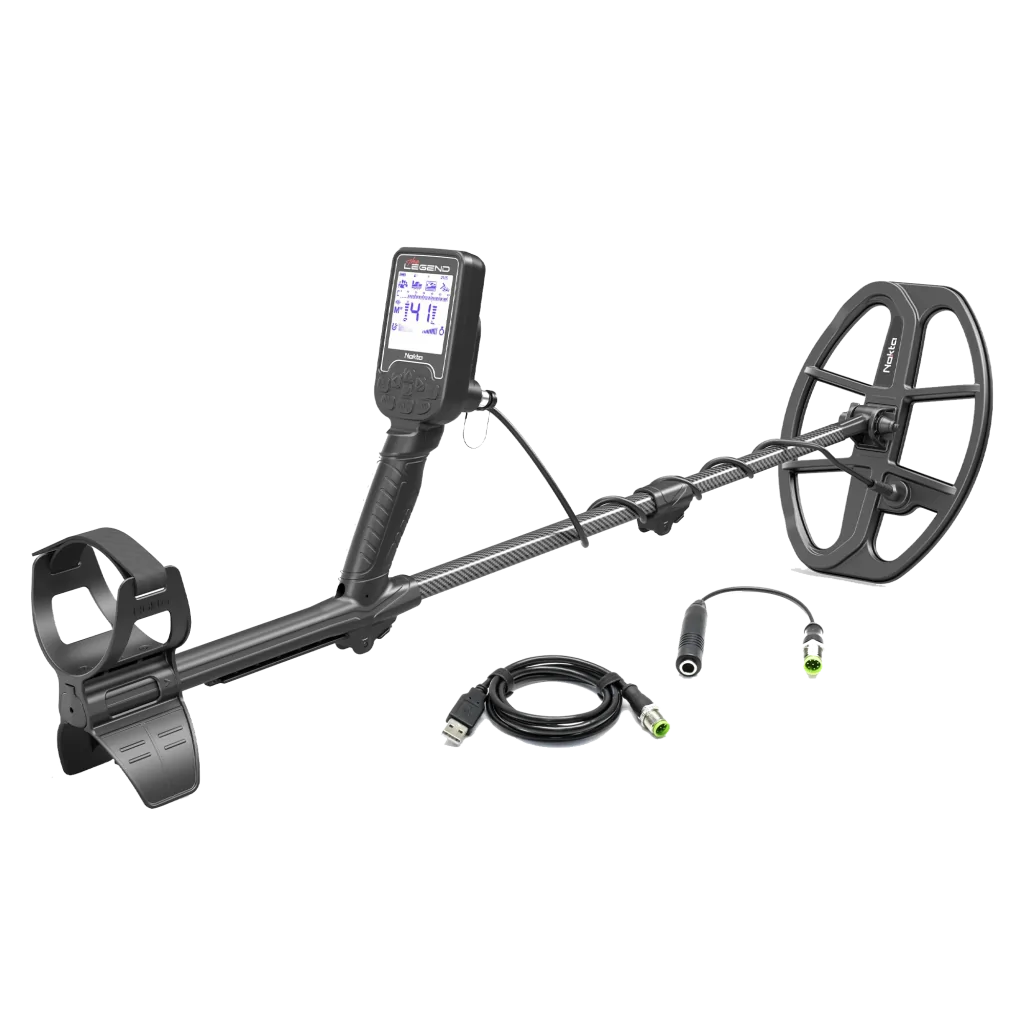
The Minelab MANTICORE available from Orient Detectors illustrates classification with more than a single number. Minelab documents a 0–99 conductive Target ID and a two-dimensional ID Map. The horizontal position represents conductive ID, while vertical placement conveys ferrous information. A live Target Trace can show how responses develop during the sweep.
MANTICORE’s Ferrous Limits setting controls whether responses are classified as ferrous or non-ferrous based on their ferrous and conductive properties. Upper Limits address many common iron objects, including screws and nails; Lower Limits address certain difficult ferrous targets such as some flat iron. Users can select presets or edit custom boundaries. Moving a boundary changes classification; it does not change the object’s metal.
Minelab warns that setting ferrous limits too close to the map’s centerline may classify some non-ferrous targets as ferrous and can reduce separation performance. This is the central tradeoff. Strong rejection can make iron-heavy ground more comfortable, while a more open interpretation can preserve ambiguous responses at the cost of hearing more iron.
A practical MANTICORE exercise uses a clean patch and known objects: a nail, steel crown cap, copper coin, foil, pull tab, and gold-colored non-precious ring for repeatable handling. Observe trace shape and placement from two directions, then place the coin near the nail and repeat. This comparison shows how ferrous vs non-ferrous targets can move or merge on the display. Do not turn that small library into a universal ID chart. Soil, spacing, orientation, mode, software, and the actual alloys will change the result.
Model example: Nokta The LEGEND
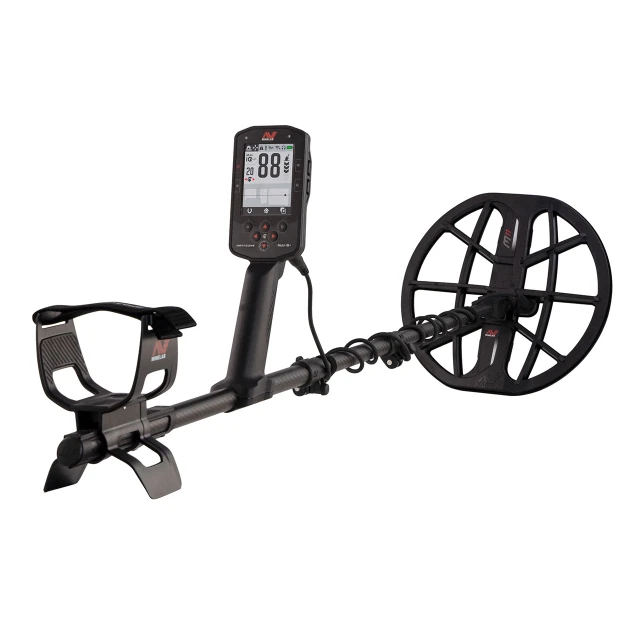
The Nokta The LEGEND listed by Orient Detectors uses a 1–60 target-ID scale and offers four discrimination patterns: All Metal, Ground Off, Ferrous Off, and Custom. The manufacturer’s current manual says Ferrous Off rejects IDs 1–10. Custom allows individual IDs to be accepted or rejected, with defaults that vary by mode.
The manual also states that the detector needs a strong, clear signal to provide an ID. This is a useful limit for all field interpretation. If a target produces audio but no stable number, the missing number does not prove iron. Signal strength, depth, ground, and target position may prevent reliable calculation.
The LEGEND includes Iron Filter and related Stability controls. Nokta describes Iron Filter as changing the probability that difficult ferrous targets, such as rusty nails, are classified as non-ferrous; the applicable Stability control provides further fine-tuning and differs in Beach mode. Lower and higher values therefore change how borderline responses are presented rather than proving an object’s identity. The current product support page should be checked for the software version because Nokta has revised classification behavior in updates.
For training, start with All Metal to hear the complete response, then compare Ferrous Off and a custom pattern. Add a nail beside a non-ferrous coin and observe how sweep direction changes the information. The lesson is how the controls present uncertainty, not which setting “finds only valuable metals.”
A reliable field-check sequence
- Stop and isolate the response. Shorten the sweep until you know where the signal begins and ends.
- Keep coil height constant. Do not lift the coil at the center or ends of the swing.
- Cross-sweep. Turn about 90 degrees and compare tone, ID, and ferrous indication.
- Watch a range, not one number. Note the values that repeat and the conditions in which they appear.
- Compare audio and screen. Agreement strengthens a classification; disagreement deserves investigation.
- Use an open pattern briefly. If the model allows it, hear the surrounding iron and ground response.
- Pinpoint the center and footprint. Check whether the best conductive response aligns with the physical center.
- Change only one setting at a time. Otherwise you cannot know which control changed the result.
- Recover carefully where permitted. Recheck the hole, spoil, and nearby ground after removal.
- Record surprising finds. Save the object, mode, ID range, depth, orientation, and soil notes for later testing.
This sequence is intentionally slower than ordinary coverage. Use it for uncertain or educational targets rather than stopping over every obvious response. Over time, the observations make normal search decisions faster because you recognize how your detector behaves in local soil.
Build a ferrous and non-ferrous test set
A useful test set should represent the targets at your sites. Include more than one nail, because square nails, modern wire nails, bent nails, and corroded nails respond differently. Add a steel cap, iron washer, small bolt, and flat iron fragment. For non-ferrous references, include local coins, brass, copper, lead, foil, several pull-tab styles, and inexpensive jewelry of known material.
Begin with above-ground tests to learn controls, but confirm observations in undisturbed or realistically prepared ground. Air tests remove mineralization and cannot reproduce long-term corrosion, moisture, or masking. The air tests versus ground tests guide explains what each method can and cannot establish.
Keep objects separated during storage and label them. Photograph unusual items and write down alloy information when known. Test one object at multiple orientations before combining two targets. Record the exact detector, coil, search mode, recovery setting, frequency choice, discrimination, ground balance, and software version. Without that context, a target-ID list is difficult to reproduce.
| Stage | Setup | What to observe | What it cannot prove |
|---|---|---|---|
| Single-target air check | One item at measured distance and orientation | Basic tone, ID region, and control operation | In-ground depth or soil behavior |
| Single-target ground check | Known item in representative soil | Ground effect and practical repeatability | Every site or long-buried halo condition |
| Orientation test | Flat, edge-on, vertical, and angled positions | Changes in ID and directional response | The orientation of an unknown target |
| Adjacent-target test | Nail and coin at documented spacing | Masking, separation, and sweep-direction effects | A universal recovery-speed setting |
| Settings comparison | Change one control per run | Effect of ferrous boundary or rejection | Chemical composition of unknown finds |
Common mistakes to avoid
The first mistake is equating non-ferrous with valuable. Most modern trash at many parks and beaches is non-ferrous. The second is equating ferrous with worthless. Historic iron can date a site or be the object being sought. Decide value from context and identification after recovery, not solely from the detector category.
Another mistake is copying target IDs from a different detector. Scales and processing differ, even when two machines show similar numbers. Use model-specific documentation and your own representative tests. Avoid copying advanced iron settings without the associated mode, coil, soil, software, and search objective.
Do not maximize discrimination to solve unstable operation. Random signals may come from electromagnetic interference, poor ground balance, excessive sensitivity, loose connections, or coil impacts. The troubleshooting approach in Why Does My Metal Detector Keep Beeping? helps separate those causes.
Finally, do not clean an unidentified find aggressively just to determine whether it is iron. Corrosion can preserve shape and archaeological evidence. Follow local law, obtain permission, fill holes, and seek conservation advice for potentially significant objects. Classification is part of responsible recovery, not a substitute for it.
Frequently asked questions
1. What is the main difference between ferrous and non-ferrous targets?
Ferrous targets contain iron as a significant component; non-ferrous targets generally do not. The field distinction is useful, but a detector estimates a response rather than testing chemical composition.
2. Are all ferrous metals magnetic?
No. Many iron and steel objects are magnetic, but magnetic behavior varies with alloy and processing. Some stainless steels are weakly magnetic or practically nonmagnetic even though they contain iron.
3. Are all non-ferrous targets valuable?
No. Aluminum foil, pull tabs, can fragments, and lead waste are non-ferrous. Copper, bronze, silver, and gold can be desirable, but context and the recovered object determine value.
4. Can a metal detector identify gold with certainty?
No. Gold responses overlap aluminum and other conductors because jewelry varies in size, shape, purity, and alloy. A target ID or tone can support a dig decision but cannot certify gold.
5. Why does a rusty nail sometimes give a high tone?
Shape, orientation, corrosion, soil, sweep direction, and processing can create an attractive response from iron. Cross-sweep and inspect the complete audio and ferrous information, while remembering that a good target near the nail may also be present.
6. Does rejecting iron make the detector ignore its physical effect?
No. Discrimination can suppress or change the audio category, but nearby iron can still mask or distort a non-ferrous response within the coil’s detection field.
7. Why does target ID change when I turn around the target?
The coil sees a different profile of the object and nearby metal. Orientation, target shape, and a Double-D coil’s directional response can make one approach different from another.
8. Should I use All Metal in an iron-filled site?
It can be valuable for investigating the amount and position of iron, but continuous audio may be tiring. Use it strategically and follow the terminology and procedure in your model’s manual.
9. Can a magnet tell me how a target will identify?
Not reliably. A magnet provides useful information about magnetic attraction, but detector classification also depends on conductivity, permeability, size, shape, orientation, soil, and settings.
10. What is the best ferrous-rejection setting?
There is no universal value. Start with the manufacturer’s preset for the mode, test representative targets, and adjust one step at a time for the site’s iron density and your willingness to investigate ambiguous signals.
Final practical takeaway
The useful distinction between ferrous vs non-ferrous targets is not a promise that every object will fall neatly into one audio bin. It is a framework for reading evidence. Material properties create the response, while soil, geometry, depth, nearby targets, coil movement, mode, and processing determine how clearly the detector can classify it.
Learn the iron sound and visual pattern of your own detector, but keep uncertain responses available for investigation. Cross-sweep, compare multiple cues, open the discrimination pattern when useful, and build a documented test set. Most importantly, let recovery confirm identity. That approach reduces avoidable mistakes while preserving the difficult finds that simple “iron or treasure” rules can miss.
Resources
- Minelab MANTICORE Instruction Manual 2.0 — official manuals catalog — official explanation of Target ID, the ID Map, Target Trace, and Ferrous Limits.
- Minelab USA Frequently Asked Questions — current manufacturer notes about MANTICORE ferrous behavior and operating features.
- Nokta The LEGEND User Manual — official target-ID, discrimination-pattern, Iron Filter, and Stability documentation.
- Nokta The LEGEND Product and Update Page — official product support and software update information.
- Encyclopaedia Britannica: Ferromagnetism — background on strong magnetic ordering in materials.
- USGS Mineral Commodity Summaries — authoritative background information for major metals and mineral commodities.