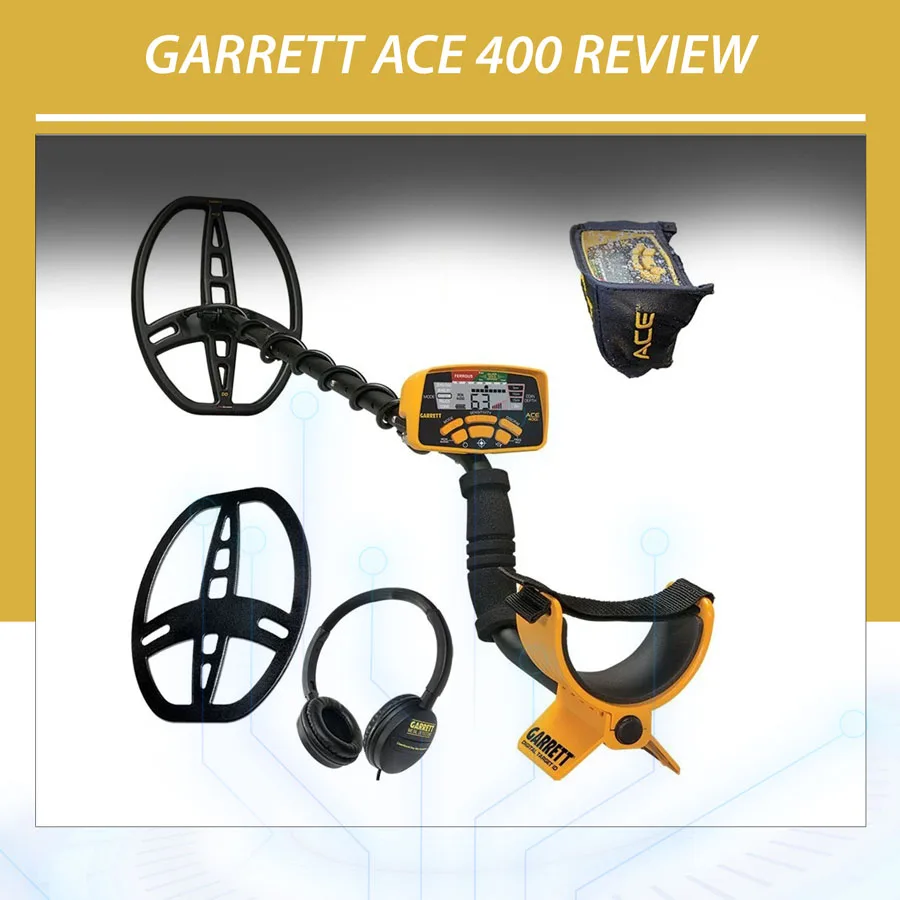
This Garrett ACE 400 review comes to a simple verdict: the ACE 400 (sold in international markets as the ACE 400i) is one of the best-value first detectors for coins, jewelry and relics in parks, fields and dry sand. It is light, simple, and includes features that used to be reserved for more expensive machines, such as Iron Audio and a digital Target ID. Its limits are equally clear: a fixed ground balance, a control box that is weatherproof but not submersible, and a single 10 kHz frequency that makes it a poor choice for gold nuggets or heavily mineralized ground.
Below, this Garrett ACE 400 review covers who it suits, the features that matter in the field, the settings worth learning, how it compares with the Garrett AT MAX and the Nokta Simplex, and the final verdict.
Garrett ACE 400 review: who it is for
- Beginners who want a detector that works well out of the box without studying a manual for a week.
- Coin and jewelry hunters in parks, schoolyards, fields and dry beach sand.
- Relic hunters on moderate sites where iron trash is manageable.
- Families who want a lightweight machine that an adult and an older child can share.
It is not the right detector for gold nugget prospecting, for wading or diving, or for the black-sand and saltwater conditions where ground balance control is essential. For those uses, see the comparison section below.
Key features that matter in the field
10 kHz operating frequency with frequency shift
The ACE 400 runs at 10 kHz, a good general-purpose frequency: sensitive enough for small jewelry and low-conductivity targets while still giving solid depth on coins. It also lets you shift the frequency slightly to reduce interference from power lines or another detector working nearby, something lower-priced ACE models do not offer.
Digital Target ID (0–99)
A two-digit number on the screen indicates the conductivity of the target. Iron reads low, foil and small gold jewelry in the lower-middle range, and copper and silver coins high. With practice you learn the numbers that recur for coins in your area and the numbers that usually mean a pull tab or bottle cap. Target ID is an indication, not a guarantee; the number for a gold ring overlaps with aluminum trash on any VLF detector.
Iron Audio
Normally, discriminated iron is silent. Iron Audio lets you hear it as a distinct low grunt, so a bottle cap or rusty washer that produces a “good” number gives itself away by the iron grunt around it. This is the single most useful feature on the detector for trashy sites, and it is one most beginners ignore. Learn it.
Five search modes plus pinpoint
Zero (all metal), Jewelry, Custom, Relics and Coins preset the discrimination pattern for each type of hunting, and Custom remembers your own notch pattern. A non-motion pinpoint mode locates the target under the coil before you dig; a handheld pinpointer still speeds up recovery in the hole.
Notch discrimination and depth indicator
Twelve discrimination segments let you accept or reject specific ranges, for example rejecting the pull-tab range while keeping coins. A coin-depth indicator estimates how deep a coin-sized target lies, which helps you decide how carefully to dig.
Coil, weight and power
The ACE 400 ships with an 8.5 x 11-inch PROformance Double-D coil, which covers ground quickly and separates targets better than a concentric coil in trash. The detector weighs about 1.3 kg (2.9 lb) and runs on four AA batteries. The coil and lower shaft can be submerged for working in shallow water at the edge of a beach or stream; the control box must stay dry.
Settings worth learning first
- Start in Coins mode with sensitivity two or three bars below maximum. Raise it only if the detector stays quiet.
- Turn Iron Audio on and spend an hour listening to how bottle caps and nails sound compared with coins.
- Use frequency shift if you hear steady chatter near buildings or other detectors.
- Dig everything for the first few outings, including low numbers. That is how the Target ID numbers become meaningful to you.
- Build a test garden with a few coins and a ring at known depths to learn the depth indicator; see our guide to building a metal detector test garden.
Limits to know before buying
- Fixed ground balance. The ACE 400 is factory-set for average soil. In mild to moderate ground that is fine; in strongly mineralized red soil, black sand or wet saltwater beaches it becomes noisy and loses depth, and there is no manual adjustment to fix it.
- Not submersible. Only the coil and shaft can go underwater. If you want to wade or hunt in the surf, buy a fully waterproof detector.
- Not a gold nugget detector. At 10 kHz with fixed ground balance, it is not designed to find small nuggets in mineralized goldfields. A dedicated high-frequency or pulse induction gold detector is the right tool.
- Basic audio. Fewer tones and less adjustment than mid-range machines; experienced users will eventually want more.
Garrett ACE 400 vs Garrett AT MAX vs Nokta Simplex
| Garrett ACE 400 | Garrett AT MAX | Nokta Simplex | |
|---|---|---|---|
| Frequency | 10 kHz, shiftable | 13.6 kHz, shiftable | 12 kHz |
| Ground balance | Fixed | Automatic and manual | Automatic and manual |
| Waterproof | Coil and shaft only | Fully submersible to 3 m | Fully submersible |
| Iron Audio | Yes | Yes, including in All-Metal | Iron volume control |
| Wireless audio | No | Z-Lynk built in | Depends on version |
| Best for | First detector, parks and fields | Serious all-terrain use, beaches, relics | Beginners who want waterproof at low cost |
The Garrett AT MAX is the natural step up: the same brand logic and Iron Audio, with adjustable ground balance, full submersion and wireless headphones, at roughly double the price. If you expect to hunt saltwater beaches or mineralized ground within a year, go straight to the AT MAX. Our detailed ACE 400 vs AT MAX comparison works through that decision.
The Nokta Simplex competes directly on price and adds full waterproofing and ground balance. The ACE 400 answers with Garrett’s simpler interface, Iron Audio and a long service record. Read our Nokta Simplex review before deciding.
Frequently asked questions
Is the Garrett ACE 400 good for beginners?
Yes. It is light, turns on ready to hunt in a sensible preset mode, and its Target ID and Iron Audio teach you to read targets quickly. It is one of the most common first detectors worldwide for good reason.
Can the Garrett ACE 400 find gold?
It can find gold jewelry such as rings and chains, which are its intended targets. It is not designed for natural gold nuggets in mineralized ground, where a dedicated gold detector is needed.
Is the ACE 400 waterproof?
The search coil and lower shaft are waterproof and can be submerged. The control box is weatherproof against rain and splashes but cannot go underwater.
What is the difference between the ACE 400 and ACE 400i?
The ACE 400i is the international version of the same detector. The features described in this Garrett ACE 400 review apply to both.
How deep does the Garrett ACE 400 detect?
Depth depends on target size, soil and settings. In typical park soil, coin-sized targets are commonly found in the range of roughly 15–25 cm; larger objects deeper, small jewelry shallower.
Verdict
The Garrett ACE 400i earns its reputation as a dependable first detector. It is simple, light and well-featured for its price, and Iron Audio alone saves many wasted holes. Buy it if your hunting is parks, fields, dry sand and moderate relic sites. Look at the AT MAX or a dedicated gold detector if you need ground balance, full submersion or nugget sensitivity.
Conclusion
To close this Garrett ACE 400 review: it is a well-judged entry-level detector that does the common jobs well and is honest about what it is not. If you are unsure whether the ACE 400 or a step-up model fits your ground and budget, our team in Istanbul can advise you over WhatsApp.
Not sure which detector fits you? Contact us on WhatsApp.
Read also
Related Articles