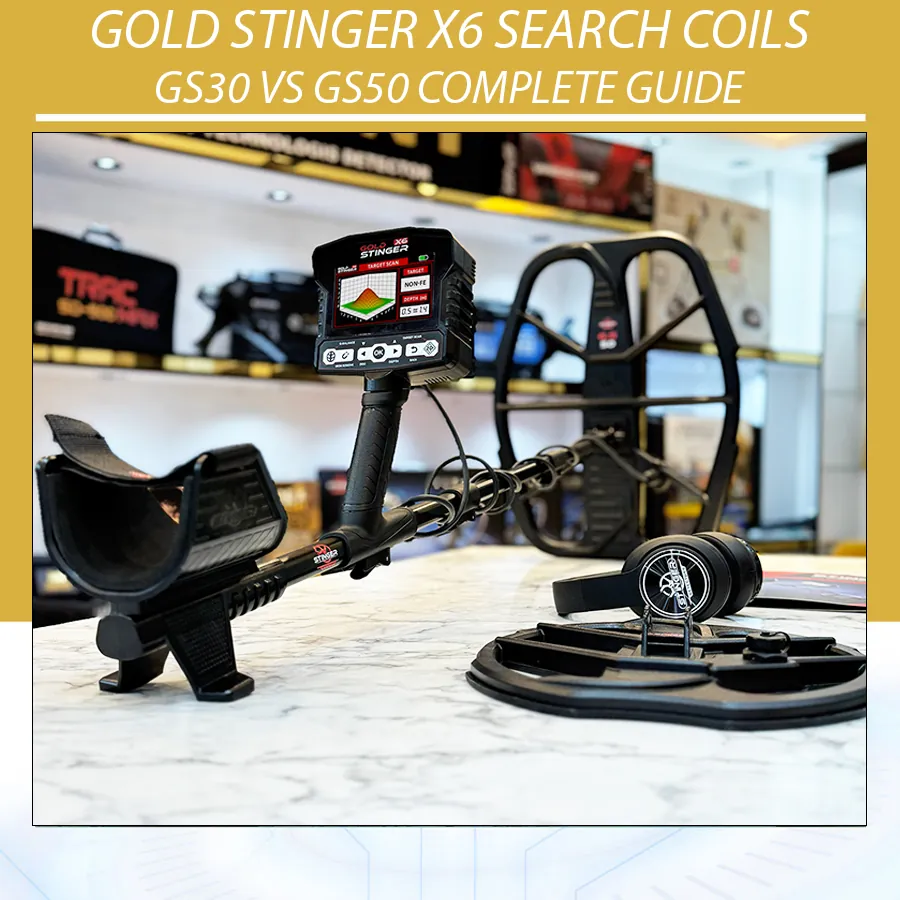
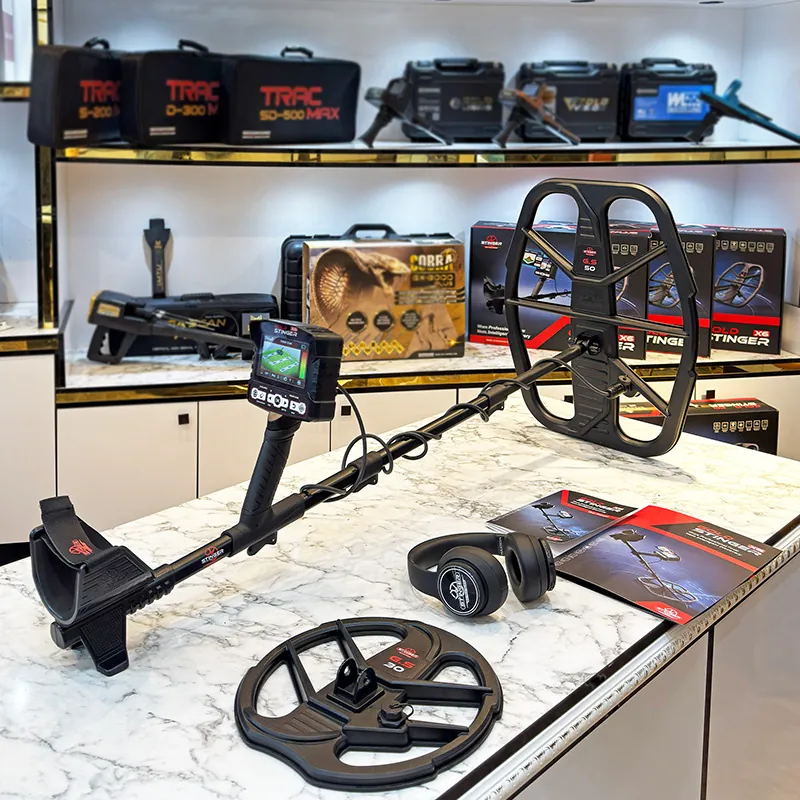
GS30 vs GS50 Quick Comparison
| Factor | GS30 | GS50 |
|---|---|---|
| Physical size | Smaller | Larger |
| Ground coverage | Narrower per sweep | Wider per sweep |
| Small-target priority | Preferred starting option | Broader response footprint |
| Large/deep-target priority | Useful for localization and difficult ground | Manufacturer-recommended option |
| Target separation | Better around closely spaced objects | More likely to see several targets together |
| Mineralized soil | Sees less ground volume | May require lower Sensitivity or Turbo |
| Obstacles | Easier near rocks and vegetation | Best in open sweep lanes |
| Coverage time | More passes required | Fewer passes for the same area |
| Operator fatigue | Lighter and easier to maneuver | Larger leverage during long sessions |
Why Coil Size Changes Detector Behavior
A search coil creates and receives an electromagnetic field. A larger coil interacts with a larger volume of ground. This can increase coverage and support response to some larger targets, but it also includes more mineralized soil and more nearby metal in each sweep. A smaller coil examines a tighter area, which helps separate objects and control ground response.
Coil size does not change trash into treasure or provide chemical identification. It changes the signal environment presented to the detector. Target size, orientation, alloy, depth, soil, settings and sweep technique remain important.
The best coil is therefore defined by the search question. “Which coil goes deeper?” is incomplete. The target and ground must be specified. GS50 may be favored for a large object in clean open ground; GS30 may produce the more usable response to a small object beside iron or in mineralized soil.
Understanding the GS50 Coil
The manual describes GS50 as the larger coil for greater coverage and improved depth performance. Its broad footprint suits reconnaissance in open areas where the operator wants to cover ground efficiently. It is also the logical manufacturer-recommended starting option for larger and deeper-target objectives.
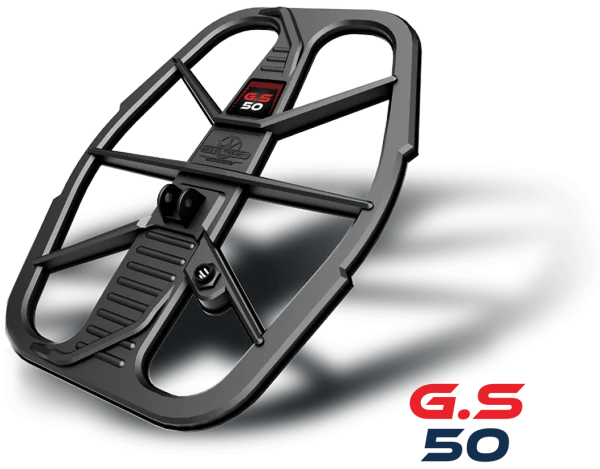
GS50 strengths
- Wider area covered on each controlled sweep.
- Useful for open fields with few physical obstacles.
- Manufacturer-stated depth advantage for appropriate larger targets.
- Broad response that can help recognize an extended target or anomaly.
- Efficient first-stage survey before GS30 confirmation.
GS50 limitations
- More soil mineralization enters the search field.
- Several nearby targets can blend into one response.
- Large iron can dominate a wider area.
- Movement is harder near rocks, bushes, walls and uneven terrain.
- Long sessions may create more arm and shoulder fatigue.
Begin with moderate Sensitivity and Turbo. Ground balance over representative soil after installing the coil. If the detector becomes unstable, do not assume extra noise represents extra depth. Reduce settings until real responses can be repeated.
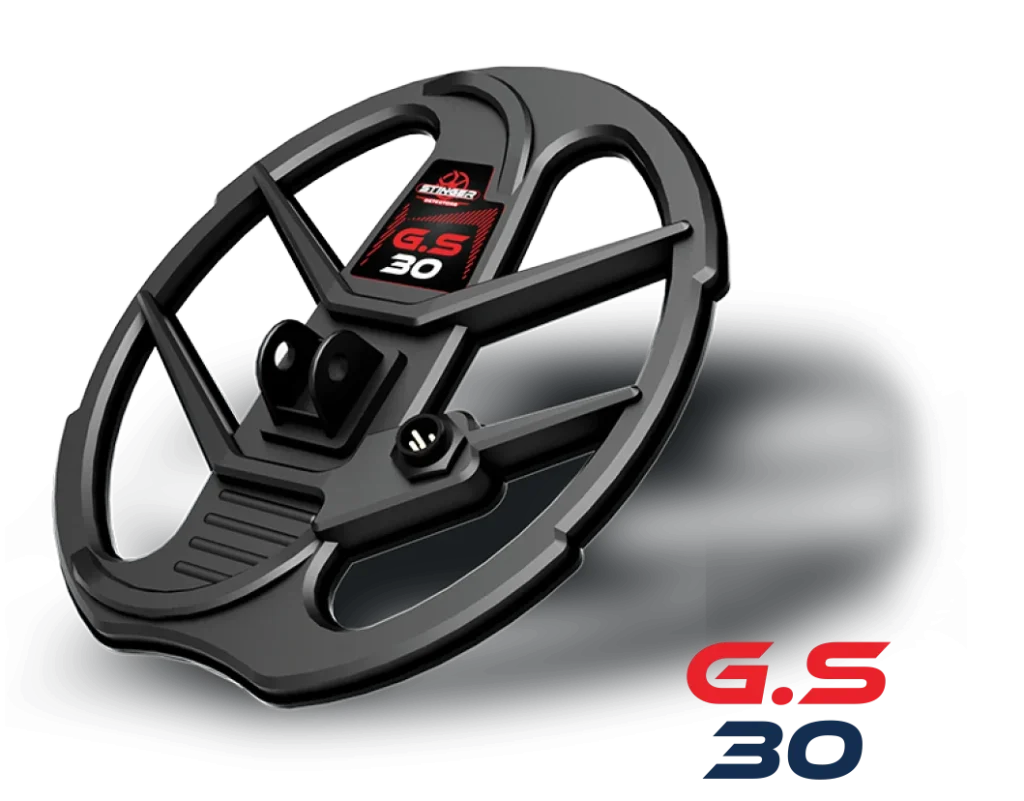
Understanding the GS30 Coil
The manual describes GS30 as smaller and lighter, with enhanced sensitivity to small targets and improved maneuverability in tight or cluttered environments. It is useful when target separation and precise coil placement matter more than maximum sweep width.
GS30 strengths
- Smaller detection footprint for closely spaced targets.
- Manufacturer-stated sensitivity advantage for small targets.
- Better maneuverability around obstacles and uneven ground.
- Less ground volume sampled in mineralized soil.
- Easier short sweeps for pinpointing and boundary checks.
GS30 limitations
- Narrower coverage requires more overlapping passes.
- A broad site survey takes longer.
- Large extended targets may require careful mapping from many positions.
- The smaller footprint does not guarantee identification or depth.
GS30 is often the better training coil because its physical size encourages controlled movement. It can also be used after GS50 identifies a broad area, helping determine whether the response comes from one compact object or several nearby objects.
Which Coil Is Better for Coins?
For isolated coins in clean open soil, both coils may produce useful responses. GS50 covers more ground, while GS30 gives tighter localization. In a park or historical site with nails, foil and multiple targets, GS30 is usually the stronger starting choice because fewer objects enter the field together.
Use All Metals to hear the full response, then compare Discrimination and Pin Pointer. If a coin signal changes dramatically with direction, check for nearby iron. The smaller coil can sometimes reveal a repeatable non-ferrous response between rejected objects.
Which Coil Is Better for Natural Gold?
Small natural gold requires sensitivity to a weak, low-conductive target. Based on the manual’s positioning, GS30 is the preferred starting coil for small pieces. Mineralized goldfield soil can also favor the smaller footprint because it reduces the amount of ground included in each measurement.
Large specimens or broader mineralized structures present a different question and may justify GS50 coverage. Use known representative test targets and stable settings. No coil can guarantee natural-gold discovery or distinguish gold from every piece of lead, foil or mineralized material.
Which Coil Is Better for Large or Deep Targets?
GS50 is the manufacturer-recommended option for greater depth performance and larger-target searching. This does not mean every object will be detected deeper with GS50. Large coils can lose practical advantage when soil noise, electrical interference or multiple metal objects force the operator to reduce settings.
Map a broad response from multiple directions. Lift the coil to see whether a strong shallow object remains dominant. Large iron, pipes and sheets can create extensive signals and attractive edges. Use GS30 to refine boundaries and check whether the broad GS50 response contains several objects.
Which Coil Is Better in Mineralized Soil?
GS30 often provides a more stable starting point because it sees less ground. Complete Ground Balance with the installed coil and lower Sensitivity if Not OK appears or normal sweeps produce broad random responses. Turbo should be raised only after a stable baseline exists.
GS50 can still be useful, especially for large-target objectives, but settings may need to be more conservative. A quiet GS30 response can be more informative than a noisy GS50 response even when the larger coil has a theoretical coverage advantage.
Which Coil Is Better in Iron and Trash?
GS30 is usually preferred. Its tighter field reduces simultaneous target overlap and makes short cross-sweeps easier. Use Iron Remove as a comparison rather than permanent proof. A valuable target can sit close to a nail and produce a blended response.
With GS50, a nail, coin and foil fragment may enter the response together. Discrimination can become unstable and the apparent center may shift. If GS50 reports a promising but broad mixed signal, mark the area and rescan with GS30.
Which Coil Is Better for Cavity Test and Target Scan?
The manual describes Cavity Test and Target Scan as controlled visual workflows. Use the selected coil consistently through each scan. GS50 may cover a broader anomaly, while GS30 can help refine boundaries, but movement accuracy matters more than simply choosing the larger coil.
Maintain the same height, speed and alignment on parallel passes. Do not compare a GS50 scan and GS30 scan as though their footprints were identical. If the results disagree, repeat each scan separately with documented settings and paths.
| Scenario | Recommended starting coil | Follow-up strategy |
|---|---|---|
| Open clean field | GS50 | Use GS30 over concentrated responses |
| Coin hunting among nails | GS30 | Short cross-sweeps and open-mode checks |
| Small natural-gold target | GS30 | Stable sensitivity and frequent ground checks |
| Large-object search | GS50 | Map footprint, then refine with GS30 |
| Highly mineralized soil | GS30 | Compare GS50 only after a stable baseline |
| Vegetation and rocks | GS30 | Keep coil level between obstacles |
| Broad cavity-oriented survey | GS50 | Repeat aligned passes; use GS30 for boundary study |
| Unknown mixed site | GS50 initial grid | GS30 for ambiguous zones |
How Coil Choice Affects Sensitivity and Turbo
Sensitivity controls responsiveness, while Turbo is described as a power boost. The stable values may differ between GS30 and GS50. A larger coil sees more ground and environmental signal, so copying a GS30 setting directly to GS50 can produce noise.
- Install and connect the selected coil with the detector powered off.
- Start the detector and verify coil connectivity.
- Use conservative Sensitivity and Turbo values.
- Ground balance on representative metal-free soil.
- Test a known target from two directions.
- Raise Sensitivity gradually until instability begins, then step down.
- Test Turbo separately and keep it only if repeatability improves.
- Save written settings for that coil and site type.
Do not rate a setup by its loudest single pass. Use two-way response, target-center consistency, graph behavior and background stability.
How Coil Choice Affects Pinpointing
GS30’s smaller footprint can produce a tighter apparent center, particularly around clutter. GS50 may create a broader response on large or shallow targets. Before entering Pin Pointer, mark the target from two directions in the original search mode.
If the center changes after switching coils, do not assume one result is wrong. The coils may be emphasizing different objects in a cluster. Search a small grid and determine whether several centers exist. See the detailed metal detector pinpointing guide.
How Coil Choice Affects Depth Detect
Depth Detect requires an estimated target diameter. Coil footprint affects how the operator perceives signal boundaries. GS50 may produce a wider blended area, while GS30 may separate that area into multiple targets or define a compact center.
Enter diameter only after consistent boundary marking. If GS30 and GS50 produce very different shapes, investigate the possibility of multiple objects, large iron or variable ground. The displayed depth remains an estimate, not a measured excavation distance.
Changing Gold Stinger X6 Coils Correctly
- Power the detector off.
- Place it on a clean padded surface.
- Release the device-end connector by its locking section.
- Unwrap the cable without pulling it.
- Disconnect the coil-base connector.
- Support the coil ears and remove the mounting screw.
- Install the second coil with the specified hardware.
- Leave pivot slack and wrap the cable evenly.
- Reconnect, restart and verify the status indicator.
- Perform Ground Balance and rebuild stable settings.
The official assembly video shows the mechanical connection sequence. Never change coils by pulling on the cable or while the detector is powered.
Coil Height and Sweep Technique
The manual recommends keeping the coil parallel and approximately 5–10 cm above the surface during normal guided operation. Consistency matters more than repeatedly touching the ground. Raise the coil only to clear an obstacle, then return smoothly to the working height.
GS50 needs enough room for a controlled arc. Avoid swinging faster to compensate for its width. GS30 requires more overlapping passes; use a tighter grid so no strips remain unsearched. On both coils, overlap passes and maintain a steady forward pace.
| Technique | GS30 | GS50 |
|---|---|---|
| Sweep width | Short to moderate | Moderate, within level control |
| Overlap | Greater overlap for full coverage | Regular overlap despite wider footprint |
| Speed | Slow and controlled in clutter | Slow enough for stable graph and audio |
| Obstacle handling | Work between and around obstacles | Avoid tilting around narrow gaps |
| Target check | Precise short cross-sweeps | Map broad footprint before shortening |
Testing GS30 and GS50 Fairly
A useful comparison keeps variables controlled. Use the same target, orientation, ground, sweep direction and coil height. Ground balance each coil separately. Establish the highest stable Sensitivity and Turbo combination for each rather than forcing identical numbers.
| Field | What to record |
|---|---|
| Target | Metal, size, shape, depth and orientation |
| Ground | Dry/wet, mineralization behavior and balance result |
| Coil | GS30 or GS50 |
| Settings | Sensitivity, Turbo and Iron Remove status |
| Mode | All Metals, Discrimination, Pin Pointer or analysis tool |
| Response | Two-way audio, graph, numeric range and center |
| Stability | Random signals away from target |
Air tests are useful for learning, but representative soil adds mineralization, moisture and masking. Build a permitted test area and repeat after changing conditions. Do not publish one test as a universal depth claim.
Planning a Search Grid for Each Coil
Coil selection changes how a search grid should be walked. GS50 covers a wider strip, but its sweep still needs overlap. GS30 covers a narrower strip and benefits from closer lanes. Mark a starting edge, choose a reference line and walk parallel passes at a pace that lets the graph and audio settle.
For an open survey, begin with GS50 and mark all repeatable responses rather than stopping to interpret every number. After the first grid, return with GS30 to investigate marked points, iron concentrations and ground changes. This two-stage workflow uses GS50 for efficient coverage and GS30 for detailed confirmation.
| Planning factor | GS30 approach | GS50 approach |
|---|---|---|
| Lane spacing | Close lanes with deliberate overlap | Wider lanes but still overlapping |
| Search speed | Slow in trash and around obstacles | Moderate, never rushed to exploit width |
| First pass goal | Separate compact responses | Map broad areas efficiently |
| Second pass goal | Cross-check likely centers | Reverse direction to identify broad or elongated signals |
| Best follow-up | Pinpoint and exact boundary work | Use GS30 if signal remains mixed |
Using Both Coils on the Same Target
When both coils are available, treat their comparison as a diagnostic conversation. Start with the coil that suits the site, mark the response and record the mode and settings. Change coils with the detector off, ground balance again and return to the marked point from the same directions.
If GS50 produces a broad response and GS30 finds one compact repeatable center, the smaller coil may be separating a target from surrounding ground or trash. If GS30 finds several centers, the broad response may contain several objects. If neither coil repeats the response after setup, investigate ground change, cable movement or electrical interference before drawing conclusions.
Coils, Battery Use and Operator Energy
The GS50’s physical size can increase arm movement over a long session, while the GS30 requires more passes to cover a field. Plan rest breaks and choose the coil that lets you maintain consistent technique. A coil that is theoretically suited to a target but makes the operator lift or rush the sweep may produce poorer usable results.
Turbo and high brightness may increase energy demand. Begin a long survey with a charged detector, a conservative stable setting and a realistic area plan. Do not raise Turbo simply to compensate for fatigue or incomplete grid coverage.
When Not to Change Coils
Do not change coils in blowing dust, rain beyond the published equipment limits, unstable terrain or while the detector is powered on. Finish documenting a target response first. Changing the coil midway through an uncontrolled test makes comparison difficult because the location, soil condition and settings may no longer match.
If a target is in a legal recovery area and the initial response is compact and repeatable, complete the normal confirmation procedure before introducing another coil. Coil changes are valuable for ambiguity, not a requirement for every signal.
Coil Care and Inspection
Before each session, inspect the shell, mounting ears, cable entry, full cable and connector. Remove dry soil with a soft method. Protect coils from extreme heat, sharp impacts and sudden shocks as instructed by the manual.
After searching, clean and dry the coil before storage. Do not lift the detector by the cable or use the coil as a support while climbing. Store both coils so the ears are not carrying weight and the cable is not kinked.
Common Coil-Selection Mistakes
- Choosing GS50 for every site because it is larger.
- Using GS30 without increasing overlap.
- Copying identical settings between coils.
- Failing to ground balance after a coil change.
- Using GS50 in dense iron and interpreting blended IDs literally.
- Expecting GS30 to guarantee gold identification.
- Comparing coils at different heights or sweep speeds.
- Ignoring cable movement and connector status.
- Entering Depth Detect diameter from one unconfirmed sweep.
Gold Stinger X6 Coils FAQ
Which Gold Stinger X6 coil goes deeper?
The manufacturer positions GS50 for improved depth performance, particularly for suitable larger targets. Actual usable depth depends on the target, soil, settings and stability.
Which coil is better for small gold?
GS30 is the manual’s small-target-oriented coil and is the preferred starting option for small natural-gold objectives.
Which coil is better for coins?
GS50 covers clean open ground faster, while GS30 usually separates coins better in nails, foil and crowded sites.
Which coil is better in mineralized soil?
GS30 often runs more stably because it sees less ground volume. GS50 can still be tested with lower, stable settings.
Do I need ground balance after changing coils?
Yes. Verify connection and perform a fresh ground balance for the installed coil and site.
Can both coils use the same Sensitivity?
They may require different values. Establish the highest stable setting separately rather than copying a number.
Can GS30 confirm a GS50 target?
Yes. It can help refine the center, separate nearby objects and study the boundaries of a broad response.
Is GS50 always faster?
It covers more ground per sweep in open areas, but obstacles, noise or target density can make GS30 more efficient.
Does a larger coil identify metal more accurately?
No. Identification depends on signal processing and conditions. A larger footprint may actually blend multiple targets.
How high should each coil be swept?
Follow the manual’s approximately 5–10 cm guidance and keep the coil parallel. Use the lowest consistent safe height for the terrain.
Should I carry both coils?
Carry both when practical if the search may progress from broad survey to small-target or cluttered-area confirmation.
Can coil choice confirm a cavity?
No. Repeated controlled Cavity Test results are still interpretations, and coil size alone cannot prove an underground structure.
Conclusion
The Gold Stinger X6 coils are complementary. GS50 is the coverage and larger-target survey option; GS30 is the small-target, separation and maneuverability option. The best field plan often uses both: GS50 to locate a broad response and GS30 to inspect its center and surrounding objects.
Whichever coil is selected, correct assembly, cable routing, Ground Balance and stable settings are required. Continue with the Gold Stinger X6 complete guide for the full search sequence.
Resources
- Gold Stinger X6 product page
- Official Gold Stinger X6 Complete Guide
- Official Device Assembly video
- Official All Metals system video
- Official Pin-Pointer system video
- Gold Stinger X6 User Manual, English edition supplied with the device.