
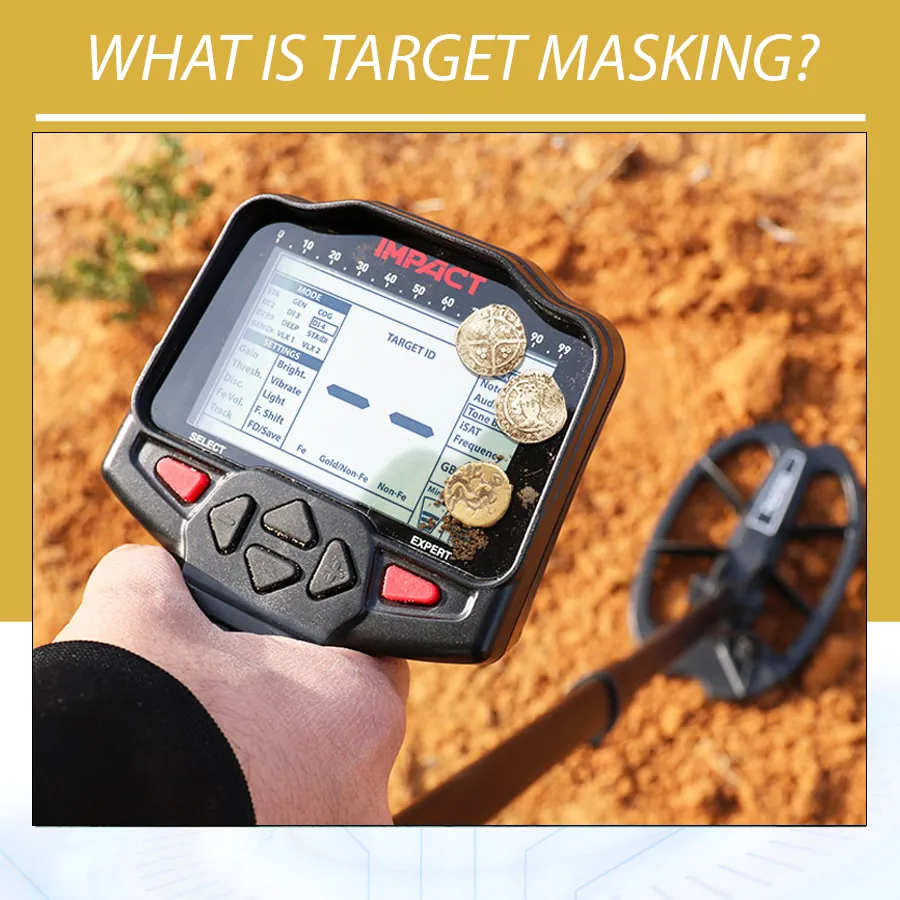
A detector does not see clean outlines of individual objects underground. Its search coil energizes a volume of ground, receives overlapping electromagnetic responses, and processes them over time as the coil moves. When two targets influence that response at nearly the same moment, the stronger or earlier signal can dominate. Discrimination, recovery speed, search mode, coil design, target depth, and the direction of the sweep then affect what reaches your headphones.
This guide explains masking without promising a setting that reveals every hidden object. It uses documented examples from the Minelab MANTICORE and Nokta The Legend, both available from Orient Detectors. You will learn how to recognize possible masking, how to build controlled tests, and how to search a difficult site systematically.
What does target masking mean?
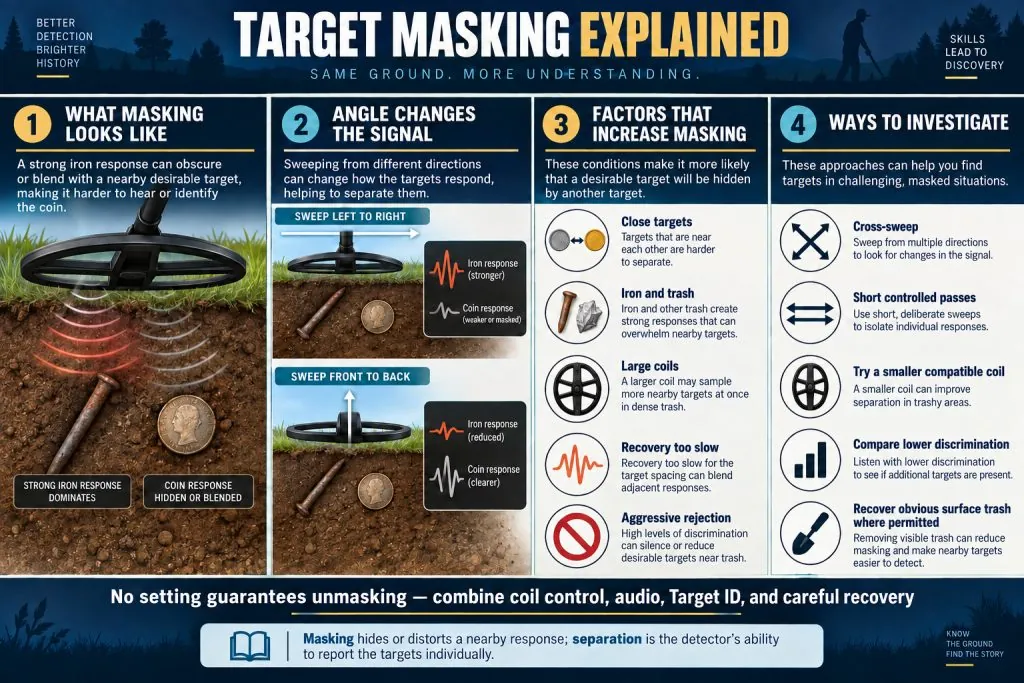
Masking describes a detection problem, not a particular type of metal. One target or ground response makes a nearby target harder to detect or classify. A common example is a coin beside a nail. If the detector reports only the nail, gives a rejected or blanked response, or combines both objects into an uncertain ferrous signal, the coin is masked. If a brief non-ferrous tone appears from one direction but disappears from another, masking may still be influencing the result.
The hidden target does not have to be physically covered. Two objects separated horizontally can overlap within the coil’s active detection field. A shallow object can also dominate a deeper target below it. In three dimensions, their spacing, depth, angle, shape, size, corrosion, and alignment all change the combined signal. A flat coin beside a lengthwise nail is a different problem from the same coin below a bent nail.
Masking is also not limited to rejected iron. A shallow aluminum can, brass cartridge case, or large coin can overpower a smaller or deeper object. Two accepted targets may sound like one long response. Mineralized ground can weaken the useful signal until nearby trash becomes dominant. The practical question is therefore broader than “Is there iron?” Ask what responses are entering the coil’s field together and how the detector is processing them.
Masking, separation, and identification are different
Target separation is a detector-and-coil system’s ability to report close objects as distinct events. Target masking is the failure mode in which one response prevents another from being recognized adequately. Identification is the attempt to classify the response through audio, Target ID, a ferrous indicator, or a visual map. These concepts interact, but they are not synonyms.
A detector may separate two sounds while giving unstable identification for the smaller target. It may produce one blended sound that still hints at a non-ferrous component. It may also identify a coin correctly in clean soil but call it ferrous when a nail is placed beside it. Better separation reduces some masking, yet no separation specification guarantees correct identification in every arrangement.
| Concept | What it describes | What you may observe | What it does not prove |
|---|---|---|---|
| Target masking | One response obscures or changes another | A good target disappears, breaks up, or reads as iron | That the hidden object is valuable |
| Target separation | Ability to report nearby objects individually | Two distinct audio events instead of one blend | Accurate identity for both objects |
| Recovery speed | How quickly processing transitions between responses | Shorter responses and clearer gaps at faster settings | Universal improvement at the maximum value |
| Discrimination | How selected response regions are accepted or rejected | Iron audio, silence, blanking, or an accepted tone | Physical removal of the rejected signal |
| Target ID | A processed estimate or classification | A number, trace, icon, or ferrous indication | Certainty about composition or value |
Why iron masks desirable targets
Old habitation sites can contain nails, wire, stove fragments, bolts, and decomposed iron on nearly every sweep. Iron may generate a strong ferrous response, a false high tone at an edge, or a mixed response whose classification changes with direction. If the detector is set to reject that iron, the rejected interval can occupy the same short time in which a nearby coin would otherwise be heard.
Rust halos and irregular shapes complicate the response. A long nail can interact differently when the coil crosses its tip, side, or length. Bent iron may produce several response points. A round iron washer can imitate some properties of a desirable target. When a coin lies close by, the processor is not simply choosing between two perfect signatures; it is evaluating a changing composite signal.
This is why an isolated bench test cannot fully predict a nail bed. The useful signal may be very brief and occur only when the coil approaches from a favorable angle. Conversely, an occasional high chirp at the end of a nail does not prove that a coin is present. Repeatability, location, short controlled sweeps, cross-sweeps, and recovery of representative targets provide better evidence than one attractive tone.
Non-ferrous trash can mask targets too
Modern parks, beaches, and event sites often contain dense foil, pull tabs, bottle caps, cans, and pieces of aluminum. Because much of this material falls within accepted conductive ranges, discrimination may not silence it. A strong shallow tab can dominate a thin ring below it, and several foil fragments can merge into a broad response. Faster recovery may separate the audio events, but it cannot tell you which accepted conductor is desirable.
Do not reject every low conductor in an effort to quiet the site. Small gold items and aluminum can share overlapping response regions. The guide to ferrous versus non-ferrous targets explains why conductivity and magnetic behavior do not create a simple valuables-versus-trash boundary.
The three-dimensional geometry of masking
Drawings usually show a nail and coin side by side on a flat line, but real targets occupy three-dimensional soil. Horizontal distance is only one variable. A shallow nail above a deeper coin can dominate even when their map positions are similar. Two objects at the same depth may separate well in one direction and overlap in another. A tilted coin presents a different effective area from a flat coin.
Sweep direction changes the order and timing with which objects influence the field. Imagine a coin east of a nail. An east-west pass encounters them consecutively; a north-south pass may place them under the coil at nearly the same time. Rotate around a suspicious point in small steps. A signal that appears on one axis and disappears at ninety degrees is useful evidence of a complex target arrangement, though it does not identify the hidden object.
| Arrangement | Possible masking effect | Useful check |
|---|---|---|
| Coin beside a nail | Iron response or rejection may dominate the adjacent coin | Sweep along and across the line between objects |
| Shallow trash above a deep coin | Strong shallow response may cover the weaker deep response | Map the shallow target, recover it, then rescan |
| Coin between two nails | Useful audio window may be extremely short | Use a tight sweep, several angles, and a suitable coil |
| Tilted or edge-on coin | Response may be weaker or less consistent | Cross-sweep and compare with a controlled tilted target |
| Multiple accepted conductors | Audio and ID can blend into one broad response | Shorten the sweep and isolate response centers |
| Irregular rusted iron | Edges can produce attractive falsing | Check repeatability, ferrous clues, and several directions |
Recovery speed and the time available between targets
Recovery speed controls how quickly a detector finishes or transitions from one response and becomes ready to report the next. A faster setting commonly shortens audio responses, making a gap between close targets easier to hear. A slower setting can preserve a fuller response and may favor an isolated deep target in suitable ground, but nearby sounds can overlap.
The tradeoff matters because the masked signal may occupy only a small time window. Raising recovery can expose a repeatable chirp between nails. However, very fast recovery can shorten weak responses, reduce isolated-target depth, or make Target ID less stable. The objective is not the highest number; it is enough separation for the site’s density while preserving intelligible responses.
Keep physical sweep speed separate from electronic recovery. Changing both at once makes the result difficult to interpret. The Metal Detector Recovery Speed guide explains this tradeoff in detail. During a masking test, keep coil height, sweep path, and pace consistent, then change one recovery step at a time.
Coil size, shape, and overlap
A smaller coil often helps in dense trash because it samples less ground and fewer objects at one time. This can improve spatial separation even before electronic processing is considered. A large coil may offer coverage and advantages for some isolated targets, but several nearby objects can enter its response area together. Fast recovery cannot completely make a large coil behave like a small coil.
Shape matters with technique. An elliptical coil can offer a narrower dimension that is useful when probing between targets, although actual behavior depends on the detector and coil design. Rotate the coil and compare. A response that separates when using the narrow axis may merge when the broad axis crosses the same arrangement.
Overlap each sweep enough to avoid leaving unsearched strips, but do not assume that overlapping one direction solves masking. Search a promising patch on a second axis. Keep the coil level, especially at the ends of the stroke. Lifting or arcing changes distance and can make a short signal vanish for reasons unrelated to masking. Review sweep speed and coil height for a repeatable movement technique.
Discrimination, blanking, and iron audio
Discrimination changes how classified targets are reported; it does not stop their electromagnetic responses from reaching the detector. Depending on the model and audio configuration, a rejected object may produce silence, a break in the threshold, a blanked interval, or another suppressed response. If a desirable target lies close, part of its signal can be caught in that rejected interval or classified with the iron.
Testing with less rejection or with ferrous audio available can reveal the structure of a crowded patch. You may hear iron on both sides of a short non-ferrous response rather than silence with one broken chirp. That extra information can guide a careful recovery. It can also make the detector noisier and increase fatigue, so use it as an investigative tool rather than assuming that maximum audio detail is always comfortable.
Iron-filter or ferrous-limit controls affect classification tradeoffs. Relaxing an iron filter may let more difficult non-ferrous responses through, while also allowing more iron falsing. Aggressive rejection can quiet nails while increasing the chance that mixed responses are treated as ferrous. Manufacturer scales and algorithms differ, so copy neither numbers nor names between brands.
Ground mineralization, depth, and weak targets
Ground minerals create their own response and reduce the margin between a weak target and background. A deep coin near iron is difficult because its signal is already small; mineralization can weaken identification further while the nearer iron remains prominent. Incorrect ground balance, excessive sensitivity, and inconsistent coil height can add instability that resembles a crowded target response.
Perform the detector’s recommended ground-balance and noise-cancel procedures before diagnosing masking. Choose a search mode intended for the environment. If the detector chatters with the coil held still, electromagnetic interference may be involved. If instability follows the moving coil and changes with soil, revisit ground settings. The ground-balance guide covers these distinctions.
Frequency and search mode
Frequency and mode influence sensitivity to target sizes, conductivities, ground, salt, and interference. Simultaneous multifrequency and single-frequency options are model-specific processing choices, not universal “unmask” buttons. A mode optimized for fast work in trash may use different filtering and recovery from a deep mode. A beach mode must handle conductive salt differently from an inland field mode.
Documented example: Minelab MANTICORE
The Minelab MANTICORE provides several documented controls relevant to masking. Its Recovery Speed range is 0 to 8. Minelab describes higher speeds as useful for separating closely spaced targets in trash-heavy ground, while slower speeds can make deep isolated targets easier to detect. The manual also warns that higher recovery may reduce detection depth and Target ID accuracy.
MANTICORE’s two-dimensional ID Map displays conductive information on one axis and ferrous characteristics on the other. Ferrous Limits define regions used to classify responses. The current instruction manual allows preset or custom Upper and Lower Ferrous Limits, and its live Target Trace remains visible while custom limits are edited. This helps an experienced user study how a response relates to a chosen boundary.
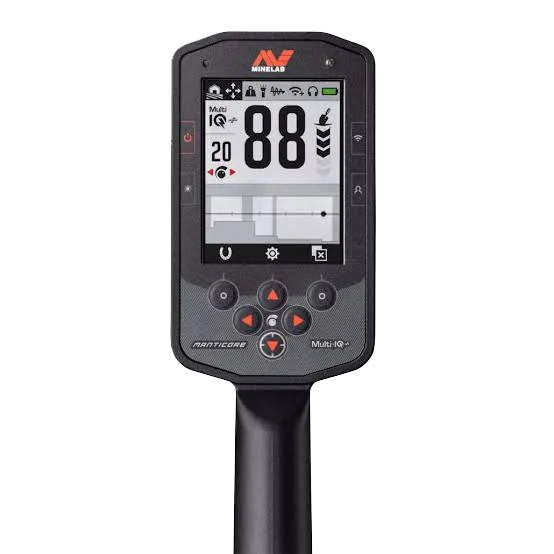
That visual information does not make a mixed trace a photograph of two underground objects. Minelab describes the system as additional target information. A trace near or across a ferrous boundary can support an audio decision, but spacing, orientation, ground, and settings still influence it. Check from several directions and recover representative signals rather than assigning certainty to a screen shape.
A controlled MANTICORE exercise can use one coin and one iron nail on clean ground. Test the coin alone, the nail alone, and then both together at increasing spacing. Keep the Search Mode and Ferrous Limits fixed while changing Recovery Speed. Next keep recovery fixed and compare an open pattern with the chosen rejection. This demonstrates which change affects timing and which affects reporting.
Documented example: Nokta The Legend
The Nokta The Legend offers another clear manufacturer example. Its software 1.17 manual states that Recovery Speed runs from 1 to 10. Low values increase depth but reduce the ability to detect close targets; high values increase close-target detection while decreasing depth. Nokta specifically recommends practicing with different metals placed close together.
The same manual describes Iron Filter as a control that can allow desirable non-ferrous targets previously masked by iron in trashy sites to be detected. For software 1.17, Iron Filter ranges from 0 to 9 in Park, Field, and Goldfield, and from 1 to 9 in Beach. Nokta also warns that lowering Iron Filter increases the probability of ferrous targets being classified as non-ferrous and vice versa. This is a classification tradeoff, not free separation.
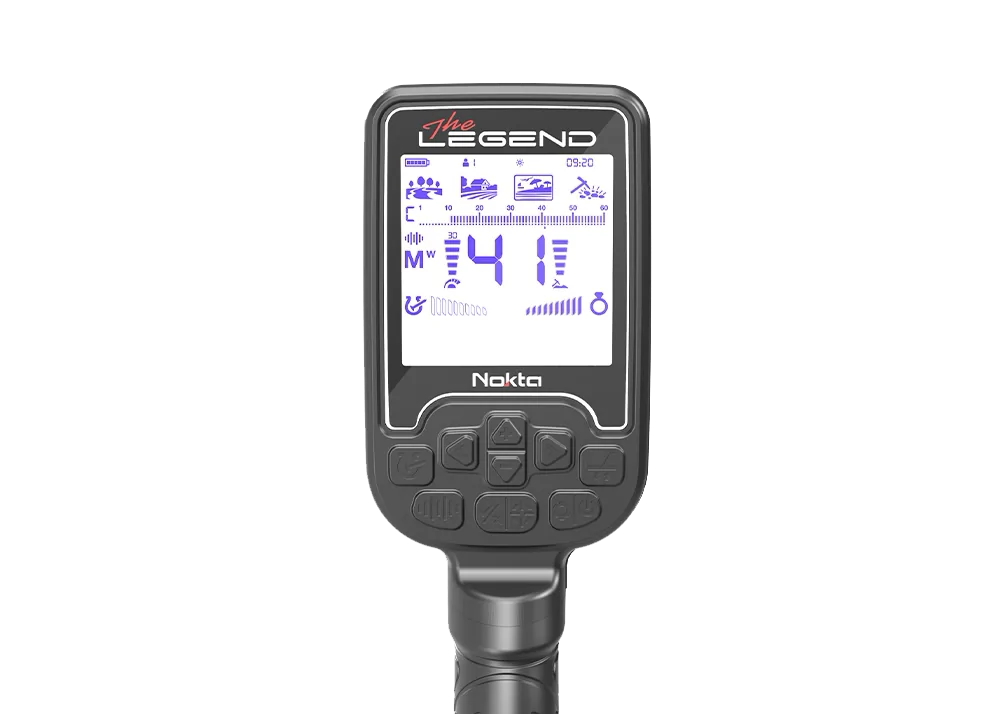
Nokta’s published software notes also describe Deep Target Identification as a feature intended to help deep non-ferrous targets that are masked or detected as ferrous. The company warns that increasing its value can reduce stability. Confirm the installed software and use the matching manual before changing the control; do not assume an older detector menu has the same features or ranges.
A sensible Legend test changes one of Recovery Speed, Iron Filter, or Deep Target Identification at a time. If all three change together, you cannot tell why the response improved or why iron falsing increased. Save written results for Park, Field, Beach, or Goldfield separately because mode processing and local settings differ.
| Detector and control | Documented function | Important tradeoff |
|---|---|---|
| MANTICORE Recovery Speed | Adjusts response timing for consecutive targets; range 0–8 | Faster can improve separation but reduce depth and ID accuracy |
| MANTICORE Ferrous Limits | Defines ferrous classification regions on the 2D ID Map | Boundary changes affect acceptance and rejection, not target geometry |
| The Legend Recovery Speed | Separates targets in close proximity; range 1–10 in the v1.17 manual | Higher values improve close-target response but decrease depth |
| The Legend Iron Filter | Adjusts ferrous/non-ferrous classification in trashy sites | Lowering it can increase classification errors in both directions |
| The Legend Deep Target Identification | Aims to improve reporting of some deep non-ferrous targets | Higher values may reduce stability |
How to test target masking correctly
Use a clean test area where each object can be recovered and where digging is permitted. Check for utilities and obtain the landowner’s approval. Begin on the surface so geometry is visible. Choose a representative iron object and two or three non-ferrous targets rather than designing the test around one favorable coin.
- Scan the empty area and stabilize the detector according to its manual.
- Test every object alone from two directions. Record audio, ID, and approximate response width.
- Place the coin and nail far enough apart to sound separately, then reduce the gap in measured steps.
- Test both sweep axes and reverse the order of approach.
- Keep coil height and physical sweep speed consistent.
- Change only one setting, such as recovery speed, and repeat the entire sequence.
- Try a second coin orientation and place the iron slightly above the coin using a nonmetallic support or controlled test bed.
- Record misses and false positives, not only successful responses.
Surface tests teach timing but do not reproduce undisturbed soil, corrosion, moisture, mineralization, or years of target-ground interaction. A metal detector test garden adds controlled depth and orientation, although freshly buried targets still differ from long-buried finds. Use both methods and state their limitations.
| Record | Example entry | Why it matters |
|---|---|---|
| Detector and software | Exact model and displayed version | Menus and processing can change |
| Coil | Model, size, and orientation | Sampling area affects separation |
| Mode and frequency | Named mode; multi or selected single frequency | Processing is mode-specific |
| Settings | Recovery, discrimination, iron controls, sensitivity | Enables a fair repeat |
| Geometry | Gap, depth, vertical offset, target angles | Masking is three-dimensional |
| Technique | Direction, sweep width, pace, coil height | Operator movement changes timing |
| Result | Audio from each axis, ID range, ferrous clues | Captures uncertainty instead of one best pass |
A practical recovery strategy for crowded sites
Start with a stable setup and a disciplined grid. Search in one direction, then cross-search the highest-potential area. Mark short repeatable responses rather than chasing every isolated high chirp. Use small, centered sweeps to determine whether there are multiple response points. Listen for iron before and after the non-ferrous interval.
When permitted, recover obvious shallow targets and rescan every hole and spoil pile. Removing a nail or aluminum item can expose another response that the first object masked. This simple process can outperform continuous setting changes because it physically removes the competing signal. Fill holes carefully and follow local recovery rules.
If the site remains dense, test a suitable smaller coil, a modestly faster recovery value, and a less restrictive discrimination view. Change one variable at a time. If weak isolated targets disappear or audio becomes too clipped to interpret, step back. Comfort matters because hours of excessive iron audio can reduce attention and cause human masking: the operator stops noticing brief useful sounds.
Return after rain or in another season if access allows. Soil moisture can change response strength and ground behavior. Search from a different direction with fresh concentration. None of these actions guarantees an unmasked find, but together they sample the site under meaningfully different conditions.
Common mistakes
- Choosing maximum recovery automatically: the shortest response may cost depth or identification quality.
- Changing several controls together: improvement cannot be attributed to one cause.
- Using only one sweep direction: target order and overlap change with angle.
- Treating every iron-edge chirp as a masked coin: irregular iron can false without a desirable neighbor.
- Trusting one Target ID: mixed and weak signals can shift classification.
- Ignoring coil height: an arced sweep changes target distance and response strength.
- Copying another brand’s numbers: scales and algorithms are not equivalent.
- Making air-test guarantees: surface tests omit soil and long-term burial effects.
- Rejecting broad conductive regions: desirable and unwanted non-ferrous targets overlap.
- Failing to rescan holes: the recovered trash item may have hidden another target.
Frequently asked questions
What is metal detector target masking?
It is the loss, distortion, or misclassification of one target because another target or ground response influences the detector at nearly the same time. The hidden target may be silent, sound broken, or appear ferrous.
Does iron cause all target masking?
No. Iron is common in old sites, but aluminum, large accepted targets, shallow objects, mineralized ground, and multiple non-ferrous targets can also dominate weaker responses.
Will maximum recovery speed unmask every target?
No. Faster recovery can separate close responses, but it may shorten weak audio, reduce isolated-target depth, or make identification less stable. Geometry and coil coverage still impose limits.
Is a smaller coil always better?
A smaller coil often improves spatial separation in dense trash, but it covers less ground and may not suit every target or search objective. Test it against the standard coil under the same conditions.
Can discrimination hide a good target beside iron?
Yes. Rejected-target reporting and classification can suppress or alter part of a nearby response. Testing with less rejection or audible iron can provide more information, with the cost of additional noise.
Why does a signal appear from only one direction?
The sweep angle changes target order, overlap, and orientation relative to the coil. One-way or one-axis audio can also come from irregular iron, so it is a reason to investigate rather than proof of a good target.
Can Target ID identify two masked objects?
Sometimes advanced displays provide clues, but a composite signal is not a precise image of separate objects. Use audio, repeatability, direction, and careful recovery alongside the screen.
Does multifrequency eliminate target masking?
No. Frequency processing can improve performance in particular conditions, but close-target geometry, recovery timing, discrimination, coil size, depth, and ground still affect separation.
How should I practice target unmasking?
Test each target alone, then arrange measured pairs at different gaps, depths, and orientations. Keep technique constant, change one setting at a time, and record both successful and failed responses.
Should I dig short, imperfect signals near iron?
That depends on permission, site importance, time, and your recovery policy. A repeatable localized response from more than one angle deserves more attention than a random edge chirp, but neither guarantees value.
Why should I rescan after removing trash?
The removed object may have dominated a deeper or adjacent target. Rescanning the hole, spoil pile, and surrounding area tests the ground after that competing response is gone.
Conclusion
Metal detector target masking is the product of overlapping responses, three-dimensional geometry, detector processing, ground, and technique. It explains why a searched site can still contain detectable targets and why one direction or setting cannot sample every arrangement.
Use recovery speed, coil choice, discrimination, iron controls, and search modes as measured tradeoffs. Stabilize the detector, cross-sweep, shorten the stroke around complex audio, remove obvious trash where permitted, and rescan. Controlled tests teach what your exact detector sounds like when a desirable target is partly hidden. They do not create a guarantee, but they replace guesswork with repeatable evidence.