Gold Detector Depth: What Affects Real Detection Performance?
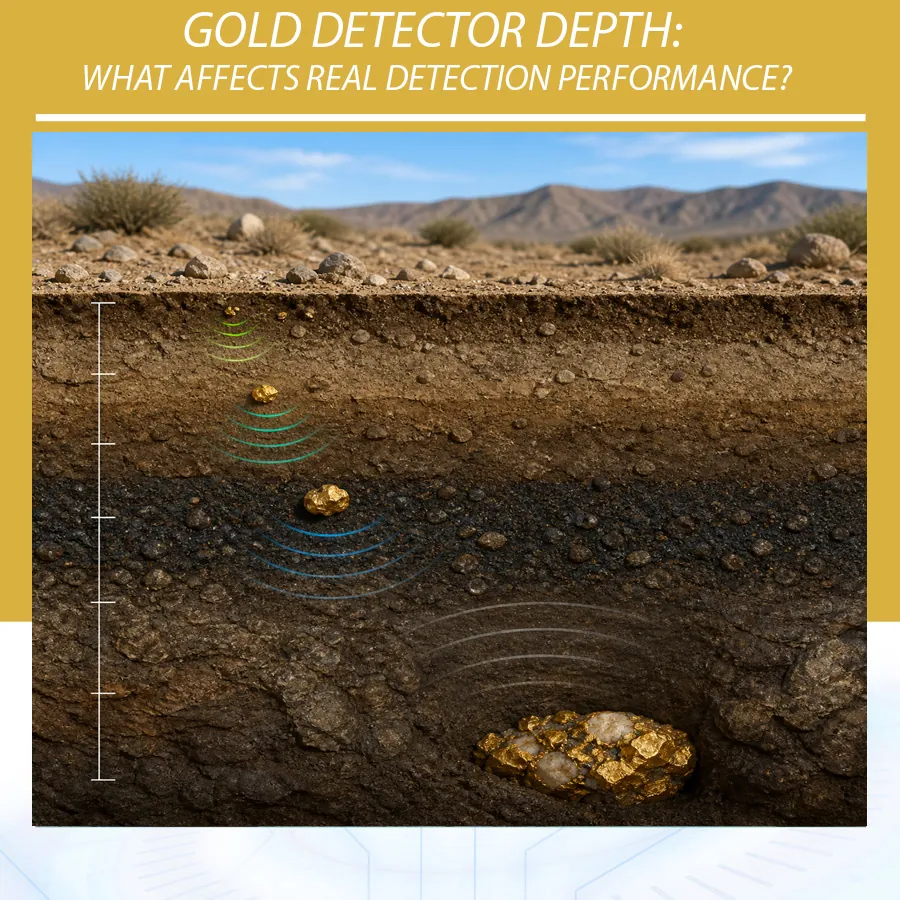
Gold detector depth is one of the first things buyers ask about, and one of the easiest things to misunderstand. A new prospector may ask, “How many meters can this detector reach?” A serious operator asks a better question: “How deep can this detector identify the type of gold I am searching for, in my soil, with my coil, at a signal quality I can trust?” Those two questions sound similar, but they lead to very different buying decisions.
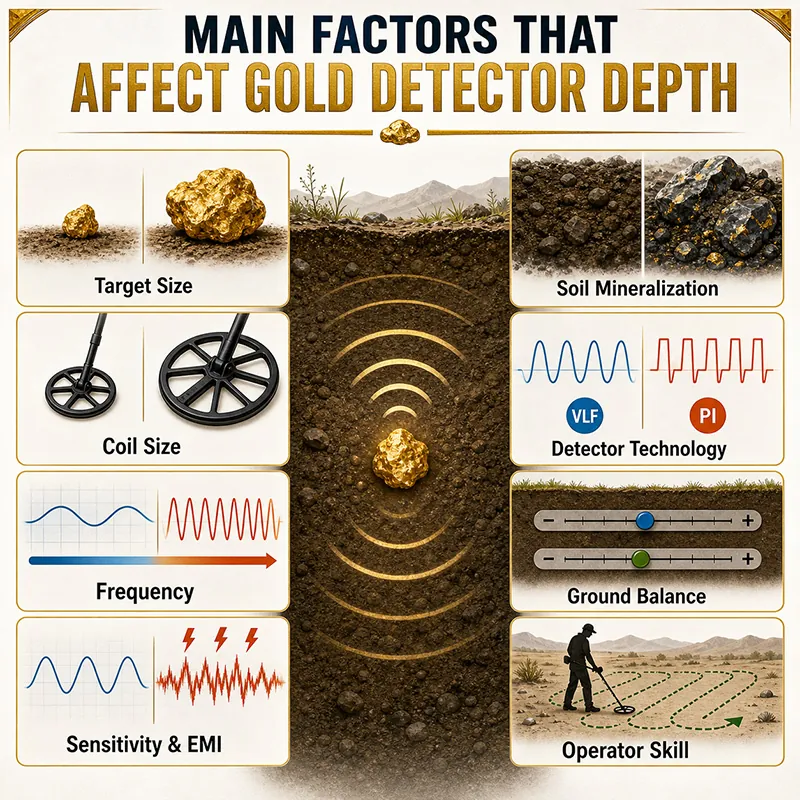
Depth is not a single fixed number. It changes with target size, gold purity, target shape, coil size, search frequency, pulse induction or VLF technology, soil mineralization, moisture, electrical interference, ground balance, sweep technique, sensitivity, recovery speed, and the level of confirmation required before digging. A detector may hear a large buried metal mass at impressive depth, yet only find a tiny natural gold nugget close to the surface. Another detector may be excellent for fine gold in mineralized ground, but not designed for deep treasure boxes or large caches.
This guide explains gold detector depth in practical buyer language. It uses online manufacturer resources and examples of devices available through Orient Detectors, including Gold Stinger X6, Nokta Magnetar 9000, Gold Monster 2000, GPZ 8000, The Legend 2, Garrett Axiom, GPX 6000, and advanced 3D or multi-system options for deep targets. The goal is to help buyers understand real performance instead of chasing unrealistic depth claims.
What Gold Detector Depth Really Means
Gold detector depth can mean several different things. It may refer to the maximum depth at which a detector can produce any signal. It may mean the depth at which the user can hear a repeatable target response. It may mean the depth at which the detector can give a useful target ID, a reliable gold/non-ferrous indication, or enough confidence to dig. These are not the same.
A faint one-way signal at the edge of detection is not equal to a stable two-way signal with a clear audio response. A large iron object at depth is not equal to a small gold nugget at depth. A long-range or 3D ground scanning device may list depth in meters for larger underground targets, while a VLF gold detector may be designed for small gold pieces measured in grams or fractions of a gram. Comparing all devices with one depth number is misleading.
For practical buying, depth should always be linked to target class. Small natural gold requires sensitivity and ground handling. Medium nuggets require balance between depth and sensitivity. Large nuggets or gold-bearing masses require power, coil coverage, and stable operation. Treasure boxes, jars, buried caches, cavities, and chambers may require pulse induction, multi-system detection, or 3D ground scanning rather than a standard small-nugget detector.
Why Published Depth Numbers Can Be Misleading
Depth ratings are often based on ideal conditions: large targets, clean soil, correct settings, controlled tests, and minimal interference. Real prospecting rarely happens in ideal conditions. Goldfields are often mineralized, rocky, salty, wet, hot, noisy, or full of ironstone and hot rocks. The operator may be tired, the coil may not stay level, the soil may change every few meters, and nearby power lines or electronics may create electromagnetic interference.
Minelab’s buyer education explains that there is no single answer to how deep a detector will go because depth depends on target size, orientation, metallic content, ground minerals, conductivity, electrical noise, ambient noise, and other variables. That is the most honest way to approach gold detector depth. A number can be useful, but only when it is attached to context.
When a product page lists a maximum depth, read it as a maximum potential under suitable target and ground conditions, not a guaranteed depth on every gold nugget. If a detector is listed with a multi-meter depth, ask whether that refers to large targets, general metals, cavities, or 3D scan anomalies. If a compact gold detector has no dramatic depth claim, it may still outperform a “deeper” machine on tiny shallow gold in difficult soil.
The Main Factors That Affect Gold Detector Depth
Real gold detector depth is the result of several variables working together. Improving one factor can reduce another. A larger coil may increase depth on bigger targets but lose sensitivity to very small gold. Higher frequency may find tiny nuggets better but lose depth on larger targets. Higher sensitivity may sound deeper in mild ground but become unstable in mineralized soil. The best setup is not always the most aggressive setup; it is the deepest stable setup for that target and terrain.
1. Target Size and Mass
Target size is usually the biggest depth factor. A large nugget, specimen, gold-bearing ore mass, or metal container returns more signal energy than a tiny flake or sub-gram nugget. This is why a detector may find a large nugget much deeper than a small one, even with the same coil and settings. Buyers should never ask only, “How deep?” They should ask, “How deep on what size of gold?”
Small gold is a special challenge. Tiny nuggets create weak signals, and their low mass makes them easier to lose in ground noise. A detector like the Gold Monster 2000 is designed around fine-gold sensitivity and automatic ground handling rather than maximum large-target depth. By contrast, high-end machines such as GPZ 8000, GPX 6000, Garrett Axiom, or Nokta Magnetar 9000 are more relevant when the user wants stronger performance in mineralized goldfields or deeper target classes.
2. Target Shape and Orientation
A flat or broad target can be easier to detect than a thin, irregular, vertical, or highly porous target. Natural gold rarely looks like a perfect coin. Nuggets can be rough, spongy, crystalline, wiry, or trapped inside rock. The same weight of gold may respond differently depending on shape and orientation in the ground.
This matters because depth tests using coins or plates do not always translate to natural gold. A detector that performs well on a flat coin may respond differently to a jagged nugget. For real prospecting, the best depth comparison is made with gold-like targets in similar soil, not only with clean air tests.
3. Soil Mineralization
Mineralized soil is one of the biggest enemies of gold detector depth. Minelab explains that mineralized soils can cause erratic signals, signal distortion, reduced detection depth, and chatter. Iron-rich soil, black sand, red clay, basalt, hot rocks, salt, and conductive wet ground can all interact with the detector’s electromagnetic field.
In mild soil, a detector can use more aggressive settings and may reach deeper. In difficult soil, the operator may need a quieter ground mode, lower sensitivity, better ground balance, a smaller or different coil, or a detector technology better suited to mineralization. A “deeper” setting that produces constant false signals may actually reduce field performance because the user cannot hear weak real targets through the noise.
4. Ground Balance
Ground balance helps the detector separate target signals from the natural response of the soil. Automatic ground balance, tracking ground balance, manual ground balance, and special ground modes all exist because the ground itself can act like a target. A detector that is poorly balanced may lose depth, become unstable, or misread targets.
Gold Monster 2000 uses automatic operation and automatic ground balance to make prospecting easier for beginners and developing users. The Legend 2 includes a mineralization indicator and ground balance features. GPZ-style and pulse induction detectors use more advanced ground handling because their users often work difficult goldfields. The lesson is simple: good ground balance does not just make a detector quieter; it protects usable depth.
5. Detector Technology: VLF, Multi-Frequency, PI, ZVT, and 3D Scanning
Different technologies handle depth differently. VLF detectors are common, efficient, and often excellent for small targets. Higher-frequency VLF machines are especially useful for tiny gold. Multi-frequency detectors transmit or process more than one frequency to handle variable targets and soil better than many single-frequency machines. Pulse induction detectors are often chosen for mineralized ground and larger/deeper targets because they can ignore some ground effects better than standard VLF platforms.
Minelab’s GPZ platform uses ZVT-style technology, and the GPZ 8000 adds GeoZVT according to the information used in Orient Detectors’ GPZ 8000 review. Multi-system devices such as Gold Stinger X6 add multiple search workflows, including depth estimation, target scan, discrimination, and cavity/void detection. 3D ground scanners are a different category again; they are not usually the tool for tiny nuggets, but they can help evaluate larger anomalies, cavities, chambers, and buried masses.
6. Frequency
Frequency affects both sensitivity and depth. Minelab explains that lower frequencies generally penetrate deeper and suit larger, higher-conductive targets, while higher frequencies are more sensitive to small or low-conductivity targets such as fine gold but do not penetrate as deeply. This is one of the core tradeoffs in gold detector depth.
Gold prospecting often needs higher-frequency sensitivity because small nuggets are common. But if the user is searching for larger gold masses at depth, a lower-frequency, multi-frequency, PI, or ZVT-style platform may be more appropriate. Gold Monster 2000 uses 12 to 76 kHz simultaneous multi-frequency according to Minelab’s technical specifications, which positions it as a fine-gold specialist. That does not make it a deep treasure detector; it makes it a smarter small-gold machine.
7. Coil Size and Coil Type
The search coil is the detector’s connection to the ground. Minelab’s coil guidance explains the basic tradeoff: larger coils can cover more ground and reach deeper on larger targets, but they may lose sensitivity to smaller targets and become more affected by EMI or mineralization. Smaller coils are more sensitive to small shallow targets, easier to control, and better in confined or trashy areas, but they usually lose maximum depth.
Coil type also matters. Double-D coils are often preferred in mineralized ground because they help with ground balancing and cover the ground more uniformly. Monoloop coils may offer slightly better depth in some PI contexts but can be harder to ground balance in extreme mineralization. Elliptical coils can fit between rocks and bushes better than round coils. For gold detector depth, the best coil is the one that matches target size and terrain, not automatically the biggest coil available.
8. Sensitivity, Noise Cancel, and EMI
Many beginners think maximum sensitivity means maximum depth. In clean air, that may sound logical. In real ground, too much sensitivity can make the detector unstable, noisy, and tiring to use. EMI from power lines, phones, towers, generators, and other detectors can cause chatter. Ground noise can mask weak targets. A calmer setting may find more gold because it allows the operator to hear repeatable signals.
Gold Monster 2000 includes automatic noise cancel on startup and Auto sensitivity modes. Minelab notes that Auto modes can help the detector avoid erratic behavior in ground noise or EMI, while more aggressive settings may add depth at the cost of more noise. The Legend 2’s deep target and Beast mode features also come with stability tradeoffs. Serious depth is not only about pushing power; it is about preserving signal clarity.
9. Sweep Technique and Coil Control
Even the best detector can lose depth if the operator swings poorly. The coil should stay low, level, and close to the ground without hitting rocks. Sweeps should overlap. The user should slow down when checking faint signals. Lifting the coil at the end of each swing reduces coverage. Moving too fast can miss weak deep targets. Scrubbing the coil over rocks can create noise and fatigue.
Good coil control can add practical depth without changing equipment. A user with a mid-range detector and disciplined technique may outperform a beginner using an expensive flagship machine carelessly. For this reason, training and patience are part of real gold detector depth.
Device Examples from Orient Detectors
The following examples show how depth should be understood by device category. These are not equal side-by-side claims. They show different approaches to gold detection and different buyer profiles.
Gold Stinger X6: Multi-System Depth and Visual Target Support
Gold Stinger X6 is positioned on Orient Detectors as a professional metal detection system with six search systems. The product page lists All Metals Mode, Discrimination System, Pin Pointer Mode, Depth Detection System, 2D Target Scan, and Cavity & Void Detection. It also lists advanced ground balance, smart metal identification, sensitivity control, Turbo Power, Iron Remove, and two coils: GS50 for greater depth and wider coverage, and GS30 for precision and smaller targets.
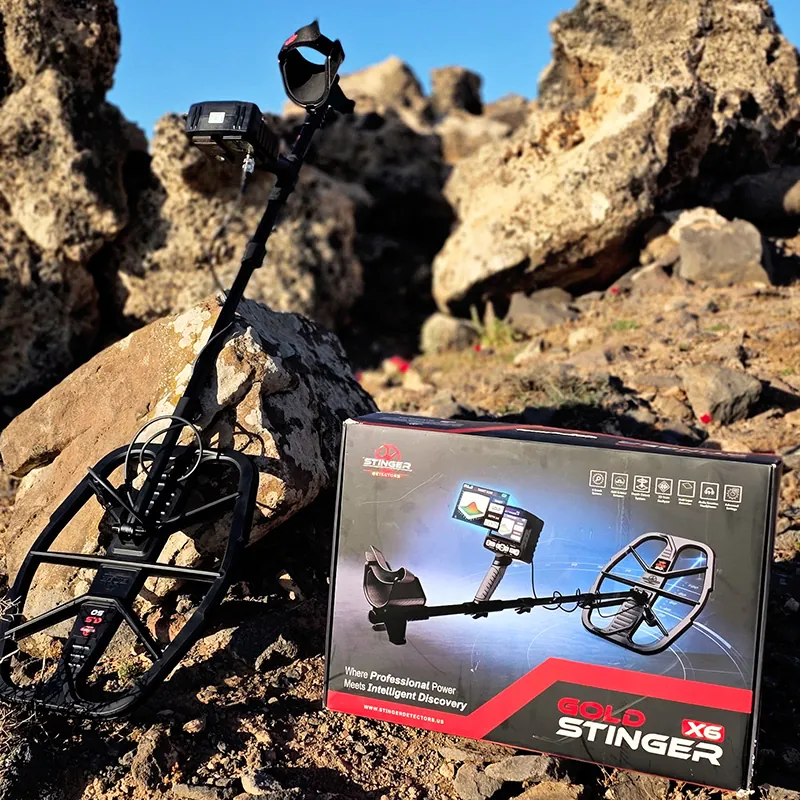
For buyers concerned with gold detector depth, Gold Stinger X6 is best understood as a flexible multi-system detector rather than a single-purpose nugget machine. Its All Metals mode is relevant for maximum response, while discrimination and iron removal help reduce unwanted targets. The Depth Detection System and 2D Target Scan can support decision-making before digging. The GS50 coil fits users who want more coverage and deeper response; the GS30 coil fits tighter searching and smaller targets.
Nokta Magnetar 9000: Pulse Induction for Serious Goldfields
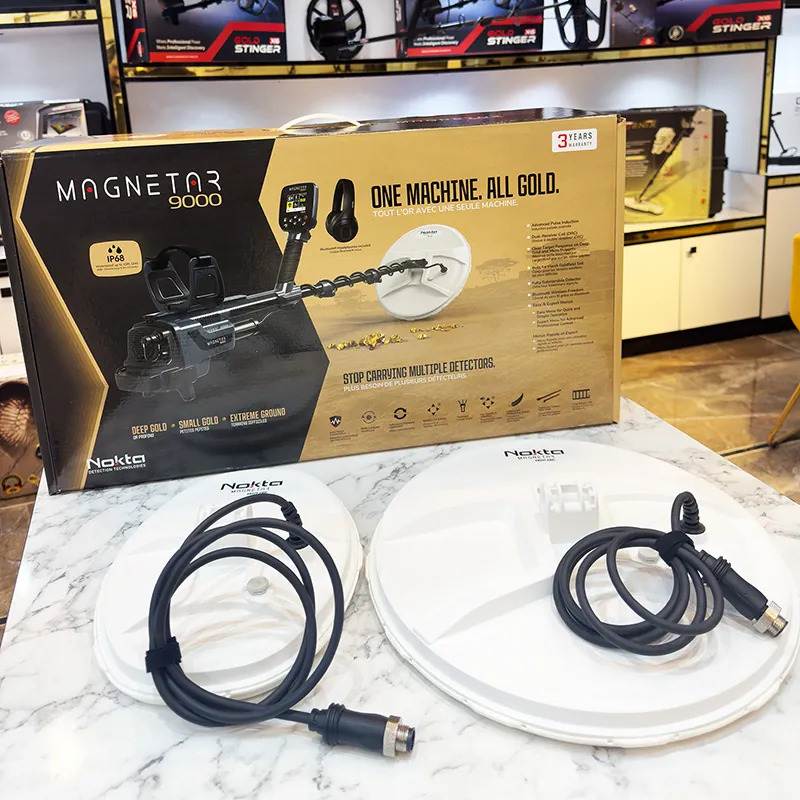
Nokta Magnetar 9000 is listed on Orient Detectors as a pulse induction detector for serious gold prospecting. The product description emphasizes mineralized soil, hot rocks, wet saltwater sand, micro-nuggets, and larger deep gold targets. It also describes a Dual-Receiver Coil system with two included coils: MG37 DRC 14.5 x 13 inches for deep seeking and MG29 DRC 11 x 8 inches for higher sensitivity.
This is a good example of depth as a balance between coil and target. The larger coil is more relevant for open ground, large targets, and deeper search. The smaller coil is more relevant for sensitivity and precision. Because the Magnetar 9000 uses PI technology, it belongs in the category of detectors built for challenging mineralized environments, where many VLF machines lose stability or depth.
Gold Monster 2000: Fine Gold Sensitivity, Not Maximum Depth Hype
Gold Monster 2000 should not be judged only by maximum depth. Minelab’s specifications list Multi-Au technology, 12 to 76 kHz simultaneous multi-frequency, Normal, Benign, and Difficult search modes, automatic noise cancel, manual and auto sensitivity, 0-99 Target ID, 25 discrimination segments, a 5-level depth indicator, and a 5-inch round Double-D coil.
Those specifications point to a specific mission: small-gold prospecting with stability and simplicity. A 5-inch coil is not meant to cover huge ground at maximum depth. It is meant to work tight terrain, bedrock cracks, small washes, shallow gullies, and hot-rock areas. Minelab’s materials describe Gold Monster 2000 as light, automatic, and able to adapt ground balance and sensitivity in changing soil. That makes it valuable for beginners and fine-gold hunters even if a larger PI or GPZ-style machine is better for deep large gold.

GPZ 8000: Flagship Depth for Experienced Prospectors
The GPZ 8000 is presented in Orient Detectors’ review as Minelab’s flagship gold detector using GeoZVT technology, Z-Set concentric toroidal coils, and ground-focused modes such as Difficult Deep, Difficult High Yield, Normal Deep, and Normal Extra Deep. The review describes coils such as Z18, Z17, and Z13 for different soil conditions, EMI behavior, vegetation, and target sizes.
For gold detector depth, the GPZ 8000 represents the professional end of the market. It is designed for users who understand ground conditions and want serious performance across difficult, conductive, and EMI-heavy goldfields. The large Z18-style coil concept supports deeper search and open ground coverage, while smaller coil options support control and smaller targets. But this level of detector still requires skill. The wrong mode, coil, sensitivity, or sweep method can reduce practical performance.

The Legend 2: Deep Modes and Mineralization Awareness
The Legend 2 is not only a coin detector; Nokta’s official information highlights updates that matter for depth and ground interpretation. Deep Target Identification can help non-ferrous deep targets that may be masked or detected as ferrous. Beast mode is designed for targets at depths that may not be detected in other modes, but the company also notes that fringe-depth targets may not give stable ID. The Legend 2 also includes a mineralization indicator showing iron particle and salt mineralization.
This is useful buyer education: deep modes can increase reach, but they may reduce stability or target ID reliability. A deeper mode is not always a cleaner mode. In mineralized soil or over hot rocks, a second ground balance or careful setup may be needed. Buyers comparing gold detector depth should look for these tradeoffs, not only the existence of a deep mode.
Garrett Axiom and GPX 6000: Professional PI Category
Devices such as Garrett Axiom and GPX 6000 belong in the professional pulse induction category. Buyers choose these platforms when mineralized ground, hot rocks, and difficult goldfields are a major concern. Their value is not just raw depth but stable operation in ground that may overwhelm simpler detectors. For serious prospectors, stability at depth can matter more than a dramatic air-test result.
Gold Detector Depth by Use Case
| Use Case | Depth Priority | Recommended Device Style | Examples on Orient Detectors |
|---|---|---|---|
| Small natural gold and fine nuggets | Sensitivity and ground stability over raw depth | High-frequency or gold-focused multi-frequency VLF | Gold Monster 2000, Gold Monster 1000, Gold Kruzer |
| Medium nuggets in mineralized soil | Balanced depth and hot-rock handling | Advanced VLF, multi-frequency, PI, or ZVT-style gold detector | Gold Monster 2000, GPX 6000, Garrett Axiom, GPZ 8000 |
| Large nuggets or deeper gold masses | Coil coverage, low noise, deep response | PI, GPZ/GeoZVT-style, or multi-system detector | Nokta Magnetar 9000, GPZ 8000, Garrett Axiom, Gold Stinger X6 |
| Mixed gold, coins, relics, and general targets | Versatility, discrimination, target ID, depth estimate | Multi-system or multi-frequency detector | Gold Stinger X6, The Legend 2, Garrett Vortex, Manticore |
| Buried caches, cavities, and deep anomalies | Large-target detection and visual confirmation | Multi-system detector or 3D ground scanner | Gold Stinger X6, Mega Scan Pro, Phoenix, Infinity Max Pro |
How to Increase Gold Detector Depth in the Field
Improving gold detector depth is not only about buying a more expensive machine. Field technique and setup often decide whether the detector reaches its potential.
Choose the Right Ground Mode
Use normal or extra-depth modes only when the soil is quiet enough. If the detector becomes unstable, switch to a difficult, salt, or mineralized-ground mode. A quieter detector may lose some theoretical depth but gain more usable depth because the target response becomes clearer.
Use Ground Balance Correctly
Ground balance on clean ground away from metal objects. Rebalance when the soil changes. If your detector has tracking ground balance, understand when to use it and when to lock it. In goldfields with hot rocks, ground balance discipline can be the difference between productive detecting and endless false signals.
Pick the Coil for the Target
For tiny gold, use a smaller sensitive coil. For larger targets in open ground, consider a larger coil. In mineralized or EMI-heavy ground, do not assume the biggest coil is best. Sometimes a medium Double-D coil gives better real depth because it stays stable.
Keep the Coil Low and Level
Depth is lost when the coil rises above the ground. Keep the coil close, level, and controlled. Overlap sweeps and slow down over suspicious signals. A target at the edge of detection may only become obvious when the sweep is careful.
Control Sensitivity and Noise
Run the highest stable sensitivity, not the highest possible sensitivity. Use noise cancel when available. Move away from EMI sources. If a detector is chattering constantly, weak gold signals can disappear into the audio clutter.
Confirm Weak Targets
Check a faint signal from multiple directions. Scrape a small layer of soil and rescan. Use pinpointing or another mode if available. Deep gold signals may be subtle, but they should still have some repeatable character.
Common Mistakes About Gold Detector Depth
Mistake 1: Comparing Small Nuggets to Large Caches
A detector’s depth on a large buried object says little about its depth on tiny gold. Buyers should separate small-gold detection from deep-treasure detection.
Mistake 2: Believing Air Tests Predict Real Goldfields
Air tests remove the biggest challenge: soil. Mineralization, moisture, salt, and hot rocks can all reduce real field performance.
Mistake 3: Using Maximum Sensitivity Everywhere
Too much sensitivity can create instability. A stable detector often finds more gold than an unstable detector set too aggressively.
Mistake 4: Ignoring Coil Choice
Coil size and type directly affect depth and sensitivity. The right coil for tiny gold is not always the right coil for deep large targets.
Mistake 5: Expecting Target ID at Maximum Depth
At fringe depth, target ID may become unstable or disappear. Nokta’s Beast mode notes are a useful reminder: deep targets may not provide stable ID even when detectable.
Buyer Recommendations by Experience Level
Beginner Gold Prospectors
Beginners should not start by chasing maximum depth. A stable, understandable detector is more productive. Gold Monster 2000 is a strong example because it focuses on automatic operation, fine-gold sensitivity, and ground adaptation. A beginner who can hear small targets clearly will learn faster than a beginner overwhelmed by a complex deep machine.
Intermediate Users
Intermediate buyers may want more control, more target information, or more flexible coil options. Gold Stinger X6, The Legend 2, and similar multi-feature detectors can make sense when the user searches gold, coins, relics, and underground targets. At this level, understanding ground balance and coil selection becomes very important.
Professional Prospectors
Professionals working mineralized goldfields, remote areas, and deeper targets should consider PI, GPX, GPZ, or advanced multi-system platforms. Devices such as GPZ 8000, GPX 6000, Garrett Axiom, and Nokta Magnetar 9000 are more relevant when the user needs serious field performance and knows how to manage settings, coils, and ground conditions.
FAQ: Gold Detector Depth
What is the maximum gold detector depth?
There is no universal maximum. Gold detector depth depends on target size, gold shape, soil mineralization, coil size, frequency, technology, settings, interference, and user technique. Large targets can be detected much deeper than tiny nuggets.
Which detector type is deepest for gold?
For difficult goldfields and deeper gold targets, PI, GPX, GPZ/GeoZVT-style, and advanced professional gold detectors usually outperform simple VLF machines. For tiny shallow gold, a sensitive high-frequency or gold-focused multi-frequency VLF may be better.
Does a bigger coil always detect deeper?
Not always. Larger coils can reach deeper on larger targets but may lose sensitivity to small gold and become noisier in EMI or mineralized soil. Coil choice must match the target and terrain.
Does higher frequency mean more depth?
No. Higher frequency improves sensitivity to small and low-conductivity targets like fine gold, but lower frequencies generally penetrate deeper on larger targets. Multi-frequency and PI technologies handle this tradeoff differently.
Why does mineralized soil reduce gold detector depth?
Mineralized soil creates background responses that can distort, weaken, or mask real target signals. This can reduce depth and make target ID less reliable.
Can a beginner get full depth from a professional detector?
Usually not at first. Professional detectors require proper ground balance, coil control, mode selection, sensitivity management, and audio interpretation. Skill is part of real detection performance.
Final Verdict
Gold detector depth is not a single number printed on a product page. It is the result of target size, soil, technology, coil, frequency, settings, and operator skill. A detector that is excellent for tiny gold may not be the best deep-cache machine. A detector that reaches deeper on large objects may not be ideal for sub-gram nuggets. The smartest buyer starts with the target and terrain, then chooses the detector.
For fine-gold beginners, Gold Monster 2000 makes sense because it focuses on small gold, automatic ground handling, and simplicity. For flexible multi-system use, Gold Stinger X6 gives depth estimation, target scan, discrimination, and multiple coil options. For serious goldfield depth in difficult soil, Nokta Magnetar 9000, GPX 6000, Garrett Axiom, and GPZ 8000 belong in the professional conversation. For deep anomalies, cavities, and larger buried targets, multi-system and 3D ground scanning devices may be more appropriate.
The best approach is realistic: know your ground, choose the right detector category, match the coil to the target, use stable settings, keep the coil controlled, and confirm weak signals carefully. That is how real detection depth is gained in the field: not by chasing the biggest claim, but by matching equipment and technique to real gold conditions.
Suggested Links
Suggested External Links
Resources
- Minelab: How Deep Can a Metal Detector Detect?
- Minelab: Detecting in Mineralized Soils
- Minelab: Understanding Coils
- Minelab: GOLD MONSTER 2000 Tech Specs
- Minelab FAQ
- Nokta: The Legend
- Orient Detectors: Gold Stinger X6
- Orient Detectors: Nokta Magnetar 9000
- Orient Detectors: Gold Monster 2000 Review
- Orient Detectors: GPZ 8000 Review