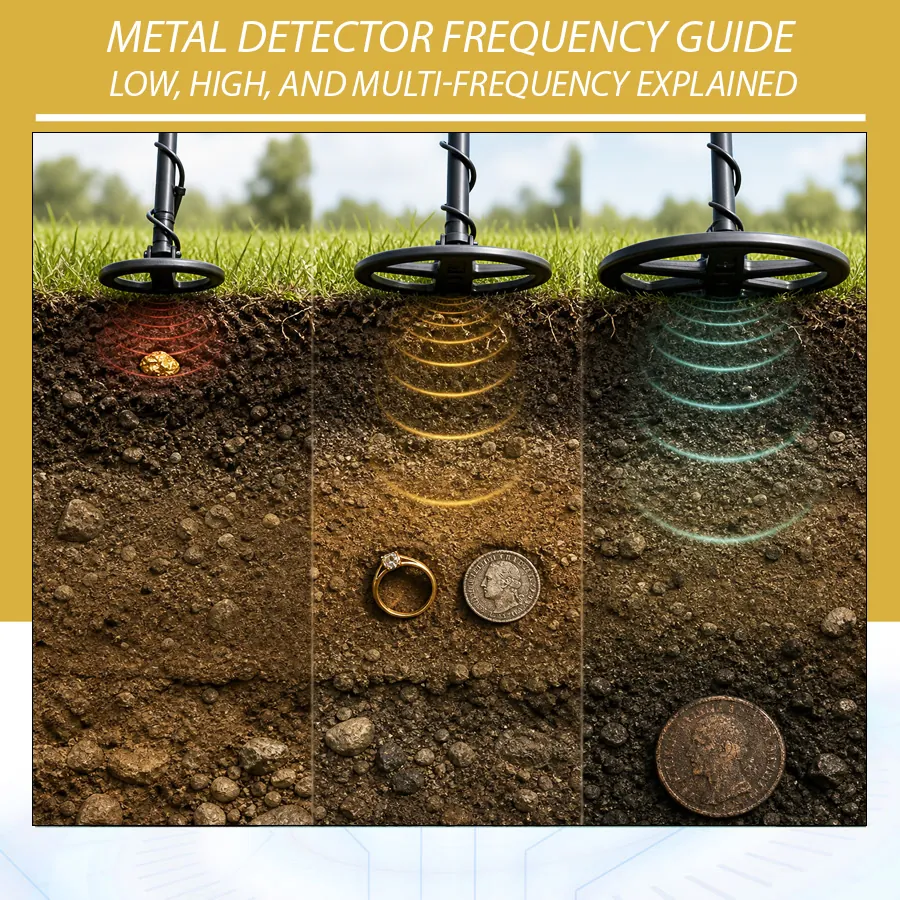
Metal Detector Frequency Guide: Low, High, and Multi-Frequency Explained
Choosing a detector by metal detector frequency can feel technical at first, but it is one of the most useful buying decisions you can learn. This metal detector frequency guide explains how low, high, and multi-frequency detectors behave in real soil, why frequency affects depth and sensitivity, and how to match the right technology to coins, relics, jewelry, natural gold, beaches, and mineralized ground. Frequency is not just a number in a specification table. It shapes how a detector “sees” targets underground.
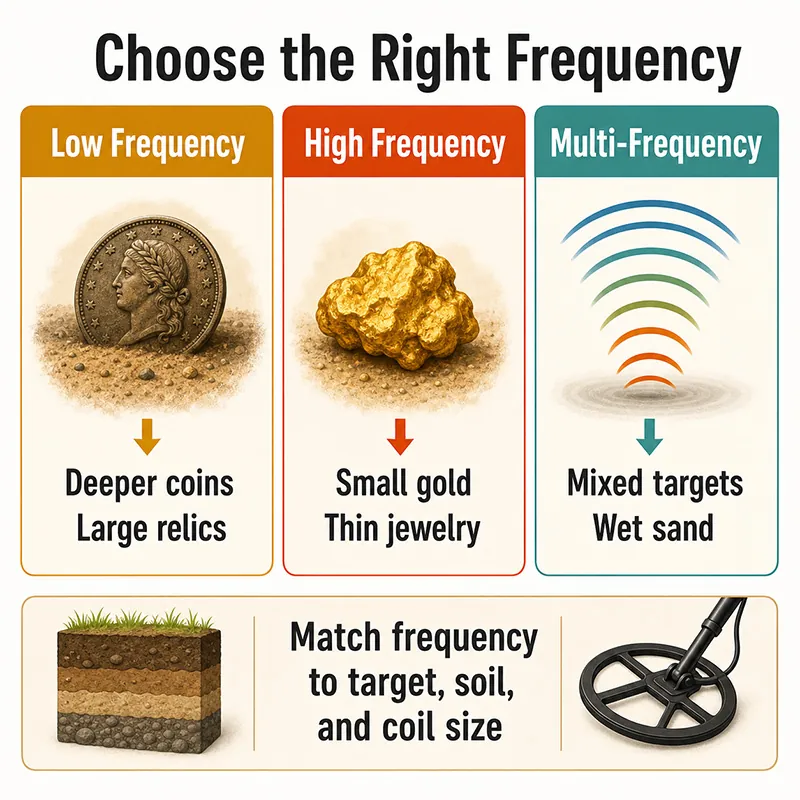
A low-frequency detector can often respond better to larger, deeper, high-conductive targets such as copper and silver coins. A high-frequency detector is usually more reactive to small, low-conductive targets such as tiny gold nuggets, thin jewelry, and small hammered coins. A simultaneous multi-frequency detector uses several frequencies together to improve versatility, target identification, and performance across mixed ground. But the best choice still depends on the target size, soil mineralization, coil size, search mode, and user technique.
This guide uses manufacturer education resources from Minelab, official specifications from Nokta, and product examples available through Orient Detectors. Examples include The Legend 2, Minelab Manticore, Equinox Metal Detector, Gold Monster 2000, Gold Stinger X6, GPX 6000, Garrett Axiom, Nokta Magnetar 9000, and GPZ 8000. The goal is practical: help buyers choose a detector that fits the ground and targets they actually hunt.

What Does Metal Detector Frequency Mean?
In a VLF metal detector, metal detector frequency describes how many electromagnetic cycles the detector transmits per second, measured in kilohertz, or kHz. A detector operating at 5 kHz transmits roughly five thousand cycles per second. A detector operating at 40 kHz transmits forty thousand cycles per second. That difference changes how the detector interacts with metal objects and the ground.
Minelab’s detector education explains that metal detectors use electromagnetic search coils to generate a magnetic field that penetrates the ground. When the field interacts with buried metal, the detector receives and analyzes a response. Advanced detectors use conductivity and magnetic properties to help assign Target ID, while ground balance reduces interference from natural minerals. Frequency is part of this system: it affects what targets respond strongly, how deeply the signal penetrates, and how the detector behaves in difficult soil.
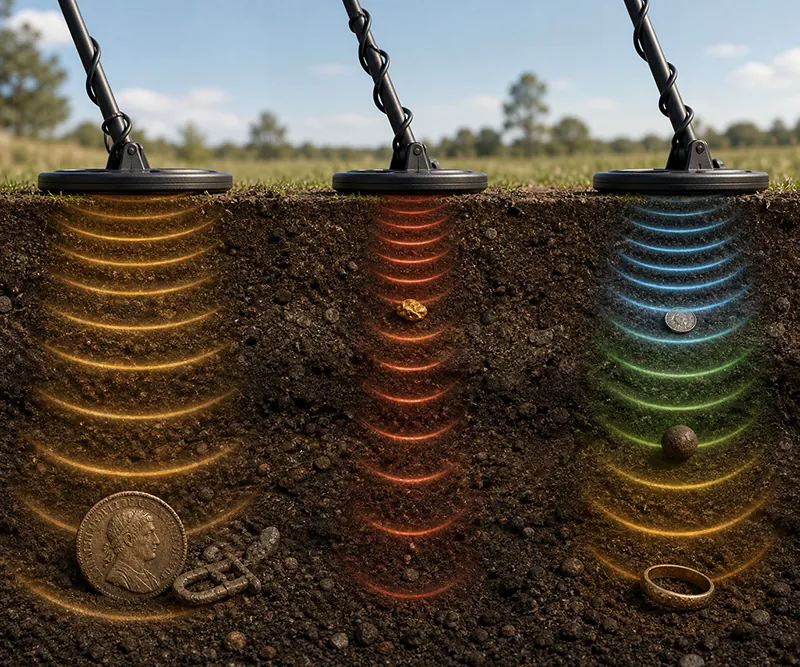
In simple buyer language, metal detector frequency is a tradeoff between depth on larger targets and sensitivity to smaller targets. Lower frequencies tend to penetrate deeper and respond well to larger, more conductive targets. Higher frequencies tend to respond better to small or low-conductive objects but may not penetrate as deeply. Multi-frequency detectors try to combine these strengths by transmitting or processing more than one frequency range at the same time.
Low Frequency Metal Detectors Explained
Low frequency usually refers to detectors operating roughly below 10 kHz, although the exact category depends on the manufacturer and detector design. Common low frequencies include 4 kHz, 5 kHz, 7.5 kHz, 8 kHz, and 10 kHz. These frequencies are often useful for larger and higher-conductive targets, such as copper coins, silver coins, large relics, and deeper metal objects in milder soil.
The main advantage of low frequency is penetration. Minelab’s FAQ gives the buyer-friendly rule of thumb: lower frequency can penetrate deeper, but sensitivity to small low-conductive targets is reduced. This is why low-frequency settings are often associated with coin hunting, relic hunting, and larger target detection. If the target is a large bronze relic, a copper coin, or a deep silver coin in relatively mild soil, a lower-frequency response can be useful.
Low frequency is not automatically better for every deep target. If soil is heavily mineralized, ground noise can reduce usable depth. If the target is very small or low conductive, such as tiny natural gold, a low-frequency detector may miss it or give a weaker signal. Coil size also matters. A large coil at a lower frequency may cover ground and reach deeper on larger targets, but it can lose precision around trash or small objects.
Best Uses for Low Frequency
- Deep coins in mild to moderate soil.
- Copper and silver targets.
- Larger relics and older metal objects.
- Open fields where coverage matters.
- General detecting when small gold is not the main target.
High Frequency Metal Detectors Explained
High frequency usually means operating above about 18 kHz or 20 kHz, with many gold-focused detectors operating from 40 kHz upward. High-frequency signals react strongly to small and low-conductive metal. That is why gold prospecting detectors often use high frequency or high-frequency weighted multi-frequency technology. Tiny gold nuggets, thin chains, small earrings, and very small hammered coins can be difficult for lower-frequency machines but much clearer to high-frequency detectors.
The tradeoff is that higher frequency usually does not penetrate as deeply as lower frequency on larger targets. It can also become more reactive to mineralized soil, hot rocks, and tiny unwanted metal fragments. In trashy ground, high frequency can hear small targets well, but it may also hear every small piece of foil or iron contamination. That is why good discrimination, recovery speed, coil choice, and ground balance become very important.
Gold Monster 2000 is a strong example for this metal detector frequency guide. Minelab lists it with Multi-Au technology using 12 to 76 kHz simultaneous multi-frequency operation. The official explanation says Multi-Au uses higher frequencies that are more reactive to gold nuggets and can ground balance mineralized soil better than standard general-purpose multi-frequency approaches. This positions Gold Monster 2000 as a fine-gold specialist rather than a deep treasure machine.
Best Uses for High Frequency
- Small natural gold nuggets.
- Fine jewelry and thin chains.
- Small hammered coins and tiny relics.
- Bedrock cracks, dry washes, and shallow goldfields.
- Searching with small coils in tight or rocky terrain.
Mid Frequency: The Practical Middle Ground
Mid frequency, often around 10 kHz to 20 kHz, is popular because it balances depth and sensitivity. Many general-purpose detectors use frequencies such as 10 kHz, 15 kHz, or 20 kHz because they can detect a broad range of targets without being too specialized. A 10 kHz setting may be a sensible start for general coins and larger jewelry. A 15 kHz or 20 kHz setting can improve response to smaller targets without becoming as specialized as very high-frequency gold modes.
Minelab’s X-TERRA guidance gives a useful example: 10 kHz is described as a good all-round starting frequency, while higher frequencies can perform better on lower-conductive targets such as gold. Nokta’s The Legend 2 also shows this practical frequency spread. The official The Legend 2 specifications list single frequencies of 4, 10, 15, 20, and 40 kHz, plus multiple simultaneous multi-frequency options. That gives the user a way to choose low frequency for deeper or higher-conductive targets, higher frequency for smaller targets, and multi-frequency when versatility and stability are more important.
For many buyers, mid frequency is where learning begins. It is forgiving, useful across many target types, and easier to interpret than very specialized settings. If you are unsure what target you will encounter, a detector that offers mid-frequency operation plus multi-frequency modes is often smarter than a detector locked into one narrow frequency.
What Is Multi-Frequency Metal Detection?
Multi-frequency metal detection can mean different things, so buyers must read carefully. Some detectors offer selectable single frequencies, where you manually choose one frequency at a time. Others offer simultaneous multi-frequency, where the detector transmits and processes multiple frequencies together. Simultaneous multi-frequency is usually more powerful and versatile than simply switching between single frequencies.
Minelab explains Multi-IQ as a technology that sends out multiple search frequencies at once. Their education page describes low frequencies as better for larger and deeper objects, high frequencies as better for small or thin targets close to the surface, and Multi-IQ as combining a range of frequencies to improve detection across varied targets and conditions. Minelab also states in its Multi-IQ discussion that true multi-frequency means more than one frequency is transmitted, received, and processed concurrently.
The advantage is not just “more frequencies.” The advantage is better information. A multi-frequency detector can compare how a target responds across different frequency ranges. That can improve target identification, salt handling, and overall stability. It can also help users avoid constantly switching settings when moving between coins, jewelry, relics, wet sand, and small gold.
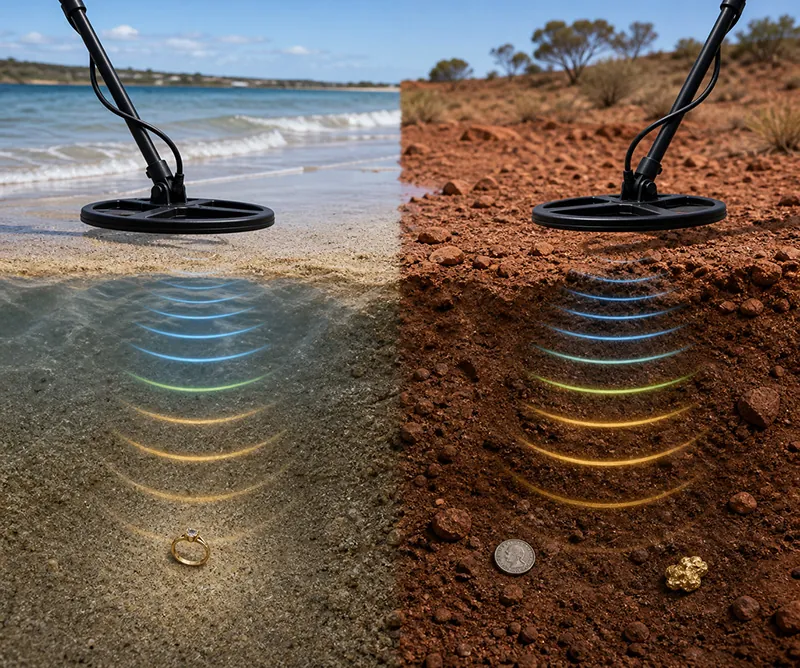
Multi-frequency is especially important for beach hunting. Wet salt sand behaves like a broad conductive target and can make simple single-frequency detectors unstable. Multi-frequency systems are often better at reducing salt response while maintaining sensitivity to jewelry and coins. This is why many modern beach-capable detectors use simultaneous multi-frequency technology.
Selectable Frequency vs Simultaneous Multi-Frequency
| Feature | Selectable Single Frequency | Simultaneous Multi-Frequency |
|---|---|---|
| How it works | User chooses one operating frequency at a time | Detector uses multiple frequencies together |
| Best advantage | Specialized control for a specific target or condition | Versatility and improved target information |
| Learning curve | User must know when to switch frequencies | Easier for mixed sites; detector handles more at once |
| Beach performance | Can struggle in wet salt unless designed for it | Usually stronger in wet salt and mixed ground |
| Example | Using 4, 10, 15, 20, or 40 kHz individually | Using Multi-IQ, Multi-IQ+, or Nokta SMF modes |
Metal Detector Frequency and Target Conductivity
Target conductivity describes how easily a target conducts electrical current. Silver and copper are high-conductive metals. Gold can vary widely depending on size, purity, shape, and alloy. Small gold nuggets and thin gold jewelry often behave as lower-conductive targets. Iron has magnetic properties that detectors often try to classify separately from valuable non-ferrous targets.
Low frequencies often respond strongly to larger high-conductive targets. High frequencies respond better to small low-conductive targets. But real targets are not perfect laboratory objects. A corroded bronze coin, a thin gold ring, an oddly shaped nugget, or a coin standing on edge may behave differently from a clean test sample. Soil mineralization and target orientation can distort Target ID.
This is why target ID should guide you but not control every decision. A detector frequency helps create the response, but the user must interpret tone quality, repeatability, depth, ground behavior, and target consistency from multiple sweep directions. Frequency is a foundation, not a guarantee.
Metal Detector Frequency and Detection Depth
Many buyers assume a lower frequency automatically means more depth. As a general rule, lower frequencies can penetrate deeper on larger targets, but that rule has limits. The target must be large enough to respond well. The soil must allow a clear signal. The coil must be suitable. The detector settings must be stable. If a low-frequency setting becomes noisy in difficult ground, a multi-frequency or different mode may produce more usable depth even if the theory suggests otherwise.
High frequency may be shallower on larger targets, but it can be “deeper” in a practical sense on tiny gold because it can hear targets that a low-frequency setting barely sees. This is an important point: depth is target-specific. If the target is a tiny nugget, a high-frequency machine at modest depth may outperform a low-frequency machine that is technically deeper on coins.
Minelab’s FAQ also notes that coil size changes depth and sensitivity: larger coils can detect deeper but lose some sensitivity to small targets, while smaller coils are better for tiny and shallow objects. Frequency and coil size must be considered together. A high-frequency detector with a small coil is a different tool from a low-frequency detector with a large coil.
Metal Detector Frequency and Mineralized Soil
Mineralized soil can reduce performance at any frequency. Red clay, black sand, ironstone, basalt, salty soil, hot rocks, and volcanic ground create signals that compete with target responses. Ground balance helps reduce the effect, but severe mineralization can still reduce depth, destabilize target ID, and create false signals.
Minelab’s education page emphasizes ground balancing as the process that helps detectors adapt to different soil conditions by reducing interference from natural minerals. For buyers, this means frequency alone is not enough. A detector with strong ground balance and smart signal processing may outperform a detector that looks good only on frequency numbers.
High-frequency gold detectors can be sensitive to small gold, but mineralization may make them noisy if the ground is severe. Pulse induction detectors such as GPX 6000, Garrett Axiom, and Nokta Magnetar 9000 are often preferred in extreme goldfields because PI technology handles ground differently from VLF frequency-based detection. GPZ 8000, with Minelab’s GeoZVT approach, belongs in a high-end goldfield category where ground handling matters more than ordinary frequency selection.
Metal Detector Frequency and Beach Detecting
Beach detecting is where simultaneous multi-frequency becomes especially useful. Dry sand is often manageable with many detectors. Wet salt sand and shallow saltwater are much harder because conductive salt produces a broad response. A single-frequency detector may need reduced sensitivity or special settings to remain stable. A simultaneous multi-frequency detector can often handle salt better while still detecting coins and jewelry.
Nokta’s The Legend 2 is a good example from Orient Detectors because it offers simultaneous multi-frequency, single frequencies from 4 to 40 kHz, Beach mode, and IP68 waterproof construction up to 5 meters according to Nokta’s official specifications. This makes it a practical choice for users who want one detector for parks, fields, relics, gold mode, and beaches.
Minelab Equinox and Manticore are also relevant examples. Minelab describes Multi-IQ and Multi-IQ+ as simultaneous multi-frequency technologies designed to combine different frequency advantages. For users hunting wet sand, coins, jewelry, and mixed terrain, this can be more practical than constantly choosing one single frequency.
Metal Detector Frequency and Gold Prospecting
Gold prospecting deserves its own section because gold is not one simple target. Tiny nuggets require sensitivity. Larger nuggets require depth and ground handling. Mineralized goldfields require stability. In many regions, the detector must handle hot rocks, black sand, basalt, ironstone, and variable soil. Frequency matters, but it is only one part of the gold equation.
Gold Monster 2000 is a clear frequency example. With 12 to 76 kHz Multi-Au technology, it is designed around fine gold response. It is useful for beginners and intermediate prospectors who want a light, focused detector for small gold. Its strength is not maximum depth on large treasure; it is responsiveness to small nuggets and simplified goldfield operation.
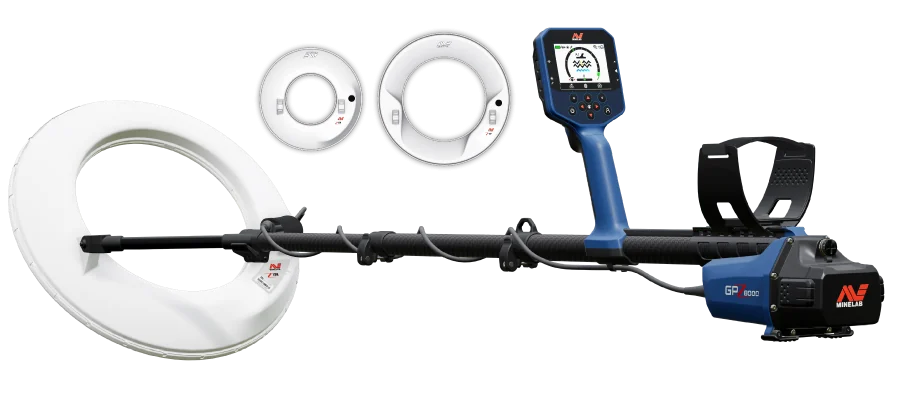
GPX 6000, Garrett Axiom, Nokta Magnetar 9000, and GPZ 8000 should be treated differently. They are not simple VLF frequency-choice detectors. GPX 6000 is a pulse induction gold detector, Garrett Axiom is a PI gold detector, Magnetar 9000 is positioned as a professional pulse induction detector, and GPZ 8000 uses advanced Minelab GeoZVT technology. These devices are relevant in a metal detector frequency guide because many buyers compare them to VLF machines, but their performance is not explained by a single kHz number. Their advantage is in the way they handle mineralized ground and goldfield signals.
Device Examples from Orient Detectors
| Device | Frequency / Technology Direction | Best Use | Buyer Notes |
|---|---|---|---|
| The Legend 2 | Selectable 4, 10, 15, 20, 40 kHz plus simultaneous multi-frequency modes | Coins, relics, jewelry, beach, small nuggets | One of the clearest examples of a flexible frequency platform |
| Minelab Manticore | Multi-IQ+ simultaneous multi-frequency | Advanced coins, relics, beach, target analysis | Best for users who want premium target information and versatility |
| Equinox Metal Detector | Multi-IQ simultaneous multi-frequency | General detecting, beaches, parks, fields, gold modes | Strong all-terrain example of multi-frequency detecting |
| Gold Monster 2000 | 12 to 76 kHz Multi-Au simultaneous multi-frequency | Fine gold, small nuggets, beginner gold prospecting | High-frequency weighted gold detector, not a deep treasure machine |
| Gold Stinger X6 | Multi-system detection with coil-based search modes | Gold, metals, depth detection, target scan, cavities | Useful for buyers who want flexible field tools beyond simple frequency choice |
| GPX 6000 | Pulse induction gold technology | Mineralized goldfields, small to large nuggets | Not judged by VLF frequency; judged by PI ground handling and gold response |
| Garrett Axiom | Pulse induction with goldfield modes | Gold prospecting, hot rocks, salt, mineralized soil | Relevant when ground is too difficult for many VLF settings |
| Nokta Magnetar 9000 | Professional pulse induction platform | Deep gold, harsh soil, professional prospecting | Built for scenarios where raw frequency is less important than PI stability |
| GPZ 8000 | GeoZVT advanced goldfield technology | Professional gold prospecting in challenging soil | High-end category beyond ordinary single-frequency comparison |
Which Frequency Should Beginners Choose?
Beginners should usually avoid buying a detector based on the highest frequency number alone. A 40 kHz or 76 kHz detector may sound exciting, but if you are mostly hunting coins in parks, it may not be the best first choice. A versatile simultaneous multi-frequency detector or a selectable-frequency detector is often easier to learn because it covers more target types and ground conditions.
For a beginner who wants coins, jewelry, relics, and occasional beach hunting, The Legend 2 or Equinox-style multi-frequency detectors make sense. They offer modes for different locations, useful Target ID, discrimination, and enough frequency flexibility to grow with the user. For a beginner focused specifically on gold nuggets, Gold Monster 2000 is more appropriate because its high-frequency weighted Multi-Au design is built for small gold.
If the beginner expects deep treasure, large buried objects, or difficult mineralized ground, frequency alone is the wrong starting point. They should compare detector categories: VLF, multi-frequency, PI, 3D scanner, or multi-system. A device like Gold Stinger X6 may be practical for mixed metal and cavity-related tools, while PI and advanced goldfield machines are better for serious mineralized goldfields.
Which Frequency Is Best for Coins?
For coins, low to mid frequencies and simultaneous multi-frequency modes are usually the most practical. Silver and copper coins often respond well to lower frequencies, especially when they are deeper. Small hammered coins, thin coins, and coins on edge may respond better to higher-frequency weighting or faster recovery settings. This is why modern multi-frequency detectors are so popular for coin hunting: they provide broader target response and better target ID across different coin sizes and soil conditions.
The Legend 2, Manticore, and Equinox are strong examples for coin users. The Legend 2 offers single frequencies from 4 to 40 kHz plus multi-frequency modes. Manticore and Equinox use Minelab simultaneous multi-frequency technologies. For most coin hunters, the best frequency choice is not a fixed number; it is the mode that gives stable target ID, good separation, and enough depth for the site.
Which Frequency Is Best for Relics?
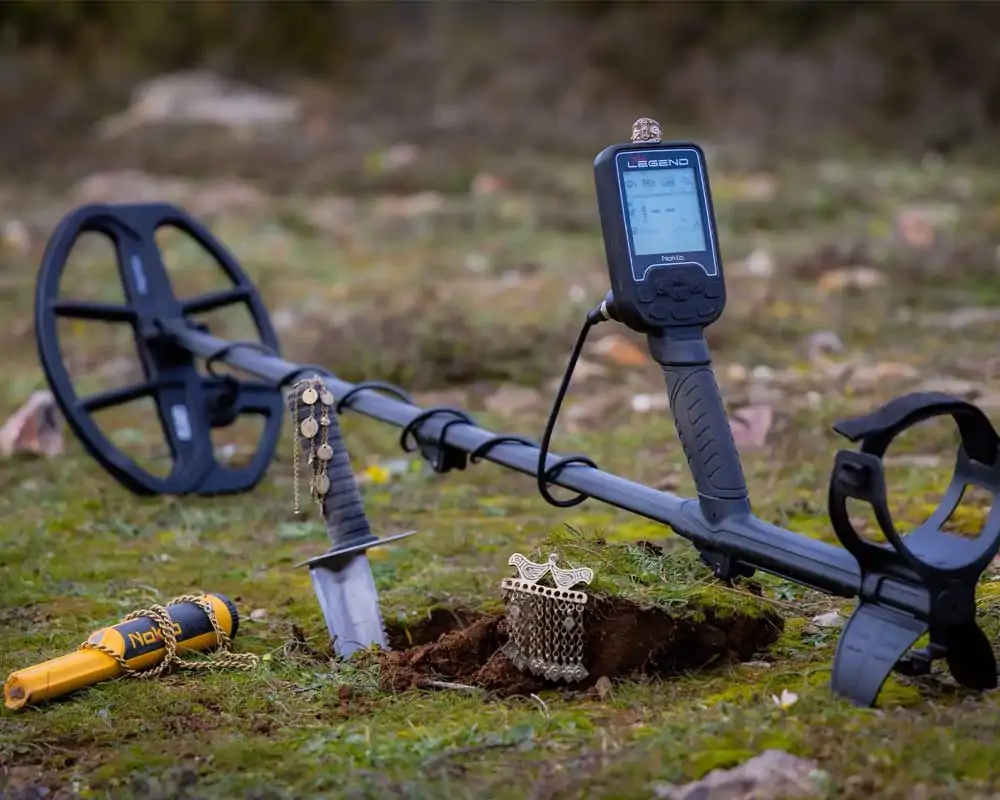
Relic hunting is broad. A large iron relic, bronze buckle, brass button, lead bullet, or tiny decorative fitting can all behave differently. In old fields, trash density and iron contamination matter as much as depth. Mid-frequency and multi-frequency detectors are often the safest choice because they provide a balance of depth, sensitivity, recovery speed, and target information.
Low frequency can be useful for larger relics and deeper conductive targets. Higher frequency can help with smaller relics and thin non-ferrous pieces. Multi-frequency helps when the site contains a mix of target sizes and conductivities. The Legend 2’s Relic mode and frequency flexibility make it relevant here, while Manticore’s target analysis can help experienced relic hunters interpret difficult signals.
Which Metal Detector Frequency Is Best for Gold?
For tiny natural gold, high frequency or high-frequency weighted multi-frequency is usually best. Small gold has a weak response and often behaves as a low-conductive target. This is why gold detectors often use higher frequencies than coin detectors. Gold Monster 2000 is an example because it uses 12 to 76 kHz Multi-Au technology and focuses on fine gold.
For larger gold or gold in severe mineralized ground, pulse induction or advanced goldfield technology may be more practical than VLF frequency selection. GPX 6000, Garrett Axiom, Nokta Magnetar 9000, and GPZ 8000 are examples of devices where the key question is not “what kHz?” but “how well does it handle this ground and target size?”
Metal Detector Frequency and Target ID Accuracy
Target ID depends on conductivity, ferrous response, signal strength, target shape, depth, ground conditions, and detector processing. metal detector frequency affects all of this. Low-frequency target ID may be stronger on deeper high-conductors. High-frequency target ID may be more responsive to small low-conductors. Multi-frequency can improve ID confidence because the detector has more information to compare.
However, no detector gives perfect ID in all conditions. Deep targets, mineralized soil, target masking, corrosion, and mixed metals can all distort numbers. A buyer should treat Target ID as a clue, not a verdict. Good users listen to tone shape, repeatability, sweep direction, and depth estimate in addition to screen numbers.
Common Metal Detector Frequency Mistakes
Thinking Higher Frequency Is Always Better
Higher metal detector frequency is better for small low-conductive targets, but it is not always better for depth on larger objects. If you mostly search deep coins or large relics, a lower or multi-frequency setting may be more useful.
Thinking Lower Frequency Finds Everything Deeper
Lower metal detector frequency can penetrate well, but it may miss or weaken tiny gold and thin jewelry. It can also lose practical depth if soil noise becomes a problem.
Confusing Selectable Frequency with True Simultaneous Multi-Frequency
A detector that lets you choose different single frequencies is useful, but it is not the same as a detector that processes multiple frequencies at the same time. Both can be valuable, but they are not identical.
Ignoring Ground Balance
metal detector frequency without ground balance is incomplete. Mineralized soil can ruin performance if the detector is not balanced and stable.
Using the Wrong Coil
A high-frequency setting with a large coil may not behave like a small-gold setup. A low-frequency setting with a small coil may not provide the coverage you expect. Coil and frequency work together.
Simple Buyer Decision Chart
| Your Main Goal | Best Frequency Direction | Products to Compare on Orient Detectors |
|---|---|---|
| Deep silver/copper coins | Low to mid frequency or multi-frequency | The Legend 2, Manticore, Equinox |
| Small jewelry and thin targets | Mid to high frequency or multi-frequency | The Legend 2, Manticore, Equinox |
| Small natural gold | High-frequency weighted gold detector | Gold Monster 2000 |
| Wet salt beach | Simultaneous multi-frequency | The Legend 2, Manticore, Equinox |
| Mineralized goldfields | High-frequency gold VLF for small gold, PI/ZVT for difficult ground | Gold Monster 2000, GPX 6000, Garrett Axiom, Magnetar 9000, GPZ 8000 |
| Mixed gold, metals, cavities, and depth tools | Multi-system rather than frequency-only choice | Gold Stinger X6 |
How to Test Frequency in the Field
If your detector offers multiple frequencies, do not rely only on theory. Test them. Place a few known targets on clean ground: a coin, small gold-colored low-conductive target, thin jewelry, iron nail, and small foil. Sweep in different modes and frequencies. Notice tone strength, Target ID stability, and how the detector behaves when you raise the coil slightly.
Then test on real soil. Ground balance carefully. Reduce sensitivity if the detector becomes unstable. Try the same target in low, mid, high, and multi-frequency modes if available. In many cases, the “best” setting will not be the one that sounds loudest in air tests. It will be the setting that gives the most repeatable target response in the ground.
Air tests are useful for learning, but they do not represent real depth. Soil mineralization, moisture, target age, and orientation change the response. A practical metal detector frequency guide must always bring the user back to field testing.
FAQ: Metal Detector Frequency Guide
What is the best frequency for a metal detector?
There is no single best frequency. Low frequency is better for larger and deeper conductive targets, high frequency is better for small low-conductive targets like tiny gold, and simultaneous multi-frequency is best for versatility across mixed targets and ground.
Is 40 kHz good for gold?
Yes, 40 kHz can be very useful for small gold and low-conductive targets. Gold Monster 2000 goes even higher with 12 to 76 kHz Multi-Au technology, making it a fine-gold specialist.
Is multi-frequency better than single frequency?
For general detecting, beaches, mixed targets, and target ID stability, simultaneous multi-frequency is often better. A single selectable frequency can still be useful for specialist situations where the user knows exactly what target and ground condition they are optimizing for.
What frequency is best for coins?
Low to mid frequency or multi-frequency is usually best for coins. Lower frequencies can help with larger deep silver and copper coins, while multi-frequency improves versatility and target ID across different coin types.
What frequency is best for relics?
Mid frequency and multi-frequency are often the safest choices for relic hunting because relics vary greatly in size, shape, and conductivity. Larger relics may respond well to lower frequencies, while smaller relics may benefit from higher-frequency sensitivity.
Does frequency affect depth?
Yes. Lower frequencies generally penetrate deeper on larger targets, while higher frequencies are more sensitive to small targets but may not reach as deep on larger objects. Soil and coil size can change the real result.
Why do gold detectors use high frequencies?
Small gold nuggets are low-conductive and often produce weak signals. Higher frequencies respond better to these small targets, which is why many gold-focused detectors use high-frequency or high-frequency weighted operation.
Should I buy VLF, multi-frequency, PI, or 3D scanning?
Buy VLF or multi-frequency for coins, jewelry, relics, and general detecting. Buy high-frequency gold VLF for small nuggets. Buy PI or advanced goldfield technology for difficult mineralized goldfields. Consider 3D or multi-system devices for buried caches, cavities, and larger exploration projects.
Final Verdict about Metal Detector Frequency
The best metal detector frequency is the one that matches your target and ground. If you hunt deep coins and larger conductive targets, low to mid frequency can be useful. If you hunt tiny gold and thin low-conductive targets, high frequency matters. If you hunt many target types in many locations, simultaneous multi-frequency is often the most practical choice. If you work severe mineralized goldfields, pulse induction or advanced goldfield technology may be more important than ordinary VLF frequency selection.
For buyers on Orient Detectors, The Legend 2 is a strong flexible frequency example because it offers 4, 10, 15, 20, and 40 kHz single frequencies plus simultaneous multi-frequency modes. Manticore and Equinox represent Minelab’s multi-frequency approach for advanced all-terrain detecting. Gold Monster 2000 is the clear small-gold frequency specialist with 12 to 76 kHz Multi-Au operation. Gold Stinger X6 is better understood as a multi-system field detector, while GPX 6000, Garrett Axiom, Magnetar 9000, and GPZ 8000 are professional goldfield options where ground handling and gold response matter more than a simple frequency number.
Use this metal detector frequency guide as a decision tool, not a rigid rule. Frequency influences performance, but it works together with coil size, soil mineralization, search mode, target type, recovery speed, ground balance, and operator skill. The smartest buyers do not chase the highest kHz or the lowest kHz. They choose the detector that gives stable, repeatable, useful information in the ground they actually search.
Suggested Links
- Pulse Induction vs VLF Metal Detectors
- Metal Detector Depth Chart
- Gold Detector Depth: Real Performance Factors
- Best Gold Detectors for Mineralized Soil
- Best Metal Detectors for Ancient Coins and Relics