Metal Detector Coils Explained: Size, Shape, and Best Uses
Introduction: Why the Coil Changes Everything
The search coil is the part of a detector that actually interacts with the ground. The control box may process the signal, the screen may show target information, and the shaft may make the detector comfortable to swing, but the coil is the detector’s first contact with the hidden target. This is why understanding metal detector coils is one of the fastest ways to improve real field performance.
Many buyers compare metal detectors by brand, price, depth claims, frequency, or technology, but they often overlook the coil. That is a mistake. A detector with the wrong coil can feel noisy, slow, shallow, or difficult to control. The same detector with the right coil can become more accurate in trash, more sensitive to small gold, better in mineralized soil, or more efficient across open ground.
This guide explains metal detector coils in a practical way: coil size, coil shape, coil configuration, target separation, depth, ground coverage, compatibility, and best uses. We will also use examples from devices and categories available through Orient Detectors, including Gold Stinger X6, Garrett ACE-style detectors, Nokta The Legend 2, Simplex Ultra, Minelab Manticore, GPX 6000, Gold Monster 2000, GPZ 8000, and other gold and treasure detectors.
The goal is simple: by the end of this article, you should know when a small coil is better than a large coil, why DD coils are popular in mineralized soil, when monoloop coils make sense, why elliptical coils help in rough terrain, and how to choose the best coil for coins, gold nuggets, relics, beaches, and deep targets.
What Is a Metal Detector Coil?
A metal detector coil, also called a search coil, is the loop at the lower end of the detector. It transmits an electromagnetic field into the ground and receives changes in that field when metal is present. The detector then processes the returned signal and converts it into audio, target ID, depth estimate, visual indication, or a combination of these outputs.
In VLF detectors, coils usually include separate transmit and receive windings. In pulse induction detectors, a coil may use a monoloop winding that transmits and receives through the same loop, or it may use a DD-style configuration depending on the detector and ground conditions. The internal design of the coil influences detection pattern, ground handling, target separation, pinpointing, and sensitivity.
In simple language, metal detector coils determine how the detector “looks” into the ground. A narrow detection field behaves differently from a wide one. A small concentrated coil behaves differently from a large coverage coil. A round coil behaves differently from an elliptical coil around rocks or roots. The detector is the engine, but the coil is the contact point with the terrain.
Quick Summary: Coil Choice by Use Case
| Search Goal | Best Coil Direction | Why It Works | Good Device Examples |
|---|---|---|---|
| Small gold nuggets | Small DD or small gold coil | Higher sensitivity, better control around rocks and bedrock | Gold Monster 2000, Gold Kruzer, Gold Master 24K |
| Coins in trashy parks | Small to medium DD or concentric coil | Better target separation and less masking | Garrett ACE 400i, Nokta The Legend 2, Simplex Ultra |
| Open fields and relics | Medium to large DD coil | More ground coverage and good depth on larger targets | Manticore, The Legend 2, ACE Apex |
| Mineralized soil | DD coil or PI-compatible coil | Improved ground balance and reduced false signals | GPX 6000, Garrett Axiom, DD-equipped VLF detectors |
| Maximum depth on large targets | Large coil, often DD or monoloop depending on technology | Larger detection field and more coverage per sweep | GPX 6000, GPZ 8000, deep-search detectors |
| Water or beach hunting | Waterproof DD or open-web coil | Better movement through water and stability in wet conditions | The Legend 2, Manticore, Simplex Ultra |
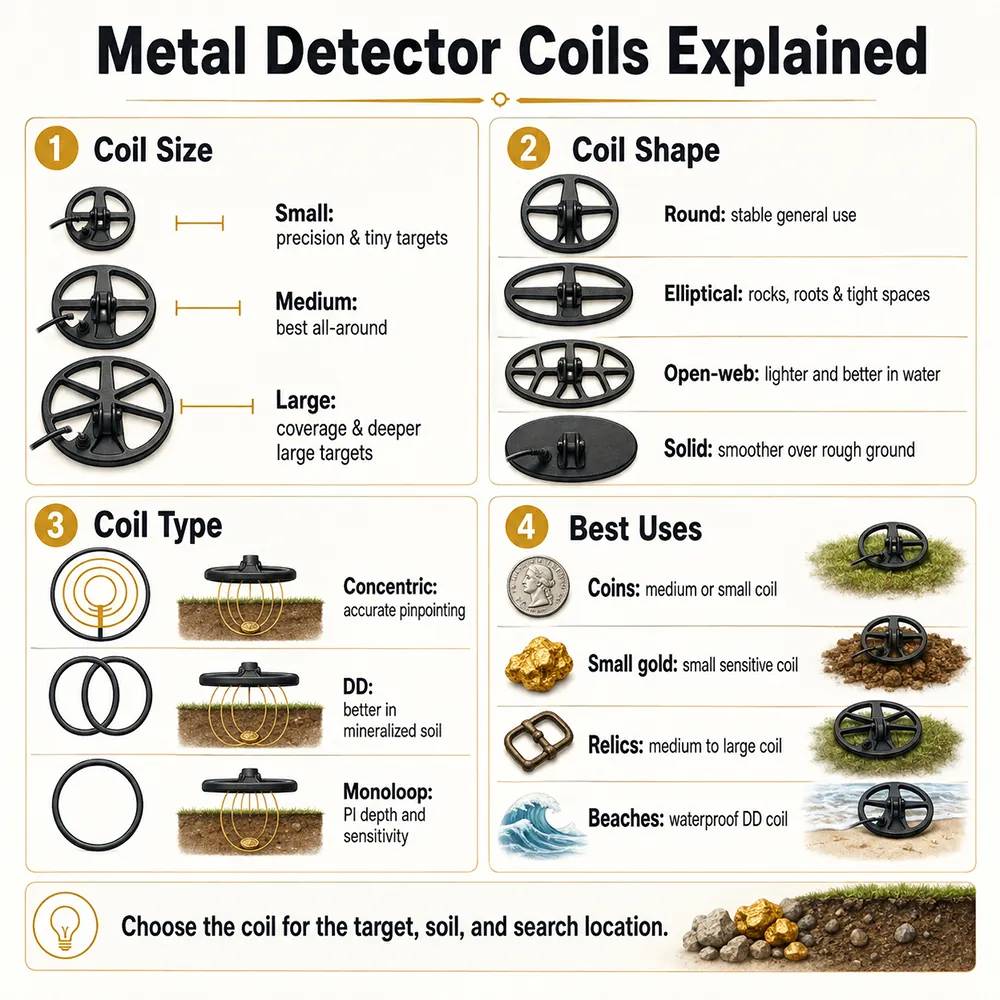
Coil Size Explained: Small, Medium, and Large
Coil size is the first specification most users notice. It affects ground coverage, depth, sensitivity, weight, target separation, and maneuverability. Minelab’s coil guidance summarizes the tradeoff clearly: larger coils cover more ground and can reach deeper, but smaller coils are more sensitive to small shallow targets, less affected by electromagnetic interference, and easier to use in confined areas.
This is the central rule of metal detector coils: bigger is not always better. A large coil may be powerful in a clean open field, but it can be frustrating in a trashy park. A small coil may not reach as deep on a large relic, but it can find a coin hidden beside a nail or a tiny gold nugget between rocks. The “best” coil is the one that matches the ground and target.
Small Coils: Precision, Separation, and Small Targets
Small coils are typically used when accuracy matters more than coverage. They are easier to control around rocks, bushes, roots, walls, playground equipment, and trash-heavy areas. They also concentrate the detection field, which can improve sensitivity to small shallow targets.
For gold prospecting, small coils are extremely useful around bedrock cracks, mineralized patches, dry washes, and tight rocky ground. This is why small coils are commonly recommended for small nuggets. Gold Monster 2000, for example, includes a compact coil option that fits this type of work. Gold Kruzer and Garrett Gold Master 24K also benefit from compact coils because they are designed for fine gold and small target detection.
For coins, small coils help when the ground contains nails, foil, bottle caps, and mixed signals. A large coil may see several targets at once and blend their responses. A smaller coil can isolate the coin more clearly. This makes small metal detector coils very valuable for old parks, picnic areas, house sites, and iron-heavy fields.
Medium Coils: The Best All-Around Choice
Medium coils are often the stock coils included with many detectors because they offer a balance between depth, coverage, and separation. An 11-inch DD coil is a classic all-purpose choice for coins, relics, jewelry, and general detecting. It covers enough ground to be efficient while still remaining manageable in moderate trash.
For many buyers, a medium coil should be the starting point. Learn the detector with the standard coil before buying accessories. Once you understand your target type and search sites, you can decide whether a smaller or larger coil would actually improve results.
Large Coils: Coverage and Depth for Bigger Targets
Large coils produce a wider detection field. They can cover more ground with each sweep and can help detect larger targets at greater depths. Garrett notes that a larger search coil can help a detector achieve greater depth because it produces a more extensive magnetic field. Garrett’s 14 x 11-inch ACE Reaper coil, for example, is promoted for greater ground coverage and deeper coin or relic cache hunting than smaller coils.
But large coils have tradeoffs. They are heavier, less precise in tight ground, more likely to detect multiple targets at once, and often more affected by electromagnetic interference or mineralization. For small gold, a large coil may not be ideal. For deep relics in open fields, it may be excellent.
Use large metal detector coils when the ground is open, trash is low, and the targets are expected to be larger or deeper. Avoid them when working heavy iron, small nuggets, tight rocks, or dense modern trash.
Coil Shape Explained: Round, Elliptical, Open-Web, and Solid
Coil shape affects how easily the coil moves through the search area and how the detection field behaves. Round coils are common because they are stable, balanced, and strong general performers. Elliptical coils are narrower and easier to maneuver in tight spaces. Open-web coils reduce weight and drag, especially in water. Solid coils can slide more smoothly over stubble, sand, or uneven ground, but may have more drag in water.
Round Coils
Round coils are popular because they provide stable performance and predictable response. They are common on gold detectors, coin detectors, and all-purpose machines. If you are not sure what to choose, a round DD or round concentric coil is often a safe starting point.
Elliptical Coils
Elliptical coils are useful where a round coil feels too wide. They can slide between rocks, bushes, roots, and narrow spaces. They can also provide good coverage along their length while keeping a narrower profile. Minelab’s coil guidance notes that elliptical coils can maneuver more easily around bushes or between rocks while still covering useful ground.
For goldfields, an elliptical coil can be excellent because natural gold often hides around uneven bedrock and tight terrain. For coins, an elliptical coil can work well near benches, fences, trees, and foundations.
Open-Web Coils
Open-web coils have visible cutouts. They are lighter and can move more easily through water because they reduce drag. They are common on beach and water-capable detectors. The open design also reduces weight during long hunts. The tradeoff is that grass, sticks, or stubble can sometimes catch in the openings depending on terrain.
Solid Coils
Solid coils have a closed underside or smooth surface. They can slide over sand, grass, crop stubble, and rocky ground without catching as easily. They may feel heavier or create more water drag depending on the design. Some users prefer solid coil covers to protect open-web coils in rough ground.
Coil Configuration: Concentric, Double-D, and Monoloop
Coil configuration refers to how the internal wire windings are arranged. The three most common configurations are concentric, Double-D, and monoloop. Each produces a different detection pattern and behaves differently in mineralized ground, trash, and pinpointing.
Concentric Coils
Concentric coils use an outer transmit winding and an inner receive winding, creating a cone-shaped detection pattern. They are known for accurate pinpointing and clean target response in milder soils. Many coin hunters like concentric coils because they can be precise and intuitive.
The limitation is ground handling. Concentric coils can be noisier in highly mineralized soil and usually require more sweep overlap for complete coverage. If your soil is mild and you want precise pinpointing, a concentric coil can be excellent. If your soil is difficult, a DD coil may be more stable.
Double-D Coils
Double-D coils, or DD coils, use two overlapping D-shaped windings. Their detection pattern is more like a blade or narrow strip down the center of the coil. DD coils are very popular because they cover ground efficiently and often perform better in mineralized soil. Minelab notes that DD coils offer stability, depth, ground balancing, and a wider search pattern that requires less overlap. Minelab’s FAQ also lists DD advantages such as less EMI susceptibility, improved performance in very wet soils, reduced false signals in highly mineralized soils, and strong tracking ground balance performance.
For most modern detectorists, DD metal detector coils are the most versatile choice. They are common on multi-frequency machines like The Legend 2 and Manticore, and they are especially useful for parks, beaches, fields, and mineralized ground.
Monoloop Coils
Monoloop coils are commonly associated with pulse induction gold detectors. A monoloop coil uses a single winding for both transmit and receive. It can provide excellent depth and sensitivity, especially in suitable ground. However, monoloop coils can be harder to ground balance in heavily mineralized soil and may be more susceptible to EMI depending on conditions.
For gold prospecting, monoloop coils can be powerful tools, but they are not automatically better in every location. In difficult mineralized ground or high EMI, a DD coil may be more stable. This is why professional prospectors often carry different coils for different sites.
How Coils Affect Detection Depth
Depth is one of the most misunderstood topics in metal detecting. Coil size affects depth, but target size, soil mineralization, metal type, target orientation, detector technology, sensitivity, EMI, and user technique also matter. A large coil can detect larger targets deeper, but that does not mean it is best for every target.
A large coin or relic in clean soil may benefit from a larger coil. A tiny gold nugget near the surface may respond better to a smaller high-sensitivity coil. A deep target in mineralized ground may need a DD coil or PI system for stability. A target close to iron may be easier to hear with a small coil even if it is not very deep.
Good depth is not just a number. It is usable depth. If the detector is noisy, unstable, or overwhelmed by ground response, extra coil size can actually reduce confidence. The best metal detector coils improve the signal-to-noise ratio for your target and soil.
How Coils Affect Target Separation
Target separation is the ability to identify individual targets that are close together. This is critical in coin hunting, relic hunting, and old sites with iron. A small coil has a smaller detection footprint, so it is less likely to see several targets at once. This helps the detector report a coin beside a nail instead of blending the two signals.
Recovery speed also matters, but coil size is part of the equation. A fast detector with a large coil can still struggle in dense trash. A smaller coil can make the same detector feel sharper and more precise. If you hunt parks, old house sites, picnic areas, or iron-heavy fields, a small coil may find targets that a large coil misses.
How Coils Affect Ground Coverage
Ground coverage is the amount of ground searched per sweep. Large coils cover more area and can reduce search time in open ground. This is useful for relic hunters, beach hunters, and prospectors covering wide areas. Medium coils balance coverage and control. Small coils require more sweeps to cover the same area but provide better precision.
If you are searching a large clean field, a larger coil can be efficient. If you are searching around rocks, brush, buildings, trees, or trash, the extra coverage may not help. A coil that cannot stay close and level over the ground loses performance. Efficient coverage means controlled coverage, not simply a bigger loop.
How Coils Perform in Mineralized Soil
Mineralized soil can make detectors noisy and reduce effective depth. It can also cause false signals and unstable target IDs. DD coils are widely used in mineralized ground because their detection pattern helps with ground cancellation and stable operation. Pulse induction detectors may use monoloop or DD coils depending on the level of mineralization, EMI, and target type.
Minelab’s FAQ explains that if a detector is noisy while sweeping but quiet when stopped, it may be responding to mineralized ground, and users should ground balance or reduce sensitivity to the highest stable level. This advice is important because a coil is not separate from detector settings. The right coil still needs correct sensitivity and ground balance.
For mineralized goldfields, small DD coils can help locate small nuggets, while larger PI coils may help with deeper gold. For mineralized coin sites, DD coils on multi-frequency detectors are often a strong choice. The key is stability.
Coil Compatibility: Why You Cannot Use Any Coil on Any Detector
Coils are not universal. A coil must be compatible with the detector’s electronics, frequency, connector, software, and calibration. Minelab’s coil compatibility guidance emphasizes that coil design and compatibility directly affect depth, sensitivity, and target differentiation, and that detectors such as Manticore use dedicated coil lineups. Nokta also lists specific coils for The Legend 2, The Legend, Simplex Ultra, Triple Score, FINDX, and other models.
Before buying accessory metal detector coils, check the exact detector model, generation, connector type, waterproof rating, and manufacturer compatibility list. A coil that fits physically may not work electronically. A coil designed for one detector family may not function correctly on another.
This is especially important for advanced detectors. Minelab notes that GPZ 8000 uses a new range of lightweight concentric coils that are not compatible with GPZ 7000. That kind of detail matters. Always verify compatibility before purchasing.
Device Examples from Orient Detectors
Gold Stinger X6: Dual Coils for Flexibility
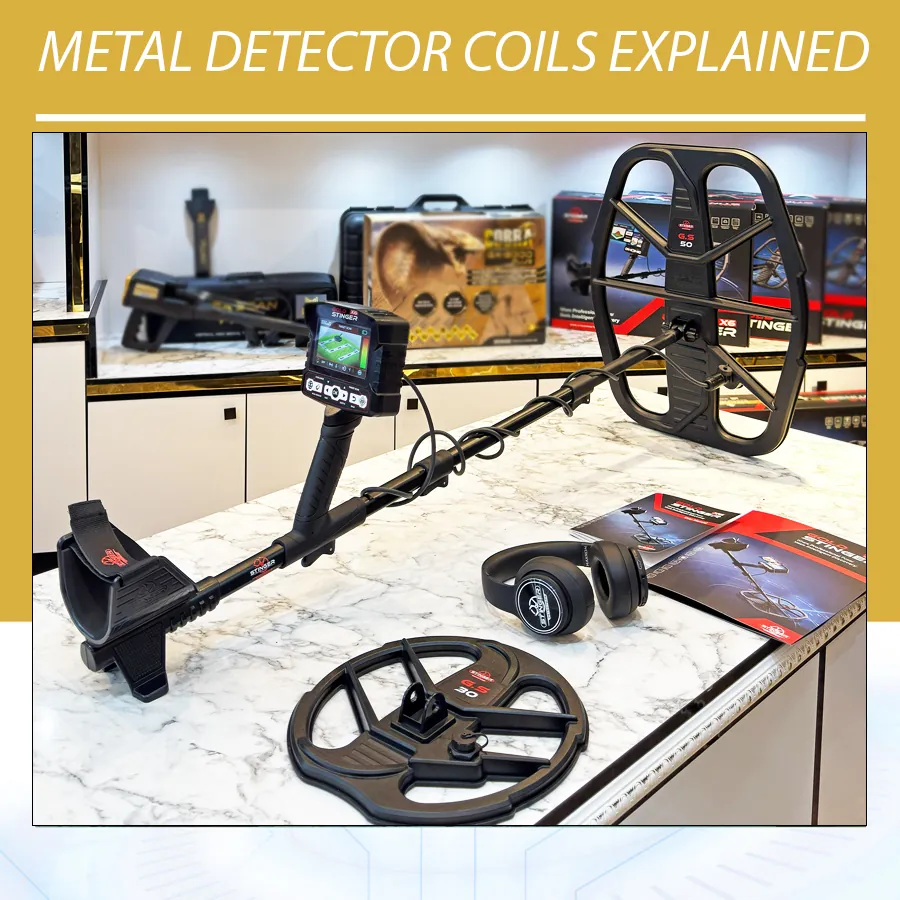
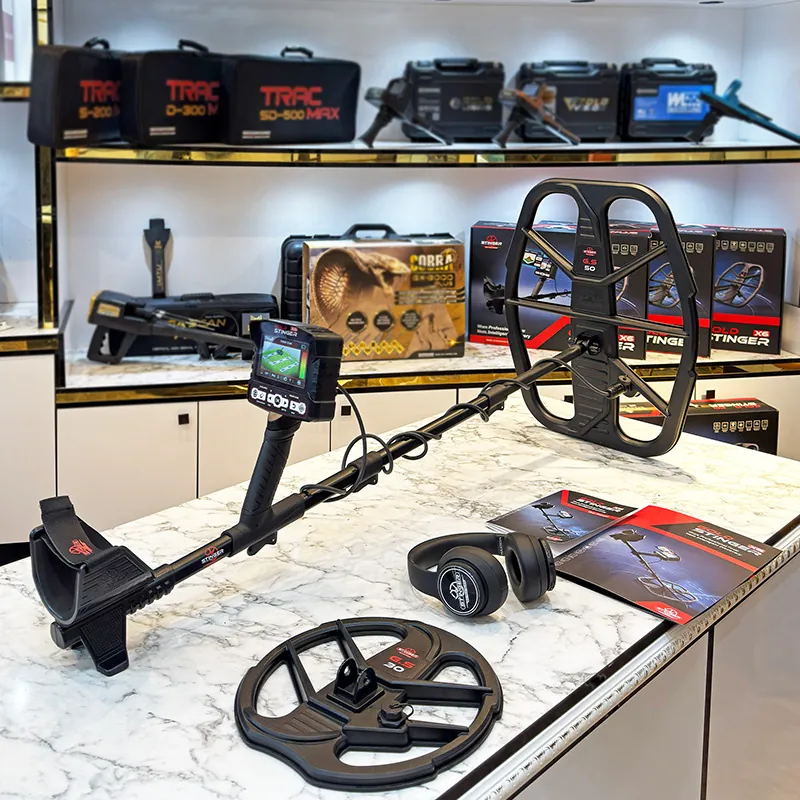
Gold Stinger X6 is a useful example because it includes two coils: GS50 and GS30. The larger coil is better for wider coverage and deeper practical searching, while the smaller coil is better for precision, small targets, and tighter spaces. This makes Gold Stinger X6 easier to adapt than a detector with only one coil size.
For users who want gold, coins, relics, and broader search options, dual-coil flexibility is valuable. It teaches the user how coil size changes the detector’s behavior in real ground.
Gold Monster 2000: Small Coil for Fine Gold
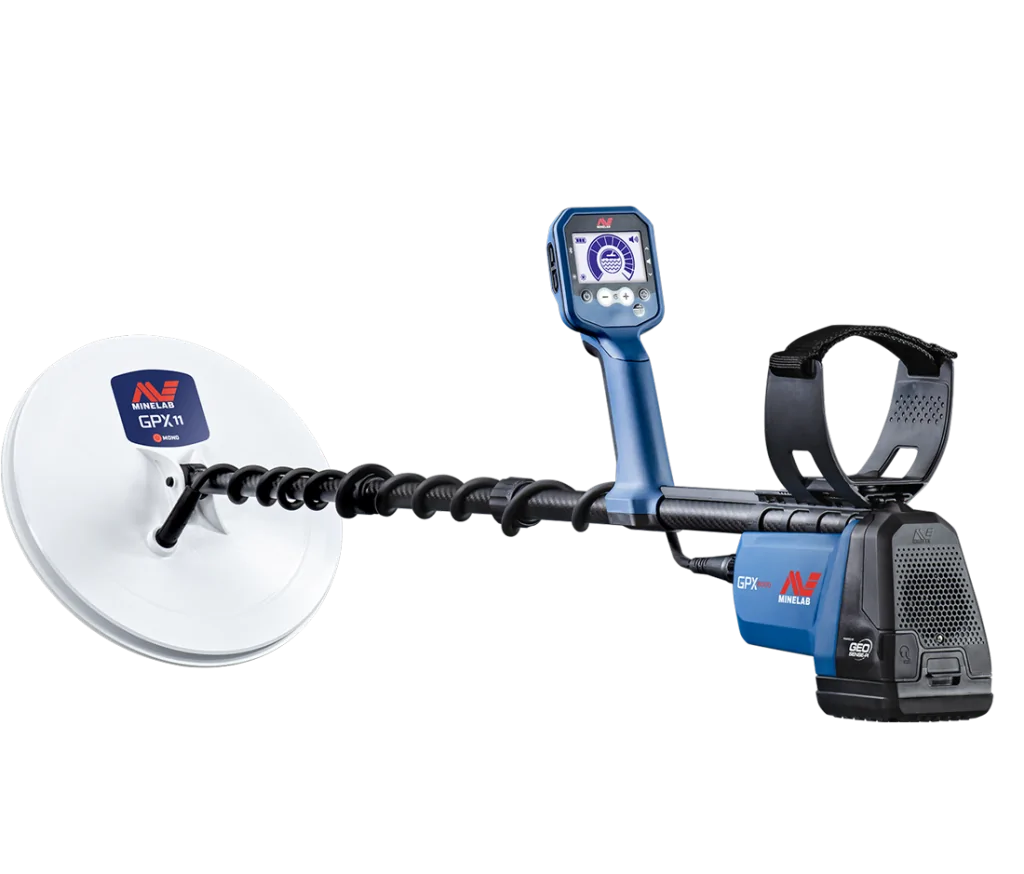
Gold Monster 2000 is designed for fine gold and small nuggets. Its compact coil options are important because small gold requires close control and sensitivity. A large coil may cover more ground, but a small coil can be better for shallow tiny nuggets near rocks, cracks, and mineralized patches.

GPX 6000: Professional Coil Options for Goldfields
GPX 6000 uses professional goldfield coil options and GeoSense-PI technology. For gold prospecting, coil choice changes how the detector handles target size, ground mineralization, and coverage. Smaller coils may help with tighter ground and smaller targets, while larger coils help cover more area and improve response to larger deeper nuggets.
Nokta The Legend 2 and Simplex Ultra: DD Coil Ecosystems
Nokta’s official search coil page lists multiple waterproof DD coils for The Legend 2 and Simplex Ultra, including smaller, medium, and larger coil sizes. This gives users a practical path: start with a standard coil, add a smaller coil for trashy coin sites, or add a larger coil for open fields and coverage.
Minelab Manticore: Dedicated Smart Coil Lineup
Manticore works with a dedicated coil lineup, including compact, medium, and larger coils. Minelab describes Manticore coils such as M8 for tight spaces and high-trash areas, M11 as a versatile standard option, and M15 for greater coverage and depth. This is a good example of how advanced detectors use coil ecosystems to adapt to different hunts.
GPZ 8000: Specialized Concentric Coils
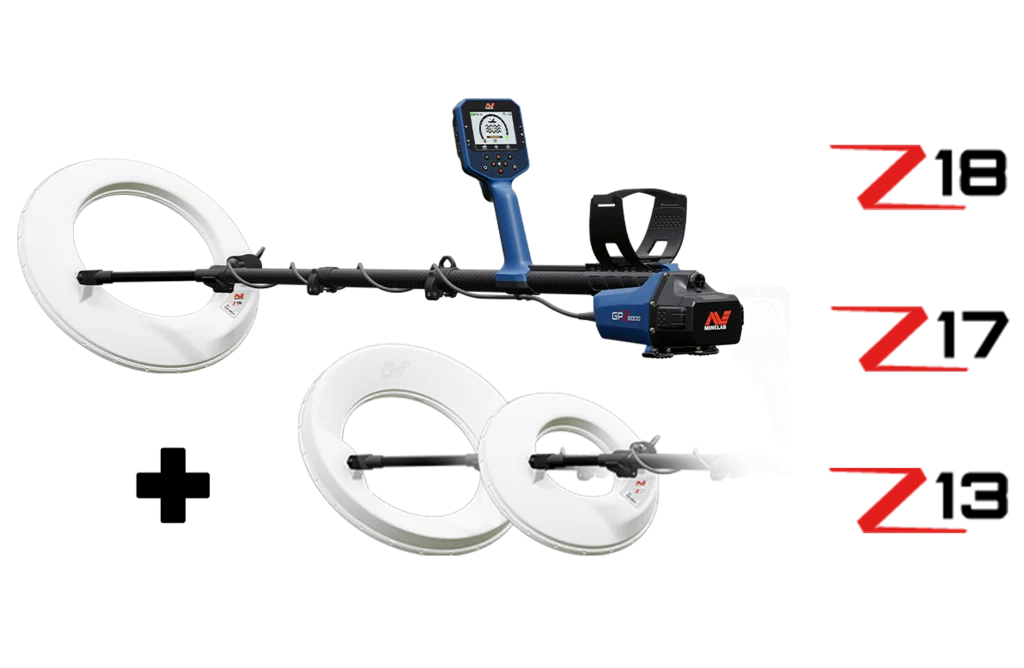
GPZ 8000 uses specialized Minelab coils designed for its technology. Minelab’s FAQ lists compatible GPZ 8000 coils such as 13-inch, 17-inch Anti-Interference, and 18-inch round coils. This shows why professional buyers must look beyond the detector body and consider the full coil platform.
Best Coil Choices by Target Type
Coins
For coins in clean open ground, a medium DD coil is a strong all-around choice. For trashy parks, use a smaller coil to improve separation. For older deep coins in clean fields, a larger coil can help, but only if the ground is not too trashy.
Gold Nuggets
For tiny gold, small coils are often best because they improve sensitivity and maneuverability. High-frequency VLF detectors benefit from small coils in shallow goldfields. PI detectors may use different coils depending on whether the user wants tiny gold sensitivity, depth, or stability in mineralized ground.
Relics
Relic hunters often use medium to large DD coils for open fields because relics can be larger and deeper. In iron-heavy sites, a smaller coil may be better. If you search old settlements, foundations, or camps, separation becomes more important than maximum coverage.
Jewelry
Jewelry varies widely in size and conductivity. Small coils help locate small rings, earrings, and fine jewelry in trashy sites. Medium coils are better for general beach or park coverage. Multi-frequency detectors with DD coils can be very effective for mixed jewelry hunting.
Deep Targets
Large coils are useful for deep larger targets, especially in open low-trash areas. But they are not the best answer for every deep search. Soil mineralization, target size, and detector technology matter. For professional deep work, users may need PI systems, 3D scanners, or multi-system detectors rather than simply a larger coil on a standard detector.
Best Coil Choices by Terrain
| Terrain | Recommended Coil | Reason |
|---|---|---|
| Trashy parks | Small DD or concentric | Better target separation and reduced masking |
| Open farm fields | Medium or large DD | Better coverage and depth on larger targets |
| Rocky goldfields | Small round or elliptical gold coil | Better control around rocks and cracks |
| Wet sand and beaches | Waterproof DD or open-web coil | Better salt stability and water movement |
| Mineralized soil | DD coil, or suitable PI coil | Improved ground handling and fewer false signals |
| Fields with stubble | Solid coil or coil cover | Smoother movement and less snagging |
Common Coil Buying Mistakes
The first mistake is buying the largest coil available because it “must go deeper.” Large coils can be excellent, but they are not always better. In trashy ground, they may detect too many targets at once. In mineralized soil, they may become unstable. For tiny gold, they may be less sensitive than smaller coils.
The second mistake is ignoring compatibility. Metal detector coils must match the detector model and technology. Never assume a coil will work because the connector looks similar. Always check manufacturer compatibility or ask a specialist before purchasing.
The third mistake is expecting a coil to fix poor technique. A smaller coil can improve separation, and a larger coil can improve coverage, but the user still needs correct sweep speed, coil height, overlap, ground balance, and sensitivity. A coil upgrade is powerful only when used correctly.
The fourth mistake is using one coil for every site. Experienced detectorists often adapt coil choice to the location. The same user may choose a small coil for a trashy park, a medium coil for general searching, a large coil for open fields, and a specialized coil for goldfields.
How to Test a New Coil
Before using a new coil in the field, test it with known targets. Place coins, nails, small gold-like targets, foil, and larger metal objects on clean ground. Sweep at different speeds and heights. Listen to the audio and watch target ID stability. Then bury targets at shallow depths and repeat the test.
Garrett and Minelab both emphasize that detector performance depends on soil, target size, and conditions. Testing helps you understand your specific detector and coil combination. A coil that air-tests well may behave differently in mineralized ground, wet soil, or trashy conditions.
Use a simple test grid: coin at 3 inches, coin at 6 inches, coin near a nail, small gold-like target at shallow depth, and larger target deeper. This gives you a realistic feel for depth, separation, and stability.
Maintenance Tips for Metal Detector Coils
Coils are built for field use, but they still need care. Use a coil cover when searching rocky, sandy, or abrasive ground. Clean dirt and sand from under the coil cover because trapped grit can create wear over time. Check the cable for damage and wrap it correctly along the shaft without leaving loose loops near the coil.
Do not over-tighten coil bolts. The coil should hold position but still allow reasonable adjustment. After beach hunting, rinse waterproof coils with fresh water if exposed to salt. Store coils away from extreme heat and avoid bending cables sharply. Good coil maintenance protects performance and extends equipment life.
Internal Links to Support This Article
Readers who want to continue learning can start with metal detectors and gold detectors on Orient Detectors. For beginners, link to Best Metal Detectors for Beginners. For coin hunting, link to Best Metal Detectors for Coins. For tiny gold, use Best Gold Detectors for Small Nuggets. For soil difficulty, link to Best Gold Detectors for Mineralized Soil. For technology comparisons, use Pulse Induction vs VLF Metal Detectors and Metal Detector Frequency Guide.
FAQ: Metal Detector Coils
What size coil is best for metal detecting?
The best size depends on the target and location. Small coils are best for trashy sites and small targets. Medium coils are best for general detecting. Large coils are best for open ground and larger deeper targets.
Are large coils always deeper?
Large coils can detect larger targets deeper in suitable ground, but they are not always better. They can be heavier, less sensitive to tiny targets, more affected by EMI, and less effective in trashy areas.
What is the difference between DD and concentric coils?
Concentric coils use a cone-shaped detection pattern and can be very accurate for pinpointing in mild soil. DD coils use a blade-like pattern that covers ground efficiently and usually performs better in mineralized soil.
What is a monoloop coil?
A monoloop coil uses one winding for both transmitting and receiving signals. It is common on pulse induction gold detectors and can provide excellent depth and sensitivity, but it may be harder to balance in difficult mineralized soil.
Can I use any coil on my detector?
No. Coils must be compatible with the detector model, connector, electronics, and software. Always check the manufacturer’s compatibility list or ask the seller before buying.
Which coil is best for gold nuggets?
Small coils are often best for tiny shallow nuggets, especially in tight rocky ground. Larger coils may help with larger deeper nuggets in open ground. In mineralized goldfields, coil configuration and detector technology also matter.
Which coil is best for coins?
A medium DD coil is a good all-around coin choice. A smaller coil is better in trashy parks, while a larger coil can help in open fields where older coins may be deeper.
Final Verdict: Choose the Coil for the Ground, Not the Brochure
Metal detector coils are not simple accessories. They change how a detector sees the ground, how deep it can respond, how well it separates targets, and how stable it feels in real conditions. A small coil can unlock trashy parks and small gold. A medium coil gives balanced daily performance. A large coil improves open-ground coverage and deeper response on bigger targets. A DD coil helps in mineralized soil. A concentric coil can pinpoint accurately in milder ground. A monoloop coil can be powerful for pulse induction prospecting.
The best coil is the one that fits your detector, your targets, your terrain, and your skill level. Start with the stock coil, learn its behavior, then upgrade with a clear purpose. That approach will improve your detecting results far more than buying the biggest coil and hoping for the best.
Sources and Useful References
- Orient Detectors – The Best Metal Detector Coils in the World
- Orient Detectors – Metal Detectors Coils Types
- Orient Detectors – Gold Prospecting with a Metal Detector
- Orient Detectors – Gold Stinger X6
- Orient Detectors – Metal Detectors and Gold Detectors
- Minelab – Understanding Minelab Coils
- Minelab – Coil Compatibility Guide
- Minelab USA – Frequently Asked Questions
- Nokta Detectors – Search Coils
- Garrett – At What Depths Can a Detector Find Treasure?