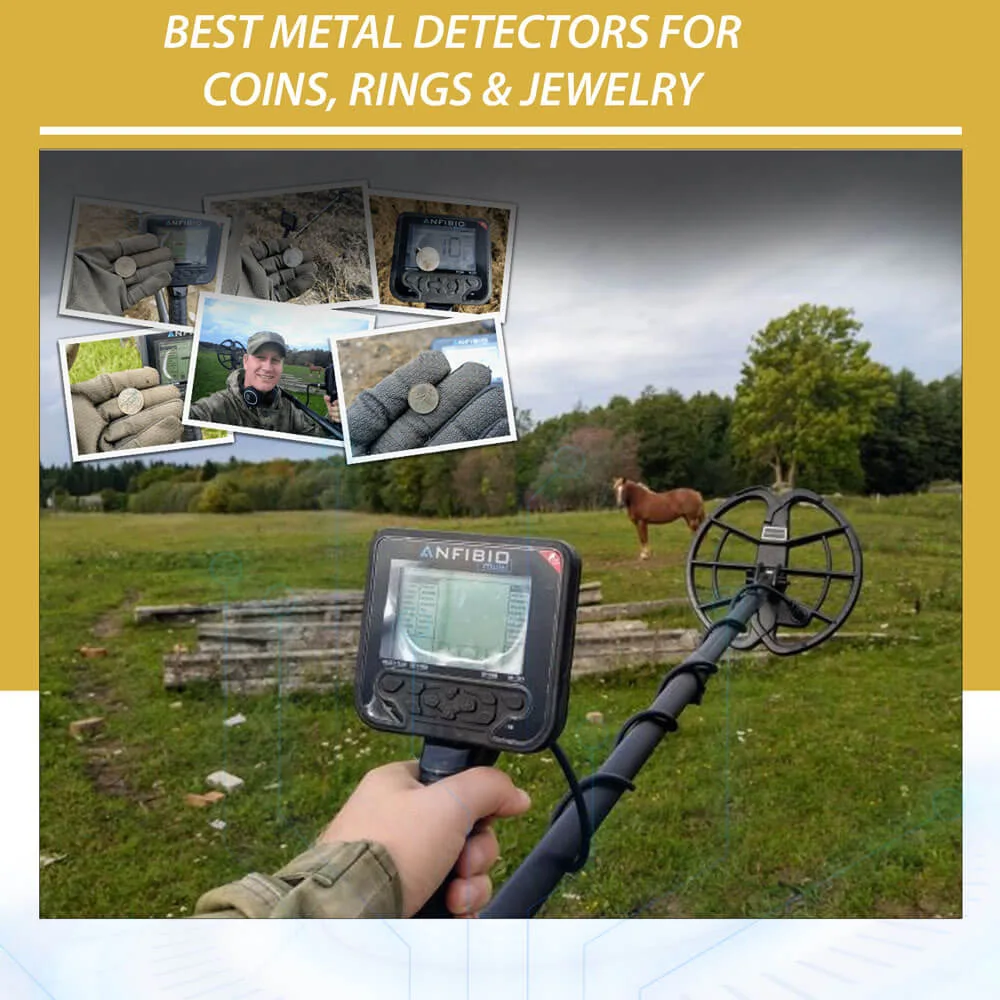
The best metal detector for coins and jewelry is a VLF detector with accurate target ID, good target separation in trash, notch discrimination and a stable response on the ground you hunt most, whether that is a park, a field or a wet beach. In our catalog the Minelab Equinox, Minelab Manticore, Nokta The Legend 2 and Minelab CTX 3030 cover the serious end of that description; the Garrett AT MAX, Minelab Vanquish and Nokta Simplex cover the mid-range and entry level.
Coins and jewelry are the two most common finds in metal detecting, and they call for the same skills: reading target ID numbers and tones, separating a small non-ferrous target from the iron and foil around it, and knowing which signals to dig. This guide explains what coins and jewelry look like to a detector, which features matter, and which models we recommend for each budget and type of ground.
What are coins and jewelry made of, and why does it matter?
A detector does not see gold or silver; it sees how well a target conducts electricity and how large it is. That is what the target ID number represents.
- Modern coins are mostly copper, nickel, zinc, brass or steel alloys. Copper and nickel coins read in the mid to high range; steel-core coins behave partly like iron.
- Older silver coins are high conductors and give strong, high-number signals. In the United States, for example, dimes, quarters and half dollars minted in 1964 or earlier are 90 percent silver, which is why they are prized by coin hunters. Many other countries also struck silver circulation coins until the mid-twentieth century.
- Gold jewelry is a weaker conductor than silver and usually small and thin, so rings and chains read low to mid-range, often in the same window as pull tabs and foil. A thin gold chain can be almost invisible to a detector because each link is tiny.
- Silver jewelry reads higher than gold, closer to coins.
- Gemstones, pearls and glass are not detected at all. A ring is found through its metal setting, never its stone.
The practical lesson: if you want gold jewelry, you cannot discriminate out the pull-tab range without losing rings. Coins are easier because they sit in a narrower, higher band. Our article on metal detector target ID explains the scale.
Features that matter for coin and jewelry detecting
- Numeric target ID and multiple tones. The difference between a nickel, a pull tab and a gold ring is a few points; a clear two-digit ID and distinct tones let you make that call.
- Notch discrimination. Lets you silence specific ID ranges, such as foil, while keeping everything else. Useful for coins; use it sparingly for jewelry.
- Fast recovery speed and target separation. Parks and old sites are full of iron. A detector that resets quickly after one target can hear a coin next to a nail instead of masking it. See recovery speed and target masking.
- Frequency. For general coin hunting a single frequency around 10 to 15 kHz is a sensible middle ground; lower frequencies favor large silver and copper coins, higher frequencies favor small gold. Simultaneous multi-frequency detectors cover the whole range at once and give steadier IDs, which is why they dominate this category.
- Ground balance and a beach mode. Jewelry hunting often leads to wet salt sand, where only multi-frequency or well-balanced detectors stay quiet.
- Pinpoint mode and a small coil option. Precise recovery keeps holes small in parks; a smaller coil separates targets in trashy ground.
- Waterproofing. Rings are lost in water. A submersible detector lets you follow them into the shallows.
Best metal detectors for coins and jewelry compared
| Model | Technology | Target ID and audio | Waterproof | Best for |
|---|---|---|---|---|
| Minelab Manticore | Multi-IQ+ | 2D target map showing conductivity and iron content | IP68 to 5 m | Separating gold rings from trash; wet beaches |
| Minelab Equinox | Multi-IQ (5 to 40 kHz) | Numeric ID, multiple tones, customizable modes | About 3 m | All-round coins and jewelry on land and beach |
| Nokta The Legend 2 | SMF plus 5 single frequencies | 99-point ID, 7 tones, FerroCheck | Waterproof, two DD coils included | Value multi-frequency with strong iron handling |
| Minelab CTX 3030 | FBS 2 multi-frequency | Smartfind 2 ferrous and conductive discrimination, color screen, GPS | 3 m | Dedicated coin hunters who want maximum discrimination |
| Garrett AT MAX | VLF 13.6 kHz | Digital ID, Iron Audio, Z-Lynk wireless | 3 m | Mid-range all-terrain coin and relic detector |
| Minelab Vanquish | Multi-IQ | Numeric ID, preset modes | Coil only | Budget multi-frequency for parks |
| Nokta Simplex / Simplex Ultra | VLF 12 / 15 kHz | Numeric ID, Park, Field and Beach modes | Fully submersible | Entry level, including wet sand |
Minelab Manticore and Equinox
The Minelab Manticore is the strongest tool in this list for jewelry, because its 2D target map shows how much iron content a signal has as well as its conductivity, which is exactly the information you need to decide between a pull tab and a ring. The Minelab Equinox offers the same simultaneous multi-frequency approach in a lighter, simpler package with Park, Field, Beach and Gold modes, and remains the most common recommendation for coin and jewelry hunters who want one detector for everything.
Nokta The Legend 2
The Legend 2 combines SMF with selectable single frequencies, an expanded 99-point target ID scale, seven tones and FerroCheck to reduce false signals from iron. It ships with an 11-inch and a smaller elliptical DD coil, which is ideal for coin hunting: the large coil for open fields, the small one for trashy parks.
Minelab CTX 3030
The Minelab CTX 3030 is a coin specialist. Its FBS 2 multi-frequency and Smartfind 2 discrimination place every target on a two-axis ferrous and conductive screen, and the built-in GPS lets you map hunted areas. It is heavier than the Equinox and Manticore, but for patient coin hunters who want to dig only silver, it is hard to beat.
Garrett AT MAX
The Garrett AT MAX is a single-frequency 13.6 kHz detector with digital target ID, Iron Audio, True All-Metal mode, Z-Lynk wireless headphones and full submersion to 3 meters. It is a reliable mid-range choice for coins and relics in parks, fields and freshwater, with the usual single-frequency limits on wet salt sand.
Minelab Vanquish and Nokta Simplex
The Minelab Vanquish brings Multi-IQ to the entry level and gives steadier IDs than most single-frequency detectors at its price; its control box is not for submersion. The Nokta Simplex is fully waterproof with Park, Field and Beach modes and a clear numeric ID, which makes it the better budget choice if beaches are part of your plan.
Which one should you choose?
- Parks and sports fields with lots of trash: Equinox, Legend 2 or Manticore, with a small coil, for target separation.
- Old silver coins on farmland and old sites: CTX 3030 or Equinox, hunting high-conductor signals.
- Gold rings on beaches: Manticore or Equinox in Beach mode, digging the mid-range signals most people skip.
- First detector, mixed use: Simplex for beaches, Vanquish for parks.
Where to hunt matters as much as what you hunt with. Our guides to places to find lost coins and jewelry, finding coins and finding jewelry cover sites and technique.
Frequently asked questions
What frequency is best for coins and jewelry?
Around 10 to 15 kHz is a good single-frequency compromise. Lower frequencies favor large silver coins, higher frequencies favor small gold. A simultaneous multi-frequency detector removes the choice by using several frequencies at once.
Can a metal detector tell gold from a pull tab?
Not reliably. Gold rings and pull tabs overlap in target ID. Detectors with a 2D target display or very stable IDs narrow the odds, but jewelry hunters still dig most mid-range signals.
How deep can a coin be detected?
Roughly 20 to 30 centimeters for a typical coin with a good detector in mild soil; less in heavily mineralized ground and for very small coins, more for large coins lying flat.
Can a detector find diamonds or pearls?
No. Gemstones are not conductive. A ring is detected by its metal band, so a lost diamond ring is found, but a loose stone is not.
Conclusion
The best metal detector for coins and jewelry gives you a clear target ID, fast separation in trash and stability on the ground you hunt, and in most cases that means a simultaneous multi-frequency detector such as the Equinox, Legend 2 or Manticore, with the CTX 3030 for dedicated coin hunters and the Simplex or Vanquish for a first machine. If you tell us where you hunt and what you hope to find, our team on WhatsApp will help you pick the right one.
Not sure which detector fits you? Contact us on WhatsApp.
Read also
Related Articles