




A metal detector sensor is the part of a detector that creates a magnetic field and senses how nearby metal changes it. In almost every hobby, security and industrial metal detector, that sensor is a search coil: a set of copper windings that act as transmitter and receiver. Some instruments use other sensors, such as magnetometers or radar antennas, but those measure different things and are not metal detectors in the strict sense.
This guide explains how a metal detector sensor works, the main coil designs, how the sensor connects to the circuit, what sensitivity means and which sensors are used in industrial machines.
How does a metal detector sensor work?
Metal detectors work by electromagnetic induction. An alternating or pulsed current in the transmit coil creates a magnetic field around the coil. When that field passes through a metal object, it induces small electric currents, called eddy currents, in the metal. Those currents produce their own weak magnetic field, and the receive coil picks up that change.
The electronics then measure how large the change is and how it is delayed or shifted compared with the transmitted signal. From this, the detector produces an audio tone, a signal strength reading and, on many models, a target ID number that estimates the type of metal. The weaker the returning signal, the weaker the response, which is why small and deep objects are hardest to detect. For the full principle, see our article on how a metal detector works.
Two families of detectors use the sensor differently:
- VLF (very low frequency): separate transmit and receive windings run continuously at a set frequency, or several frequencies at once on multi-frequency models. The phase shift of the returned signal helps the detector tell iron from non-ferrous metals.
- PI (pulse induction): one coil sends short, strong pulses, then switches to listening for the decaying response from metal after each pulse. PI handles mineralized ground and saltwater well but usually offers less discrimination.
The Minelab Equinox is an example of a multi-frequency VLF detector (Multi-IQ), while the Minelab GPX 6000 is a PI gold detector.
Types of metal detector sensors (search coils)
The coil’s winding layout changes how the sensor behaves in the field. The most common designs are:
| Coil design | How it is built | Strengths | Limits |
|---|---|---|---|
| Concentric | Transmit and receive windings in rings, one inside the other | Precise pinpointing, good in mild soil | Less stable in mineralized ground |
| DD (Double D) | Two overlapping D-shaped windings | Stable in mineralized soil, wide sweep coverage | Pinpointing takes a little practice |
| Mono | A single winding that transmits and receives | Standard for PI detectors, good depth | Mainly used on PI; fewer options for VLF detectors |
| Frame or loop | Large rectangular frame or cable loop | Depth on large objects, wide area | Poor for small targets |
Coil size also matters. A larger coil covers more ground and reaches deeper on large objects, while a smaller coil is more sensitive to small targets and separates objects that lie close together. Our guide to metal detector coil types covers sizes and shapes in more detail.
Other sensors used in detection devices
Pinpointer probes
A pinpointer is a small handheld detector with its sensor in the tip. It is used after the main detector has found a target, to locate it precisely in the hole. The Quest XPOINTER is one example. See our guide to pinpointer metal detectors.
Magnetometers
A magnetometer, such as a fluxgate sensor, measures the strength of the magnetic field. It responds strongly to iron and steel, which disturb the Earth’s field, but not to gold, silver or copper, which are not magnetic. Magnetometers are used in geophysics and for locating large iron objects. The magnetometer inside a phone works on a related principle, which is why phones cannot detect gold; we explain this in can a phone detect metal.
Ground scanner probes and radar antennas
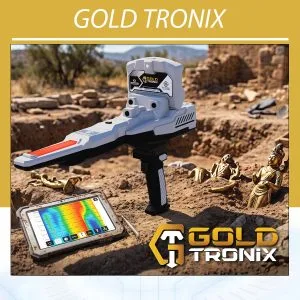
3D ground scanners use a probe that records changes in the ground’s response at many points across a grid; the software then draws these values as a color map. The map shows variations in ground response, not an image of the buried object. Ground penetrating radar uses an antenna that sends radio waves and records reflections from layers, voids and objects.
Some devices sold as “long-range locators” claim to detect metal from hundreds of meters away using antennas. These range and depth figures are manufacturer-stated specifications without independent scientific validation; for reliable results, use methods based on proven physics, such as PI, VLF, ground radar or magnetometry.
Metal detector sensor circuit diagram
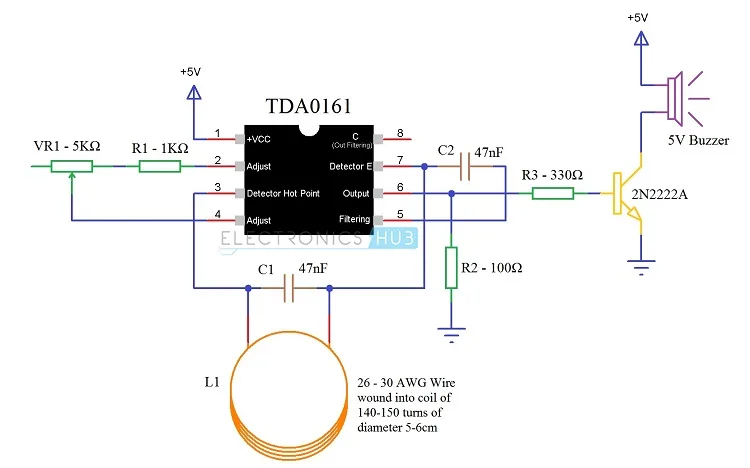
The diagram above shows a simple do-it-yourself metal detector circuit. Even basic circuits contain the same building blocks as commercial detectors:
- Oscillator or pulse generator that drives current through the transmit coil.
- Search coil that creates the field and receives the response.
- Amplifier that boosts the tiny signal from the receive winding.
- Signal processing, in older designs with analog components, in modern detectors with a microprocessor or digital signal processor.
- Output stage that turns the result into a sound, a meter reading or a display.
Hobby circuits are a good way to learn the principle, but they cannot match commercial detectors in depth, stability or ground handling. Our article on the gold detector circuit goes further into how these circuits work.
Metal detector sensor with Arduino
Arduino is an open-source microcontroller platform widely used for electronics projects. In DIY metal detectors, an Arduino board can generate pulses for the coil, measure the returned signal and drive a buzzer or small display. Simple Arduino detectors usually find coins and other metal objects at very short range, typically a few centimeters, which makes them educational projects rather than practical search tools.
If you want a working detector for coins, relics or gold, a commercial model with a well-designed coil, ground balance and discrimination will perform far better than any hobby build.
What is metal detector sensitivity?
Sensitivity is a detector’s ability to sense a given size and type of metal. In industrial metal detection it is usually stated as the smallest test sphere, made of ferrous, non-ferrous or stainless steel, that the machine can reliably detect. The smaller the sphere, the more sensitive the detector.
On a hobby detector, sensitivity is also a setting that controls how strongly the receiver amplifies signals. Higher sensitivity helps with small or deep targets but also increases noise from mineralized ground and electrical interference. Set it as high as the detector stays stable, not higher. Our guide to metal detector sensitivity explains how to adjust it.
Sensors in industrial and pharmaceutical metal detectors
Food, pharmaceutical and packaging lines use metal detectors to find contamination in products. Many use a balanced coil system: one transmitter coil between two receiver coils that cancel each other out when no metal is present. A metal particle passing through the aperture upsets the balance and triggers a reject mechanism. Other industrial systems use pulse induction or magnetic field sensors, depending on the product and packaging.
Factories also use inductive proximity sensors, small sensors that detect metal parts at very short range on machines and conveyor lines. They respond only to metal, not to plastic, wood, paper or ceramic. For more on factory systems, see our article on the industrial metal detector.
Frequently asked questions
What sensor is used in a metal detector?
Most metal detectors use a search coil made of copper windings. It generates a magnetic field and senses the changes caused by eddy currents in nearby metal.
Can I replace the sensor on my metal detector?
On most hobby detectors, yes. Manufacturers sell alternative search coils in different sizes and designs, but a coil must be compatible with your specific detector model.
Is a DD or concentric coil better?
A DD coil is usually more stable in mineralized ground and covers a wider strip. A concentric coil pinpoints more precisely and works well in mild soil.
Can a metal detector sensor detect gold?
Yes. Gold conducts electricity, so it produces eddy currents like other metals. Small gold gives weak signals, which is why gold detectors use higher frequencies or pulse induction.
Conclusion
A metal detector sensor is, in nearly all cases, a search coil that sends a magnetic field and senses the response of metal through electromagnetic induction. Its design, whether concentric, DD, mono or frame, and its size determine how it behaves in different soils and with different targets. Magnetometers, scanner probes and radar antennas measure other properties and suit other tasks. If you want help choosing a detector or a replacement coil for your search, our team can advise you over WhatsApp.
Not sure which detector fits you? Contact us on WhatsApp.
Read also
Related Articles



One comment
Metal detactor spare parts requment