

What Metals Can a Metal Detector Detect? A Complete Guide
What metals can a metal detector detect? A conventional search-coil metal detector can respond to many metals, including iron, steel, gold, silver, copper, aluminium, brass, bronze, lead, platinum and titanium. Stainless steel is also detectable, although some grades and small shapes can be challenging. The more useful question is whether your particular detector can detect a particular object under the conditions where you are searching.
A gold ring and a tiny gold chain are made from similar material, but they can behave very differently beneath the coil. A copper coin in clean soil may produce a clear signal, while another beside a rusty nail can be difficult to identify. Metal type matters, but it is only part of the explanation.
This guide explains the detectable metal groups, why targets overlap on the screen, and how to improve your understanding through simple tests. Examples from detectors listed by Orient Detectors connect the principles to real equipment. The exercises are suggested learning activities, not reported field-test results.

What metals can a metal detector detect? Quick comparison
The table describes common objects and practical cautions. It is not a depth chart or a universal ranking of sensitivity. Every entry assumes an object large enough to produce a usable response, suitable settings, and conditions within the detector’s capabilities.
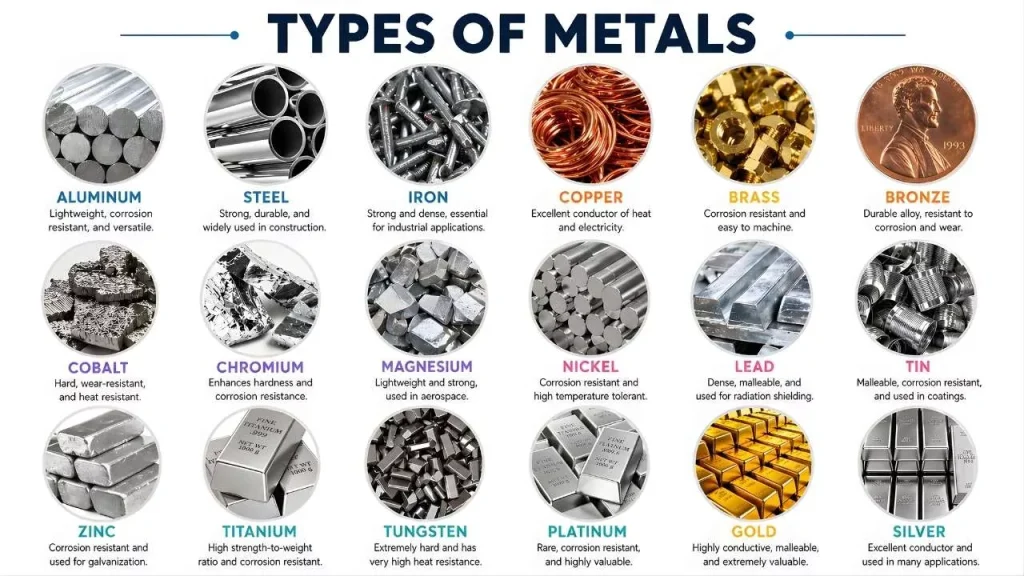
| Metal or alloy | Typical targets | What to understand |
|---|---|---|
| Iron and ordinary steel | Nails, tools, bolts and relics | Detectable, but iron discrimination may silence them. |
| Gold | Rings, earrings, coins and nuggets | Small items can overlap with foil and other unwanted targets. |
| Silver | Coins, jewellery and small objects | A small chain behaves differently from a solid coin. |
| Copper | Coins, wire and fittings | Wire orientation and object dimensions affect the response. |
| Aluminium | Foil, pull tabs, cans and tokens | Different shapes can occupy widely different ID ranges. |
| Brass and bronze | Buttons, buckles, fittings and coins | Alloy composition and construction vary considerably. |
| Lead | Fishing weights and other cast objects | A response does not confirm that the target is lead. |
| Stainless steel | Rings, fasteners and utensils | Grade, size and magnetic behaviour make a difference. |
| Platinum | Rings and jewellery | Detectable, without a unique platinum identification number. |
| Titanium | Rings, fasteners and components | Small or thin pieces may give a difficult response. |
How a detector responds to metal
A search coil produces a changing electromagnetic field. Conductive objects within its useful range develop electrical currents, often called eddy currents. Their response influences the signal received by the detector. The electronics process this information and present it as sound, a numerical identification, a visual trace, or a combination.
Electrical conductivity describes how readily current flows through a material. Magnetic properties also influence the response. Gold and aluminium do not need to stick to a household magnet to be detectable. A detector is therefore not simply an electronic magnet looking for magnetic objects. Minelab’s explanation of how detectors work describes these underlying principles.
Three separate outcomes are worth remembering: the machine can detect a response, classify that response, and help you locate its source. None automatically establishes the object’s exact composition. A signal can be strong enough to hear while remaining too uncertain for a dependable target number.
Ferrous, non-ferrous and stainless steel explained
Ferrous metals
Ferrous metals are iron-based materials. Ordinary steel, cast iron and many everyday nails belong here. In hobby detecting, “ferrous” also describes the detector’s classification of a signal. This electronic classification can be imperfect, particularly around difficult ground or overlapping objects.
Iron is often rejected during coin hunting because modern sites contain so many nails and fragments. However, a historical iron tool may be the object you want. “Ferrous” describes material or signal behaviour; it does not mean worthless. Your search objective determines whether rejecting it makes sense.
Non-ferrous metals
Gold, silver, copper, aluminium, lead and platinum are familiar non-ferrous examples. Brass and bronze are copper-based alloys. These materials can be detected through their electromagnetic response even when they are not attracted to a magnet. Their value and desirability vary enormously: aluminium rubbish and precious jewellery both belong in this broad group.
Non-ferrous does not universally mean non-magnetic: nickel and cobalt are important exceptions. For everyday searching, it is more useful to learn the actual object’s response than to rely on a simplified magnetic-versus-non-magnetic checklist.
Why stainless steel deserves its own discussion
Stainless steel is iron-based, so it is not a separate non-ferrous family. It is discussed separately because its grades have different magnetic properties and conductivity. Some are magnetic; common austenitic grades can be weakly magnetic or effectively non-magnetic in ordinary use. Manufacturing and deformation can also change their behaviour.
METTLER TOLEDO’s metal detection guidance explains why some stainless steels are challenging. Its industrial examples should not be converted into hobby-detector depth predictions, but the material distinction is useful: stainless steel is detectable, without every stainless object being equally easy to find.
Gold: rings, chains, coins and natural nuggets
Many general-purpose detectors can find gold jewellery. Dedicated gold detectors are designed around prospecting requirements such as small natural targets and difficult ground. Neither category provides a magical gold-only response. A detector sensitive to a gold ring can also respond to aluminium, lead or other metal objects.
Jewellery is often an alloy. Two rings can differ in diameter, thickness, alloy mixture and construction even when their hallmarks indicate the same gold content. Those differences can produce different readings. Target ID cannot establish karat, purity, weight or selling value.
Fine chains create another challenge. The detector does not necessarily respond as though every link were one solid piece. A clasp may produce the clearest response while the delicate chain itself remains difficult. Testing a ring therefore tells you little about whether the same settings will locate a thin necklace.
Natural nuggets add irregular shape and mineralized surroundings. For prospecting, consider the ground and expected nugget size together. A detector demonstrated on a large gold object in air has not demonstrated its ability to locate a tiny nugget in mineralized soil.
Silver and copper: useful targets for learning
Silver coins and substantial silver jewellery can produce clear responses in favourable conditions. Nevertheless, “high number equals silver” is not a dependable identification rule. Other targets may share that reading, and a small silver earring can behave differently from a broad coin.
Copper appears in coins, wire, fittings and many alloys. A copper coin can be a convenient training target because you can repeat sweeps over the same object. The useful lesson is consistency under controlled conditions, rather than treating its displayed number as a universal copper code.
For a comparison, place a known copper object and a known silver object separately on a clean test surface. Record their responses, then change their orientation. Label the actual objects in your notes. Avoid writing simply “silver number” or “copper number,” because those labels hide the differences between objects.
Aluminium, brass, bronze and lead
Aluminium illustrates why metal identification is complicated. A small foil fragment, a pull tab and a crushed can contain the same principal metal but have very different dimensions. Rejecting one aluminium response range does not guarantee that you have rejected every aluminium object.
Brass and bronze are common in buttons, buckles, decorative fittings and older objects. Their alloy proportions and construction vary. A thin button and a heavy fitting should not be expected to produce identical readings merely because both are described as brass.
Lead fishing weights are also detectable. Their rounded, flattened or elongated forms provide useful examples of how geometry influences target behaviour. A response resembling a familiar lead weight still does not establish what is underground. Recovering and examining the object supplies the missing evidence.
Keep these metals in your learning collection where appropriate. They help demonstrate that low, middle and high responses are categories of detector information, rather than a simple scale running from worthless material to valuable material.
Platinum, titanium and mixed-metal objects
Platinum jewellery and titanium objects are not inherently invisible to conventional metal detectors. However, their presence on a list of detectable metals does not guarantee recovery of every ring, screw or fragment. Target dimensions, detector design and conditions still determine whether the signal is useful.
A mixed-metal object complicates interpretation further. Jewellery can combine different alloys, while a plated object has a surface material and an underlying body. Coins may also use layered or mixed construction. The detector reports the combined electromagnetic behaviour; it does not perform a laboratory analysis of each constituent.
This matters when identifying finds. A gold-coloured object is not necessarily gold, and a convincing jewellery-like signal does not resolve that uncertainty. Cleaning, markings and suitable material testing after recovery provide information that the detector’s display cannot supply.
What metals can a metal detector detect at useful depth?
There is no single useful depth for “gold,” “silver” or “iron.” A meaningful claim must describe the object, coil, ground, settings and detection criterion. Hearing an occasional sound is a different result from obtaining a repeatable response with a stable identification.
Size, shape and orientation
A substantial object generally offers more opportunity for detection than a tiny fragment, but weight alone is not enough. Compare a compact ring with fine jewellery of similar mass. The arrangement of the metal affects the currents that form in it and the resulting response.
A coin lying flat can respond differently when turned on edge. Long wire, loops and irregular fragments may also change as the sweep direction changes. Checking from a second direction gives additional information, although a weak response from one angle does not automatically make the target unimportant.
Mineralization and salt
The ground can contribute its own signal. Iron minerals, some rocks and conductive salt conditions can interfere with the response from a small object. Appropriate ground handling and search modes help, but they do not remove every limitation. Minelab’s mineralized-soil guide explains the effect on stability and identification.
Nearby metal and interference
A nail beside a coin may dominate or distort what the detector reports. This is target masking. Electromagnetic interference is different: electrical equipment or another detector can cause instability even without a target beneath your coil. Investigate the source before assuming the machine cannot detect a particular metal.
For buyers, ask to see a demonstration using a representative object in representative ground. Record unsuccessful passes as well as successful ones. One impressive response, without the test conditions, is too little evidence for choosing equipment.
Why Target ID cannot name every metal
Target ID translates a measured response into a scale chosen by the manufacturer. It is not an elemental analysis. Numbers can overlap between desirable and unwanted objects, and different models can assign different numbers to the same target.
Imagine that a ring and a pull tab produce similar readings in your test. The detector has not necessarily malfunctioned. Their measured characteristics overlap under those conditions. Rejecting that range may remove both. Likewise, a stable number increases confidence in repeatability, not certainty about the object’s identity.
Use audio, repeatability, the width of the response and checks from different directions alongside the display. Then compare your prediction with the recovered object. Orient’s complete Target ID guide explains the differences between identification scales in more detail.
Examples from detectors available at Orient Detectors
These examples show different approaches to metal detection. They are selected from Orient’s catalogue and supported by manufacturer documentation. They do not establish that one model detects every listed metal better than another.

Minelab MANTICORE: conductive and ferrous information help users investigate metal targets. Product image: Minelab.
Garrett ACE 400i: learning with familiar objects
The Garrett ACE 400i provides numerical Target ID and Iron Audio. Garrett’s manual describes its 0–99 identification scale and controls for accepting or rejecting responses. These features make it a useful example for explaining the difference between detecting a target and choosing to hear it.
For a learning exercise, compare a nail, a coin and an aluminium pull tab separately. Note the identification and sound before changing discrimination. Then repeat the test with Iron Audio as described in the official ACE 400i manual. Your notes should describe what the particular specimens did, rather than declaring a number exclusive to one metal.
Minelab MANTICORE: conductive and ferrous information
The Minelab MANTICORE uses Multi-IQ+ and a two-dimensional identification map. Its documented conductive scale is 0–99 with ferrous indication. The additional information helps explain why conductivity and iron classification are related but separate observations.
A useful exercise is to compare a coin alone with the same coin near a nail. Observe how the trace and sound change with spacing and sweep direction. Do not interpret the screen as a photograph of the objects. See Minelab’s MANTICORE specifications for the official feature list.
Minelab GPX 6000: matching equipment to goldfield conditions
The Minelab GPX 6000 is a dedicated gold prospecting example. Minelab describes its GeoSense-PI technology as analysing ground and target signals to support operation in challenging ground. Its purpose illustrates why detector selection involves the environment as well as the metal you hope to find.
Someone searching for nuggets should compare responses to representative gold specimens in the intended soil, where practical. Jewellery demonstrations alone do not answer that question. A prospecting focus also does not mean that other metals become invisible. Consult the official GPX 6000 product information when evaluating its intended use.
Choosing settings for the metal you want
| Search objective | Useful starting approach | Common mistake |
|---|---|---|
| Coins | Learn local coins and common rubbish with the selected mode. | Assuming every coin is non-ferrous or reads high. |
| Lost jewellery | Accept a broad range and test a similar item if available. | Rejecting the range containing small gold. |
| Iron relics | Make sure iron responses are audible. | Using heavy iron rejection while searching for iron. |
| Natural gold | Choose equipment and ground handling appropriate to the site. | Applying a jewellery test to all nugget conditions. |
| Mixed objects near rubbish | Investigate from several directions and control coil movement. | Trusting one sweep or a single number. |
Begin with the manufacturer’s recommended mode for the environment. Make one change at a time. If you change sensitivity, discrimination, coil height and sweep speed together, you will not know which adjustment changed the result. Stable operation is more informative than a maximum setting that produces constant uncertainty.
Discrimination manages which responses you hear or accept. It does not make unwanted metal disappear from the electromagnetic environment. Orient’s metal detector discrimination guide provides further examples of the trade-off between reducing rubbish and retaining useful signals.
A practical test to answer what metals can a metal detector detect
- Choose known specimens. Gather a coin, nail, foil, pull tab and brass fitting. Add jewellery only when it can be handled securely. Label uncertain material as uncertain.
- Find a clean test area. Scan the surface first. Keep the targets away from metal furniture, reinforced floors and other objects that could confuse the comparison.
- Record your baseline. Note the detector, coil, mode and settings. Sweep each object separately at a consistent distance and speed.
- Change orientation. Turn the same object and repeat. Write down the range of readings rather than only the most attractive number.
- Check your filtering. Compare broad acceptance with your intended discrimination pattern. Identify which desirable test objects become quieter or disappear.
- Add realistic ground testing. Where permitted, use a marked shallow test position and recover every specimen. Compare the result with the clean-surface test.
Your record should distinguish three outcomes: audible response, repeatable response and stable identification. These are different achievements. Include coil-to-target distance and any unusual ground behaviour. A brief, honest notebook is more valuable than a collection of impressive numbers without test conditions.
For a lost ring, practise with a genuinely similar ring when available, but retain broad acceptance. An exact match cannot be assumed, and the lost object may be tilted, deeper, or beside rubbish. The test teaches search technique and likely responses; it does not prove where the missing ring must appear on the scale.
Three everyday situations that change your search
A missing wedding ring in a garden
Start with the likely loss area and a systematic grid. The useful question is not simply whether gold is detectable, but whether the chosen settings retain a response from a similar ring. Check garden furniture, edging and nearby metal before interpreting a confusing signal. If the area contains foil, accepting some foil-like responses may be necessary. Write down where you have searched so that repeated passes cover new directions rather than the same convenient path.
Old coins around an iron-filled building site
Suppose a site contains nails, copper-alloy coins and steel fragments. A strong iron filter may quiet the detector, but silence alone does not demonstrate that all coins remain audible. Practise with a coin and nail at several spacings on a clean surface. Return to uncertain positions from a different direction and keep the coil movement controlled. Your aim is to understand overlapping responses before deciding how much filtering the site will tolerate.
Small jewellery in a beach picnic area
Small earrings and pieces of foil may create an inconvenient mixture of responses. Begin by deciding whether you are searching for a specific lost item or conducting a general hunt. The first goal may justify investigating a wider range of signals in a small area. For a larger search, note which recovered objects repeatedly occupy the same ranges, while recognising that jewellery could share them. Where wet salt conditions become relevant, review the detector’s documented beach capability and setup before extending the search.
These situations show why a metal list should lead to a search plan. Knowing that gold, copper and aluminium are detectable is useful; knowing how your intended object interacts with the surrounding rubbish and ground is what makes that information practical.
Putting metal type into perspective
The best answer to what metals can a metal detector detect includes both capability and context. Many metals are detectable, but an object’s form, surroundings and the chosen settings determine what the operator actually hears. A machine that finds one silver coin has not demonstrated equal performance on every silver object.
Choose equipment around your intended targets and terrain, learn its responses with known samples, and use identification as evidence to investigate. If you need help comparing models, provide Orient Detectors with the target type, approximate size and search environment. That description is more useful than asking for a machine that detects “all metals at maximum depth.”
Frequently asked questions
1. What metals can a metal detector detect?
Conventional search-coil detectors can respond to iron, steel, gold, silver, copper, aluminium, brass, bronze, lead, platinum, titanium and stainless steel. Actual detection depends on the object and conditions. Being made from detectable metal does not guarantee that a tiny or deeply buried piece will produce a usable signal.
2. Can a metal detector find non-magnetic metals?
Yes. Electrical conductivity allows metals such as gold, copper and aluminium to respond even without ordinary magnetic attraction. A magnet test cannot tell you everything about detectability. It can help describe a specimen, but it is not a substitute for testing it with the detector.
3. Can metal detectors detect stainless steel?
Yes, although grade, dimensions and orientation matter. Some stainless steels are more difficult than common iron objects, particularly in small forms. Avoid universal claims that stainless steel is either invisible or always easy to find.
4. Can a detector distinguish gold from aluminium?
Sometimes their responses differ, but overlap prevents a universal gold-versus-aluminium rule. A discrimination setting that rejects one pull tab may also reject desirable jewellery. Learn with examples and accept that recovery may be needed to resolve an uncertain signal.
5. Does a high Target ID mean silver?
No. A high reading can be consistent with some silver objects, but other metals and shapes can produce similar results. The number belongs to the detector’s response scale, not to a laboratory list of elements.
6. Why does a detector miss a small gold chain?
Fine links can be difficult to detect, and the clasp may give the strongest response. Coil choice, settings, orientation and ground conditions also matter. Finding a gold ring successfully does not demonstrate equal sensitivity to every form of gold jewellery.
7. Can a gold detector find other metals?
Yes. A detector designed for gold prospecting can respond to other conductive objects. “Gold detector” describes its intended application and design priorities; it does not guarantee exclusive identification of gold or complete rejection of rubbish.
8. Can a detector identify gold purity?
A standard hobby detector cannot establish karat or purity from Target ID. Size, shape, alloy composition and surroundings all influence the reading. Appropriate material testing after recovery is needed for a reliable composition assessment.
9. Can a metal detector find diamonds or plastic?
Ordinary search-coil detectors do not directly identify diamonds or plain plastic through a metal response. They may detect metal associated with them, such as a ring setting or fastener. Finding the setting is different from detecting the stone itself.
10. Why does a known metal object produce no sound?
Check whether its response is rejected, whether it is too small or distant, and whether nearby metal or ground noise is interfering. Repeat the test with a known detectable object using the manual’s procedure. A silent response by itself does not identify the metal or prove a detector fault.
Resources and further reading
- Minelab: How Detectors Work — electromagnetic response, conductivity and magnetic properties.
- Minelab: Frequently Asked Questions — target identification, depth and practical detecting questions.
- METTLER TOLEDO: Metal Detection Guidance — metal categories and stainless-steel considerations in industrial detection.
- Minelab: Detecting in Mineralized Soils — ground effects and practical limitations.
- Garrett: ACE 400i Owner’s Manual — identification, discrimination and Iron Audio.
- Minelab: MANTICORE Technical Specifications — documented detection and identification features.
- Minelab: GPX 6000 — the manufacturer’s gold-prospecting overview.
- Orient Detectors: Metal Detector Target ID Guide — understanding numerical readings.
- Orient Detectors: Metal Detector Discrimination Guide — accepting targets and managing unwanted responses.