
Gold Stinger X6 Review: Features, Depth, Coils and Field Performance
Introduction
The Gold Stinger X6 is a multi-system treasure detector for gold and gold prospecting and metal detection designed for users who want more than a basic audio signal.
It combines interchangeable search coils, ground balance, metal discrimination, pinpointing, depth estimation, cavity checking, and target analysis in one platform.
That makes it more suitable for serious treasure hunting than casual park scanning.

This review looks at the X6 from a practical buyer’s perspective. The device is advertised with a maximum detection depth of up to 500 cm, but that figure should be treated as a best-case claim. Actual depth depends on target size, soil mineralization, coil choice, sensitivity, Turbo level, ground balance, and operator technique.
The strongest argument for the X6 is not one single specification. Its value is the workflow: search broadly, confirm the target, estimate depth, and use visual analysis before deciding whether to dig.
Quick Verdict
The Gold Stinger X6 is a capable treasure detector for users who want depth-oriented searching, target filtering, cavity awareness, and multiple confirmation tools.
It offers good flexibility through the GS50 and GS30 coils, but it requires careful ground balance and realistic expectations.
Beginners can use it, but experienced users will benefit most from its layered search systems.
Specifications Table
| Specification | Details |
| Product name | Gold Stinger X6 |
| Detector category | Multi-system treasure and metal detector |
| Advertised maximum depth | Up to 500 cm, depending on target and field conditions |
| Search coils | GS50 large search coil and GS30 small search coil |
| Primary systems | Ground Balance, All Metals, Pin Pointer, Discrimination, Depth Detect, Cavity Test, Target Scan |
| Target feedback | Numerical values, value bar, linear graphs, 2D/3D graph displays, and audio tones |
| Iron filtering | Remove Iron option with ON/OFF status |
| Sensitivity | Adjustable from 0 to 100 |
| Turbo power | Adjustable from 0 to 100 |
| Volume and brightness | Adjustable from 0 to 100 |
| Connectivity indicators | Coil connectivity status on the display |
| Ports and audio | Headphone jack (AUX), speaker, Type-C charging jack |
| Languages | English, Spanish, French, German, Turkish, Arabic |
Gold Stinger X6 Package Contents
The package includes the control box unit, upper shaft, middle shaft, lower shaft, GS50 large search coil, GS30 small search coil, coil connection cable, arm strap, coil mounting screw, headphones, battery charger, charging cable, and user manual.
Including both coils is important because the buyer can adapt the detector to open ground, deeper targets, tighter spaces, and smaller targets without immediately needing an extra coil purchase.
Design and Build Quality
The Gold Stinger X6 uses a familiar shaft-and-control-box layout with a display, keypad, speaker, coil connector, AUX headphone jack, rear power switch, and Type-C charging jack.
The keypad gives quick access to ground balance, iron removal, menu navigation, OK/Enter, Back, and Target Scan.
The interchangeable coil design is the most practical hardware feature.
It gives the detector two different field personalities, but it also means cable connection and coil mounting should be handled carefully. Loose connectors, rough cable wrapping, or shock to the coil can create avoidable problems in the field.
GS50 vs GS30 Search Coils
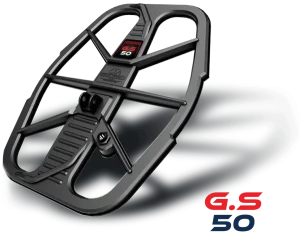
The GS50 search coil is the larger coil. It is the better choice for open areas, wider coverage, and searches where depth potential matters. If the target is expected to be large or deeply buried, the GS50 is the logical starting point.
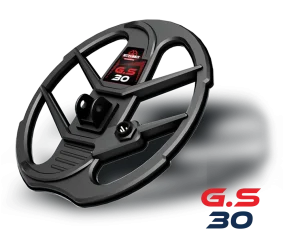
The GS30 is smaller and lighter. It is easier to maneuver in tight or cluttered ground and is better suited to smaller targets or sites with obstacles. Neither coil is universally better; the right choice depends on terrain, target size, and search conditions.
| Coil | Main Advantage | Best Use |
| GS50 large search coil | Greater coverage and improved depth potential | Open areas, larger search zones, deeper or larger targets |
| GS30 small search coil | Lighter handling, better maneuverability, stronger small-target control | Tight locations, cluttered ground, obstacles, smaller targets |
Search Modes
All Metals Mode
All Metals is the broad search mode. It detects ferrous and non-ferrous targets without filtering, which makes it useful for opening a new site and understanding how active the ground is.
The screen shows a numerical value, value bar, and linear graph. Red indicates a metal target, while blue indicates a cavity or hollow space. Because this mode responds to all metals, it should often be followed by Discrimination, Pin Pointer, or Target Scan before digging.

Discrimination Mode
Discrimination helps separate gold and other valuable metals from unwanted metals such as iron, nails, and tin. The X6 uses color graphs and different sounds to support target interpretation, including yellow for gold-style responses and green for other precious metal responses.
This mode is useful, but it is not perfect. Corroded steel, chrome-plated metal, lead, tin, galvanized material, deep targets, and mineralized soil can confuse the response. Poor ground balance can also create discrimination errors, so this mode should be used only after proper calibration.

Pin Pointer Mode
Pin Pointer is used to narrow the exact location of a detected target. The audio response peaks near the target center, while the display values change according to signal strength.
Mode 1 focuses on metallic objects, Mode 2 focuses on cavities and low-density areas, and the combined P-Point mode can respond to both. The numerical ranges are useful guides: non-precious metals around -50 to +30, gold around +30 to +60, and precious metals around +60 to +90. These values should still be treated as indicators, not absolute identification.

Depth Detect Mode
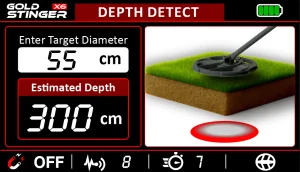
Depth Detect estimates target depth after the user has already located the signal area. The operator marks the start and end of the response from more than one direction, forms an estimated square or rectangle around the target, enters the target diameter, and lets the device calculate approximate depth.
This makes technique very important. If the target outline is poorly marked, the depth estimate will be less reliable. Used carefully, the mode helps decide whether a target is likely shallow, moderate, or deep.
Cavity Test Mode
Cavity Test is designed for gaps and unopened spaces such as rooms, tunnels, basements, graves, and similar voids. The system uses a blue 2D graph for cavities and can also show mineral-rich soil with a brown graph.
This mode is valuable when the search goal includes underground spaces, but it should be confirmed with a careful scan pattern and realistic site interpretation.

Target Scan Mode
Target Scan is the analysis mode. It is used over a suspected target after another system has located it. The screen guides the coil movement, then presents a three-dimensional graph when the scan is complete.
If metal is present, the graph appears in red. The Target section indicates ferrous or non-ferrous response, while the Depth section gives approximate depth. It is best used as a second-stage confirmation tool rather than the first search method.

Ground Balance
Ground balance is essential on the Gold Stinger X6. It calibrates the detector to the mineral content of the soil, reducing false signals and improving stability. Skipping this step can weaken depth performance and create misleading discrimination results.
The coil should be kept about 5 to 10 cm from the ground while the detector is moved up and down until a stable value appears. If the device shows OK, the detector is ready. If not, the process should be repeated. In difficult ground, lowering sensitivity before balancing can help the detector stabilize.

Detector Performance
The Gold Stinger X6 performs best when its systems are used together.
All Metals covers ground quickly, Discrimination gives target category clues, Pin Pointer finds the center, Depth Detect estimates depth, Cavity Test checks voids, and Target Scan adds visual analysis.
Sensitivity and Turbo are both adjustable from 0 to 100.
Higher values may improve response and depth, but they can also increase noise or battery use. In mineralized soil, moderate settings often produce cleaner results than maximum settings.
Performance in Different Soil Types
In cleaner soil, the GS50 coil and higher sensitivity settings can be useful for larger or deeper targets.
In mineralized soil, the user should expect more false signals and should lower sensitivity, repeat ground balance, slow the sweep, and confirm signals from different angles.
In cluttered ground, the GS30 coil is often the better choice because it is easier to control and can help separate close targets.
Remove Iron and Discrimination can reduce unwanted responses, but old iron and mixed metals can still mislead any detector.
Actual Detection Depth
The advertised maximum depth is up to 500 cm, but real results depend on field conditions. A large buried object in mild soil is very different from a small coin or nugget in mineralized ground.
Coil choice also matters. The GS50 is the depth and coverage coil, while the GS30 is the control and small-target coil. Buyers should view depth as a combined result of target size, soil, settings, coil selection, and user skill.
Best Targets
The Gold Stinger X6 is best matched to treasure-style targets such as gold, silver, bronze, copper, lead, ancient coins, bullion, statues, archaeological objects, underground chambers, tunnels, and other voids. It is more compelling for open-field and deep-target searches than for simple shallow coin hunting.
User Experience
Setup is straightforward: assemble the shaft, mount the preferred coil, connect the cable, power on the device, and complete ground balance. The interface also includes language, volume, brightness, sensitivity, Turbo, Remove Iron, reset, and device information settings.
Field technique matters. Keep the coil parallel to the ground, maintain a 5 to 10 cm scanning height, sweep slowly in overlapping arcs, and re-scan strong signals from multiple angles. This methodical style is where the Gold Stinger X6 makes the most sense.
Who Should Buy It?
The Gold Stinger X6 is best for treasure hunters and serious hobbyists who want multiple systems for detecting, confirming, and analyzing targets. It is a good fit for users searching old sites, open ground, mineralized areas, and locations where cavities may matter.
It is less ideal for someone who wants the simplest possible beginner detector. The X6 is usable by beginners, but only if they are willing to learn ground balance, coil selection, and the meaning of its visual indicators.
Advantages
- Two interchangeable search coils included in the package.
- Multiple detection systems for search, confirmation, depth estimation, cavities, and target analysis.
- Dedicated ground balance workflow for better stability in changing soil.
- Adjustable sensitivity and Turbo levels from 0 to 100.
- Visual graphs, numerical values, and audio tones give more feedback than sound alone.
- Remove Iron option helps reduce unwanted ferrous signals.
- Target Scan and Cavity Test add useful analysis for advanced treasure searches.
Things to Know Before Buying
- Do not skip ground balance. It directly affects stability, depth, and discrimination accuracy.
- Use the GS50 coil for coverage and depth, but switch to the GS30 coil when the site is tight or cluttered.
- Treat target ID and depth estimates as decision aids, not absolute proof.
- Reduce sensitivity in mineralized or noisy soil before assuming the detector is faulty.
- Protect the coils, cable connectors, screen, and battery from heat, shock, and rough handling.
Pros
- Two interchangeable search coils included in the package.
- Multiple detection systems for search, confirmation, depth estimation, cavities, and target analysis.
- Dedicated ground balance workflow for better stability in changing soil.
- Adjustable sensitivity and Turbo levels from 0 to 100.
- Visual graphs, numerical values, and audio tones give more feedback than sound alone.
Cons
- Maximum depth is conditional and should not be treated as a guaranteed field result.
- Correct ground balance is essential, especially in Discrimination mode.
- Old oxidized metals and difficult soil can still produce misleading target readings.
- The multi-system workflow requires more learning than a simple beginner detector.
- High sensitivity and Turbo settings can increase noise or battery consumption.
Value for Money and Rating
The Gold Stinger X6 offers strong value if the buyer will use its full feature set: two coils, multiple detection systems, adjustable sensitivity, Turbo control, iron filtering, cavity checking, and target analysis. If the goal is only basic shallow coin hunting, it may be more complex than necessary.
Rating: 9.5/10. The score reflects strong feature coverage and coil flexibility, with cautions for learning curve, ground balance dependency, and conditional depth performance.
FAQ
Is the Gold Stinger X6 good for gold detection?
Yes. The Gold Stinger X6 includes modes and numerical ranges intended to help identify gold targets, but gold detection still depends on target size, soil conditions, ground balance, and user technique.
How deep can the Gold Stinger X6 detect?
The advertised maximum depth is up to 500 cm. Actual depth varies by target size, target type, soil mineralization, coil choice, settings, and operator skill.
What is the difference between the GS50 and GS30 coils?
The GS50 is larger and better suited to open areas and deeper targets. The GS30 is smaller, lighter, and better for tight or cluttered locations and smaller targets.
Does the Gold Stinger X6 detect cavities and tunnels?
Yes. Cavity Test is designed for gaps, rooms, tunnels, basements, graves, and similar hollow spaces, while Pin Pointer also includes a cavity-focused mode.
Is ground balance necessary?
Yes. Ground balance is one of the most important steps because incorrect balancing can cause unstable signals and discrimination errors.
Can the detector ignore iron?
The X6 includes a Remove Iron setting that can be switched on to filter iron responses and reduce unwanted signals.
Is Discrimination mode always accurate?
No discrimination system is perfect. Corroded steel, chrome-plated metals, lead, tin, galvanized materials, mineralized soil, and poor ground balance can produce misleading readings.
What does Target Scan do?
Target Scan analyzes a suspected target after it has been located by another mode, then displays information such as target type, approximate depth, and graph strength.
Is the Gold Stinger X6 beginner friendly?
It can be used by beginners, but it is better suited to users who are willing to learn ground balance, coil selection, scanning technique, and mode confirmation.
Which coil should I use first?
For open ground and deeper searching, start with the GS50. For cluttered areas, obstacles, or smaller targets, use the GS30.
What scanning height is recommended?
The coil should generally be kept around 5 to 10 cm above the ground and parallel to the surface.
Does higher sensitivity always mean better performance?
Not always. Higher sensitivity can increase depth and responsiveness, but it can also increase noise in mineralized or difficult ground.
Final Verdict
The Gold Stinger X6 is a serious multi-system detector for users who want a structured search workflow.
Its dual coils, ground balance, All Metals, Discrimination, Pin Pointer, Depth Detect, Cavity Test, and Target Scan systems give the operator several ways to evaluate a signal before digging.
The main caution is expectation management. The advertised 500 cm maximum depth is conditional, and discrimination can be affected by old metals, mineralized soil, and poor calibration.
Used carefully, however, the X6 is a flexible and capable detector for treasure-focused field work.