
German metal detectors are detectors designed and made by companies based in Germany, mainly OKM, Mega Detection and Lorenz. They cover very different technologies: OKM is known for 3D ground scanners and ground-penetrating radar, Lorenz for pulse induction (PI) detectors, and Mega Detection for multi-system and long-range locator devices. The right choice depends on what you are looking for, and some of the depth and range figures advertised for this category should be treated as manufacturer-stated claims rather than proven performance.
This guide explains what each German manufacturer makes, how the technologies differ, which claims need caution, and how to choose between models. Orient Detectors ships these devices worldwide from Istanbul, and we advise customers on them every day over WhatsApp.
Who makes German metal detectors?
Three German companies account for most of the German detectors sold worldwide:
- OKM: professional 3D ground scanners, ground-penetrating radar and groundwater detectors, used by treasure hunters, surveyors and mining companies.
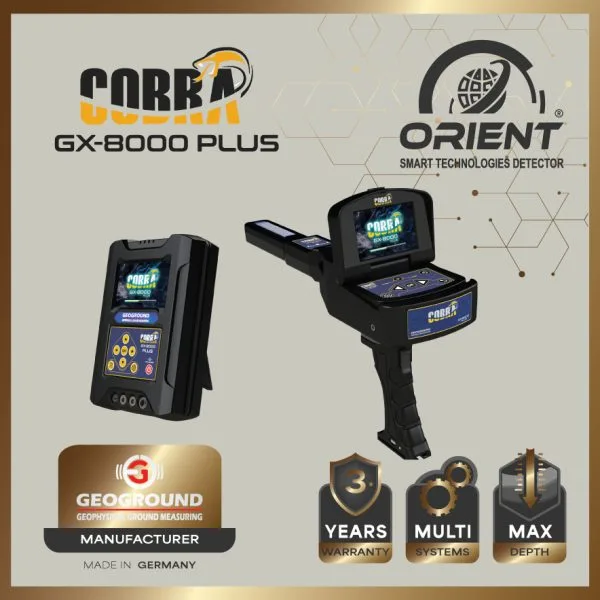
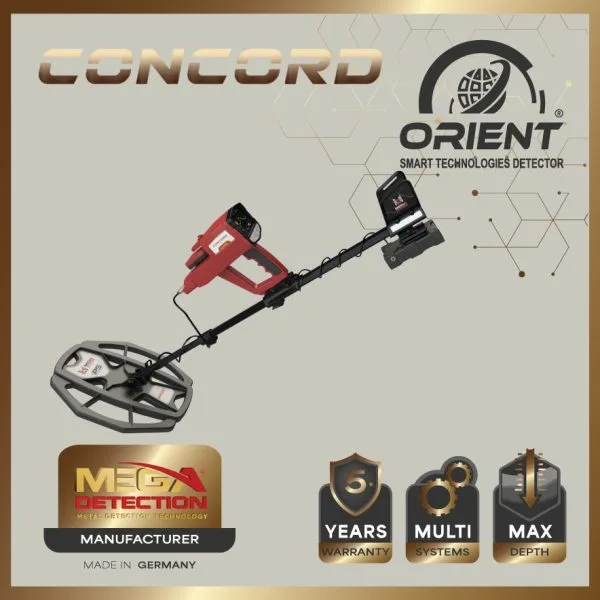
- Mega Detection: multi-system devices that combine long-range locator, ground scan and other systems, as well as its older Mega series.
- Lorenz: a small company specializing in pulse induction metal detectors and search coils.
German manufacturing has a strong reputation for build quality, but country of origin alone does not decide performance. What matters is the detection technology and whether it suits your target. For a wider brand comparison, see the best metal detector brands.
Which technologies do German detectors use?
| Technology | How it works | Scientific status | Examples |
|---|---|---|---|
| Pulse induction (PI) | Sends pulses through a coil and measures the target’s decaying signal | Proven physics | Lorenz Deep Max Z2 |
| VLF | Continuous transmit signal; measures the target’s phase shift | Proven physics | VLF mode on Evolution NTX |
| Ground-penetrating radar (GPR) | Sends radar pulses into the ground and records reflections from layers and objects | Proven physics; results need expert interpretation | OKM GEPARD GPR |
| 3D ground scanning | A probe takes readings across a grid; software plots the ground’s response in 3D | Shows variations in ground response, not an image of the object | OKM EXP 6000, Fusion, Rover C4 |
| Long-range locator (LRL) | Claimed to detect targets from a distance by a “frequency” or field method | No independent scientific validation | LRL systems on Mega Detection devices |
| Ionic and bionic systems | Claimed to detect ions or fields around buried metal | No independent scientific validation | Mega Scan Pro, OKM BIONIC X4 |
A 3D ground scanner does not produce a picture of a buried object. It plots how the ground’s response changes across the scanned area, and the user interprets those changes. Our guide on how to read 3D ground scan results explains how to avoid common misreadings.
OKM: 3D ground scanners and GPR
OKM is the best-known German name in professional ground scanning. Its devices pair scan probes with software that displays results as 3D graphics on a tablet or computer. OKM states very large scan depths for several of its devices, in some cases of the order of 20 meters or more. Treat these as manufacturer-stated specifications without independent validation: real depth depends on target size, soil and interpretation, and any target should be confirmed with proven methods before digging. More detail is in our OKM detectors overview.
EXP 6000
The OKM EXP 6000 is OKM’s most complete ground scanning system, sold in Professional and Professional Plus packages that differ in the probes and accessories included. Scan data is displayed in 3D with the Visualizer 3D software. It is aimed at professional treasure hunters and survey work.
Fusion series
The Fusion series comes in three versions: Fusion Light, Fusion Professional and Fusion Professional Plus. Depending on the version, it offers ground scan, live sound and live scan modes, with 3D visualization on a tablet. The Fusion Light is the entry point and uses a companion app on an Android tablet or phone.
GEPARD GPR
The OKM GEPARD GPR uses ground-penetrating radar, an established geophysical method, to locate underground structures such as pipes, cables, cavities, tunnels and bunkers, as well as larger metal objects. GPR results depend heavily on soil: clay and wet, conductive ground limit penetration. OKM’s advertised maximum depth for this device is a manufacturer-stated figure.
Rover C4 and Evolution NTX
The OKM Rover C4 is a 3D ground scanner with integrated batteries that displays results in the Visualizer 3D Studio app. The software color-codes the readings, but identifying the metal type of a buried target from a scan is a manufacturer claim that should be confirmed by excavation or other methods. The Evolution NTX combines a 3D ground scan probe with a VLF metal detector in one package, with 3D scan and live sound modes, making it one of OKM’s more affordable options.
Mega Detection: multi-system devices
Mega Detection was known for its Mega series (Mega Scan Pro, Mega G3 and Mega Gold), which are based on long-range locator technology. Its newer devices combine several systems with tablet software. Examples include:
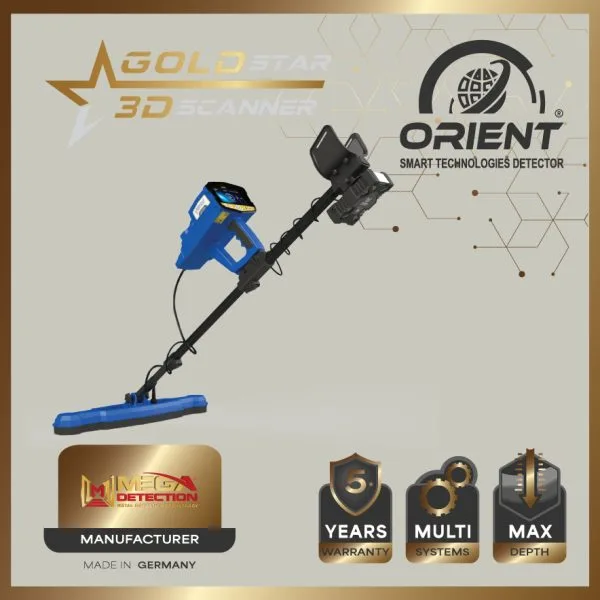
- Gold Star 3D Scanner: a multi-system device that combines several search systems, including long-range and 3D ground scan, with results shown on a screen or tablet. The manufacturer states a long-range scan range of 3000 m and a depth of 50 m. These are manufacturer-stated specifications with no independent scientific validation.
- Phoenix: a multi-system 3D ground scanner with probes designed to record changes in the ground’s magnetic response, and software in many languages.
- Mega Scan Pro: combines a long-range locator, an ionic system and a magnetic system, with preset programs for metals and gemstones. Long-range and ionic detection, and the detection of diamonds or gemstones by any metal-detection device, have no scientific basis.
If you consider an LRL or multi-system device, treat its long-range indications as leads only, and confirm any target with physics that has been tested: PI or VLF detection, GPR or magnetometry. Our article on long range gold detectors explains how to use them realistically.
Lorenz: pulse induction detectors
Lorenz focuses on pulse induction detectors and its own coil designs. The Lorenz Deep Max Z2 builds on the earlier Deep Max Z1 and is designed for professional use, including searching for larger metal objects and battlefield relics. PI technology is well proven and handles mineralized ground well; with large coils, large objects can be found at depths of the order of 1 to 2 m, while small objects are found much shallower. See our Lorenz Deep Max Z2 review for more.
How much do German metal detectors cost?
German professional devices are generally expensive compared with hobby detectors. Listed prices on our store at the time of writing:
| Device | Maker | Main technology | Listed price (USD) |
|---|---|---|---|
| Fusion Light | OKM | 3D ground scan | 5,450 |
| Evolution NTX | OKM | 3D ground scan + VLF | 6,550 |
| Phoenix | Mega Detection | Multi-system 3D ground scan | 6,900 |
| Lorenz Deep Max Z2 | Lorenz | Pulse induction | 7,500 |
| Gold Star 3D Scanner | Mega Detection | Multi-system | 9,500 |
| Rover C4 | OKM | 3D ground scan | 12,100 |
| Fusion Professional | OKM | 3D ground scan | 14,700 |
| GEPARD GPR | OKM | Ground-penetrating radar | 21,900 |
| EXP 6000 | OKM | 3D ground scan | 32,750 |
Prices can change, so check the product page or contact us for a current quote.
How to choose a German metal detector
- If you want to find metal objects with proven technology, choose a PI detector such as the Lorenz Deep Max Z2, or a VLF detector for smaller targets.
- If you need to locate cavities, tunnels, pipes or structures, GPR such as the GEPARD GPR is the established method, but expect to learn how to interpret radar data.
- If you want a 3D ground scanner, start with an entry model such as the Fusion Light or Evolution NTX, and learn to read scans on known buried objects before relying on results.
- If a device is sold mainly on long-range, ionic or bionic claims, understand that these lack independent scientific validation before you invest.
Reality vs myth and legal framework
No device, German or otherwise, shows a photograph of buried treasure or identifies gold from a distance. Treasure signs and long-range methods have no scientific basis as ways of finding buried objects. Excavating archaeological sites without authorization is illegal in most countries, and prospecting may require permits under the heritage and mining laws of your country. See our guide to legal and ethical metal detecting.
Frequently asked questions
Which German companies make metal detectors?
The main German manufacturers are OKM, known for 3D ground scanners and GPR; Mega Detection, known for multi-system and long-range devices; and Lorenz, known for pulse induction detectors.
Are German metal detectors the best?
They have a strong reputation for build quality, but no single country makes the best detector for every job. Choose by technology and target, not by country.
Can a German 3D scanner show the shape of buried gold?
No. A 3D ground scanner plots variations in the ground’s response. It can suggest an anomaly, but it does not produce an image of the object or prove what metal it is.
Do German long-range detectors work?
Long-range ranges and depths are manufacturer-stated and lack independent scientific validation. Confirm any indication with a PI or VLF detector, GPR or a magnetometer.
Conclusion
German metal detectors range from proven pulse induction detectors and ground-penetrating radar to 3D ground scanners and long-range systems whose claims need caution. Match the technology to your target, treat advertised depths as manufacturer-stated, and confirm results with proven methods. Our team can help you compare German models over WhatsApp before you buy.
Not sure which detector fits you? Contact us on WhatsApp.
Read also
Related Articles